Bowling, 1861


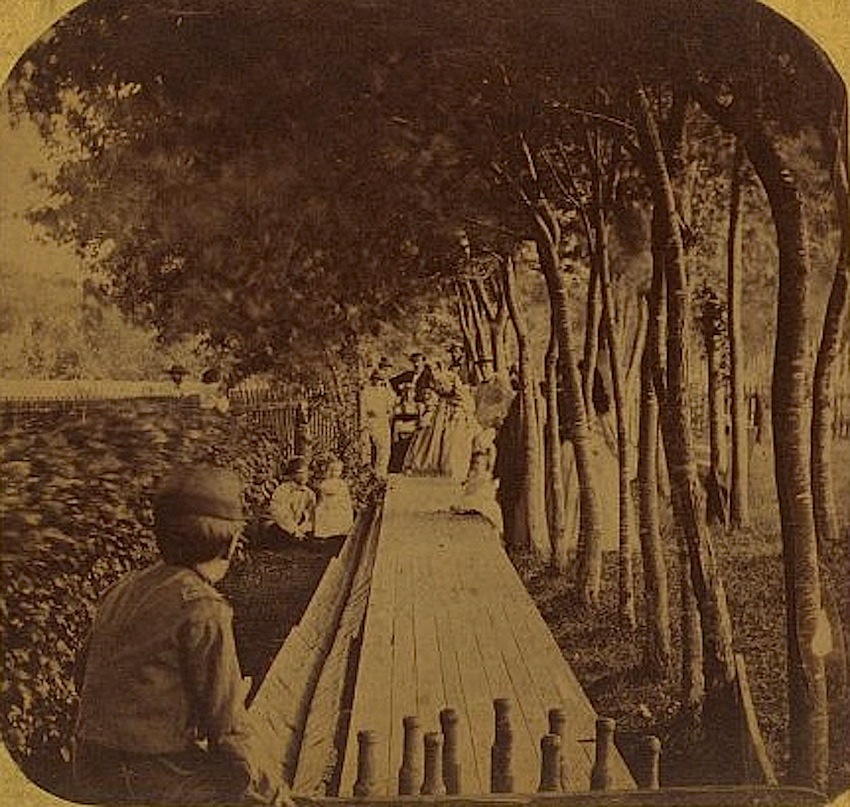
“Group of people bowling on a wooden lane erected in a yard,” July 4, 1861, via Library of Congress Prints and Photographs Division.

I just found this photo. It was taken exactly one year before yesterday’s picture, probably by James Hunter,* who would host the 1862 picnic.

The Library’s online catalogue says that “Mrs. H. Bowling and Coleman Sellers, Jr.,” have been identified in this image, although it doesn’t say where they are — probably the woman bowling (Mrs. H., bowling†) and perhaps the boy in charge of setting up the pins.
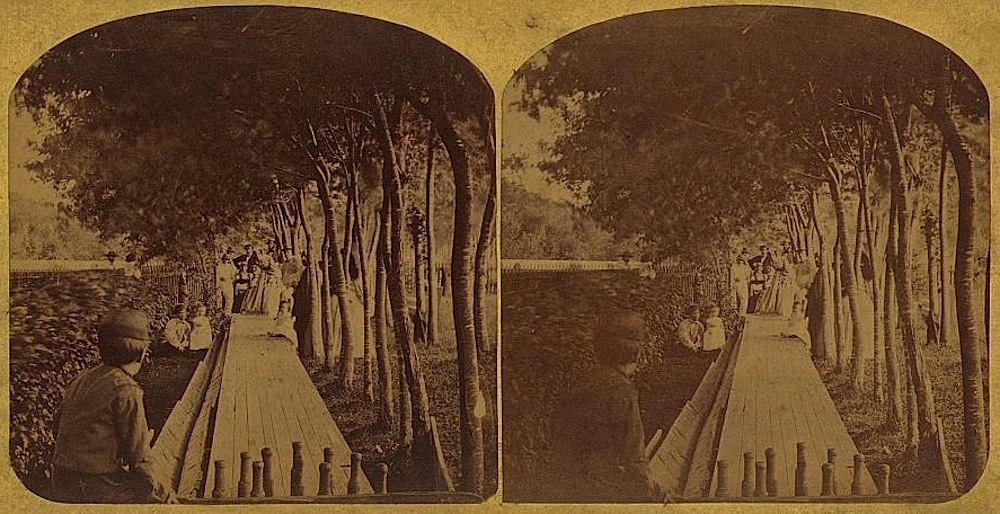
The full stereograph. I do hope they removed the baby from the lane before she bowled.

“By the mid-1800s, the game of ninepins was so popular that wealthy families installed bowling lanes at their estates. . . , ” according to American Profile. “When some states outlawed ninepins [in the 1830s and 40s] because it encouraged gambling, the modern game of tenpins evolved to skirt the laws.” I’m not sure if there are nine pins in this picture or ten. What looks like one middle pin may be two pins lined up.

The image is part of the Charles F. Himes collection of stereographs by amateur photographers, primarily members of the Pennsylvania Photographic Society (1860-61) and the Amateur Photographic Exchange Club (1861-63).


*James Hunter may have been co-owner of the Print and Dye Works in Hestonville, Pennsylvania.

†H. for Hunter? Coleman Junior’s father was Coleman Sellers II, a prominent engineer and inventor from Philadelphia. — as well as an amateur photographer.

Hestonville, Pennsylvania

Fourth of July picnic at Mr. James Hunter‘s, Hestonville, Pennsylvania, 1862, a stereograph by Coleman Sellersvia Library of Congress Prints and Photographs Division.

Hestonville is now a neighborhood of Philadelphia.

The Sunday porch: Vincennes, Indiana

Sunday afternoon on the front porch, Vincennes, Indiana, July 1941, by John Vachon, via Library of Congress Prints and Photographs Division.

Nice striped socks.

Interrupted by visitors.
At least it looks like he didn’t have to leave his book and go inside with them.

Madison, Georgia

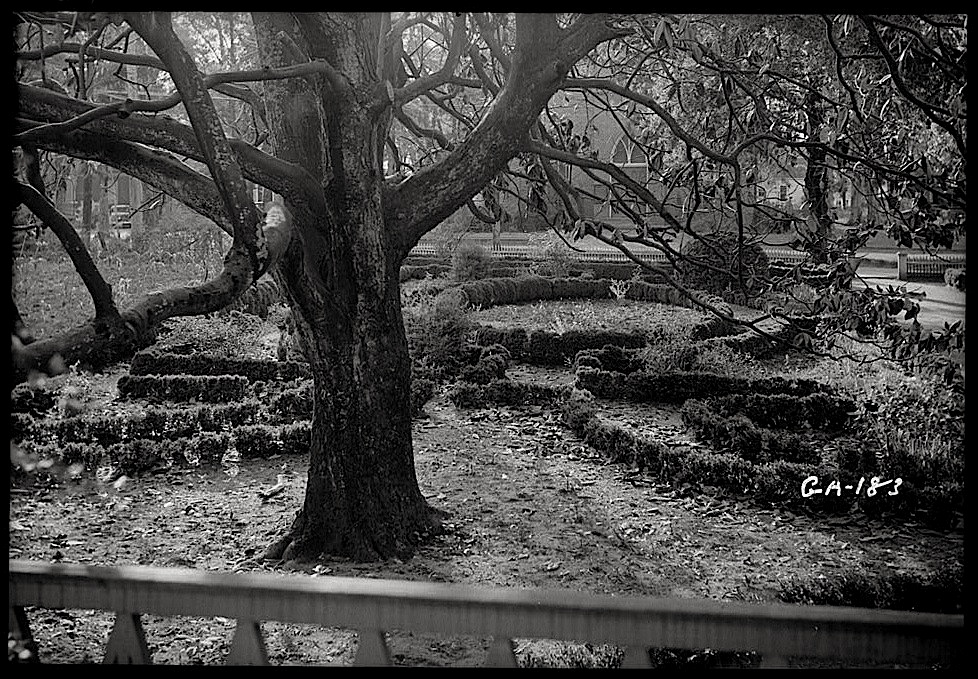
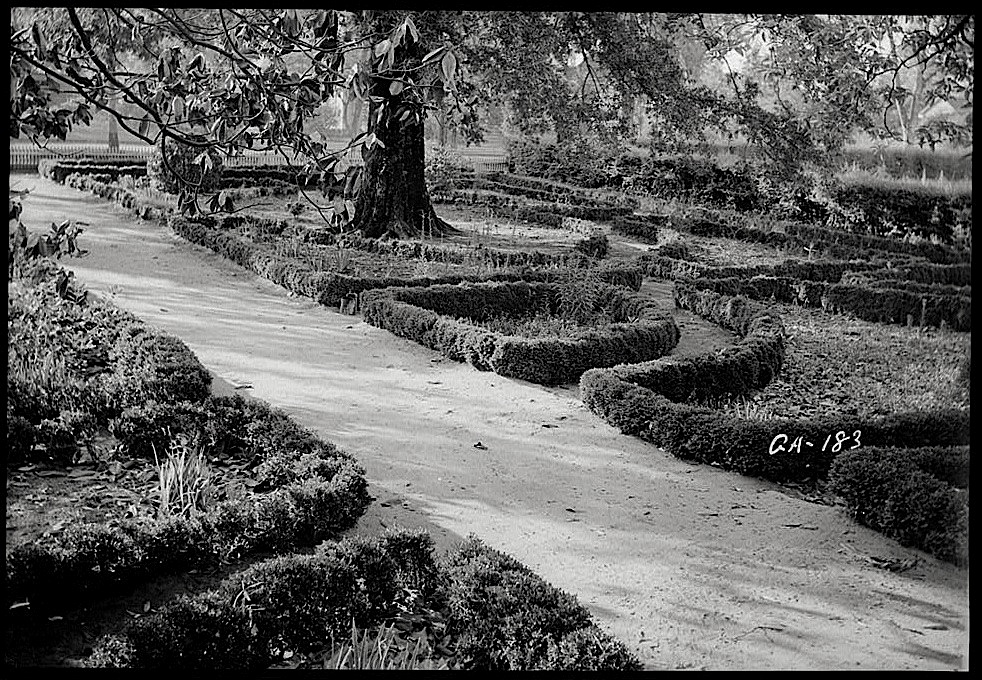
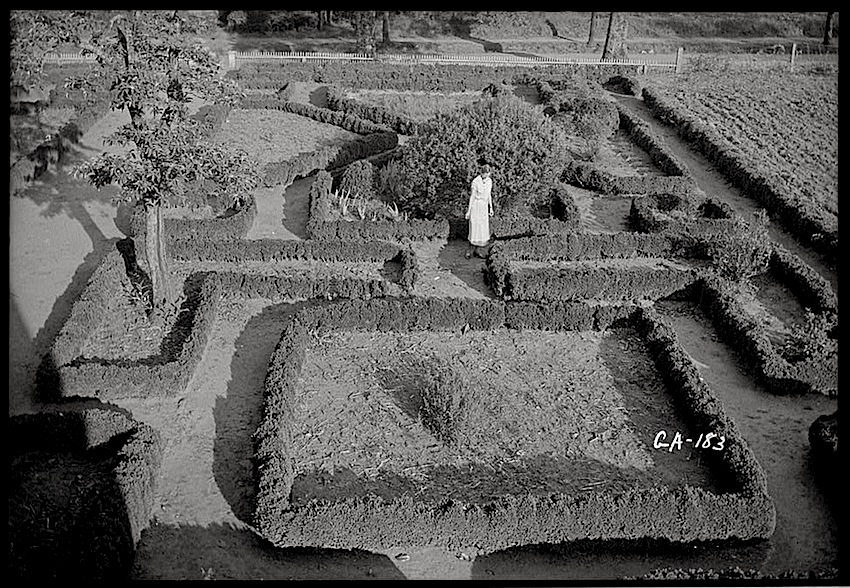
The parterre, viewed from the porch of “Boxwood” (Kolb-Pou-Newton House), Madison, Georgia, June 1936, by L. D. Andrew for an Historic American Building Survey (HABS), via Library of Congress Prints and Photographs Division (all three photos).

‘Parterre’ means ‘on the ground’ (par terre) in French.

The other side of the house, looking down from second-story window.

A parterre is a garden of planting beds laid out on level ground, typically in geometric patterns, often outlined in clipped boxwood.

This house was built about 1845; its garden was laid out about 1854. A 1935 HABS drawing of its parterres, front and back, is here.

There are more photos of the garden in this 2007 article in Garden and Gun.

Nantucket, Massachusetts

3-picket-fences-nantucket-ma-habs-library-of-congressWhitewashed picket fence, Pleasant Street, Nantucket, Massachusetts, 1969, by Jack E. Boucher for Nantucket Historical Study, HABS, via  Library of Congress Prints and Photographs Division (both photos).

Fence on Upper Main Street, Nantucket.

Is there a name for this style of picket fence — with three to four saw-tooths (saw-teeth?) on each wide board?  I feel like there must be, but I can’t find it.