

On December 19, 1939 — in the photo above — the White House was being decorated for Christmas. But the “gayly colored” lights on the wreath and trees would not be lit until Christmas Eve when President Roosevelt would also light the “community Xmas tree.”
At that time, what is now known as the National Christmas Tree was called the National Community Christmas Tree (I like that).
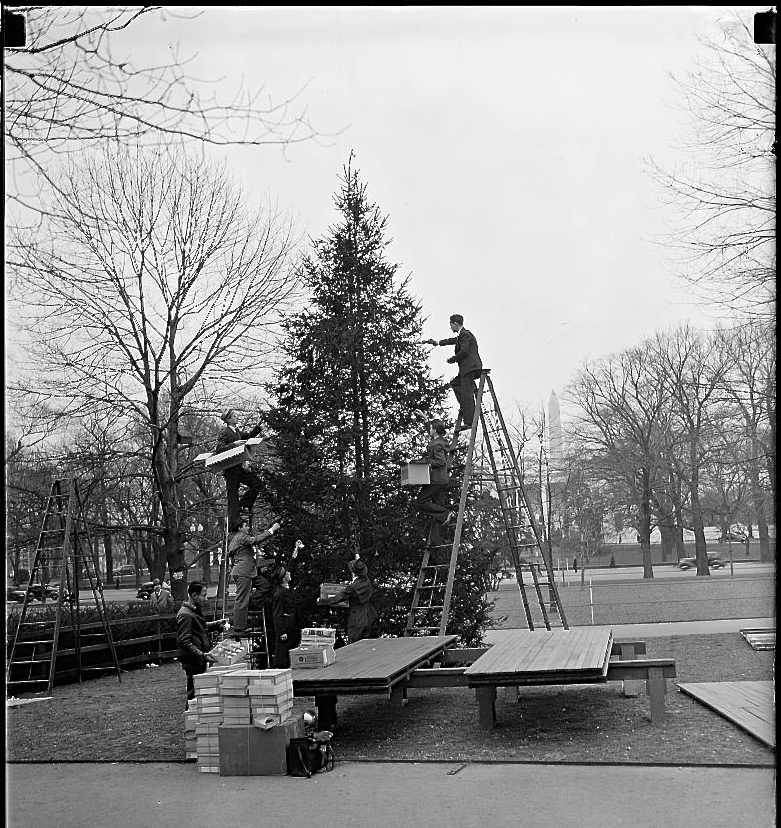
For most of the 1930s, the tree was installed in Lafayette Park, on the north side of the White House. In the photo below, workers (in suits) decorate the 1937 tree on December 23.
However, the first national tree had been placed on The Ellipse (also its current location), on the south side of the White House, in 1923 (below).
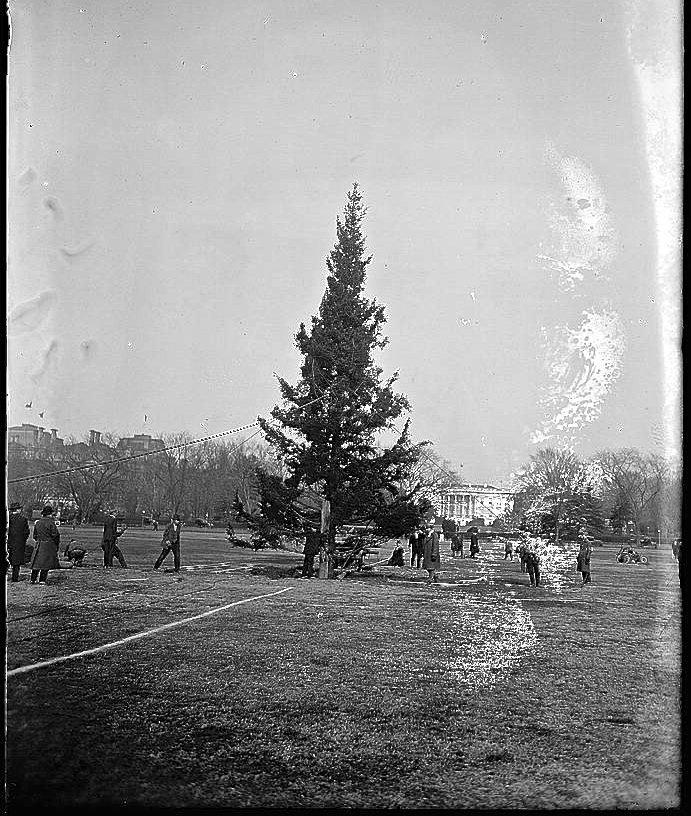
In the early 1920s, according to Wikipedia, “The Society for Electrical Development (an electrical industry trade group) was looking for a way to encourage people to purchase more electric Christmas lights and use electricity, and [Frederick Morris] Feiker [past editor of Electrical World] suggested that President Calvin Coolidge personally light the tree as a way of giving Christmas lights prominence and social cachet.”
The 48′ tall balsam fir was cut and donated by Middlebury College in the President’s home state of Vermont. The Electric League of Washington donated the 2,500 red, green, and white lights.
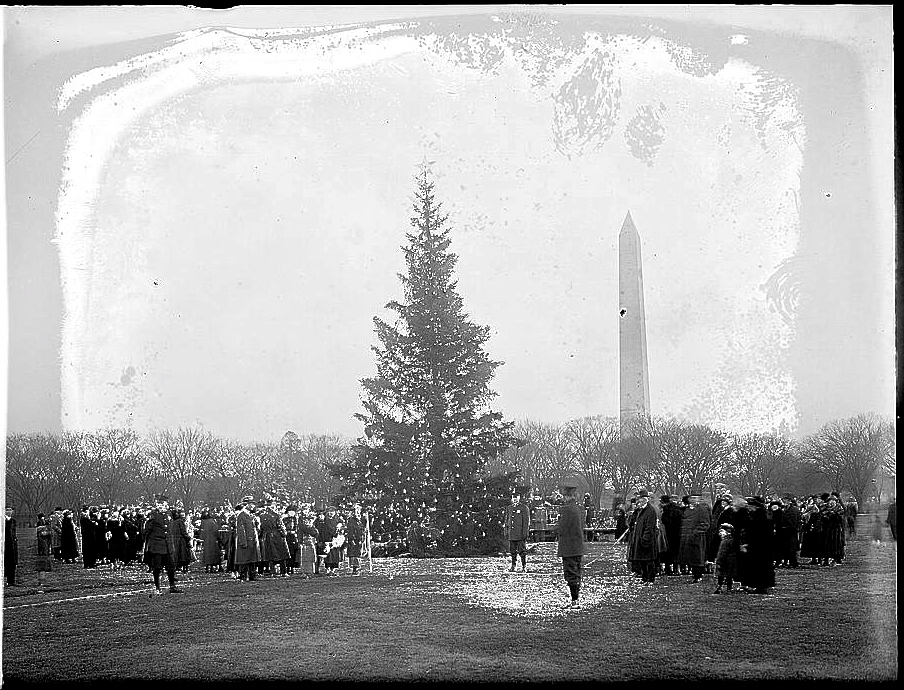
President Coolidge lit the tree on Christmas Eve without making any remarks (below). A two-hour music concert was then held. Wikipedia notes that “after the white residents of the city had dispersed, African American residents of the city were permitted on the park grounds to see the National Christmas Tree.”
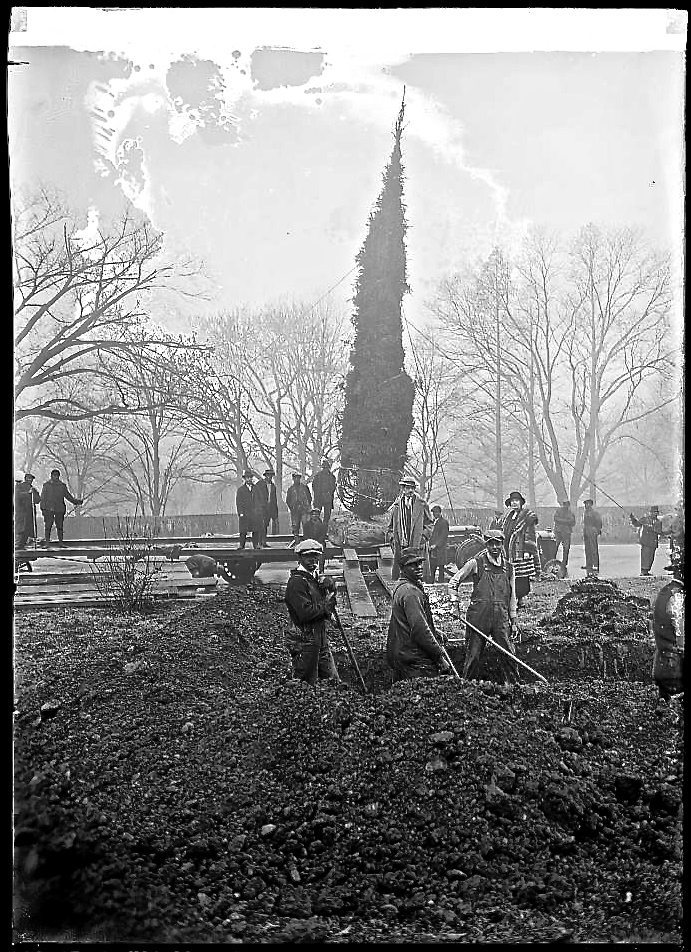
On December 17, 1924 (below), a live “community” tree was planted in Sherman Park (just southeast of the White House). This had become necessary after Coolidge, speaking before the American Forestry Association that April, had criticized cutting trees for Christmas decorations. (The national tree had to be replaced in 1929 and has been replaced many times since. From the early 50s to the early 70s, cut trees were used.)
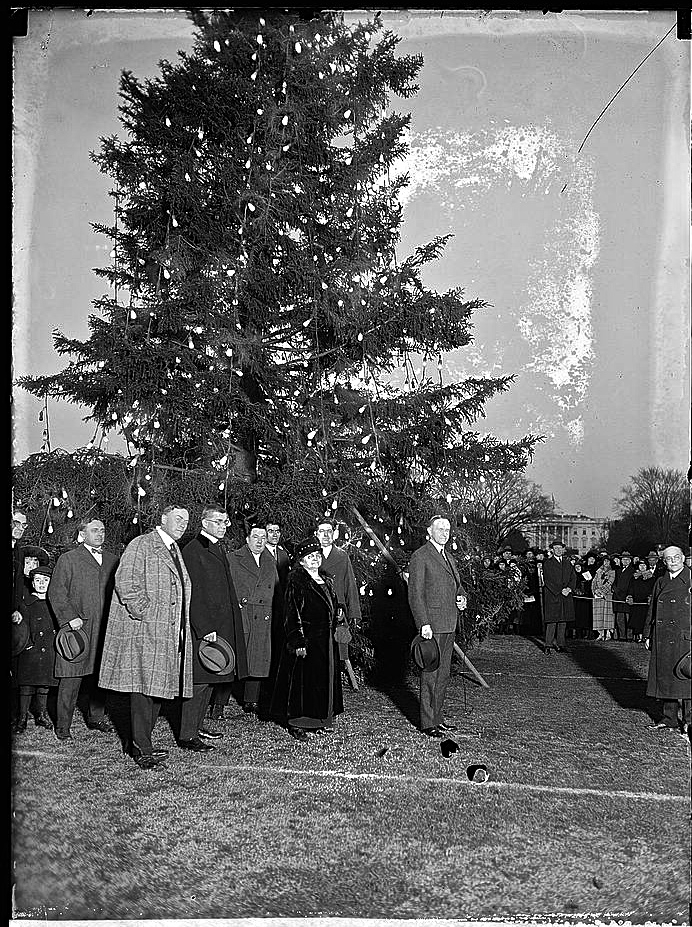
Below is a rather solemn moment from the lighting. The Coolidges’ son had died of blood poisoning earlier in the year, and a new Christmas carol, “Christmas Bells” — dedicated to Mrs. Coolidge — was performed at the ceremony.

Wikipedia has an interesting complete history of the National Christmas Tree here. Two more facts from the article:
“During the 1931 ceremony, a buzzer went off when Hoover lit the tree at 5:00 p.m. Because the button he pressed was not actually connected to the electricity, the buzzer alerted another official to actually light the tree. The button the president pushed would not be reconnected to actual electricity again until 1980.”
In 1932, “loudspeakers connected to a phonograph were concealed in the branches of the tree, and Christmas carols were played every night from 6:00 p.m. to 10:00 p.m. until New Year’s Day. The Singing Tree was a hit with the public, and although music and choirs continued to perform each year, the tradition of the Singing Tree lasted for several more decades.”
Facts about this year’s tree are here.
Photo Sources:
1. and 2. Photos by Harris & Ewing via Library of Congress Prints and Photographs Division.
3. to 8. National Photo Company collection via Library of Congress Prints and Photographs Division.


 enclos*ure