The Sunday porch: Sagamore Hill

T. Roosevelt porch, Library of CongressThe porch of President Theodore Roosevelt’s country home, Sagamore Hill, ca. 1905, photographer unknown, via Library of Congress Prints and Photographs Division (both photos here).

The rug was a mountain lion.

Roosevelt purchased the land in Oyster Bay, New York, in the early 1880s and began planning the Queen Anne house with his first wife, Alice. But she died in 1884, and it was second wife Edith who moved into the newly completed home two years later.

Sagamore Hill, ca. 1905, Library of Congress

Sagamore Hill was their family’s primary residence, except from 1901 to 1909, when it was known as the “Summer White House.”

Theodore died there in 1919, as did Edith in 1948.  The family continued to own it until the 1950s, when it was passed to the Theodore Roosevelt Association and later to the National Park Service.

The house reopens to the public today, after being closed for three and a half years for renovation.
Life in gardens: standing watch

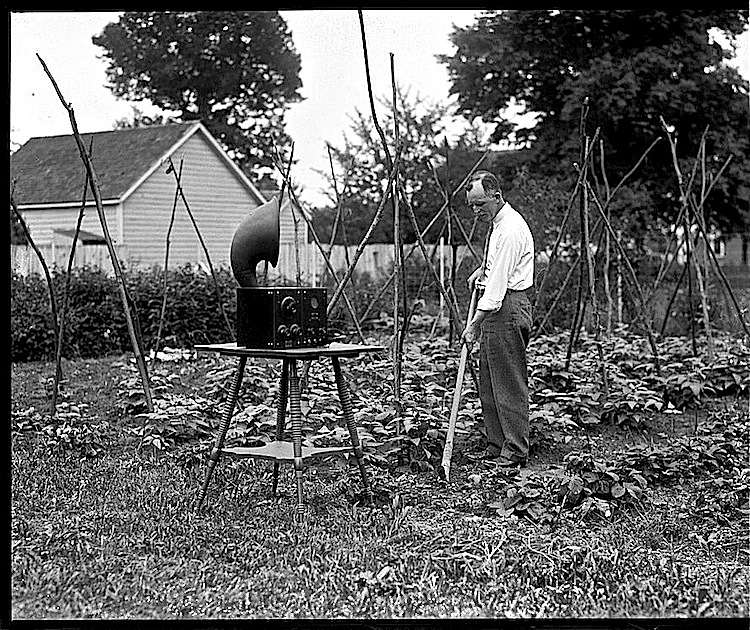
Hoeing garden w:music, Library of Congress“W. D. Terrell in garden with radio,” probably in the Washington, D.C., area, July 7, 1926, by National Photo Company, via Library of Congress Prints and Photographs Division.

Mr. Terrell was Chief of Inspection Service of Radio at the U.S. Department of Commerce during the 1920s.

Just as Ariel, in the fables of the Middle Ages, was a spirit guardian of the air, so in this day of wireless, the Radio Inspector, a modern Ariel, stands a silent watch over the ether. But though he may be silent and, indeed, an angel, he is far from a fable, as those who attempt to dispute his wavemeter soon find out.

— from “Guiding the Good Ship Radio,” an October 1925 interview with Terrell in Radio Broadcast magazine

Life in gardens: Detroit, Michigan

Detroit wall, 1941, J. Vachon, Library of CongressBlack children standing in front of a half-mile concrete wall  in northwest Detroit. It was built in 1941 to separate their neighborhood from a white housing development going up on the other side.

The photo was taken in August 1941 by John Vachon for U.S. Farm Security Administration and is via Library of Congress Prints and Photographs Division.

The 1930s and 1940s were times of great growth for the city of Detroit and the inner-suburbs. The Federal Housing Administration (FHA), founded in 1934, pushed the idea of home ownership as an accessible goal for the average working class. . . .

[However], the FHA’s policies of mandated racial homogeneity in housing developments and redlining made it difficult for African Americans to become home owners. . . . Between 1930 and 1950, three out of five homes purchased in the United States were financed by FHA, yet less than two percent of the FHA loans were made to non-white home buyers. . . .

Public or private housing being hard to come by in the city, some African Americans were able to purchase land lots around the Wyoming Avenue and 8 Mile intersection with hopes of eventually building houses. . . . When the FHA was approached by a developer wanting to build an all-white subdivision west of the site, funding was refused because the area was too risky for investment. In a compromise with the FHA, the developer erected the wall that was to divide the “slum” from his new construction project.

— “The Detroit Wall,” Wikipedia

Life in gardens: summer moonlight

Under the moon, Library of Congress“Yūgao dana nōryō zu” (cooling beneath an evening glory canopy), 1880s, a woodcut print by Yoshitoshi Taiso, via Library of Congress Prints and Photographs Division.

The image “shows a couple in the country with a child and a teapot, sitting on a mat beneath a trellis covered with yūgao vines, enjoying the full moon,” according to the Library’s online catalogue.

Vintage landscape: Pasadena, Calif.

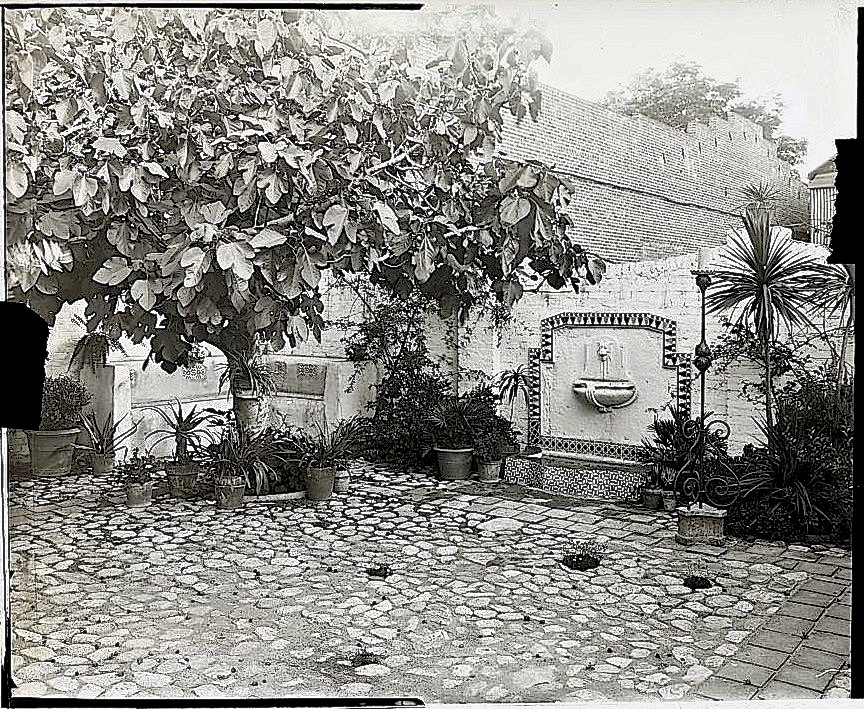
Vroman's Bookstore, Pasadena, CA, FBJohnston, Library of CongressThe patio at Vroman’s Bookstore, 60 E. Colorado Street, Pasadena, California, Spring 1923, by Frances Benjamin Johnston, via Library of Congress Prints and Photographs Division.

Vroman’s Bookstore was founded in 1894 by Adam Clark Vroman and is still a Pasadena cultural institution, with three locations in the city.

However, the little patio above, with its fig tree and fountain, no longer exists. Vroman’s moved to 695 E. Colorado Street in 1929.

Johnston used this image in her garden and historic house lectures.