Ruston, Washington

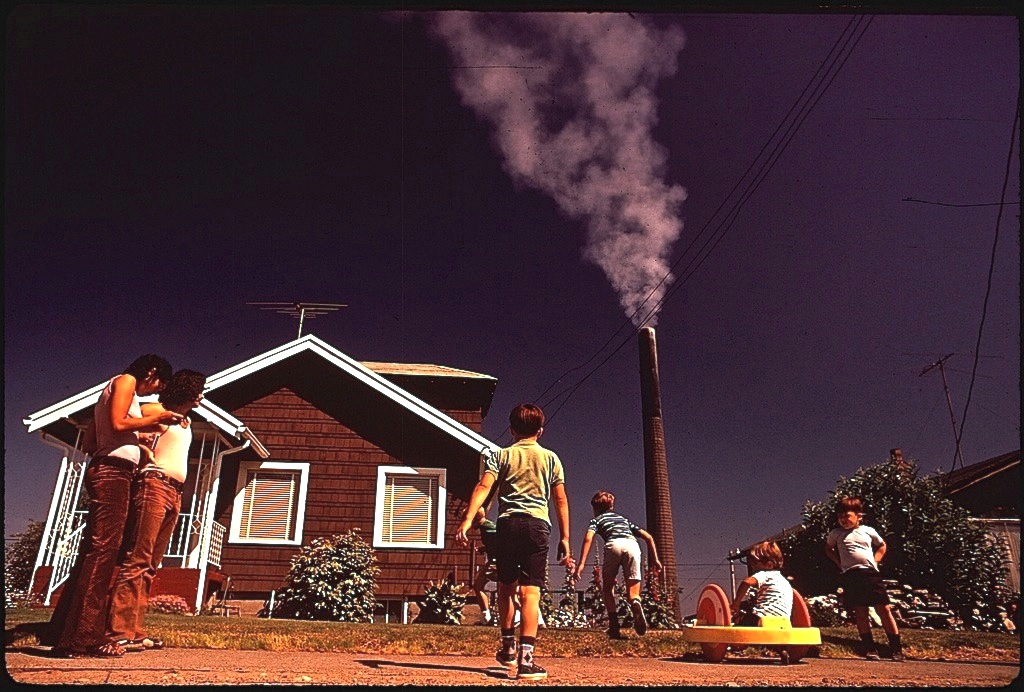
“Children play in yard of Ruston home, while Tacoma smelter stack showers area with arsenic and lead residue,” August 1972, via The U.S. National Archives Commons on flickr.

The photo was taken by Gene Daniels for DOCUMERICA, an early photography program of the U.S. Environmental Protection Agency (EPA). It is shown here with its original caption.

From 1972 to 1977, the EPA hired over 100 photographers to “document subjects of environmental concern.” They created an archive of about 20,000 images.

In addition to recording damage to the nation’s landscapes, the project captured “the era’s trends, fashions, problems, and achievements,” according to the Archives, which held an exhibit of the photos, “Searching for the Seventies,” in 2013.

The Sunday porch: Miami, Florida

House in Miami, Florida, July 11, 1955, via Florida Memory (State Library and Archives of Florida) Commons on flickr (cropped slightly by me).

Widely available by the 1950s, aluminum awnings were touted as longer-lasting and lower-maintenance than traditional [canvas] awnings. . . . [T]hey were especially popular with homeowners. Aluminum awnings were made with slats called “pans” arranged horizontally or vertically. For variety and to match the building to which they were applied, different colored slats could be arranged to create stripes or other decorative patterns.

— U.S. National Park Service “Preservation Brief

Vincennes, Indiana

This slideshow requires JavaScript.

Hollyhocks in Vincennes, Indiana, July 1941, by John Vachon, via Library of Congress Prints and Photographs Division.

Madison, Georgia

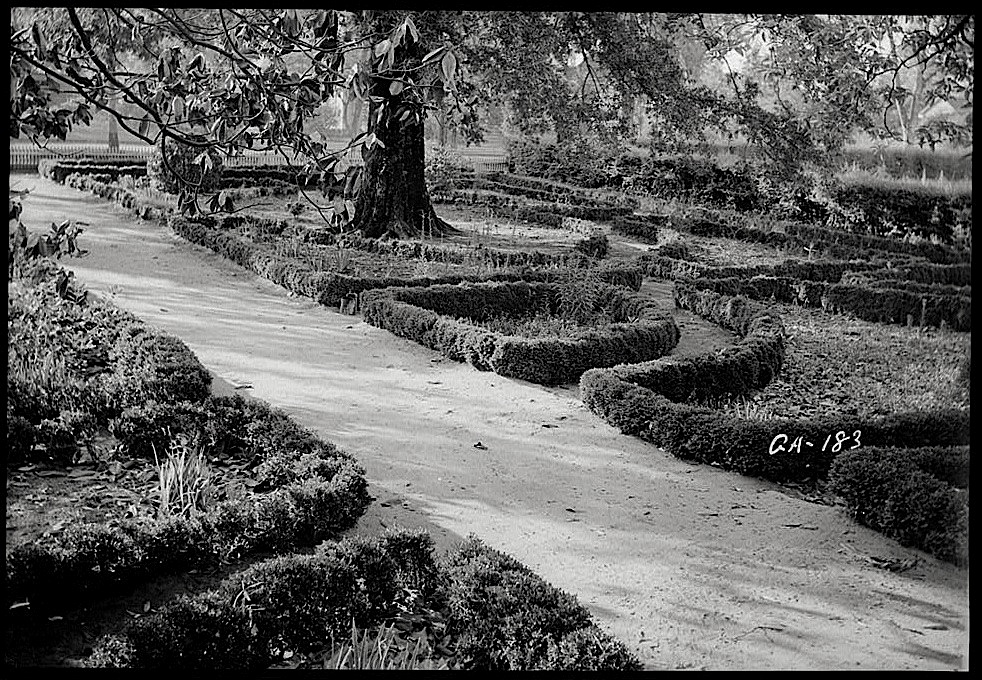
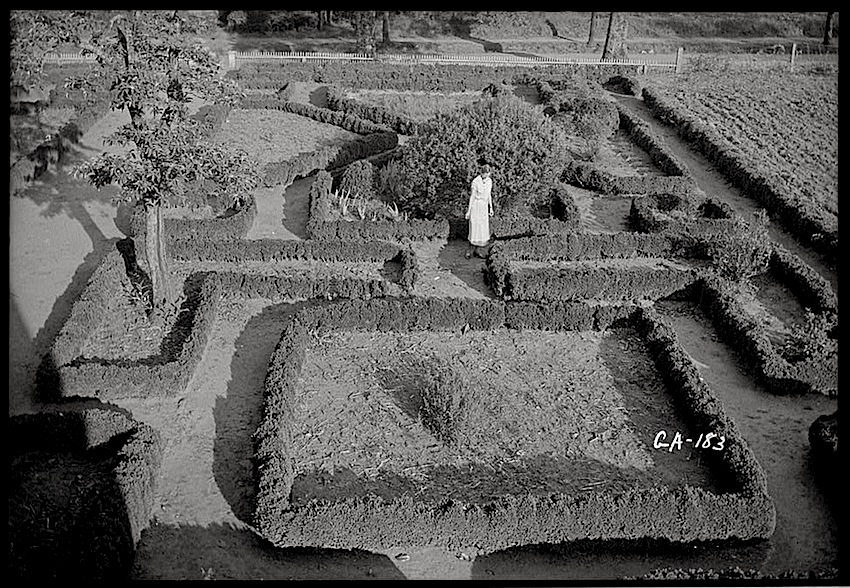
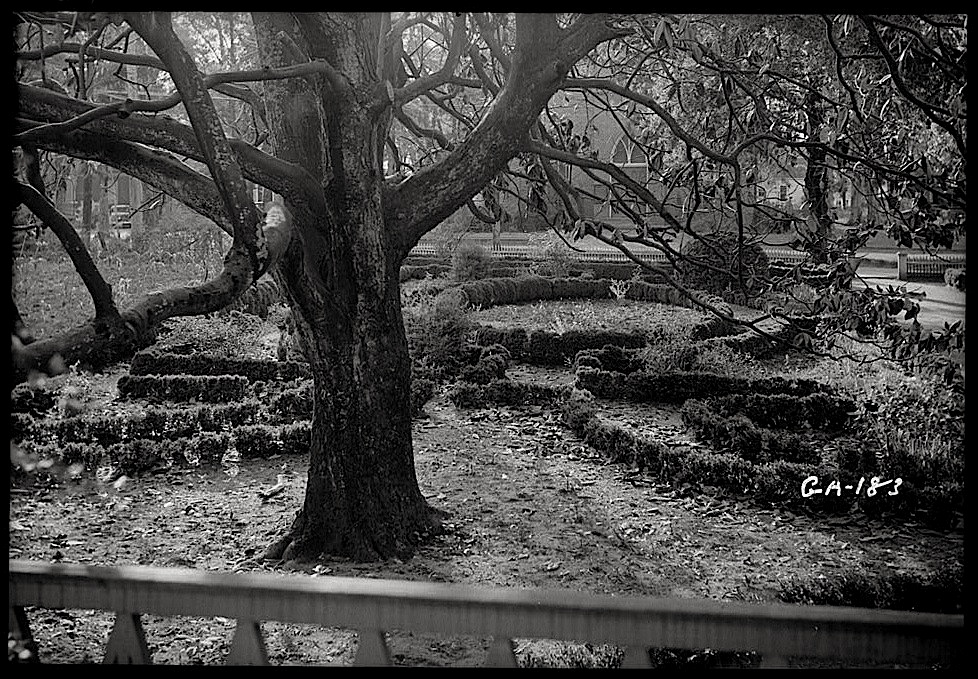
The parterre, viewed from the porch of “Boxwood” (Kolb-Pou-Newton House), Madison, Georgia, June 1936, by L. D. Andrew for an Historic American Building Survey (HABS), via Library of Congress Prints and Photographs Division (all three photos).

‘Parterre’ means ‘on the ground’ (par terre) in French.

The other side of the house, looking down from second-story window.

A parterre is a garden of planting beds laid out on level ground, typically in geometric patterns, often outlined in clipped boxwood.

This house was built about 1845; its garden was laid out about 1854. A 1935 HABS drawing of its parterres, front and back, is here.

There are more photos of the garden in this 2007 article in Garden and Gun.

The Sunday porch: Hill End


“Two women on veranda of rendered* cottage with shingle roof and front garden, Hill End, New South Wales, ca. 1872,” by Charles Baylissvia National Library of Australia Commons on flickr.

Hill End was a gold rush town. At the time of this photo, “it had a population estimated at 8,000 served by two newspapers, five banks, eight churches, and twenty-eight pubs,” according to Wikipedia. The rush was over by the early 20th century. In 2006, the town was down to 166 people.

The photographer came to Hill End as an assistant to a traveling photographer who had been contracted to take pictures of the area that could be used to advertise the mining colony and attract new residents.


*Render is stucco.