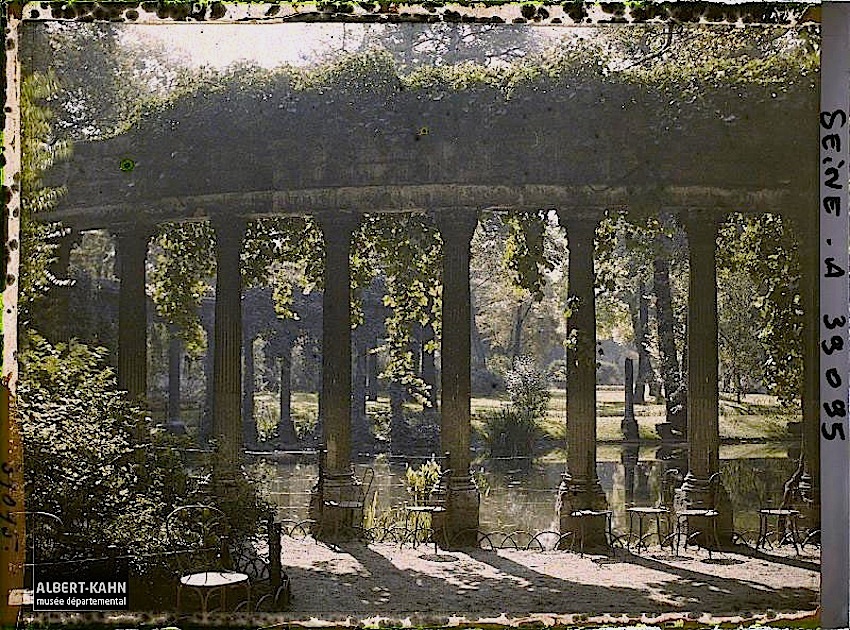
Parc Monceau, Paris

Colonnade dans le parc Monceau, la Naumachie, Paris (VIIIe arr.), France, 12 septembre 1923, (Autochrome, 9 x 12 cm), Auguste Léon, Département des Hauts-de-Seine, musée Albert-Kahn, Archives de la Planète, A 39 095 S
La Naumachie Colonnade in Parc Monceau, Paris, September 12, 1923, by Auguste Léon, via Archives of the Planet Collection – Albert Kahn Museum /Département des Hauts-de-Seine (both photos).

In Ancient Rome, a naumachia was a large basin dug for staging naval battles* as public entertainment. In Parc Monceau, La Naumachie is a tranquil oval pool framed on one end by a Corinthian colonnade.
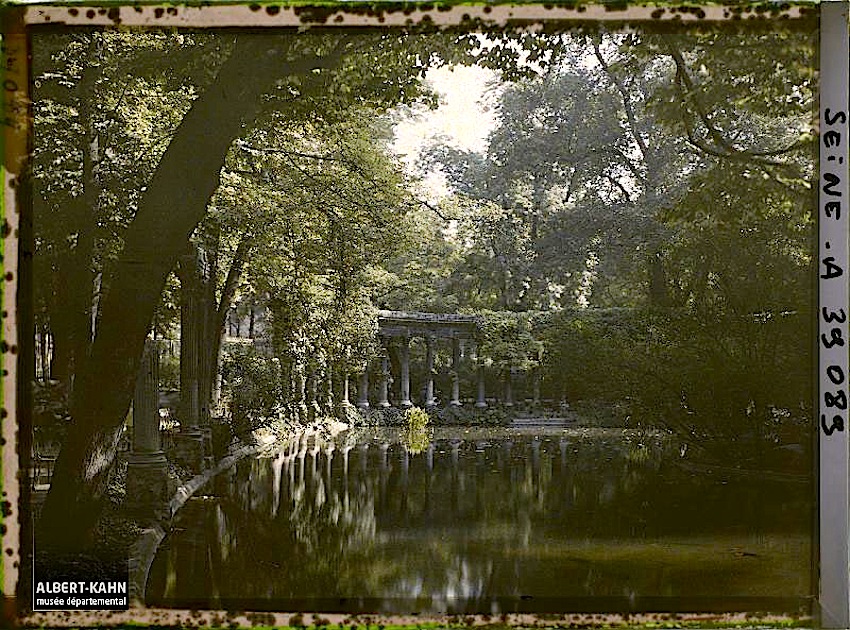
Colonnade dans le parc Monceau, la Naumachie, Paris (VIIIe arr.), France, 12 septembre 1923, (Autochrome, 9 x 12 cm), Auguste Léon, Département des Hauts-de-Seine, musée Albert-Kahn, Archives de la Planète, A 39 089 S

The columns were once part of a never-completed late 16th century mausoleum attached to the Basilica of Saint Denis. In the late 1770s, they were acquired by the Duke of Chartres for an elaborate “Anglo-Chinese” public garden he was creating in northwest Paris. He filled it with architectural follies (see here) — one of them being a “Roman” colonnade.

The Duke was guillotined in 1793. His land was first confiscated and then returned to his heirs, who sold about half of it to developers. In the 1850s, the city bought the last 20 acres of the old garden, and Parc Monceau opened in 1861 as a largely informal “English-style” park. Today, there are still a few follies, although only the colonnade/naumachia and a small Egyptian pyramid remain from the 18th century.

The autochromes above are two of about seventy-two thousand that were commissioned and then archived by Albert Kahn, a wealthy French banker, between 1909 and 1931. Kahn sent thirteen photographers and filmmakers to fifty countries “to fix, once and for all, aspects, practices, and modes of human activity whose fatal disappearance is no longer ‘a matter of time.'”† The resulting collection is called Archives de la Planète and now resides in its own museum at Kahn’s old suburban estate at Boulogne-Billancourt, just west of Paris. Since June 2016, the archive has also been available for viewing online here.


*The word also refers to the spectacle itself.

words of Albert Kahn, 1912. Also, the above photos (A 39 095 S and A 39 089) are © Collection Archives de la Planète – Musée Albert-Kahn and used under its terms, here.

The Sunday porch: New Jersey

new-jersey-porches-1935-nypl-digitalcollections
“Porches, New Jersey,” February 1936, by Carl Mydans for the U.S. Farm Security Administration, via The Miriam and Ira D. Wallach Division of Art, Prints and Photographs, The New York Public Library.

The Sunday porch: Le Droit Park

Le Droit Park, 1974, Wash.DC, HABS, Library of CongressDetail of porch column, Le Droit Park, 3rd Street, N.W., Washington, D.C., 1974, by Ronald Comedy for an Historic American Building Survey (HABS), via Library of Congress Prints and Photographs Division.

Le Droit Park is an old Washington subdivision of large freestanding houses and duplexes of related architectural design, located just south of Howard University. When it was built in 1873, it was restricted to white buyers only and gated, but a series of protests brought the fences down in 1891, and by 1920 its residents were predominately African-American and included professors, politicians, and artists.  The area suffered decline in the 1980s, but today its renovated homes are selling quickly, according to The Washington Post. The neighborhood is on the Heritage Trail, a self-guided walking tour developed by Cultural Tourism DC.

The home pictured above — with its distinctive porch columns — still exists.

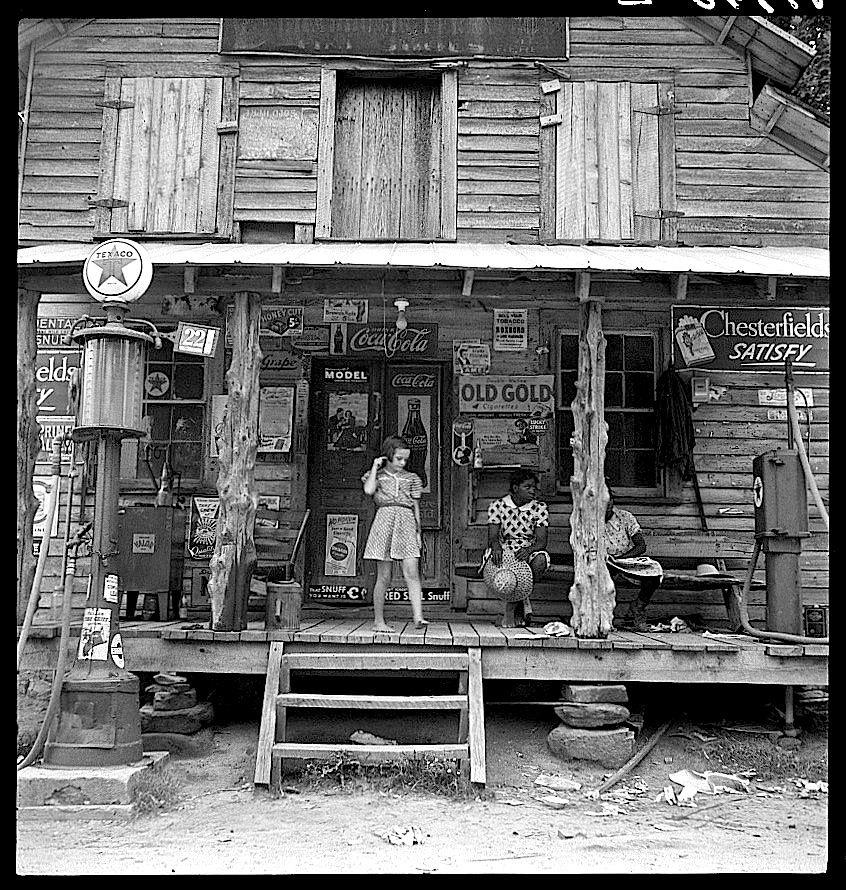
The Sunday porch: storefront

Store porch, D. Lange, Library of CongressCountry store with rough tree trunk columns, Person County, North Carolina, 1939, by Dorothea Lange for U.S. Farm Security Administration, via Library of Congress Prints and Photographs Division.

Life in gardens: Galveston, Texas

Lawn tennis in Texas, Texas State Archives
Two women playing badminton or lawn tennis while others look on, “The Oaks,” Galveston,Texas, ca. 1900, via Texas State Archives Commons on flickr.