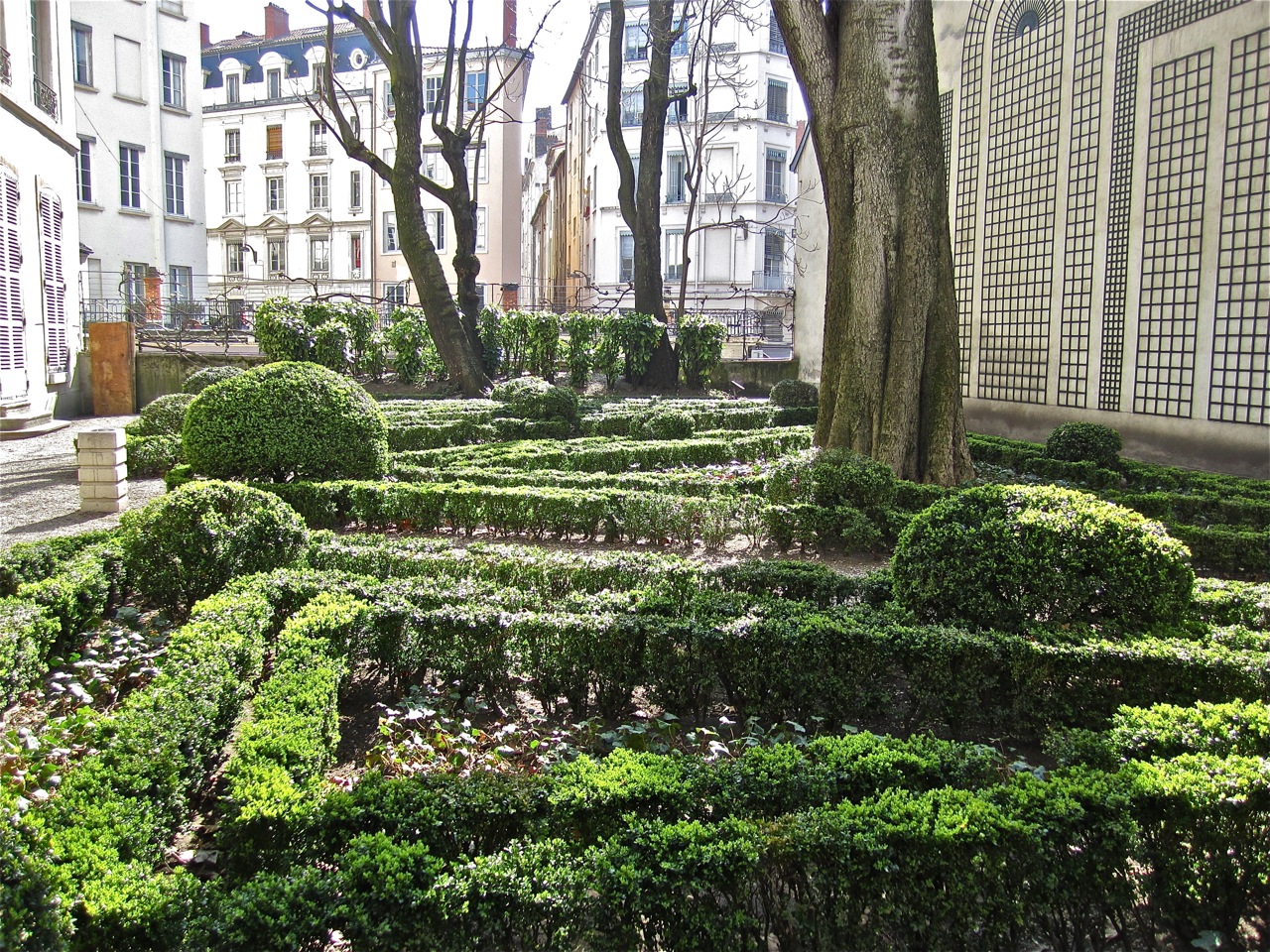
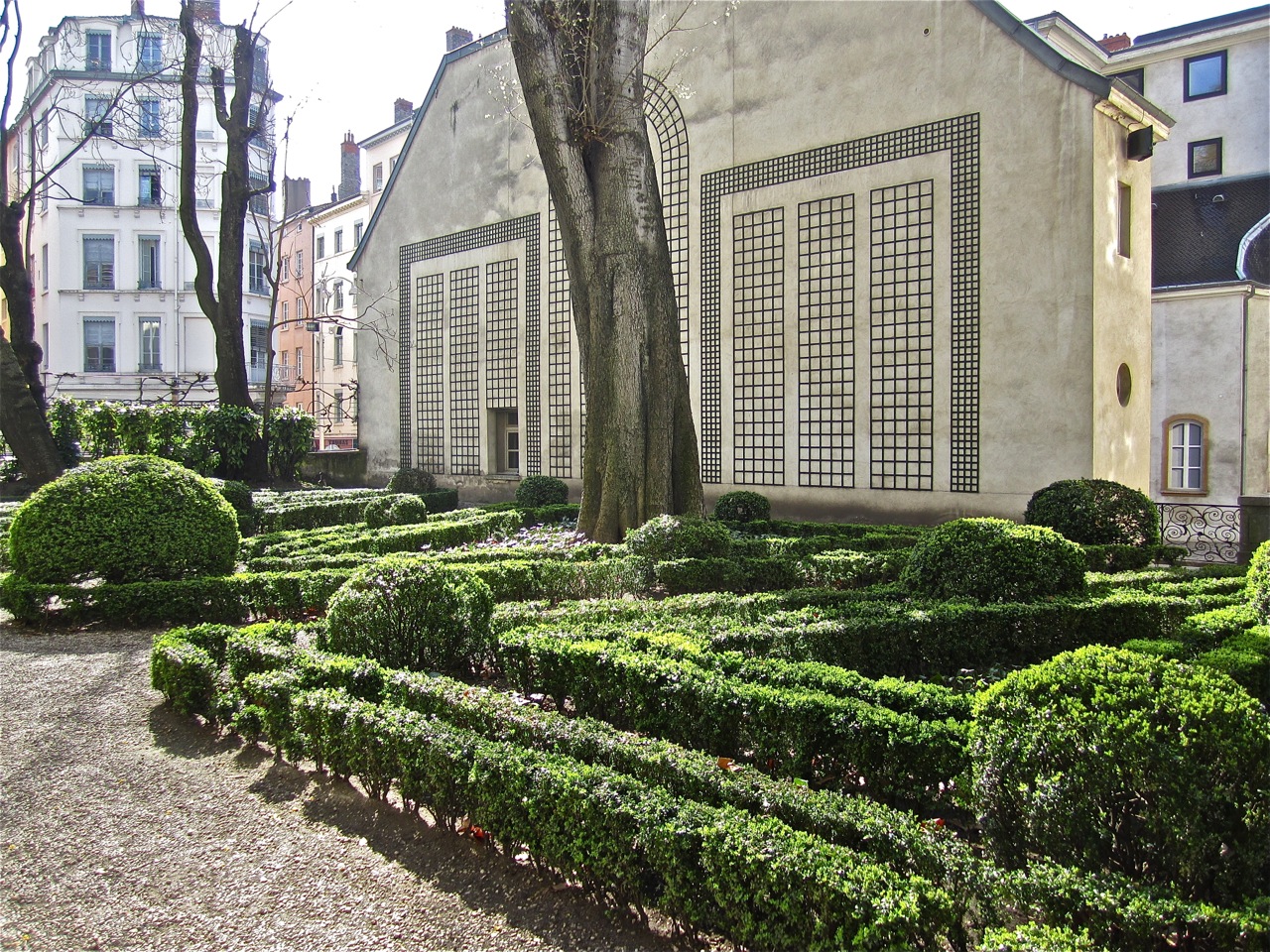
Jardin de l’Infante, Paris

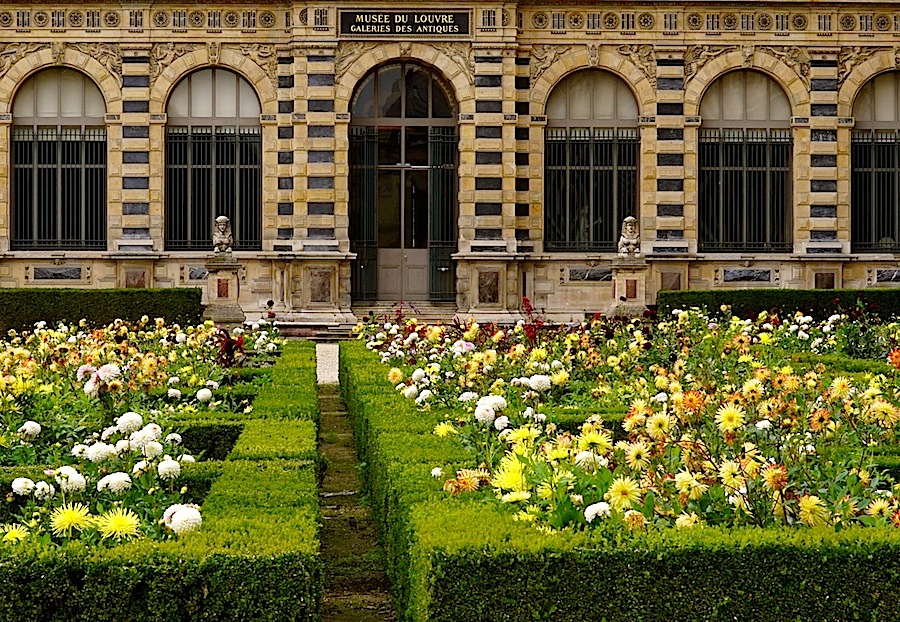
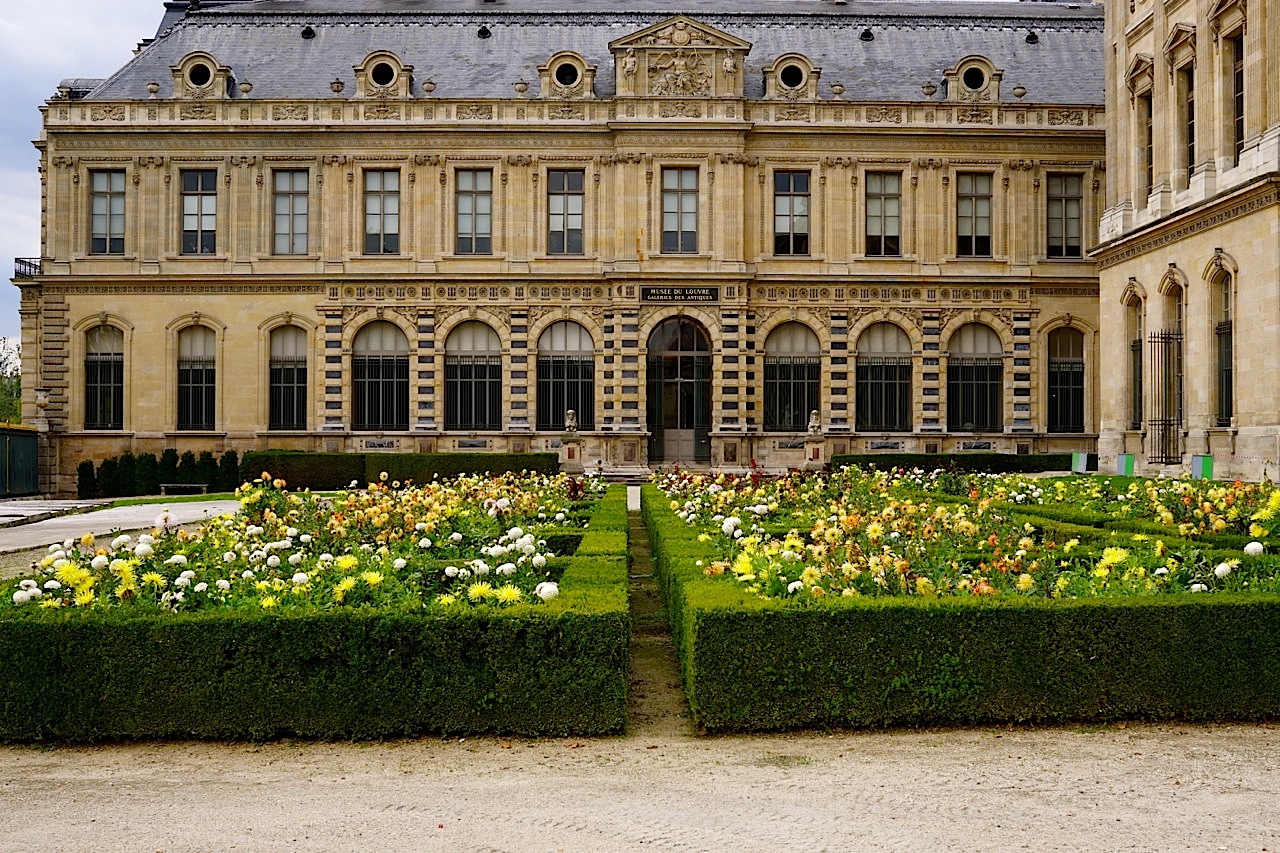
My favorite flower display in Paris last week was at the entrance to the Cour Carrée of the Louvre, near the Pont des Arts.

DSC01756full

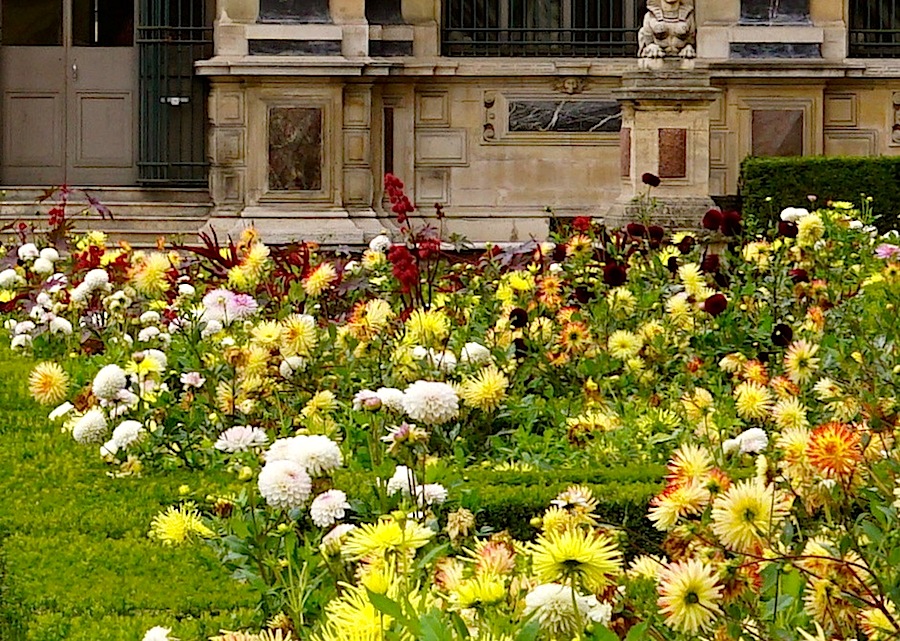
But I’m a pushover for massed dahlias — these were yellow, white, orange, and dark red, mixed with some burgundy amaranth and caster bean plants in the back.

Jardin de l'infante, Louvre, Paris, Sept 2015, by enclos*ure

Jardin de l'Infante, The Louvre, Paris, September 2015, by enclos*ure

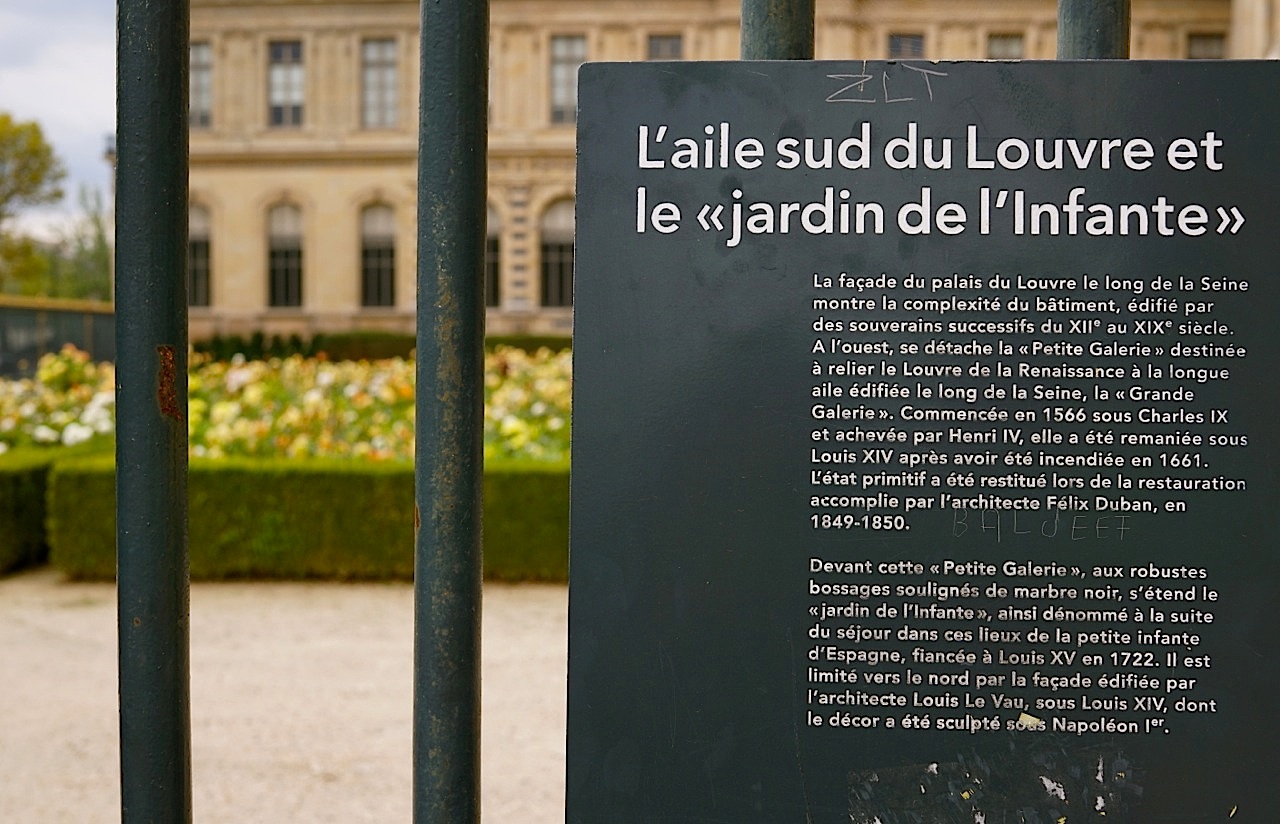
Unfortunately, a tall iron fence blocked them off from close inspection.

DSC01757

 I didn’t have a zoom lens, so I did the best I could to get some useable photos by pushing the camera through the bars and holding it out.

Jardin de l'infante,detail 2, Louvre, Paris, Sept 2015, by enclos*ure

The space is named “Garden of the Princess” for Mariana Victoria of Spain.  The three-year-old Infante was brought to live in the Louvre in 1721 when she was engaged to the preteen King Louis XV.

Jardin de l'infante,detail, Louvre, Paris, Sept 2015, by enclos*ure

Although she was deemed the “sweetest and prettiest little thing,” four years later, Louis broke off the match in order to marry an older Polish princess.

Jardin de l'infante,detail 3, Louvre, Paris, Sept 2015, by enclos*ure

Mariana was sent back to Spain and later married King Joseph I of Portugal.

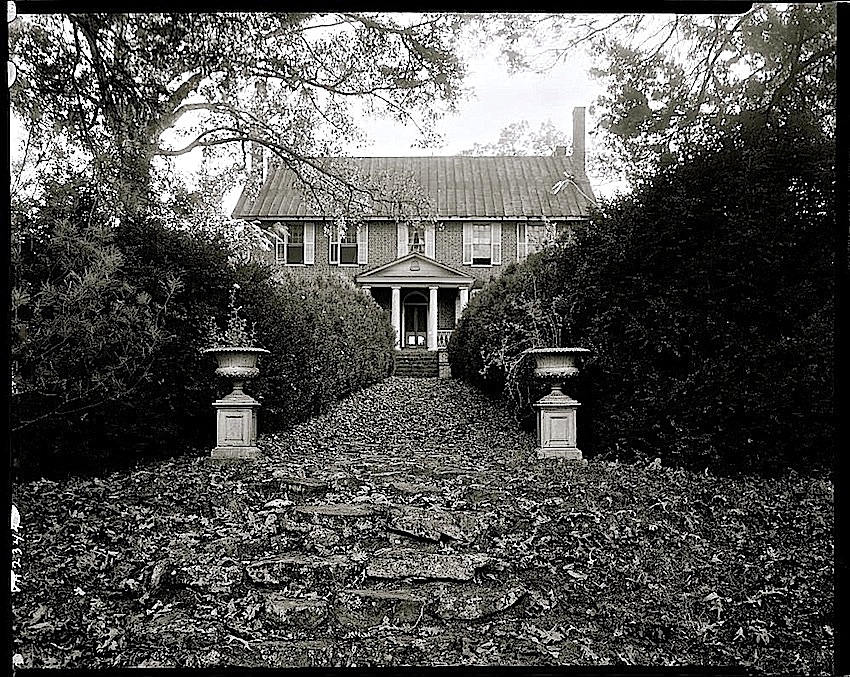
Vintage landscape: boxwood drive

Boxwood hedge, by F.B. Johnston, Library of CongressDriveway, Castle Hill, Charlottesville, Virginia, 1926, by Frances Benjamin Johnston, via Library of Congress Prints and Photographs Division.

The original house on the plantation of Castle Hill was built in 1764 by Dr. Thomas Walker and his wife Mildred.  Walker was a friend of Peter Jefferson and later guardian to his son,Thomas.

At the time of this photo, the property was owned by his descendant, Amélie Louise Rives Troubetzkoy, a novelist married to a Russian prince who eventually ran somewhat short of funds.

By the fall of 1938, when future novelist Louis Auchincloss, then a law student at the University of Virginia, came to have tea with the aging princess, he found her living in “romantic, impoverished isolation in a decaying manor house.” To get to the house, he had to find his way through a double row of aromatic box hedges that rose up three stories high and were so enormous that his bulky Pontiac could barely pass through. The awe-inspiring hedges even became the subject of one of Amélie’s poems, which she wrote in middle age. She ends the poem with “Hedges of Box,/Hedges of Magic./…Behind your barrier of glad enchantment/I have rediscovered reality.” The reality Amélie envisioned had herself within the encircling wall of boxwood, still a young beauty of twenty-one, seated on the back of a unicorn.

— Donna M. Lucey, from “The Temptress of Castle Hill,” Garden and Gun

Today, the estate is still privately owned.  Its remaining 1,203 acres (from the original 15,000) have been permanently protected against development by a conservation easement with The Nature Conservancy.

The Sunday porch: French Legation

This slideshow requires JavaScript.

The front porch of the French Legation to the Republic of Texas, Austin, Texas, 1934, by Louis C. Page, Jr., via Historic American Building Survey (HABS), Library of Congress Prints and Photographs Division.

This house — now the French Legation Museum — is the oldest extant building in Austin.  It was constructed between 1839 and 1841 for Monsieur Jean Pierre Isidore Alphonse Dubois, a secretary at the French Legation in Washington, D.C., who was sent to Texas to investigate the benefits of establishing relations with the new Republic of Texas.

On Dubois’s advice, Texas was soon recognized as a sovereign nation by France and he himself was appointed as the King’s chargé d’affaires.  Unfortunately — and probably before he could ever occupy his house — he became involved in a number of political, financial, and personal controversies, culminating in the so-called “Pig War.” When the Republic’s capital moved to Houston in 1841, Dubois left for New Orleans, only occasionally returning to Texas.

The style of the house is a blend of vernacular Greek revival and Mississippi Valley French. It may have been designed by carpenter Thomas William Ward, who had previously worked in Louisiana.

At the time of the 1934 photos above, the house was owned and occupied by Miss Lillie Robertson, whose father had purchased it in 1848.  After Lillie’s death, the property was sold to the State of Texas in 1945.  It was then put into the custody of the Daughters of the Republic of Texas.  They restored it and opened it to the public in 1956.

This slideshow requires JavaScript.

The same views in 1961, by Jack E. Boucher, also via HABS, Library of Congress.

By 1961, the Legation house was surrounded by a formal arrangement of boxwood hedges — perhaps having taken a lesson from  M. Dubois, the son of a tax collector,  who styled himself Count de Saligny after he arrived in Texas.

Today, the museum looks much the same.  Its surrounding park is 2 1/2 acres and is open to the public. Its wide gravel paths are sometimes used for games of pétanque. From the front porch, visitors can see the Texas Capitol Building and downtown Austin.

Vintage landscape: Danville, Virginia

Oak Hill, Danville, Va,1930s, via Library of CongressMore massive boxwood hedges — this time at Oak Hill, near Danville, Virginia, ca. 1930s, by Frances Benjamin Johnston, via Library of Congress Prints and Photographs Division.

The house was built in 1825 by the Hairston family. It burned down in 1988.

Museum garden in Lyon

Staying in France a little longer: The city of Lyon has two excellent museums located side-by-side on the Rue de la Charité in the Presqu’île area.

The Decorative Arts Museum is housed in the Hôtel de Lacroix Laval, built by Jacques Germain Soufflot in 1739.

Its windows overlook a small traditional parterre — or would, were they not covered by protective shades and gorgeous silk drapes.

The boxwood hedges are laid out in concentric triangles, punctuated by clipped balls.  Ivy fills the centers, and acuba is planted at either end of the space.

Inside, the museum displays beautiful complete rooms of paneling, lighting, and furniture taken from 18th c. French residences, as well as ceramics and silver.

Next door, The Textile Museum exhibits clothing, tapestries, and carpets — from ancient Egypt and Asia to modern France.

I nearly had a religious experience in its gallery of silk Persian garden carpets hung against deep gray walls.

While I was in the garden, I also remembered the triangular patterns in the Rwandan Royal Palace garden in Nyanza.