Garden of “As You Like It,” the James Harper Poor House, East Hampton, New York, ca. 1915, by Frances Benjamin Johnston, via Library of Congress Prints and Photographs Division Commons on flickr.
Poor was a New York City businessman (dry goods) and Shakespeare devotee, who, in 1899, bought a shingled American Colonial country house, part of which was built in the 17th century. He then changed its style to English or Tudor Revival — all half-timber and stucco, as was so fashionable at that time. Today, the property is The Baker House 1650 bed and breakfast.
I could not find out when this simple house* was built or if it still exists. It is somewhat similar to this house in the same area, which Johnston’s notes say was built between 1776 and 1850.
Michaux was one of eleven plantations in southern Virginia owned by the Hairston family, one of the largest slaveholders in the South. Its name probably indicates that the land was also once owned by a member (this one?) of the local branch of the Michaux family.
This is the kingdom that you find
When the brave eye-holes stare
impartially against the air. . .
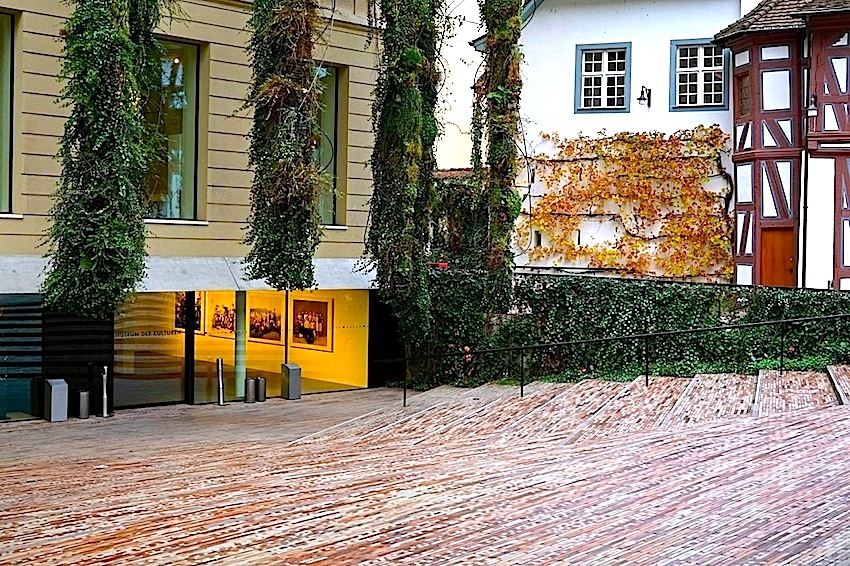
After I took a number of photos of the hanging plant columns of the Basel Museum of Culture (during our visit at Thanksgiving), I turned my attention to the courtyard around them — the Schürhof — the floor of which is largely a set of low, wide steps descending to the museum lobby and gift shop.
Before the museum was renovated in 2011 by Herzog & de Meuron, the Schürhof* was not open to the public. The museum shared a door with the Museum of Natural Sciences around the corner.
Looking at a “before” photo (here, fourth image), the old courtyard appears to have been used at least partly as a parking lot.
Looking out on the courtyard from the lobby.
The renovation excavated it to open up a new museum entrance in the base of the existing 1917 neoclassical building.
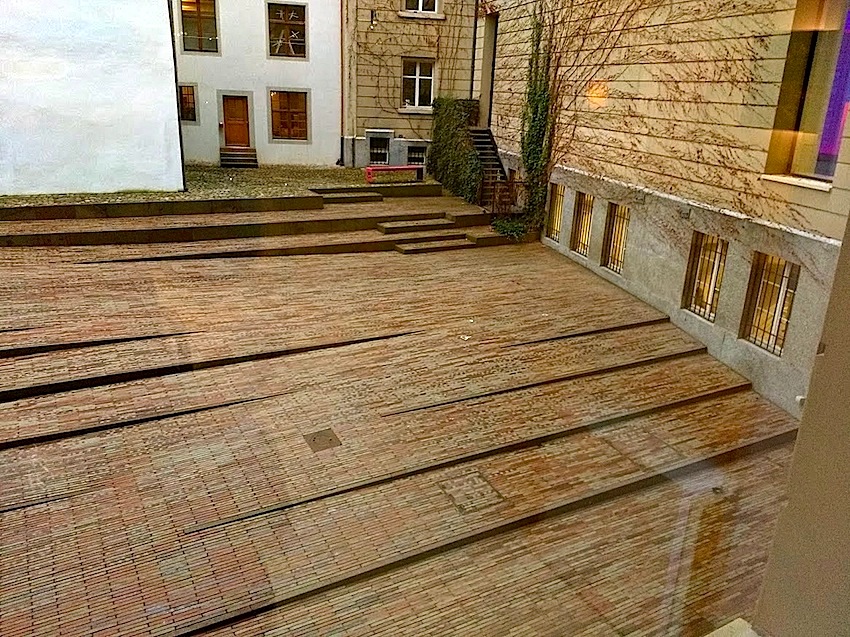
The other buildings that enclose the Schürhof are medieval.
Above and below are three views from upper windows inside the museum.
The entrance to the courtyard is in the upper left corner.
You can see a plan of the courtyard here (fifth image).

 Garden of “As You Like It,” the James Harper Poor House, East Hampton, New York, ca. 1915, by Frances Benjamin Johnston, via Library of Congress Prints and Photographs Division Commons on flickr.




 enclos*ure