 “Roominghouse district, Washington,” a Kodachrome slide by Charles W. Cushman, mid-September 1940.*
In the two years leading up to the U.S. entering World War II, the population of Washington, D.C., went from 621,000 to over 1,000,000, according to journalist David Brinkley.
Most of the new arrivals were women, many of whom were hired “before they had even found a place to leave their bags.” Thousands of townhouses were turned into roominghouses and several women shared each room. (According to one of them, Enid Bubley, it was “social suicide” to violate the morning schedule of eight minutes each in the bathroom.)
By 1941, Malcolm Cowley described the city this way: “Washington in wartime is a combination of Moscow (for overcrowding), Paris (for its trees), Wichita (for its way of thinking), Nome (in the gold-rush days) and Hell (for its livability).”
So the two or three benches placed in each little yard above are significant. They were undoubtedly places of real reprieve from the crowded conditions inside the houses and the chaos of the city.
These gardens still have their wrought iron fences. During the war, the metal was much needed, and many D.C. residents gave up their black railings for wooden pickets.
The photographer, Charles Cushman, was a talented amateur who traveled across the U.S. and other countries and took more than 14,500 Kodachrome slides from 1938 to 1969. He bequeathed his images to Indiana University, his alma mater.
*Used with the permission of the Charles W. Cushman Photograph Collection of the Indiana University Archives. Please do not “pin” or re-blog without contacting them here.
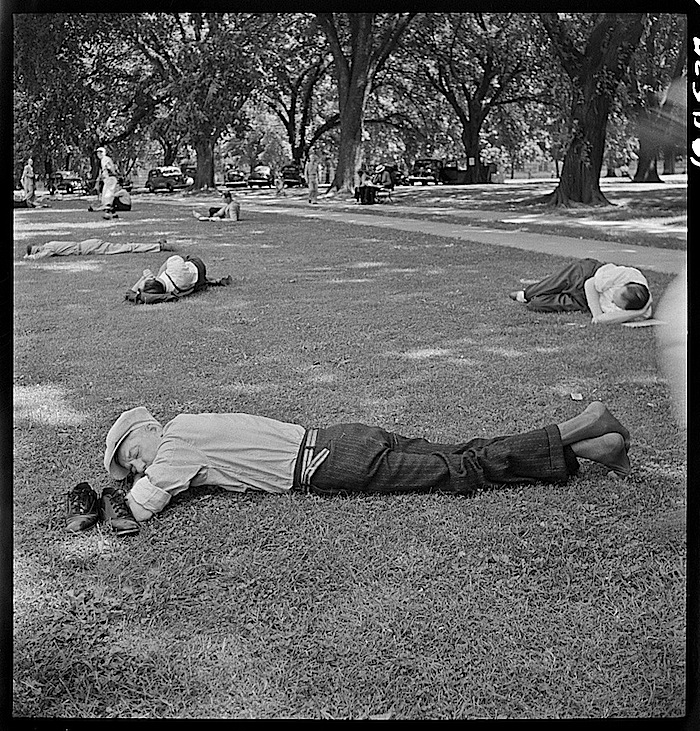 A hot Sunday in Washington, D.C., before air-conditioning.


 enclos*ure