Placing potted bay trees on the east wing terrace, White House, Washington, D.C., between 1910 and 1917, by Harris & Ewing, viaLibrary of Congress Prints and Photographs Division (both photos).
Colonnade, Central Park, Louisville, Kentucky, between 1900 and 1910, Detroit Publishing Co., via Library of Congress Prints and Photographs Division.
The park’s 17 acres were owned by the Dupont family in the 1870s, yet open for public use as “Dupont Square.” In 1883, the space — temporarily “roofed in” — was used to demonstrate Thomas Edison’s light bulb.
In 1904, the Duponts sold the land to the city, and Frederick Law Olmsted, who was already working in Louisville, designed a large open-air shelter and colonnade for the park’s high point. The colonnade still exists and is undergoing restoration.
This morning, I combined the tulips that I bought last week at the supermarket with some white sweet woodruff, or Galium oderatum, just picked from a shady spot in our backyard.
The flowers in my arrangements smell lightly of honey, but sources say that as the plant wilts and dries, its leaves will smell like fresh-cut hay and vanilla.
G. oderatum is native to Europe. In Germany, it is known as Waldmeister or ‘master of the forest.’ Traditionally in spring, before it blooms, its leaves have been added to wine to create May wine or Mai Bowle.
For a good discussion of the culinary uses of the herb in Germany — where it flavors jell-O and hard candy — see this article, “May’s sweetest herb,” in the blog Spoonfuls of Germany.
To see what other gardeners have put in a vase today, please visit Cathy at Rambling in the Garden.
The three women were folk musicians. Alone or in duets, they sang songs like “Swedes Blessing,” “There was a Wealthy Merchant,” “Way Out West in Texas,” “Barbara Allen,” and “The Gypsy’s Warning.” Unfortunately, I can’t find an online recording of them. They look delightful in these pictures, however, particularly in those flowered dresses.
Mrs. Minnie Smith, Mrs. Elizabeth Fulks, Mrs. Albertina Kimball, at Mrs. Fulks’s home.
These are four snapshots from four hundred made during the sound recording expeditions of the Lomax family. From 1934 to around 1950, John Avery Lomax, Ruby Terrill Lomax, and Alan Lomax traveled the southern United States and the Bahamas collecting folk music and folklore for the Library of Congress.
Mrs. Fulks on her porch.Mrs. Fulks in her garden.
There’s a previous “Sunday porch” from the Lomax Collection here.
Our world, so worn and weary,
Needs music, pure and strong,
To hush the jangle and discords
Of sorrow, pain, and wrong.
*These photos were labeled with the location as Prairie Lea or Prairie Lea R.F.D., but also as Stanton, Texas. Prairie Lea and Stanton are in different parts of Texas, and I have been unable to find out which town is correct. The labels on the sound recordings the women made say “Prairie Lea” — which certainly sounds like a place in a folk song.

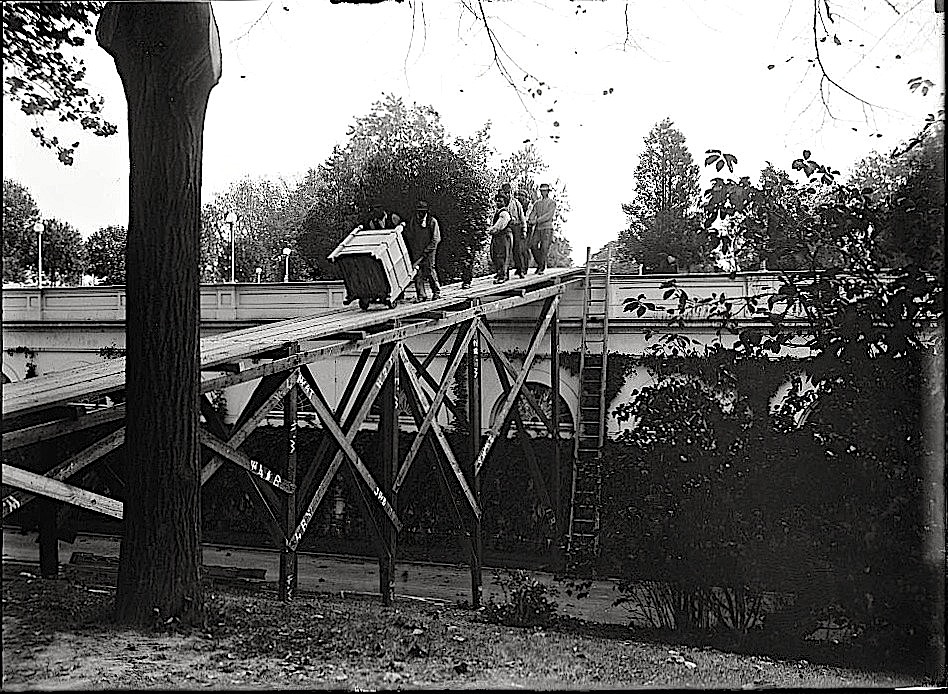 Placing potted bay trees on the east wing terrace, White House, Washington, D.C., between 1910 and 1917, by Harris & Ewing, via Library of Congress Prints and Photographs Division (both photos).
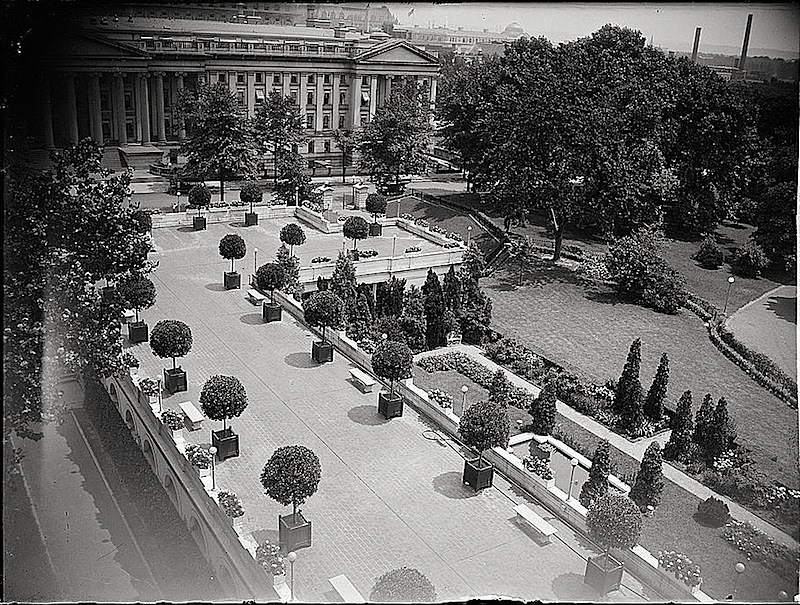 East terrace, White House, 1923, by National Photo Company.



 enclos*ure