
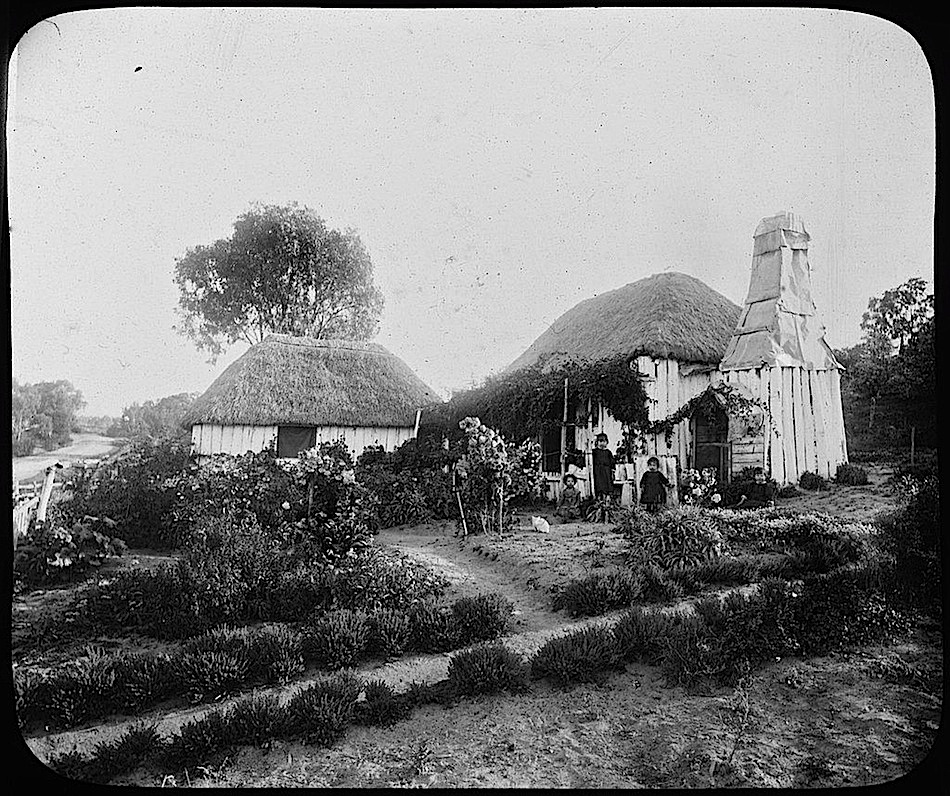
“Three children and a white cat in the garden of a thatched house, Australia, ca. 1886, by Charles H. Kerry, via National Library of Australia Commons on flickr.
“Three children and a white cat in the garden of a thatched house, Australia, ca. 1886, by Charles H. Kerry, via National Library of Australia Commons on flickr.

Collegiate Institute, Los Angeles, California, ca. 1920, a hand-colored glass lantern slide, via Arthur Peck Photograph Collection, OSU Special Collections & Archives Commons on flickr.
Arthur Peck was a Professor of Landscape Architecture at the Oregon Agricultural College* from 1908 to 1948. This picture was part of his teaching library of 24 boxes of glass lantern slides — now in OSU’s archives.
I like the hose left out on the grass in this otherwise very neat picture. It would illustrate to a class the major problem in maintaining a lawn in Southern California.
Unfortunately, I can’t find anything about a “Collegiate Institute” in Los Angeles.
*The college later became Oregon State University (OSU).
A repeat “Life in” from 2013. . .
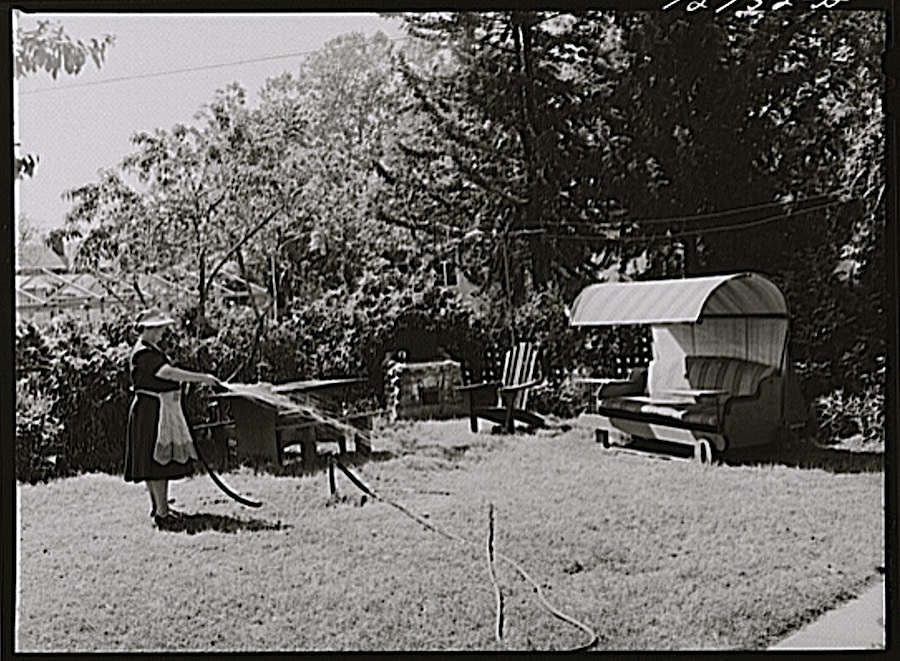
I love this photo by Russell Lee, * of a May 1942 Turlock, California, backyard. (Unfortunately, it’s not very sharply focused.) The caption, possibly by the photographer, reads:
Housewife waters the lawn. All garden furniture and barbecue pit were made by her husband; about one out of every three houses in this town has such an arrangement in the backyard, and during the summer months people eat and spend many hours in their yards.
I particularly like the rolling sofa thing with the awning. Turlock is located in central California between Modesto and Merced. Continue reading “Life in gardens: California”
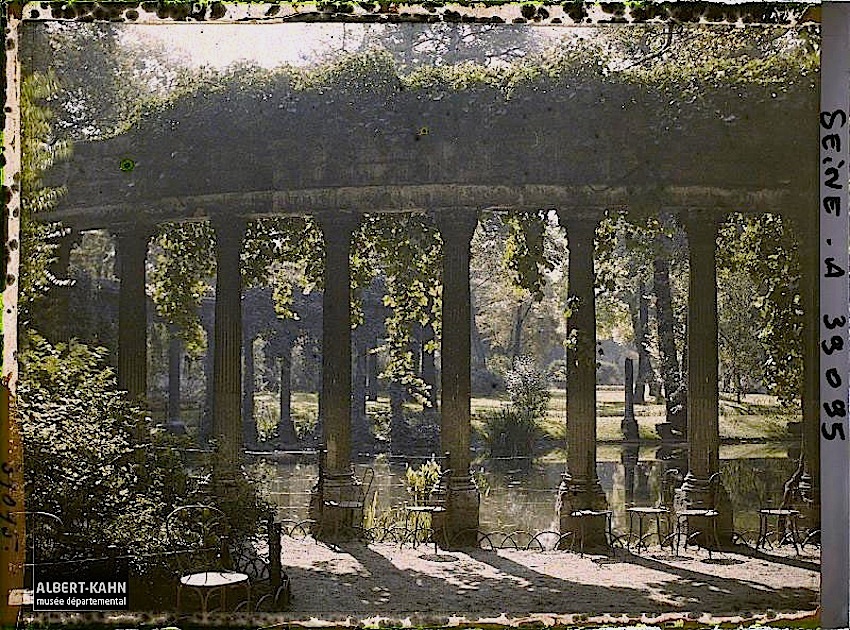
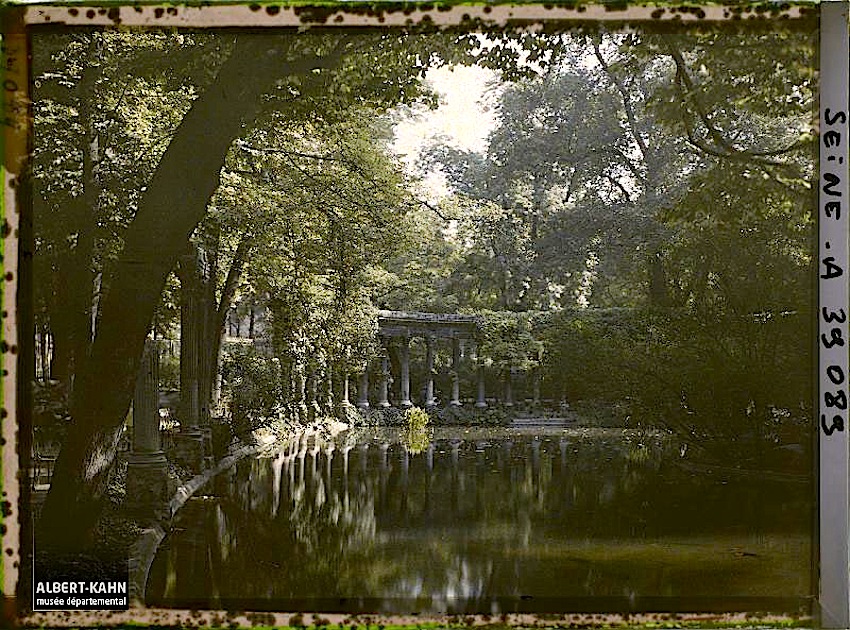
La Naumachie Colonnade in Parc Monceau, Paris, September 12, 1923, by Auguste Léon, via Archives of the Planet Collection – Albert Kahn Museum /Département des Hauts-de-Seine (both photos).
In Ancient Rome, a naumachia was a large basin dug for staging naval battles* as public entertainment. In Parc Monceau, La Naumachie is a tranquil oval pool framed on one end by a Corinthian colonnade.
The columns were once part of a never-completed late 16th century mausoleum attached to the Basilica of Saint Denis. In the late 1770s, they were acquired by the Duke of Chartres for an elaborate “Anglo-Chinese” public garden he was creating in northwest Paris. He filled it with architectural follies (see here) — one of them being a “Roman” colonnade.
The Duke was guillotined in 1793. His land was first confiscated and then returned to his heirs, who sold about half of it to developers. In the 1850s, the city bought the last 20 acres of the old garden, and Parc Monceau opened in 1861 as a largely informal “English-style” park. Today, there are still a few follies, although only the colonnade/naumachia and a small Egyptian pyramid remain from the 18th century.
The autochromes above are two of about seventy-two thousand that were commissioned and then archived by Albert Kahn, a wealthy French banker, between 1909 and 1931. Kahn sent thirteen photographers and filmmakers to fifty countries “to fix, once and for all, aspects, practices, and modes of human activity whose fatal disappearance is no longer ‘a matter of time.'”† The resulting collection is called Archives de la Planète and now resides in its own museum at Kahn’s old suburban estate at Boulogne-Billancourt, just west of Paris. Since June 2016, the archive has also been available for viewing online here.
*The word also refers to the spectacle itself.
†words of Albert Kahn, 1912. Also, the above photos (A 39 095 S and A 39 089) are © Collection Archives de la Planète – Musée Albert-Kahn and used under its terms, here.
 Women on a veranda at Tonsåsen Sanatorium (the woman on the left is wearing a traditional costume similar to the one in this photo), Valdres, Norway, ca. 1890, by Carl Curman, via Swedish National Heritage Board Commons on flickr (all three photos).

Tonsåsen Sanatorium was established for the treatment of tuberculosis in 1881 — the same year that the bacillus causing the disease* was identified by Robert Koch. Like similar facilities, just about the only treatment it could offer was a combination of nutritious food, rest, and plenty of fresh air. However, it also had thermal baths, and the photographer, Carl Curman, was a physician, specializing in the science of health baths (balneology).

Even at the better sanatoriums, fifty percent of patients were dying within five years in 1916. It was only after the development of antibiotics after World War II that it was possible to treat and cure TB reliably. Tonsåsen closed in the 1960s.
*TB was proven to be communicable in 1869.
 enclos*ure

