
Midsummer in my garden. . . .

Midsummer in my garden. . . .
I’m stuck inside with a cold today and have been all weekend, so I haven’t been able to take any new pictures.
However, I found these photos of Tanner Springs Park in Portland, Oregon, which I took in 2008. I thought I would share them because I was thinking about Fiona Stephenson’s chalk stream show garden and about how a landscape type (in this case, wetlands) can be interpreted effectively in a garden design (in this case, a .92 acre urban public park).
Also, the children in the photos are having such a nice time fooling around in the grass and water, and, while I look at them, I reflect that it’s going to be 95° here in Washington, D.C., today and only 70° in Portland.
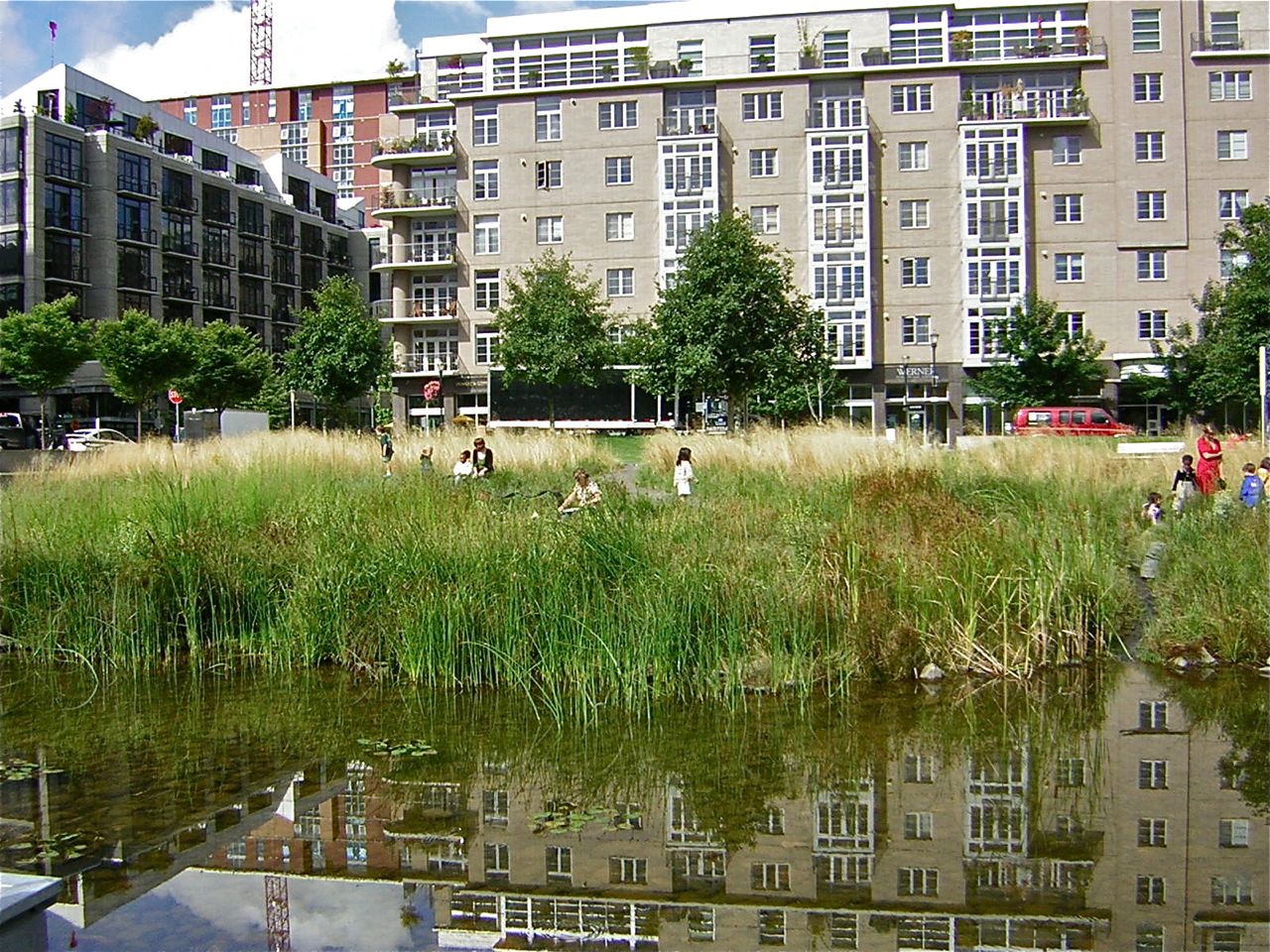
The Tanner Springs Park opened in 2006 in the Pearl District, which is a neighborhood partly made up of old warehouses that are now turned into apartments and shops. Before the warehouses, there was Tanner Creek, which fed streams, wetlands, and a lake and ended at the Willamette River close by. In the late 19th century, Tanner Creek was rerouted into an underground system of pipes.
The park is not a restoration of the original environment but is meant to imitate and function somewhat like a wetland.
The concept for the park was provided by Peter Walker & Partners. The design was by Atelier Dreiseitl and Green Works, P.C.
Click the link for an article about the park by George Hazelrigg in the April 2006 issue of Landscape Architecture Magazine.
Click on any thumbnail in the gallery below to scroll through all the enlarged photos.
Addendum: For more recent (May 2011) photos of the park, check out the blog Metropolitan Gardens.


Even though my garden is only about 16′ wide, I so want this Deluxe Tractor Scoot — but in lime green with the plastic trug in orange. I would scoot up and down my long walkway and then leave it out on my tiny “lawn” as an ornament. It’s $99.95 at Gardener’s Supply Company.

On July 4th, my husband and I walked home through Georgetown after lunch. When we reached R Street, we decided to cut through Montrose Park and then over behind Dumbarton Oaks.
This is how we came upon Dumbarton Oaks Park, a section of Rock Creek Park with an exceptional pedigree, but a difficult present existence. It is an almost lost remnant of the Country Place Era of American garden design (1880 – 1940).
The Dumbarton Oaks garden, which was designed by Beatrix Farrand for Mildred and Robert Bliss, is famous, but the park behind it is far less known. I had never heard of it — not from garden history classes nor during visits to the DO garden — until this April, when I received an e-mail about the launch of efforts of save it.

But the DO Park, also designed by Farrand, is on the National Register of Historic Places. “To landscape historians,” writes Adrian Higgins of The Washington Post, “it is hallowed ground.”
In 1928, these 27 acres of former farmland became a naturalistic extension of the Bliss estate’s formal gardens. A series of paths and meadows were composed along a small tributary of Rock Creek and planted out with drifts of native and exotic wildflowers, bulbs, and woodland shrubs. Eighteen waterfall dams were built, as well as two arbors and several benches and footbridges — all in the rustic Arts and Crafts style.
In 1941, when Dumbarton Oaks was given to Harvard University, this part of the property went to the National Park Service.
Over time, however, it seems that the highly designed and delicately crafted landscape was just too much for the Park Service to handle. Photos taken in the late 1980s show it in very bad condition. Through the decades, there has been serious damage from runoff to the stream-edge areas, and invasive weeds and vines have smothered and pushed out Farrand’s trees and plants.
The formation of the Dumbarton Oaks Park Conservancy offers some hope for its restoration. Headed by Rebecca Trafton, a garden designer and documentary maker, it is currently raising money and hopes to present a work plan in October.
The DO Park is a remarkable place even now, and the strength of Farrand’s vision and of her artful use of materials still shines through. The refrain “this is how it’s done” ran through my mind as we walked along. If you visit Dumbarton Oaks, please walk down Lover’s Lane on its east side and take a look.
Click on any thumbnail in the gallery below to scroll through the enlarged photos. The order follows a walk from one end of the path along the stream to the other.


My husband and I enjoyed the 4th by going out to lunch in Georgetown and then taking a walk through Dumbarton Oaks Park, which will be the subject of my next post.
Then we returned home and tag-teamed cutting our grass.
It’s not that we have very much lawn — quite the contrary as you can see from the photos below. It’s that we live in an attached rowhouse and the only way to get from the front yard to the back, or vice-versa, is go through the house (or around the block).
It’s also that we cut the grass with an antique reel lawnmower that my father gave me. I believe it belonged to my grandfather. It weighs 26 very awkward pounds (feels like 50, as they say about the weather). But I use it for sentiment, and because I think it’s rather beautiful, and because I can’t resist a free tool.
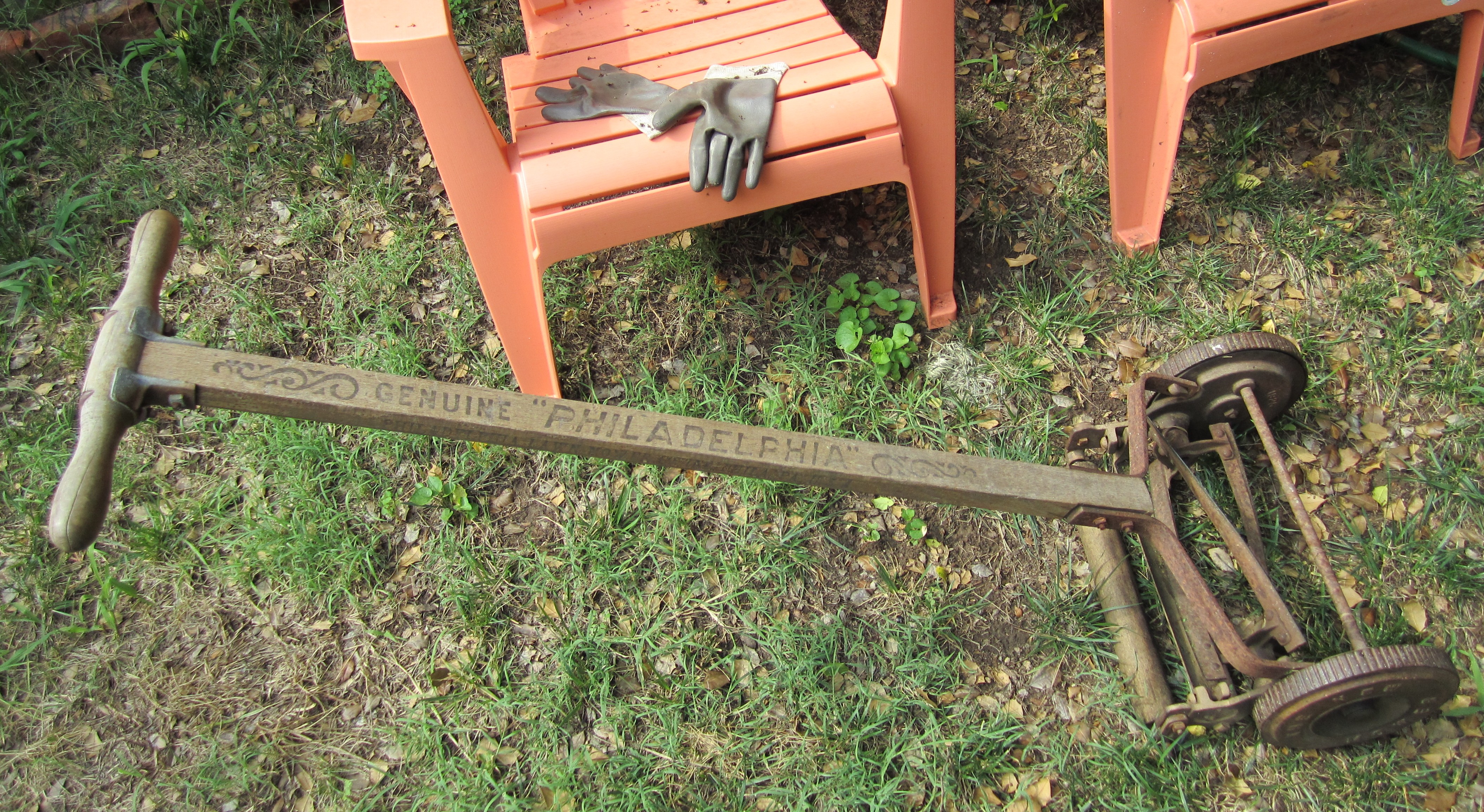
To cut our grass, my husband first pulls the mower from the covered area outside the back door and rolls it through the basement and out a front door, up the basement steps and out to our tiny strip,

which he cuts in about three minutes. Then he carries it back down the steps,

through the basement again, and back out the door. Then he hands it over to me.
Then, I take the mower up the back basement steps to the deck,

down the deck steps,

and down the sidewalk to our little round “lawn.”
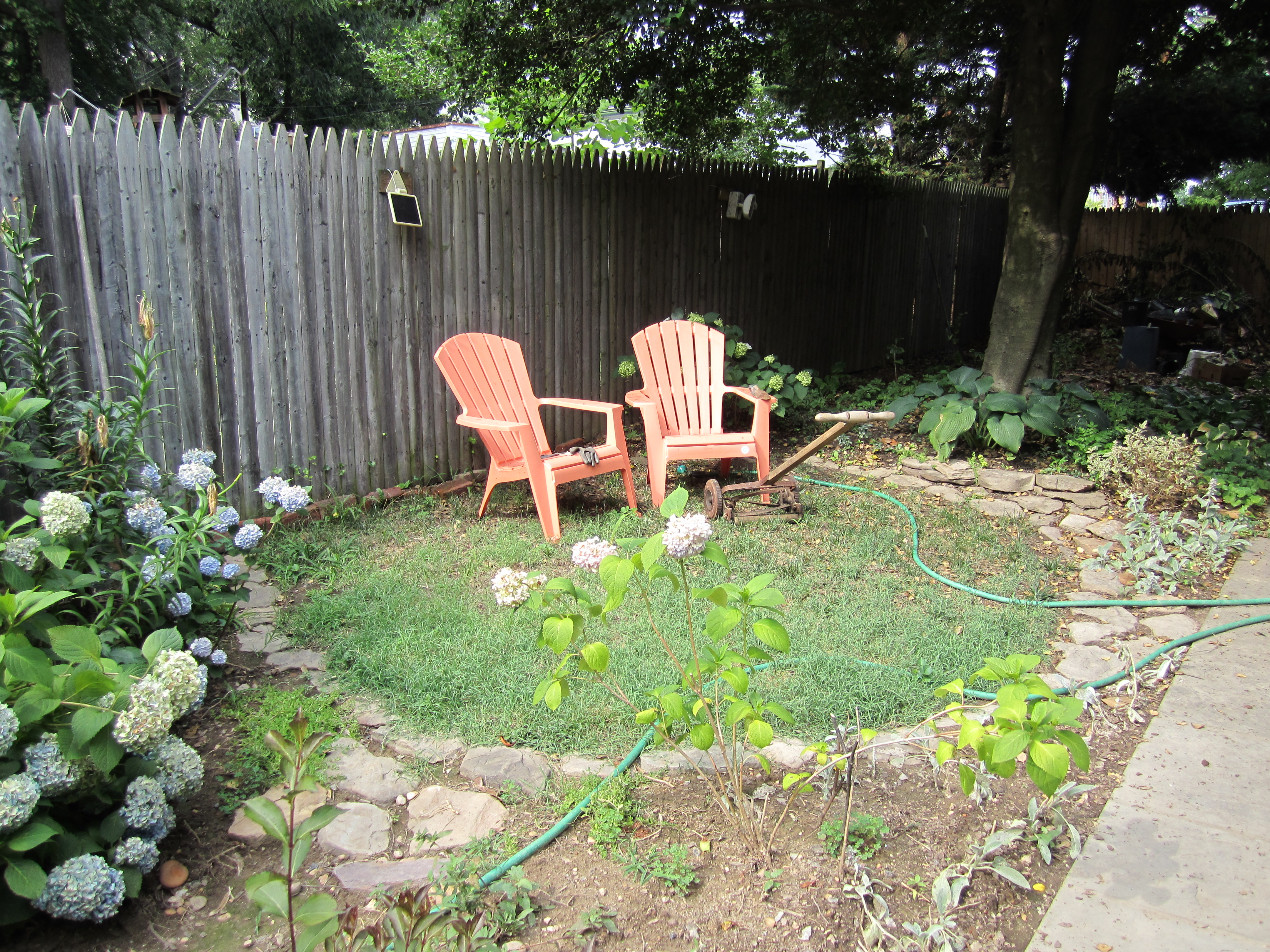
The cutting takes me about seven minutes only because I have to move a couple of chairs. Then I have to retrace my steps, maybe take an Advil, and think about how a tiny meadow in that spot would be a good idea.
If you are in the U.S., enjoy the fireworks tonight!
 enclos*ure