The butterfly garden

This slideshow requires JavaScript.


On the same early August day that I visited the Smithsonian’s Heirloom Garden, I also enjoyed a long walk back and forth through the Butterfly Habitat Garden, located on the east side of the National Museum of Natural History.

The garden is made up of plants that have specific relationships to the life cycles of eastern U.S. butterflies. As you walk along, you pass sections that mimic habitats important to the insects: wetlands, meadows, edges of woods, urban gardens.

It’s a long corridor really, bordered by busy 9th Street, N.W., on one side and the museum’s parking lot on the other. Yet, stepping in, you feel enveloped in another world, one that combines a little city polish with naturalism.

I offer these pictures from last summer as more inspiration for those in cold climates who are deep into their nursery catalogs and graph paper, planning for spring.

I haven’t labeled all the plants because the Smithsonian’s interactive map at this link has plant lists for each habitat.  (However, they do not include the grey-green plants in the first and seventh photos  [It’s dinosaur kale, possibly Brassica oleracea var. acephala ‘Lacinato’ or ‘Cavalo Nero’] or the tall plants with the small, purple, fuzzy blooms in the tenth.  [It’s Ironweed, Vernonia.  Thanks James Golden.]  Can anyone identify them?  I feel they are just on the tip of my brain.)

To see much larger versions of the slideshow photos, click on ‘Continue reading’ below and then click on the first thumbnail. You’ll be able to scroll through the images in succession. Continue reading “The butterfly garden”
A Kodachrome heirloom

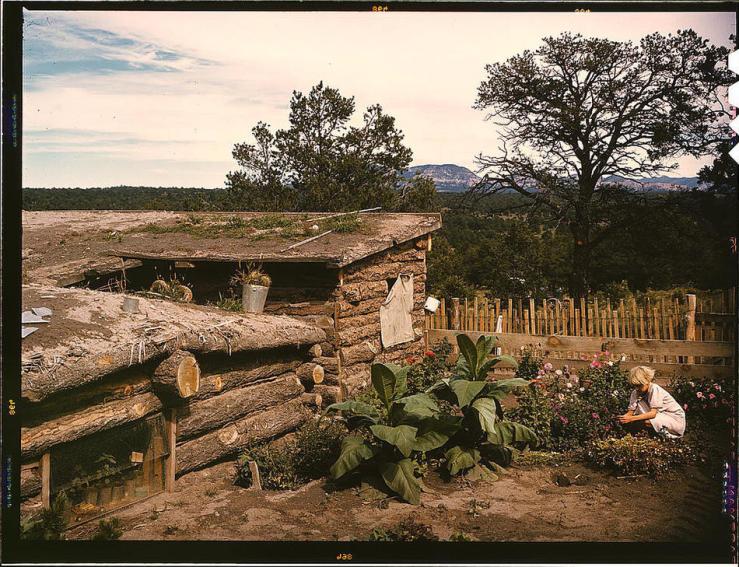
Photo by Russell Lee. Prints and Photographs Division, Library of Congress.

This photo of a homesteader’s garden in Pie Town, New Mexico, September 1940, was taken by Russell Lee, a photographer of the Farm Security Administration/Office of War Information. It was part of a 2006 Library of Congress exhibition of early color images taken between 1939 and 1943, “Bound for Glory: America in Color.” Thanks to links by Studio G and The Denver Post.
Click this link to see a larger version or to buy a print.  Click here to see another view of the same homesteader’s garden.

The heirloom garden

On a hot day in early August, I visited the Heirloom Garden of the National Museum of American History* and took a lot of photos,  but because of our move, I never had time to post them.  Now that it is seed-ordering time in the U.S., I thought they might be inspirational.

(Click on any image above to scroll through larger photos.)

The garden — huge, raised planters, all the way around the museum building — contains a mix of open-pollinated plants cultivated in America prior to 1950 (heirlooms). The plantings are anchored by crape myrtles and a variety of shrubs.

The colorful annuals, perennials, bulbs, and herbs are all so familiar, but  the combinations are often surprising.  It’s a splendid ode to the flower gardens of our grandparents.

The museum pipes in a selection of American music from speakers set in the planters (in fake rocks).  Normally, I would find this annoying, but in the already noisy, wide open site, it actually drew me in to the garden and enhanced the experience.  And their selection is excellent — folk, jazz, blues, musicals.  The planters are raised about 3′, which also helps the plants compete for attention in the immense space.

By late summer, the flowers were being allowed to grow a little leggy and fade naturally, which added to the various forms and tones of the groupings.


*The Smithsonian Institution on the National Mall in Washington, D.C., has eight beautiful gardens (ten if you count the inner courtyards of the Freer Gallery and Museum of American Art).

Bloom Day in January

I was surprised this week by this pretty cream and pink canna, blooming among some shrubs near the garage. It’s a short variety, and I need to move it to a place where it will get a little more attention.

This is another small canna currently blooming near the patio.

They are all I’ve found in our flower beds, which is a little strange since cannas are such a common plant here.

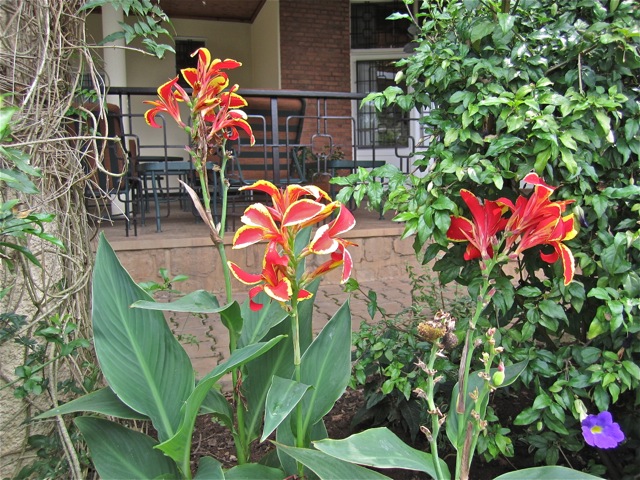
This is my favorite local variety. It’s medium tall and the blooms are clear orange.

These are my neighbors’ cannas, planted outside their garden walls.

Cannas are so common in Africa that you might think of them as native plants, but all cannas are native to the Americas.  In the U.S., they range from southern South Carolina, west to southern Texas.

Cannas like full sun and consistently moist soil. They have a high tolerance for contaminants and can be used to extract pollutants from wetlands.

The blooms and foliage of cannas have such a strong presence that I think they need to be placed in gardens that are rather dramatic in return and maybe somewhat tropical.

Beautiful use of burgundy-leaved cannas in front of the Smithsonian’s Museum of American History, Summer 2011.

Here is a nice old-fashioned garden bed with canna from the South African blog Sequoia Gardens.

Via Sequoia Gardens.

Of course, they’re great in showy pots.

Cannas and coleus at The Morton Arboretum, via This Garden Cooks.

I found an interesting online newsletter, Old House Gardens, which offers a lot of history and advice on the use of cannas.  It reports that Georgia gardener Ryan Gainey uses Canna indica (commonly called Indian Shot) in a big clump with chartreuse ‘Limelight’ hydrangeas and yellow ‘Hyperion’ daylilies.

Russell Page included them in his imaginary personal garden in groups of pots, along with “yuccas, hedychium, Francoa ramose, tigridias, yellow and white lantanas clipped into balls, and the dwarf pomegranate.”

Henry Mitchell lamented in The Essential Earthman that cannas had been swept out of favor, along with geraniums, elephant’s ear, and crotons, “because people remembered well how ridiculous they had looked in the wormy little dribbles of Victorian gardens.”

He recommended the large, red-flowered, green-leaved variety, ‘The President’, with “clumps of ligularias and rhubarbs and so on.”

For cannas with reddish-purple or bronze leaves, Mitchell recommended pairing them with plants of gray and bronze foliage, as well as straw-yellow, buffy, or sharp lemon flowers like daylilies — or with figs, pomegranates, or “chest-high mounds of gray wormwood and black-green yews.”  It is perfectly OK to cut off the canna flowers if they are “too flashy” for you.

Thanks to May Dreams Gardens for hosting Garden Blogger’s Bloom Day.

Tea gardens

Tea growing around Kinihira, Rwanda. Tea plantations are traditionally called ‘tea gardens.’

In late December, we were included in a Christmas season lunch at the home of the Director General of Sorwathe and his wife. Sorwathe is the Société Rwandais de Thé or, in English, the Rwanda Tea Company, and is located about 70 kms. north of Kigali.

Before the meal, we had a chance to tour the factory, which is the largest in Rwanda and produces over 6 million lbs. of made tea annually, almost all of it for export.

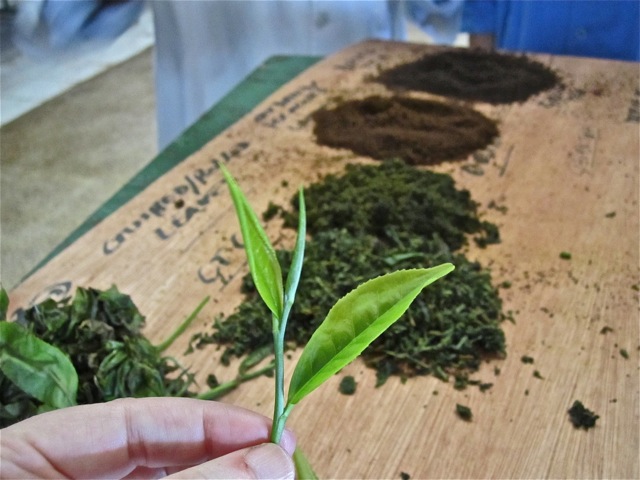
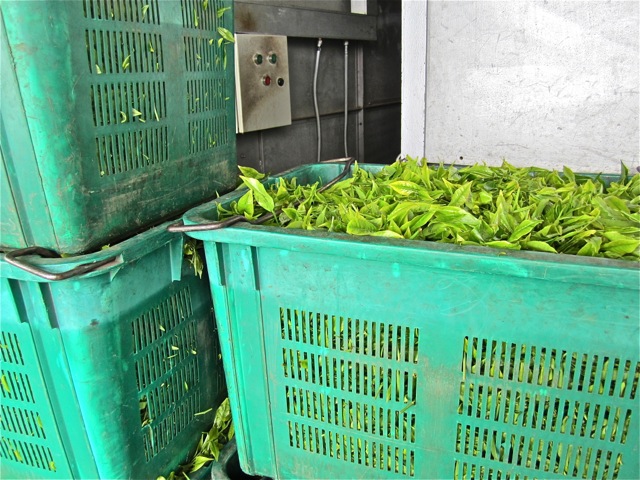
Fresh tea leaves about to go to the withering process, where they will lose excess moisture. The leaves have no scent while fresh.

Sorwathe was founded in 1975 by American Joe Wertheim.  It remains 85% owned by Mr. Wertheim’s Connecticut-based company, Tea Importers, Inc.  It cultivates 650 acres, mostly in drained swampland (marais). Click here to see some really nice photos of their tea gardens.

After coffee, tea is Rwanda’s most important export.  Tea cultivation began here in 1952, and Sorwathe was the first private factory.  Although the factory sustained serious damage during the genocide, it was also one of the first to reopen in the aftermath.

The stages of black tea processing. Only the terminal bud and 2 young leaves are plucked from the bush.
These beautiful sacks will take most of the withered tea to the cutting stage, after which it will become green or black tea, depending on how long it is oxidized. Orthodox tea is not cut, but rolled whole leaf, which gives it a more nuanced flavor.
The chopped tea is a vivid green.

Sorwarthe was the first tea factory in Rwanda to obtain ISO 9001:2000, ISO 22000:2005, and Fair Trade certification.  It is also a participant in the Ethical Tea Partnership.  The company was the first to manufacture orthodox (rolled, whole leaf) and green teas (also white).  (They will proudly tell you that they export green tea to China.)  It is also the first to start organic tea cultivation in Rwanda.

Sorwarthe creates 3,000 job opportunities for the surrounding Kinihira community.  It also supports the local tea growers’ cooperative, ASSOPTHE.

[UPDATE:  The U.S. State Department presented its 2012 Award for Corporate Excellence to Tea Importers, Inc., and SORWATHE, in recognition of their commitment to social responsibility, innovation, and human values. The award is given annually to two American businesses abroad.]

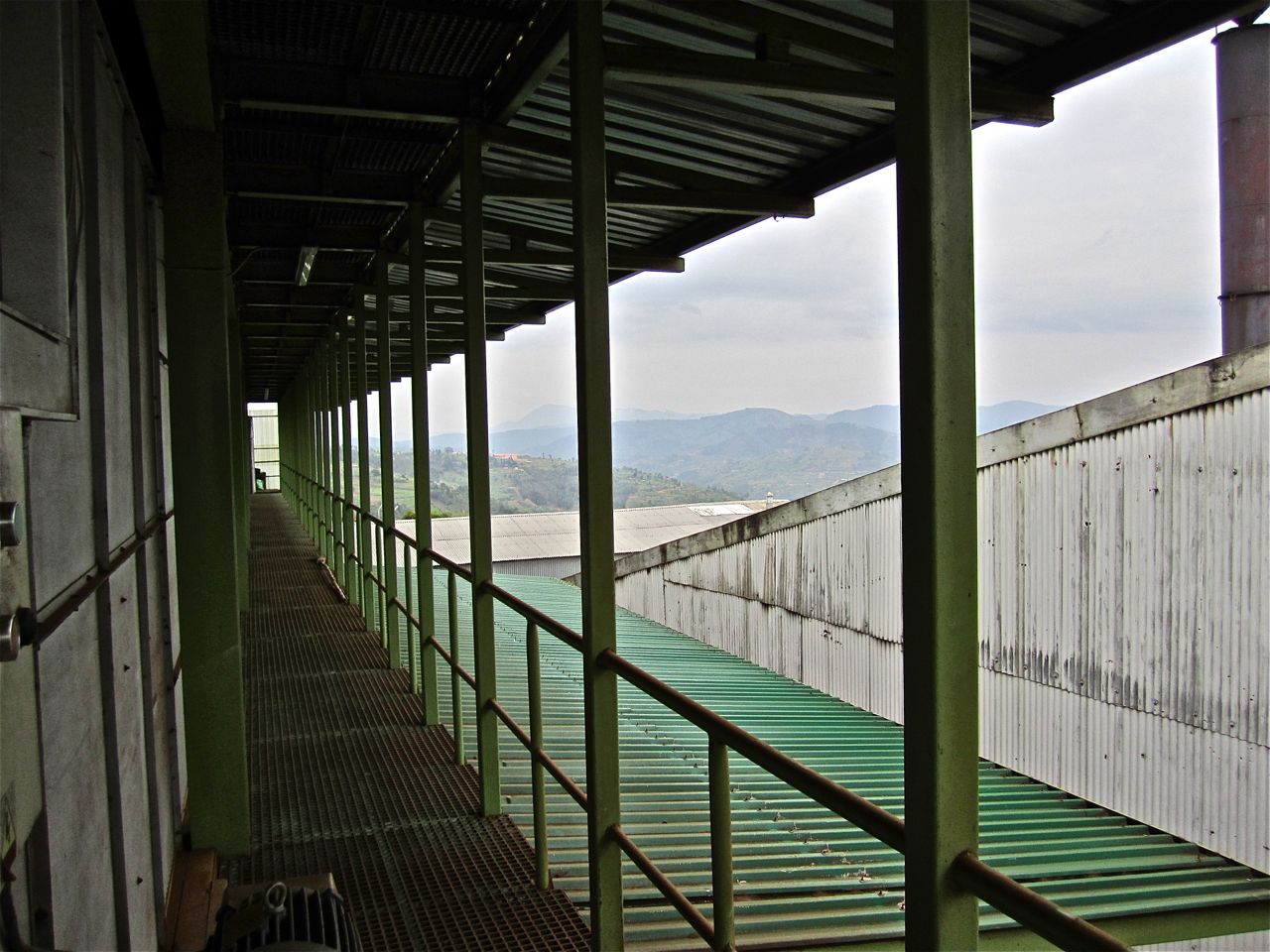
The factory’s buildings are detailed in shades of green, and its surroundings are friendly and sometimes rather whimsical.

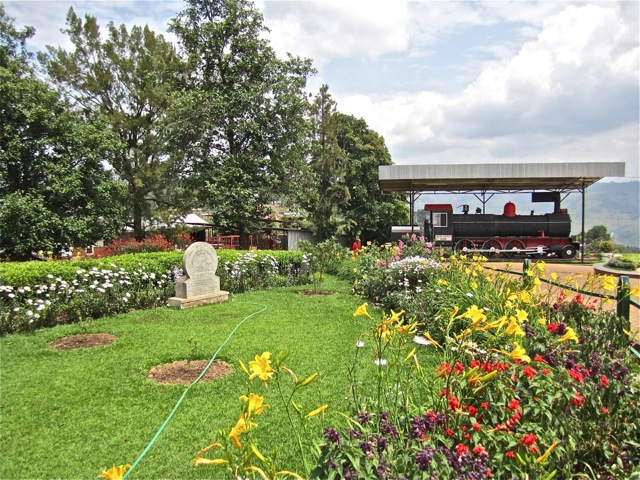
In the early days of the factory, old railroad steam engines were brought in to provide heat for the tea dryers (used after oxidation). To celebrate the 30th anniversary of Sorwathe in 2005, a 1920’s steam locomotive of the East Africa Railway Company was restored in Nairobi and installed in the factory garden.
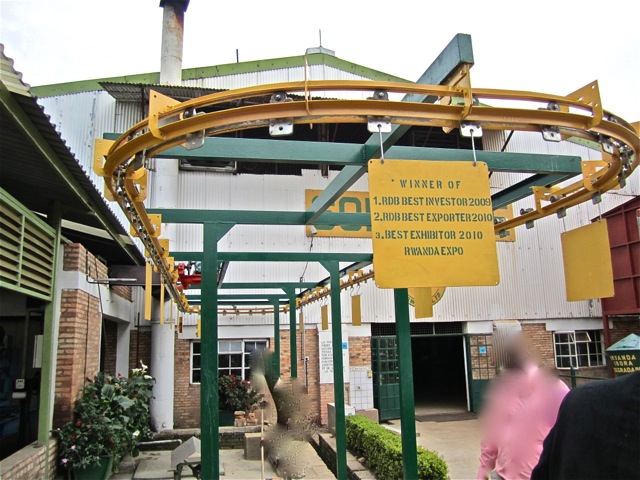
The company’s accomplishments are displayed on a sort of merry-go-round at the entrance.
Sorwathe was an early large donor to the construction of Rwanda’s national public library, now almost complete.
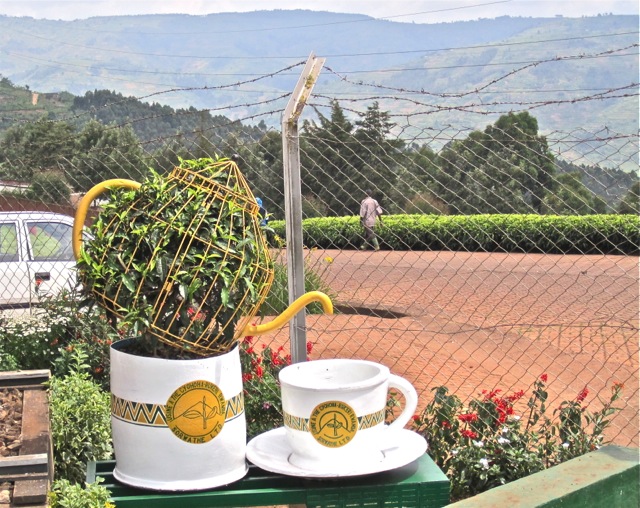
A topiary teapot at the entrance to the factory.
The factory has beautiful views.  In clearer weather, the Virunga volcanoes are visible.

You can order Rukeri Tea, Sorwathe’s garden mark, from Tea Importers’ website.  The company also runs a guest house next to its factory.

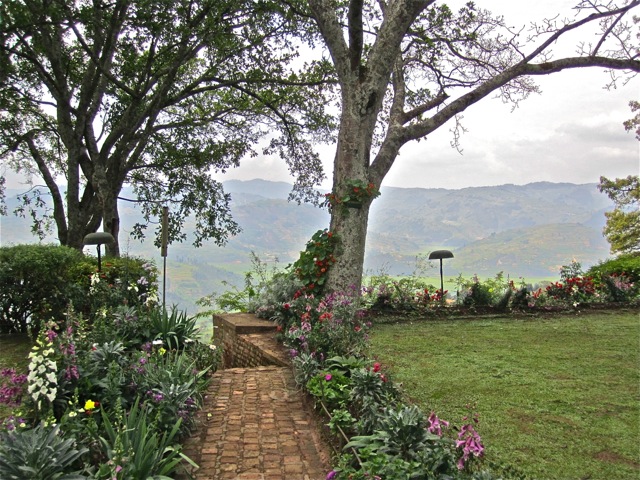
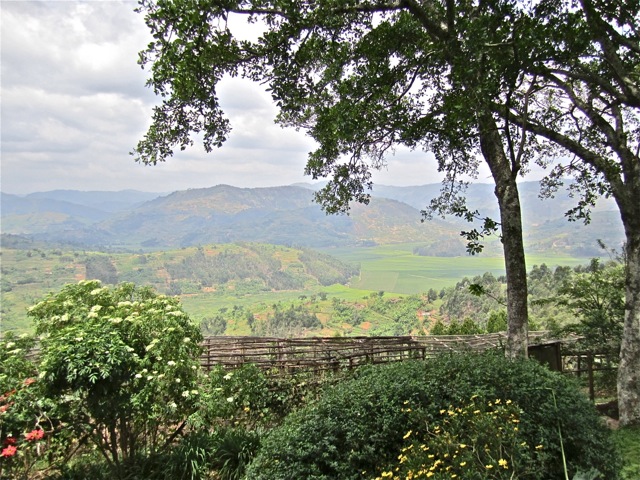
Our lunch was eaten on the patio of the couple’s house, which overlooks their lovely garden and a knockout view of the tea gardens in the valley below.

Cottage garden flowers and tea fields.
Foxglove and stock are among the old-fashioned annuals in the garden.
The tea fields and hills beyond a shaded garden.
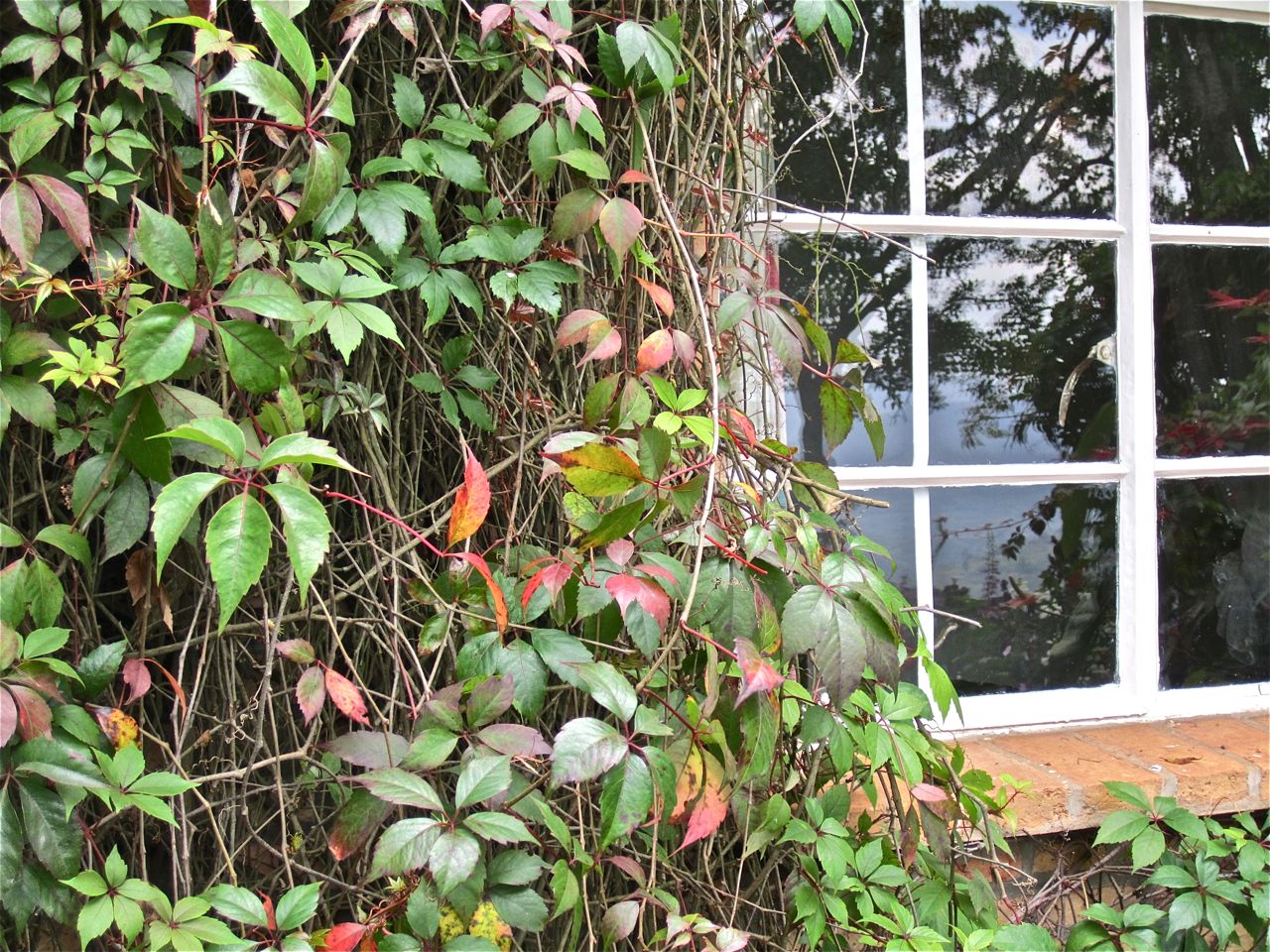
Virginia creeper vines on the house.
The trees in the foreground are Ficus sycomorus or sycamore fig. They are native to much of central Africa and parts of the Middle East.

If you live in U.S. zone 7 or higher, you can try growing tea bushes (Camellia sinensis) at home.  The plants like soil a little on the acid side and are drought tolerant.  Pests can be treated with horticultural oil.  If left unpruned, the plants will grow into small trees.  You can buy them from Camellia Forest Nursery in Chapel Hill, N.C.