Garden Bloggers’ Bloom Day for August

Now is the winter of our discontent
Made glorious summer . . .

by our water hoses.

We are just below the equator here in Rwanda, so technically it is near the end of winter — and of the long dry season, which began in May and normally ends in September.

But last night there was a light rain for about seven hours, so today I don’t need to water anything in the garden, not even the new plants.
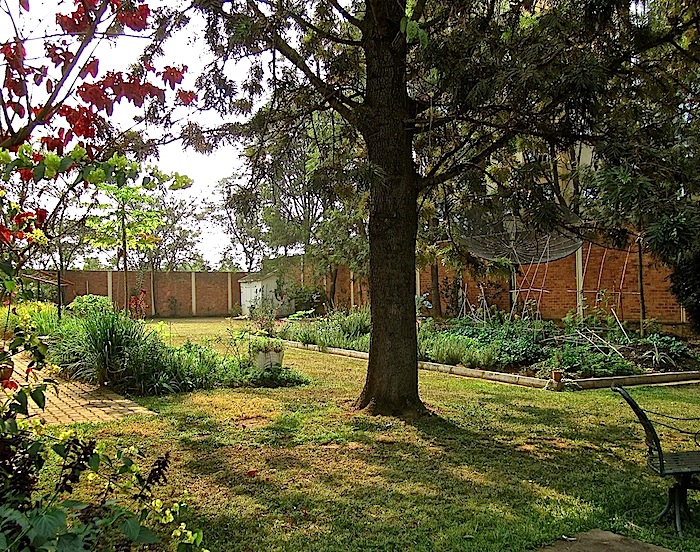
The cutting garden (left) and the vegetable garden (right).

We’ve really cut back on watering this year, anyway — none for the grass and a lot less for the planting beds. The grass is going brown, but we still have a lot of flowers, particularly my stalwarts, yellow daylilies and pink gerbera daisies.

The vegetable garden with kale, sunflowers, Missouri primroses, nasturtiums.

My biggest project in the last month has been to tackle our mess of a vegetable garden, which has consisted of several not very productive, but very wide and long raised beds.  Their dimensions just weren’t manageable, so we’ve dug new paths and now all the beds are about 4′ x 5′.

Orange nasturtium in our vegetable garden.
Orange nasturtium bloom in our vegetable garden.

Growing among the argula, lettuce, kale, strawberry, and tomato plants are also celosias, nasturtiums, Missouri primroses, and sunflowers.

Sunflower (one of the shorter varieties) in our vegetable garden.
The garden with celosia, feverfew, supports for tomatoes and beans, with lettuce gone to seed in the back.
Our still rather disorderly garden with celosia, feverfew, supports for tomatoes, with a row of lettuce going to seed along the back.

Recently, I tried to grow American hardy hibiscus from seed (in the vegetable garden, where the soil is best), and, despite the fact that I have always read that this is a very easy thing to do, only about ten seedlings appeared from two packets of seeds, and for weeks they have remained at 2″ tall.

Nothing at all came up from a packet of black-eyed Susan seeds; only one plant from a packet of Verbena bonariensis.  However, alpine strawberry seeds have produced about 15 plants.
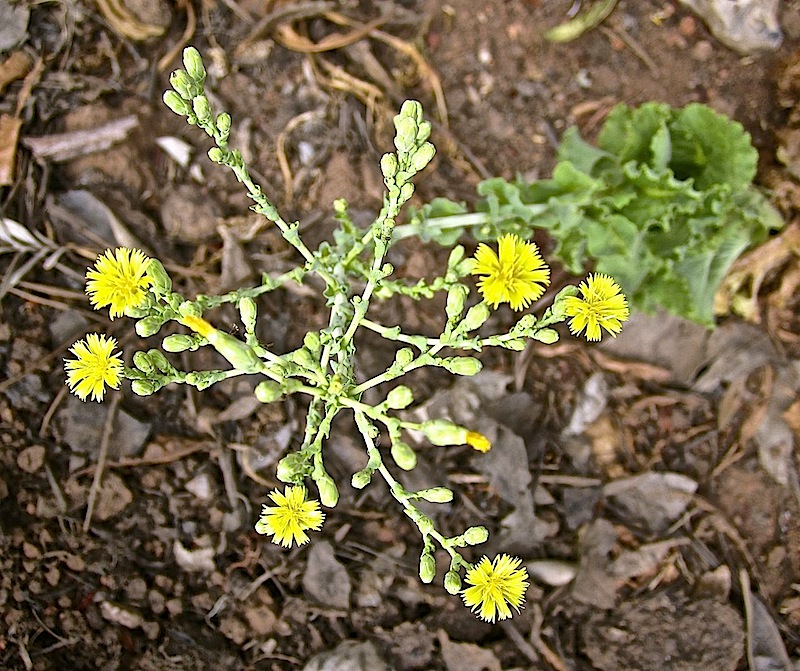
Lettuce flowers.
Lettuce flowers.

I have also done well with re-seeding lettuce, dill, basil, garlic chives, and coriander and with rooted rosemary cuttings. I have high hopes for my cherry tomato plants, many of which have clusters of tiny fruit.

Feverfew in the vegetable garden.
Celosia in the vegetable garden. The fading blooms are full of seeds.

In the long flower border along the lower lawn, I have one bloom from several purple coneflower plants that I have grown from seed.

The first coneflower bloom.
The first coneflower bloom from plants I grew from seed.

Garden Bloggers’ Bloom Day is the 15th day of every month.  Check out May Dreams Gardens to see what’s blooming in other garden bloggers’ gardens today.

Opportunity for interesting design

In late June, we attended the launch of the Women’s Opportunity Center in Kayonza, Rwanda.

Women's Opportunity Center, Kayonza, Rwanda. Supported by Women for Women International and designed by Sharon Davis Design./enclos*ure

Constructed with the support of Women for Women International (WfWI) and other donors, the center will train the region’s women in financial literacy, business, agribusiness, and life skills.  WfWI has given support to over 56,000 women in Rwanda since 1997.

The facility was designed by the American firm Sharon Davis Design.   Particular attention was given to using local building materials and installing eco-friendly technology.

Handmade bricks, Women's Opportunity Center, Kayonza, Rwanda. Supported by Women for Women International and designed by Sharon Davis Design./enclos*ure

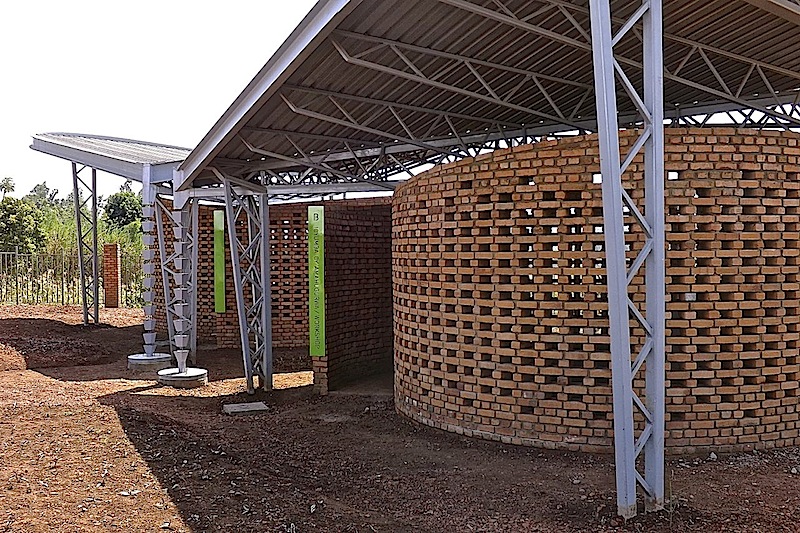
The buildings and walls around the center were constructed with 450,000 beautiful handmade bricks — each one stamped with the logo of WfWI.  They were pressed by a co-op of WfWI training graduates from clay dug in an adjacent valley.

Women's Opportunity Center, Kayonza, Rwanda. Supported by Women for Women International and designed by Sharon Davis Design./enclos*ure

The plan above is from the Sharon Davis Design brochure.  You may want to click on the photo to see a larger version.

The brochure explains some of the design concept:

To keep the scale and quality of the center’s spaces intimate and diverse, the organization of traditional Rwandan residences and villages became the inspiration for organizing and dispersing the many program elements across the 1-hectare* plot.  A series of human-scaled pavilions are clustered around the center of the site.  . . .  The circular nature of many of the interior spaces is also in response to WfWI’s approach of teaching in the round.

During the ceremony, Sharon Davis explained that her team wanted to create a particularly reassuring design for women who might be shy about entering this type of public place. WOC expects 200-300 women to participate in various activities every day.

Handmade bricks and rain chain, Women's Opportunity Center, Kayonza, Rwanda. Supported by Women for Women International and designed by Sharon Davis Design./enclos*ure

The center includes domitory lodging — in the tent above — for students and visitors.  All toilets on site are composting toilets, which will produce fertilizer for use in the center’s farm and for sale in its market.

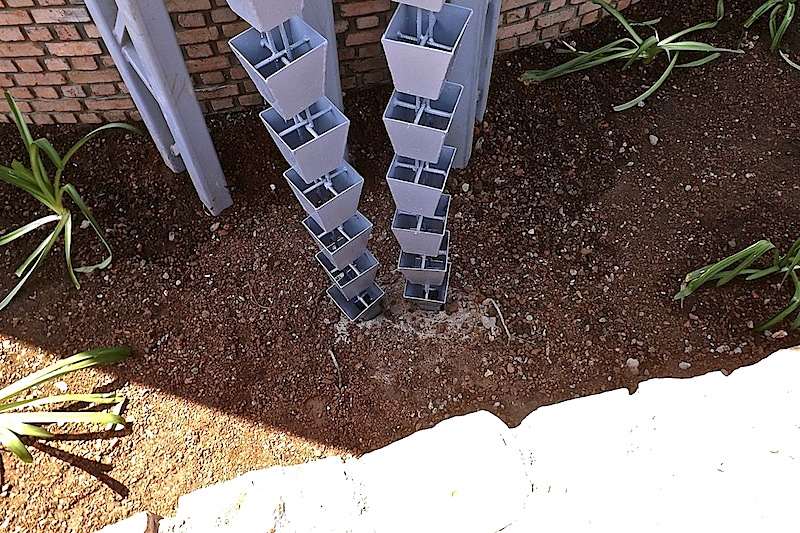
Rainchains direct all the runoff from the buildings to two buried 40,000 liter cisterns. This collection is expected to meet all the water needs of the site.

Rain chains, Women's Opportunity Center, Kayonza, Rwanda. Supported by Women for Women International and designed by Sharon Davis Design./enclos*ure

The bonding pattern and curves of the buildings’ brick walls eliminate the need for concrete columns and beams.

Workshop classroom, Women's Opportunity Center, Kayonza, Rwanda. Supported by Women for Women International and designed by Sharon Davis Design./enclos*ure

The workshop buildings have no doors or ceilings, and the open pattern lets in diffuse natural light and air.

Workshop classroom, Women's Opportunity Center, Kayonza, Rwanda. Supported by Women for Women International and designed by Sharon Davis Design./enclos*ure

Inside the workshop rooms, students sit on two levels of benches.  (I don’t think the chair is meant to stay.)  The floor tiles were made by WfWI graduates in the Democratic Republic of Congo.

The recently planted landscaping consists of simple rounded shapes of turf grass and ground cover plants.

Women's Opportunity Center, Kayonza, Rwanda. Supported by Women for Women International and designed by Sharon Davis Design./enclos*ure

I don’t know how they will handle the large center area labeled as ‘Gathering Space’ on the plan above (there was a large tent there on the launch day).  They may leave it flat for event tents or build a circle of benches similar to the workshop interiors.

Below are photos of the area labeled ‘Farm’ on the plan.  It was being partly used for parking that day, but I hope it will eventually be filled by raised-bed vegetable gardens like these.

WOC kitchen gardens, Kayonza, Rwanda/enclos*ure

Just below, you can see the rainwater cisterns and the partly underground ‘Farm House,’ which I was told will be used for storage. Rainwater cisterns, Women's Opportunity Center, Kayonza, Rwanda. Supported by Women for Women International and designed by Sharon Davis Design./enclos*ure

The center hopes to be financially independent from the WfWI in five years.  It will rent training and event space to partner organizations and market, retail, and storage spaces to local small businesses.  It will also offer lodging and restaurant services for visitors and travelers.

You can see more photos of WOC by Sharon Davis Design here.


*2.471 acres

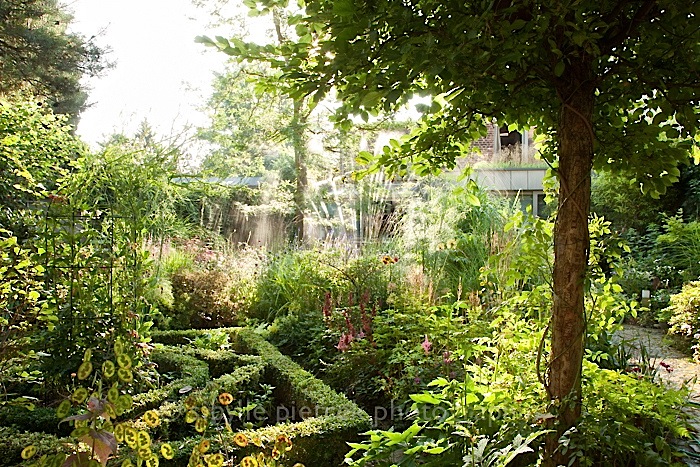
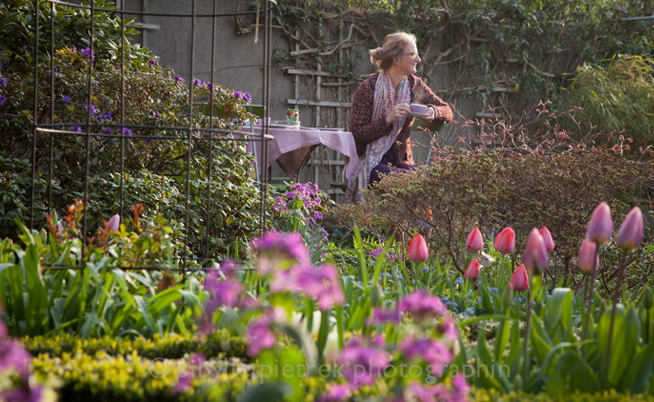
A view of Sibylle’s garden

Small urban garden by Sibylle Pietrek, Gartenblick/enclos*ure

Back in October, I posted some photos from photographer Sibylle Pietrek’s blog Gartenblick (Garden View) of her small dachterrasse or roof terrace.

Today, I wanted to show you her garden on the ground —  on a mid-summer morning, a few days ago.

Sibylle says that the garden at the back of her rowhouse is 450 sq. meters (4,844 sq. ft.)  and “close to town,” which would be Dusseldorf.

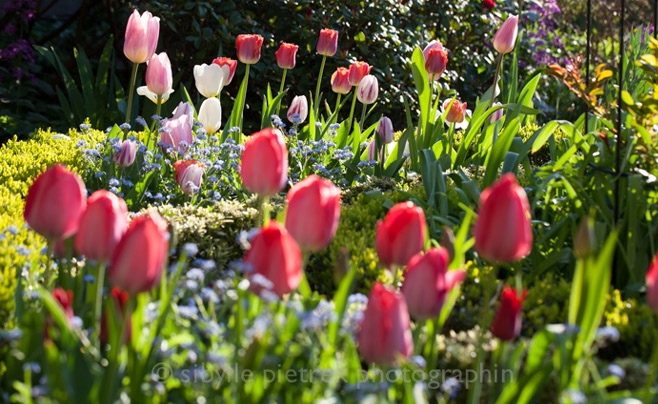
I love the combination of clipped boxwood with the mix of flowers and grasses that, lit from behind, conjure up a sliver of meadow.

Small urban garden by Sibylle Pietrek, Gartenblick/enclos*ure

Above is the garden in May (with Sibylle). In the post, she wrote: “Do not go out in the midday sun in the garden, but only in the early morning, when the back light streaks across the tulips; it looks great.”

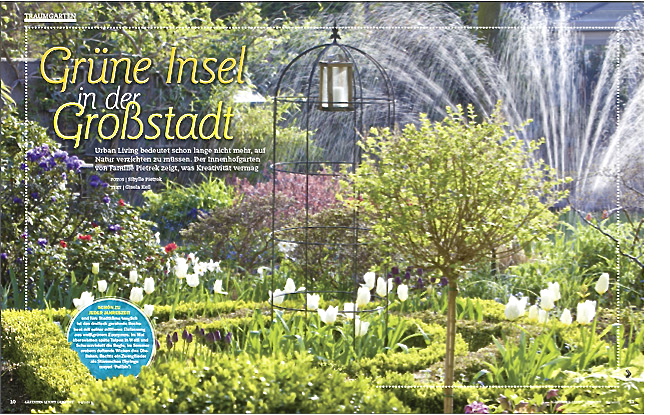
Urban garden by Sibylle Pietrek, Gartenblick/enclos*ure

Sibylle’s garden and her photography have also been featured in the magazine Gärtnern leicht gemacht (Gardening Made Easy).

Urban garden by Sibylle Pietrek, Gartenblick/enclos*ure

All the above photos: ©Sibylle Pietrek, used here with permission.

I see the wild flowers, in their summer morn
Of beauty, feeding on joy’s luscious hours. . .

— John Clare, from “Summer Images”

Foliage Follow Up for July

Garden Bloggers' Foliage Follow Up for July, Kigali, Rwanda/enclos*ure

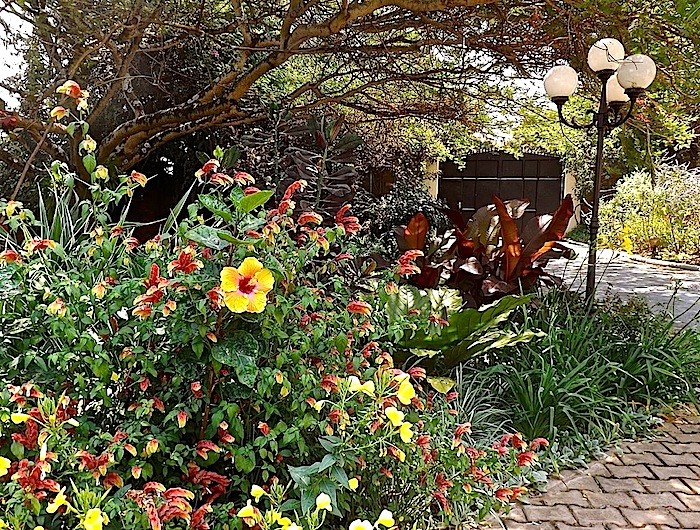
I thought I would give you a look at the plants surrounding the hibiscus and shrimp plants from yesterday’s Bloom Day.

Garden Bloggers' Foliage Follow Up for July, Kigali, Rwanda/enclos*ure

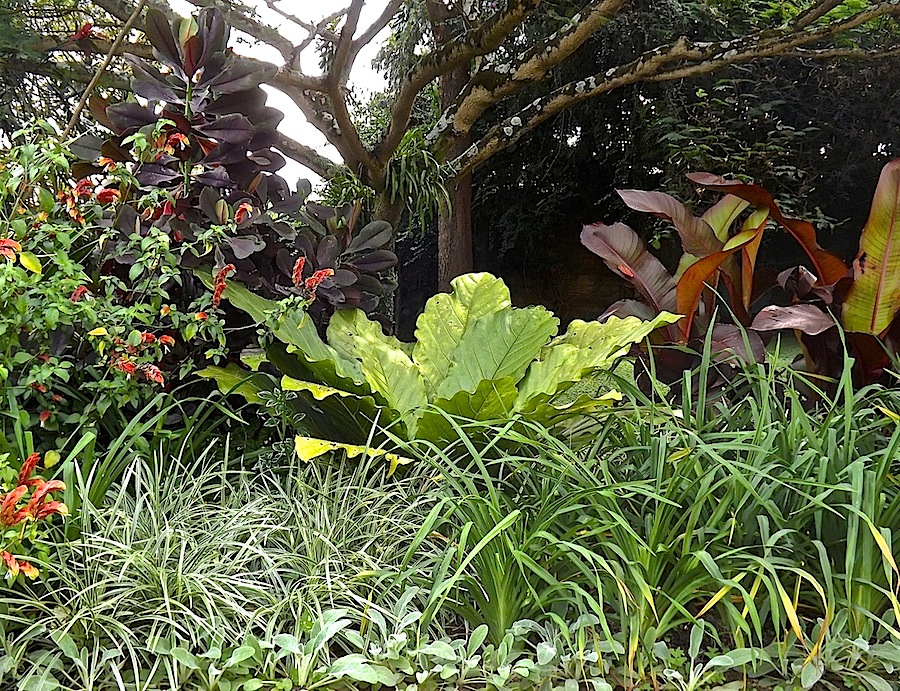
First, I would be grateful if anyone could identify the tropical plant with the very large leaves in the center above — and below with clover poking up through the leaves.

Garden Bloggers' Foliage Follow Up for July, Kigali, Rwanda/enclos*ure

When we arrived in Kigali, it was in a big pot on an upstairs porch, where I felt it was not getting the attention it deserved.  It was also really in the way — it’s over 4′ across.

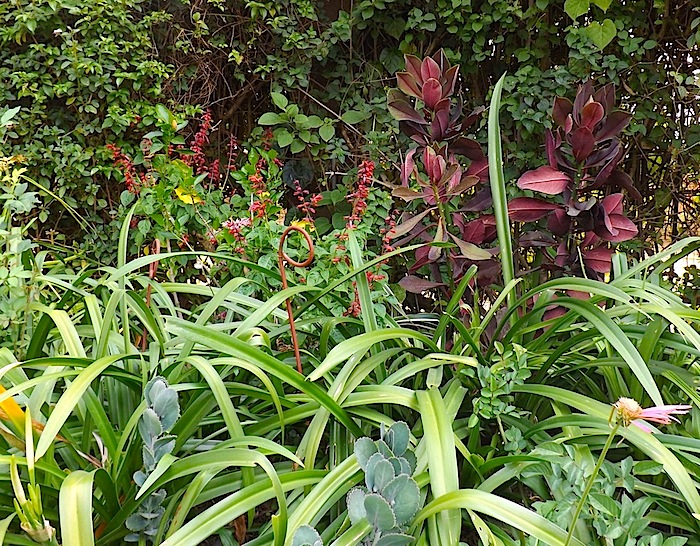
On its left above and in the photo below is a large burgundy-colored succulent — sedum? kalanchoe? — which I also haven’t yet identified.  Does anyone recognize it Euphorbia grantii (aka Synadenium grantii), possibly the Rubra variety.  It’s also called African milk bush and is native to East Africa.

[Thanks to Alison in Australia, who wrote me with the I.D. in November 2014.]

Garden Bloggers' Foliage Follow Up for July, Kigali, Rwanda/enclos*ure

This one is about 5′ tall, but I have seen specimens in Rwanda the size of a small tree.

Garden Bloggers' Foliage Follow Up for July, Kigali, Rwanda/enclos*ure

The burgundy leaves (red, green, and pink when the backlit by the sun — above) look good almost everywhere, so I have cuttings spread throughout the garden.

Garden Bloggers' Foliage Follow Up for July, Kigali, Rwanda/enclos*ure

In the picture above, there’s one in the back of a pink section of the long flower border — or it will be pink if the small shrub roses planted there will oblige me by growing and blooming. They are supposed to push up through the beach spiderlilies (Hymenocallis littoralis).

Below is one of two original plants that were here when we moved in.

Garden Bloggers' Foliage Follow Up for July, Kigali, Rwanda/enclos*ure

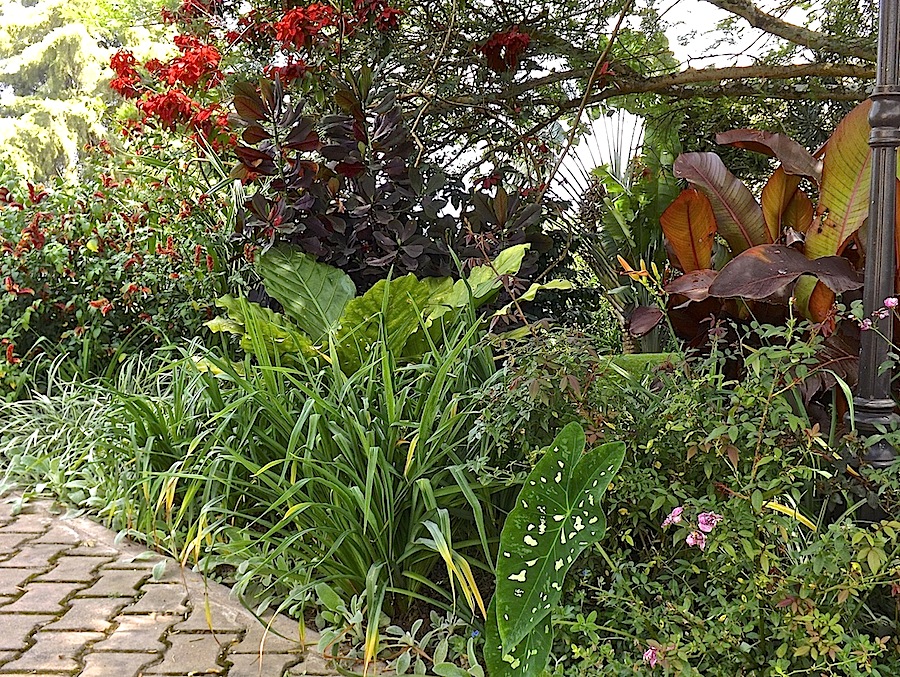
In the same planting bed with my two mystery plants are burgundy cannas, variegated liriope, yellow daylilies, and some lamb’s ear that I grew from seed from my parent’s garden in Virginia.

Garden Bloggers' Foliage Follow Up for July, Kigali, Rwanda/enclos*ure

At the ends are shrimp plants, “Fairy” roses, a caladium, and a small cycad (not in the picture).

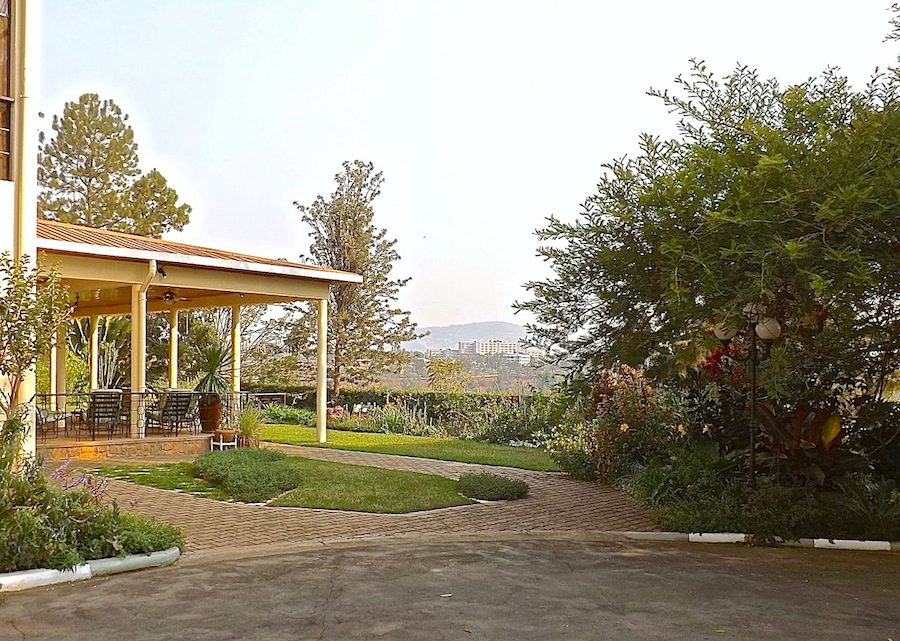
This planting bed is on the right in the photo below.
Garden Bloggers' Foliage Follow Up for July, Kigali, Rwanda/enclos*ure

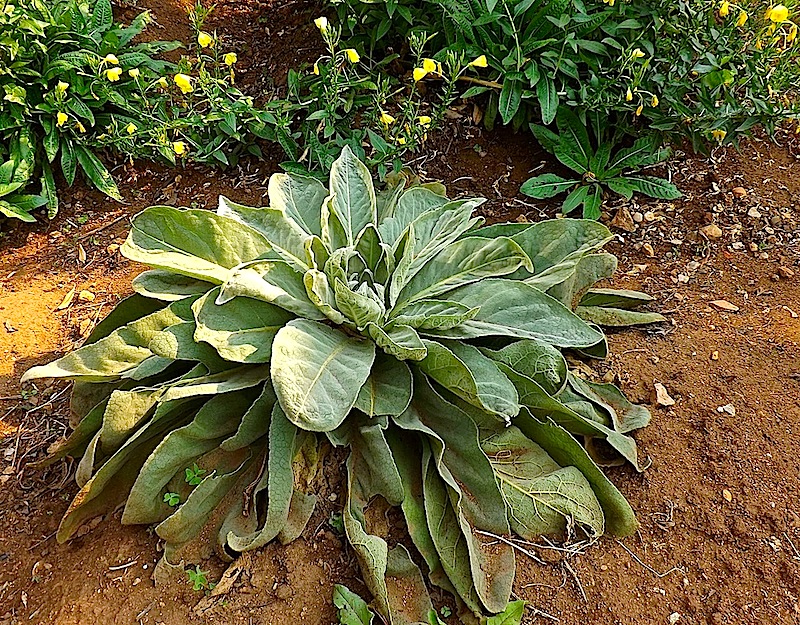
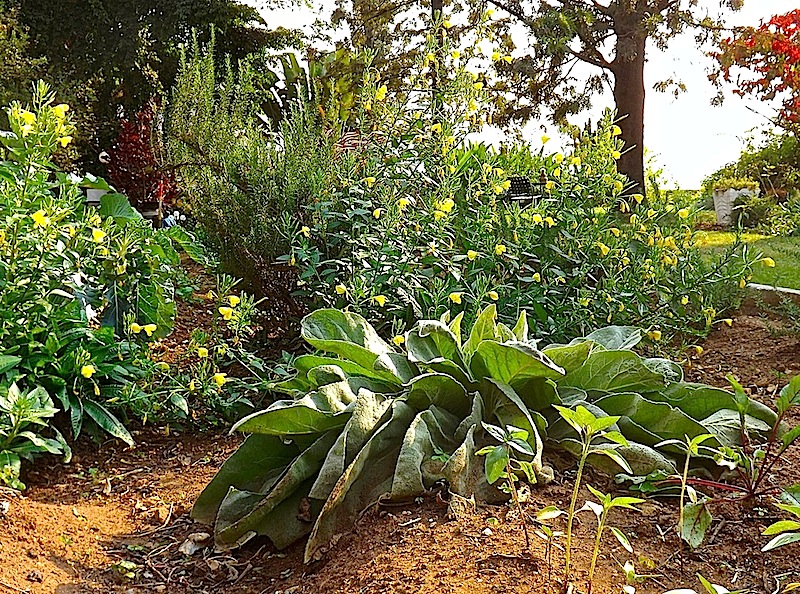
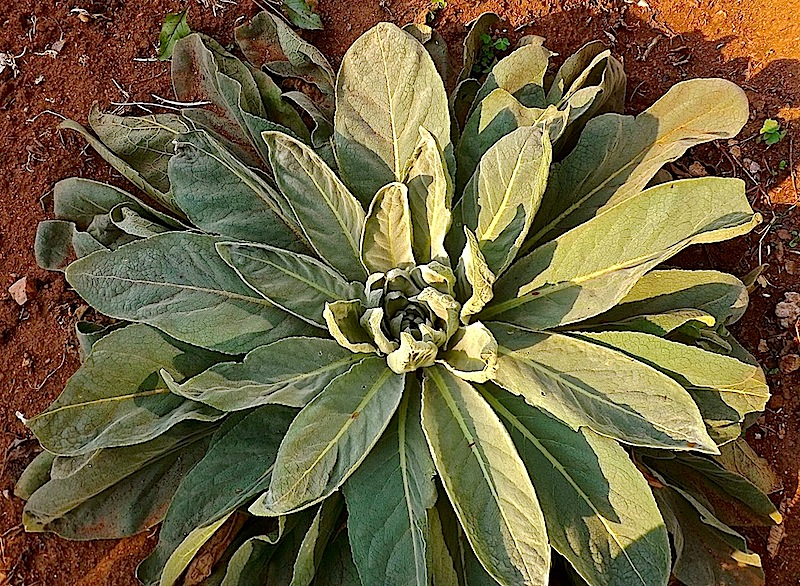
I also wanted to show you one of the common mulleins (Verbascum thepus) that I grew from seed taken from my parent’s garden last year.

Garden Bloggers' Foliage Follow Up for July, Kigali, Rwanda/enclos*ure

This one (located not very artistically in the vegetable garden) is 3′ across. The other plants are only 12″.

Garden Bloggers' Foliage Follow Up for July, Kigali, Rwanda/enclos*ure

The plant is something of a roadside weed in the mid-Atlantic region of the U.S., but it can send up a yellow flower stalk to 10′ tall. The garden writer, Henry Mitchell* liked tall mulleins so much that he wrote, “O for a lute of fire to sing their merits.”

Garden Bloggers' Foliage Follow Up for July, Kigali, Rwanda/enclos*ure

Thanks to Pam at Digging for hosting Garden Bloggers’ Foliage Follow Up the 16th of every month.


*in The Essential Earthman.