A Sunday in the streets of Brussels

On the first day of our recent travels, we were lucky enough to arrive in Brussels on its annual “Car Free Sunday.” The streets of the city were closed to “all traffic with an engine”* from 9:00 a.m. to 7:00 p.m.

The streets were full of happy bikers, skaters, skateboarders, and walkers — in about that order. In addition, stands devoted to regional food and drink, organic farming, and ecology were set up from the Grand’Place to the Royal Palace and Brussels Park.

This slideshow requires JavaScript.

I like this garden (above slides) at the Mont des Arts. Like so many outdoor spaces in Brussels, its design successfully encompasses many centuries.

Under the rows of pleached trees, there were booths selling food and wine from France, so, bien sur, we had fois gras sandwiches for lunch.

This slideshow requires JavaScript.

A little farther east, on the street between the Royal Palace (above slides) and Brussels Park, sod had been put down over the stone block paving, and people were picnicking on every kind of organic cuisine.

I also really like Brussels Park (below slides).  It has very formal wide gravel walkways laid out in the shape of the Free Masonry symbol of an architect’s compass. Two rows of espaliered trees surround its perimeter.  But inside, there are forest-style groupings of very tall trees, long berms planted in a natural way with a variety of shrubs, and some well-used grass.

This slideshow requires JavaScript.

In the afternoon, we went back to our hotel for a rest and found that the street under our window had been blocked off for children’s activities. A local radio station had set up a stage, and, for the length of our planned nap, it featured a teenage punk rock band. I must admit they sang and played (what seemed like) their one song over and over again with some proficiency (I guess).

We ended our lovely day of walking in the neighborhood of Dansaert, along Rue de Flandre (or Vlaamsesteenweg), where the shops and residents were having a street-long yard sale/block party. At no. 17, we ate traditional Belgian food at the restaurant Viva M’Boma** (long live grandmother), which we highly recommend — as long as you eat meat.

To scroll through larger versions of all the photos above, click on ‘Continue reading’ below.


*Except for buses, taxis, some delivery vans, police, and ambulance.  The event is always in September, to coincide with the  European Week of Mobility.  I found one webpage indicating that it will be on September 16 in 2014.

**But they are normally closed on Sundays — and Wednesdays.  Main courses are between 11€ and 18€.


Vintage landscape: canal towpath

C&O Canal towpath, ca. 1900, Library of Congress
Towpath along the C & O Canal near Washington, D.C., about 1900.  The canal was still in operation at this time, principally transporting coal.

Photo by Detroit Publishing Co. via Library of Congress Prints and Photographs Division.

October Bloom Day: home again

We returned from three weeks of travel on Saturday night.  Not a minute too soon, as a steady trickle of water was flowing from below the master bathroom sink and probably had been for a couple of days.  The bedroom floor and two carpets were soaked — welcome home!  Thankfully, the furniture and the rooms below were fine.

Until that moment, however, it had been a great trip — especially since I was able to visit Loi of Tone on Tone and his beautiful shop of Swedish antiques in Bethesda, Maryland.  And in Madison, Wisconsin, Linda from Each Little World and her husband, Mark,  not only took us on a tour of their lovely garden, but gave us lunch.  We had very interesting conversation about art collecting and Wisconsin politics.

I was also able to go and pull invasive weeds at Dumbarton Oaks Park in Washington, D.C., and meet the great Ann Aldrich and some of the other weed warriors of the DOP Conservancy, which is supporting the National Park Service in restoring this Beatrix Farrand’s masterpiece.

Back at home, about five weeks into the rainy season, our grass is green again and there are a lot of flowers.   Being away, however, has opened my eyes to a number of problems that daily familiarity was hiding, so now back to work. . . .

To see what’s blooming in other garden bloggers’ gardens this October 15, visit Carol at May Dreams Gardens.

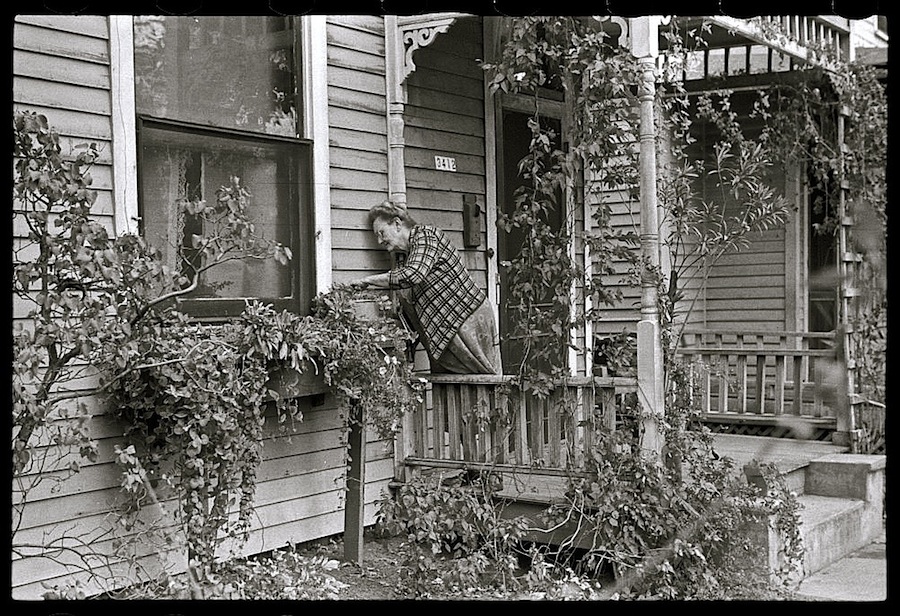
The Sunday porch: Omaha, Nebraska

The Sunday porch/enclos*ure: Omaha, Nebraska, 1938, by John Vachon, Library of Congress“Lady tending her flower box, Omaha, Nebraska,” (probably October) 1938, by John Vachon, via Library of Congress Prints and Photographs Division.

(Click on the image to get a better look.)

The photographer, John Vachon, was on his first solo assignment for the Farm Security Administration in October and November 1938.  In addition to taking pictures of rural agricultural projects  in Nebraska, he was tasked with recording scenes of  life in Omaha for a book by Atlantic magazine writer George Leighton.

There is an interesting discussion of his Omaha work here.  His pictures in the city captured “portraits of Depression victims and scenes of comfortable everyday life,” like the one above.

Vachon later worked for Look magazine for 25 years, and he won a Guggenheim fellowship in 1973, two years before his death at age 60.

The Sunday porch: Mount Morne

Reed-Morrison Hse, Mt. Mourne, in North Carolina, 1938, via Library of Congress.Reed [or Reid] Morrison House, Mount Mourne, North Carolina, 1938, by Frances Benjamin Johnston, via Carnegie Survey of the South Collection, Library of Congress.

Click on the photo to enlarge it and check out the pretty little sconces on each side of the front door.

The house exists today as a private residence — in seemingly excellent condition, but, alas, the sconces and vines are gone.