The winter garden: the White House

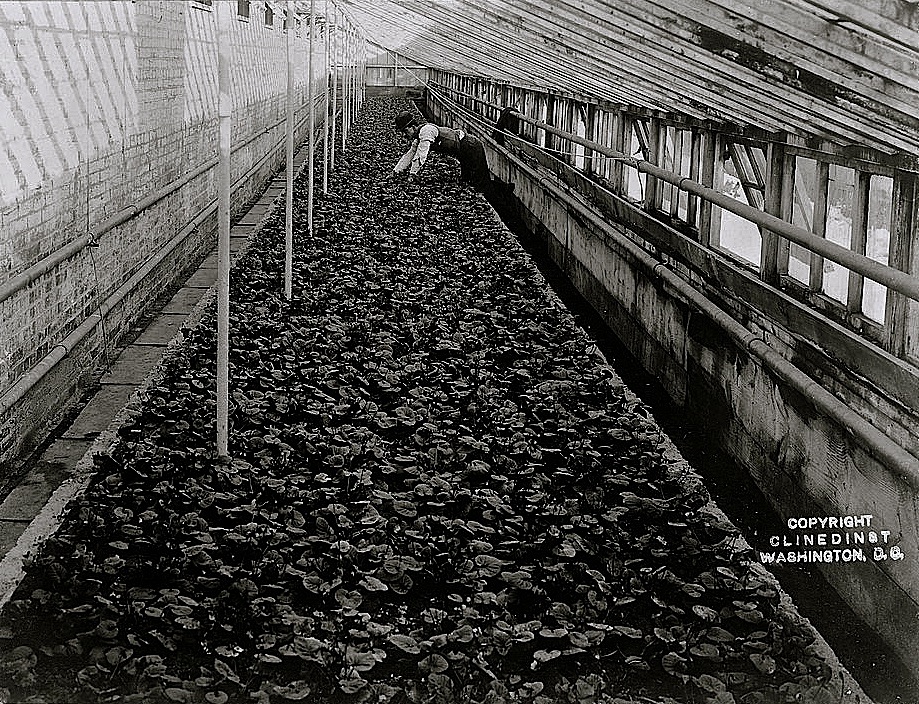
Violet house section of the White House conservatory, early 1900s, by Barnett McFee Clinedinst
The violet house section of the White House conservatory, early 1900s, by Barnett McFee Clinedinst

Wouldn’t it be nice to have a whole greenhouse devoted to growing violets for the house during the cold weather months?

Or orchids and palms?

This slideshow requires JavaScript.

Frances Benjamin Johnston took the above photographs (except one) in 1889 and 1890.

Or azaleas?

This slideshow requires JavaScript.

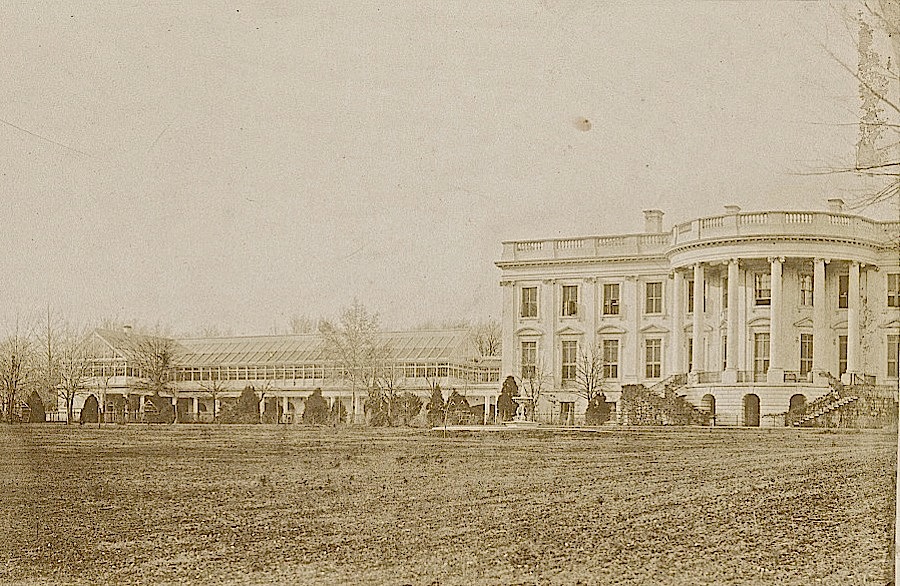
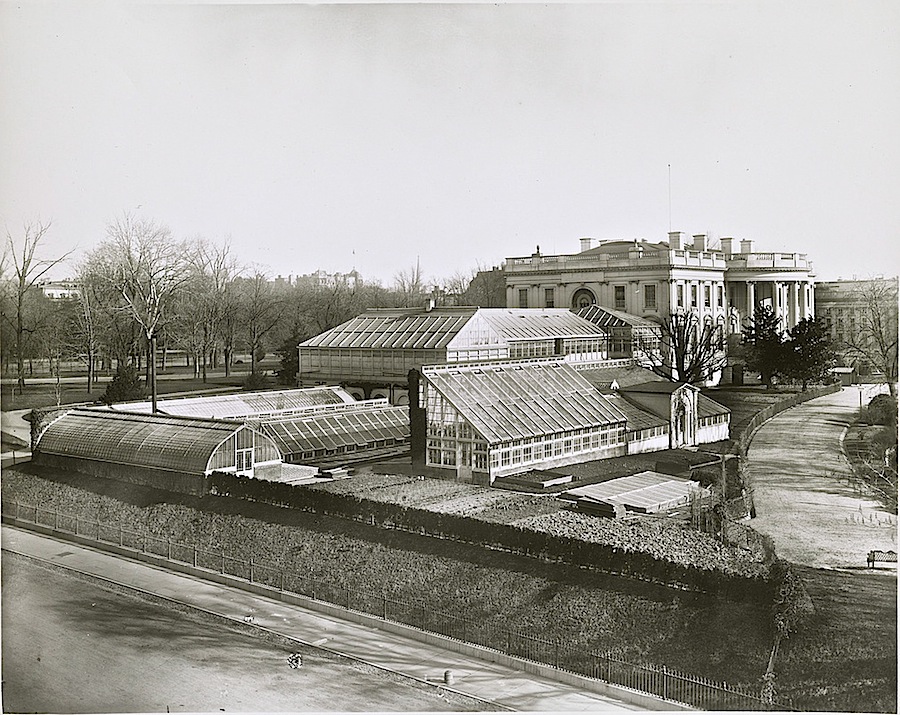
A large conservatory complex occupied the west side of the White House from 1857. . .

The White House and conservatory in 1857 by Lewis Emory Walker.

until 1902, when the West Wing was built.

The greenhouses in 1889 by Frances Benjamin Johnston.

All photos above via Library of Congress Prints and Photographs Division.

Four more winter gardens are here.

The perfect loveliness that God has made,—
Wild violets shy and Heaven-mounting dreams.

Alice Moore Dunbar-Nelson, from “Sonnet

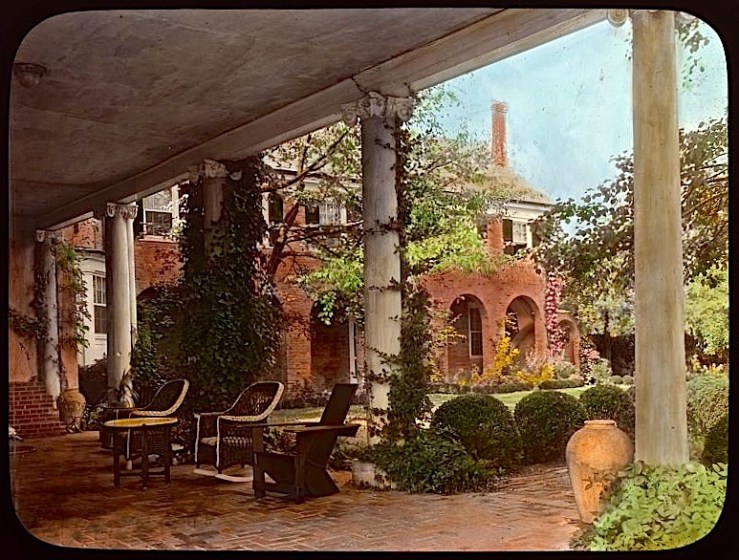
The Sunday porch: Wellington

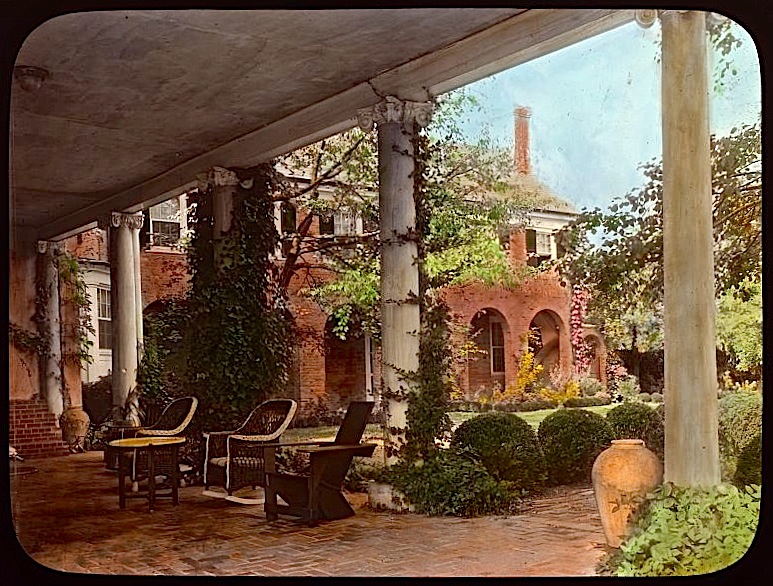
The Sunday porch/enclos*ure: Wellington, now River Farm, about 1931, Alexandria, VA, via Library of Congress.“Wellington,” near Alexandria, Virginia, 1931, hand-colored glass lantern slide by Frances Benjamin Johnston, via Library of Congress Prints and Photographs Division.

The white columned, ground-level porch wrapped around two and a half sides of one wing of the house.  I like the black and white wicker rockers and those terracotta jars.

Today, the house (built in 1757) and its surrounding 25 acres are the headquarters of the American Horticultural Society (AHS) and are called River Farm.

George Washington originally gave the property that name after he purchased it in 1760.  It was then 1,800 acres in size and became one of his five farms around Mount Vernon.

During the 1800s, the property, re-named Wellington, passed through several owners’ hands, becoming progressively smaller in size.  It was only 280 acres in 1919, when it was purchased by local businessman Malcolm Matheson, who restored the house and gardens.

In 1971, when Matheson wanted to retire to Florida, the house and (then) 27 acres were bought by the AHS.  The funds for the purchase had been donated by board member Enid A. Haupt — partly to help the AHS, but also to keep the last of George Washington’s old farm out of the hands of the Soviet Embassy, which had wanted to buy it as a summer dacha for its employees.

Today, River Farm is open to the public  weekdays, from 9:00 a.m. to 5:00 p.m. From April through September, it is also open on Saturdays, from 9 am to 1 pm. Admission is free.

And, of course, it can be rented for weddings and events.

A gardyn saw I, ful of blosmy bowes
Upon a ryver, in a grene mede,
There as swetnesse everemore inow is,
With floures whyte, blewe, yelwe, and rede

— Geoffrey Chaucer, from “The Parlement of Foulys

Vintage landscape: U.S. Capitol steps

Vintage landscape:enclos*ure - from Capitol steps to Library of Congress, 1923, via Library of CongressSnowy scene on February 6, 1923 — from the steps of the U.S. Capitol, looking toward the Library of Congress, Washington, D.C., photographer unknown, Library of Congress Prints and Photographs Division.

Vintage landscape: Central Park

Vintage Landscape:enclos*ure -- Central Park, 1906, via Library of CongressCentral Park, New York City, c. 1906, photographer unknown, via Library of Congress Prints and Photographs Division.

Vintage landscape: winter ice of ’22

Skating on the Reflecting Pool of the Lincoln Memorial, Washington, D.C., January 1922, by Harris & Ewing, via Library of Congress Prints and Photographs Division.

To scroll through larger versions of the images, click on any of the thumbnails in the gallery.

The Pool and its surroundings were actually still under construction when these skaters took to the ice. From 1922 to the 1980s, people skated on the Pool during very cold periods (it’s no longer allowed).

These photos may have been taken between January 23 and 27, when an Arctic airmass was keeping Washington’s temperatures down below freezing.  On the 28th, it began to snow, eventually accumulating to 28″ (71 cm.).*  

This was the infamous Knickerbocker Storm, so named because, about 9:00 p.m. that night, the flat roof of the Knickerbocker Theater collapsed during a movie, killing 98 people and injuring 133.


*It was D.C.’s deepest snow on record until 2010.