Jamaica Bay, New York

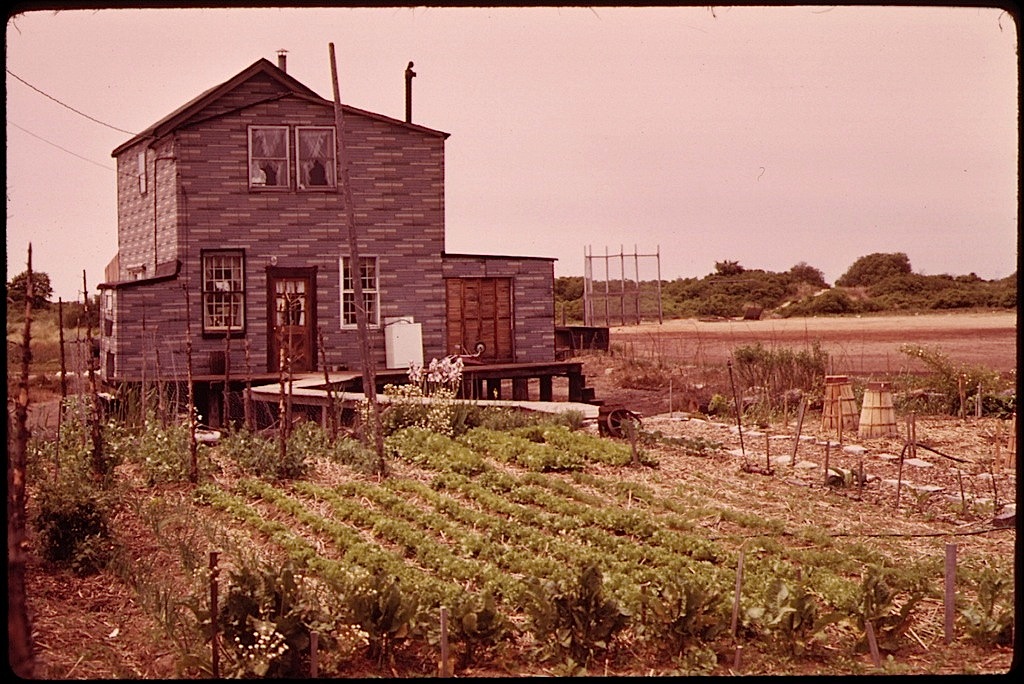
Vintage landscape/enclos*ure: Jamaica Bay vegetable garden, 1973, by A. Tress, via National ArchivesBroad Channel, marginal land in Jamaica Bay near the JFK Airport. New York City owns this land and leases it for five year periods. This renter is cultivating a vegetable garden.”

Arthur Tress took this picture* in May 1973 for DOCUMERICA, a program of the U.S. Environmental Protection Agency, which “photographically document[ed] subjects of environmental concern” from about 1972 to 1977.

Note that the house is raised on pilings, as well as the walkway from the back door to the garden.

There are more pictures from DOCUMERICA here.


*Via the U.S. National Archives Commons on flickr. Caption by photographer or EPA.

Another May

Poem on window pane (detail), HABS, Library of Congress

Another May new buds new flowers
Ah why has happiness no second spring

Scratched into a sitting room window pane of Borough House, which was built between 1758 and 1821 in Sumter County, South Carolina.

The words (with slight variations) are from “Sonnet II” by Charlotte Smith  — whose poems were praised by her contemporaries Wordsworth and Coleridge.

I have not been able to find out who might have put them on the window.

Borough House, S.C., HABS, Library of CongressBorough House is architecturally noteworthy because it is partly constructed with rammed earth — an unusual building material in the United States.  (There is more about the house here.) It still stands today, in private ownership.

(I believe that the window with the poem is one of the two left of the front door.)

The photos here are part of an Historic American Buildings Survey (HABS), May 1985, via Library of Congress Prints and Photographs Division.

The Sunday porch: South Beach

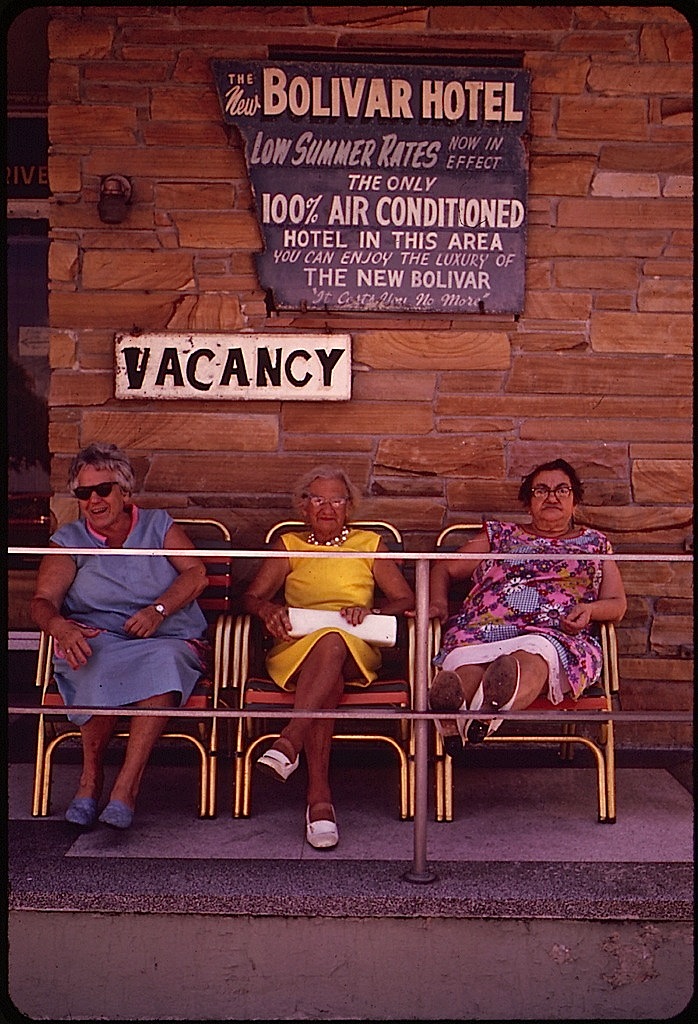
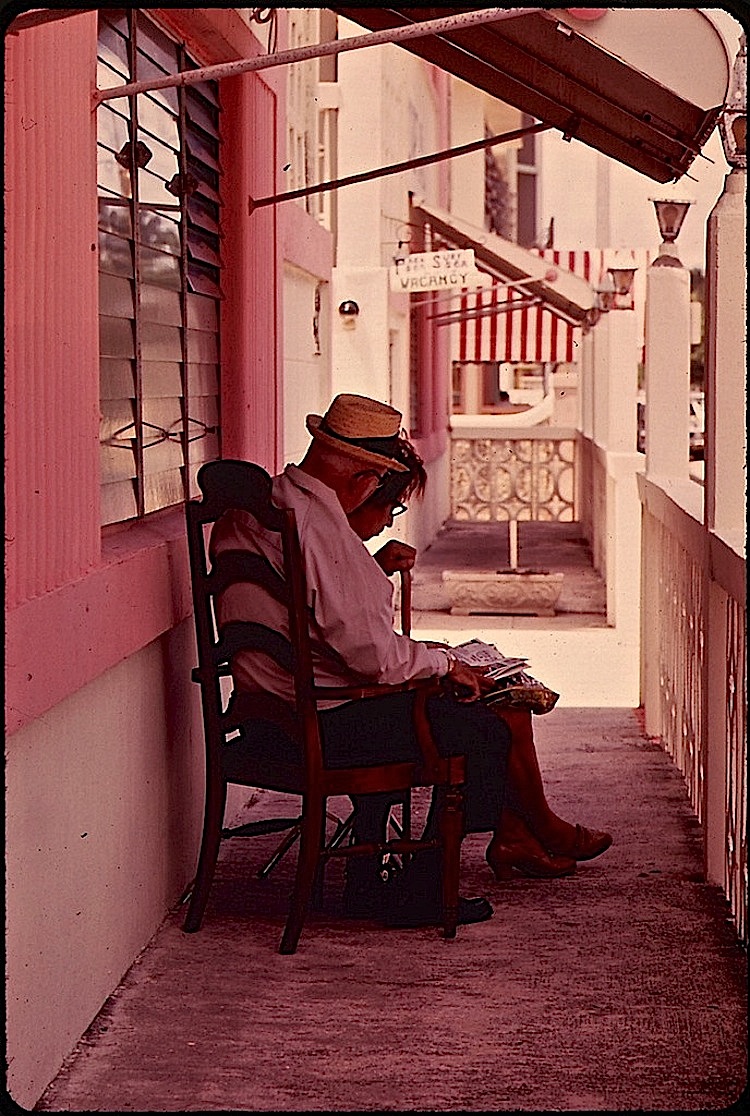
South Beach porch, 1973, via Natl. Archives“Inexpensive retirement hotels are a hallmark of the South Beach area [of Miami Beach, Florida]. A favored place is the front porch, where residents sit and chat or watch the activities on the beach.”

South Beach, c. 1975, via Natl. Archives

These c. 1975  pictures* (shown here with their original captions) were taken by Flip Schulke for DOCUMERICA — a photography program created in late 1971 by the brand new U.S. Environmental Protection Agency.

The EPA hired over 100 photographers to “document subjects of environmental concern.”  The work continued until 1977 and left behind an archive of about 20,000 images.

In addition to recording damage to the nation’s landscapes, the project captured “the era’s trends, fashions, problems, and achievements,” according to the U.S. National Archives, which held an exhibit of the photos, “Searching for the Seventies,” in 2013. 

South Beach, c. 1975, via Natl. Archives“One of the many residential hotels for retired people living on small incomes. . . . The front porch is a favorite retreat.”

South Beach, c. 1975, via Natl. Archives“Income of the retirees in this area is not high, and most live in residential hotels such as the one pictured here.”

There are more pictures from DOCUMERICA here.


*Via the U.S. National Archives Commons on flickr.

Life in gardens: conversation

This slideshow requires JavaScript.

I like this trio of photos by Louise Rosskam, which capture two men on a town common bench evidently enjoying a funny story or joke.

They were  taken in Vergennes, Vermont, in August 1940.*

New England commons were (and are) community spaces that probably evolved from the lots originally set aside for village meetinghouses or churches.  After the mid 19th century, many began to function like parks.†

Although Rosskam was not employed there, a series of photos that she took in rural Vermont became part of the picture archives of the Farm Security Administration.

In a 1965 oral history interview, she related how she proposed taking these pictures for the FSA, where her husband, Edwin, was a photo editor.

. . . [O]nce I took a vacation in Vermont, and I said to Roy [E. Stryker, head of the Information Division],”Could I take some pictures for you?” you know, “I’ll buy my own film and everything.” And he said, “Oh, here’s some film,” and then he starts rambling along about Vermont and really it didn’t sound as if it had anything to do with what you wanted to do at all. You started talking about hills, farmhouses and how people build a little extension on the house for the old people, and about pickled limes, the sky and how to get to Vermont 50 years ago, you know; by the time you got through listening to him ramble along, you begin to get some sort of formation in your mind of what there was up there so that when you get out there (phone rings)-

LOUISE ROSSKAM: (continues after phone conversation) But I’m sure that everybody sitting around, listening to Roy ramble, as it seemed, began to get his mind turned in the direction to be open to a lot of things that ordinarily he wouldn’t perceive when he got to a place. Don’t you think that’s true?

For many years afterward, her Vermont photos were attributed to her husband.  The records were corrected in 2001.

Laura Katzman, an associate professor of art history at James Madison University, curated two exhibits of Louise Rosskam’s photos and described her work like this:

She was one of those documentary photographers for whom the people and the work were so much more important than her name or her career. . . .  She tried to erase herself as much as possible. It was a pure documentary ideal that was impossible to achieve: let the subject feel comfortable, take yourself out of it and see what happens in the encounter. She did this beautifully because her ego wasn’t invested in it.

You can see four more photos by Rosskam of the Vergennes common by clicking on ‘Continue reading’ below.


*All via the Library of Congress Prints and Photographs Division.

†Vergennes is actually a city — the first chartered in Vermont and currently its smallest (in population). It is approximately 2.5 sq. miles in area.

Bloom Day in May: Mugongo

This slideshow requires JavaScript.

My parents were visiting us last week, and we took an overnight trip to the north of Rwanda. We made a stop at Mugongo, the former home and plantation of long-time American resident Roz Carr, who founded Imbabazi Orphanage in 1994, reworking her old farm buildings.

You can read about Roz’s life in Rwanda, from 1949 to 2006, here.

The long English-style flower borders looked particularly colorful as we near the end of the rainy season. Among the many plants blooming were calla lilies, hybrid tea roses, crocosmias, cannas, calendulas, fuchsias, violets, ageratum, hydrangeas, borage, sedum, Santa Barbara and Shasta daisies, azaleas, irises, dahlias, begonias, and day lilies.

It is a credit to Roz’s good strong design and to the continuing dedication of the gardeners she trained that the garden is still so beautiful, almost eight years after her death.

Click here for more information about the Imbabazi Foundation and how to visit the Mugongo garden.

You can scroll through more (and larger) photos by clicking on ‘Continue reading’ below and then on any of the thumbnail images.

Thanks to Carol of May Dreams Gardens for hosting Garden Bloggers’ Bloom Day (the 15th day of every month). Continue reading “Bloom Day in May: Mugongo”