A garden plot in a communal garden, Town of Locke, Sacramento County, Ca. Photo by Jet Lowe, April 1984, part of a Historic American Buildings Survey (HABS) of the town, via Library of Congress Prints and Photographs Division.
Locke, California, is a small, rural Chinese ghetto on the Sacramento River. It was developed in the early 20th century to serve Chungshan Chinese laborers who worked in the fruit orchards and vegetable fields in California’s Delta region. Today, virtually all Chinese communities in America are urban enclaves. By contrast, Locke has remained an unincorporated village since its founding in 1915. For this reason, it is unique within the United States as the only extant rural Chinese community still occupied by Chinese people.
Today, the population of Locke is 70 to 80 people, about 10 of whom are of Chinese descent.
Tant que mai n’est au 28, l’hiver n’est pas cuit.
Until May 28, winter is not cooked.
— French saying, via Paris côté jardin
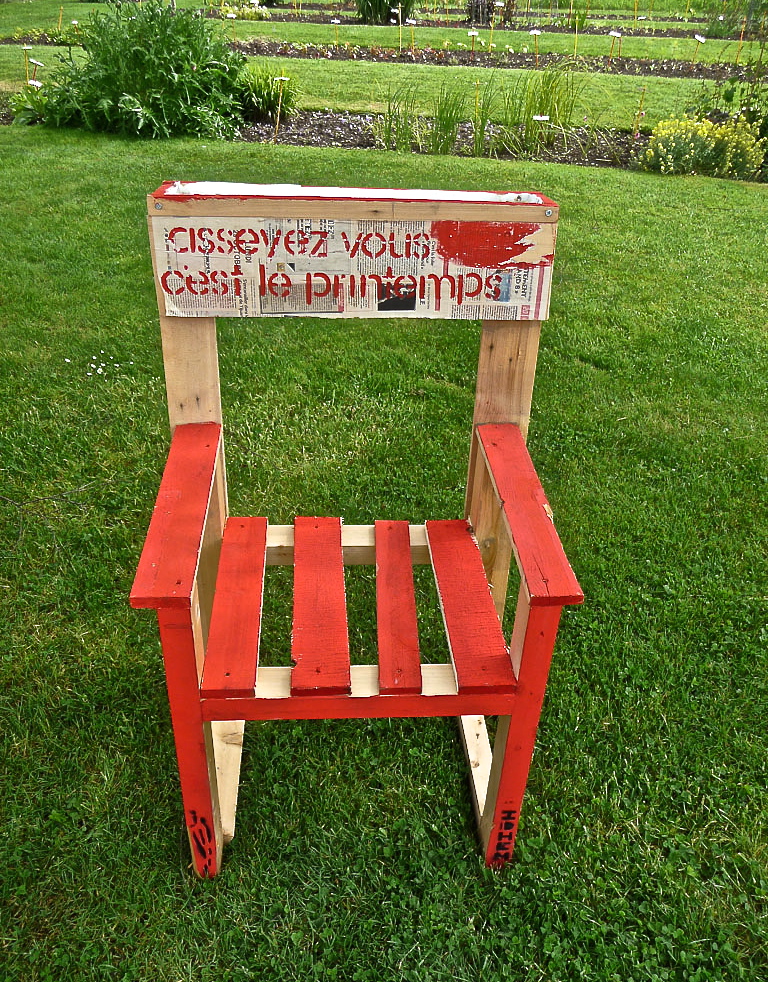
École du Breuil, Paris 12e, photo by Alain Delavie.
“Sit down, it’s spring!”
This is the message of a charming chair at the Ecole du Breuil in Paris. The photo is by Alain Delavie* from his blog Paris côté jardin (Paris garden side).
However, in his post on May 26, Delavie noted that the temperature was “hardly conducive to lazing in the shade of a tree … more to a jacket and mulled wine.” Indeed, Paris had record cold weather for the end of May. Today, the temperature will be around 14°C or 57°F — pretty chilly.
Paris côté jardin is a wonderful resource for gardeners preparing to visit (or even luckier, live in) Paris or the Ile-de-France. Delavie is the editor of Rustica Hebdo magazine and editorial advisor to www.rustica.fr. Equally impressive, he is a member of the European Network of Master Composters.
(The blog is in French, but there is a Google Translate button.)
The Breuil School is run by the city of Paris and is located on 23 hectares in the Bois de Vincennes. It was founded in 1867 by Baron Haussmann and Alphonse Du Breuil to provide the Paris and Seine region with properly trained gardeners. Today, its mission is to train gardeners, technicians, and managers for the city of Paris “on the subject of plants in the urban space.”
The school enrolls 300 students at a time: 200 in the classroom and 100 in apprenticeships. Its grounds and facilities include an arboretum, heritage orchard, greenhouse, many plant collections, and library.
As gardeners, surely we have done our duty once we have registered our disapproval at the general arrangement of the universe, with complaints of special sharpness directed toward the clumsiness — indeed, sloth — with which wind and rains are scheduled. It is all that can be expected of us. The rest is the full responsibility of the heavens and need not, therefore, concern us. It does seem to me odd, nevertheless, that this “Nature,” which is supposed to be so wonderful, so rarely lets anything come to full perfection. It is all designed on the frog in the well principle, two hops forward and one backward until a certain level is reached, then the whole thing collapses. That is all anybody needs to know about nature.
I saw this photo on the blog The Enduring Gardener and thought of my parents, who had their forest thinned last fall, which left a lot of woody debris. A simple metal frame holds the logs and sticks in place.
Are you currently cleaning up from a lot of winter tree damage?





 enclos*ure