Yesterday: a Blumen selbt schneiden or ‘cut your own flowers’ field, with an honor-system money box.
There were lots of calendulas and cornflowers, but only a few red poppies left in the Sommerblumen mischung or summer mix row. In the next couple of weeks, we’ll have gladiolus and dahlias.
Yesterday, a repairman came over to fix the window/door behind my desk chair. It turned out to be fine; I just did not know how to operate it properly. (German windows are wonderful, but this one is a bit over-engineered.) He pushed the handle and pulled the frame and said, “And now you can go out into the beautiful . . . looks out, slight pause. . . garden.”
You can read about the beginning of my “garden without (much) gardening” here.
The middle of the month brings Garden Bloggers’ Bloom Day (the 15th) and Foliage Follow Up (the 16th). Please visit Carol at May Dreams Gardens and Pam at Digging to see what’s blooming and leafing out in July.
You can scroll through larger versions of the photos above by clicking on ‘Continue reading’ below.
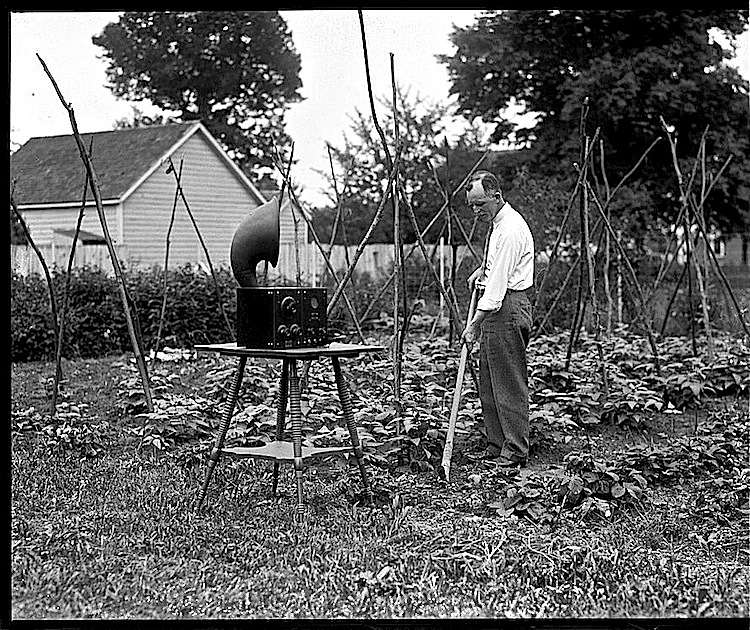
“W. D. Terrell in garden with radio,” probably in the Washington, D.C., area, July 7, 1926, by National Photo Company, via Library of Congress Prints and Photographs Division.
Mr. Terrell was Chief of Inspection Service of Radio at the U.S. Department of Commerce during the 1920s.
Just as Ariel, in the fables of the Middle Ages, was a spirit guardian of the air, so in this day of wireless, the Radio Inspector, a modern Ariel, stands a silent watch over the ether. But though he may be silent and, indeed, an angel, he is far from a fable, as those who attempt to dispute his wavemeter soon find out.
My question here in Stuttgart is a common one: “how to make a garden without much gardening?”
Our backyard is an enclosed strip of lawn that runs the length of the back of the house and wraps halfway around on both sides. There are two large trees and a concrete patio outside the center door. In one far corner is a small, oval-ish planting bed with a few shrubs and perennials and a lot of weeds. About 5′ beyond the fence are mature woods.
This slideshow requires JavaScript.
And when I say ‘lawn,’ I mean moss, clover, dandelions, plantains, buttercups, lawn daisies, sprouted trees, an assortment of other low creeping plants, and some grass.
I have no desire to dig the planting beds (or buy the trees and shrubs) that would improve this dull (except for the woods) space. We want to spend our time in Europe getting out and about.
But I do want to have a garden that’s a little more pretty aesthetically satisfying to sit in during the long daylight of summer.
My solution (at least for this year) has taken inspiration from several different sources.
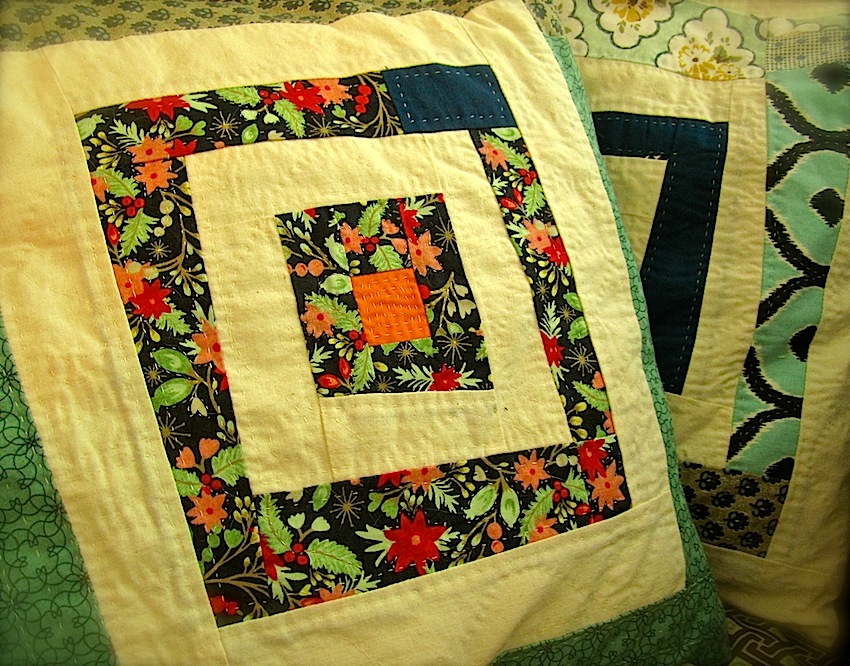
1) The “wonky” log cabin patchwork pillows I made for the living room.
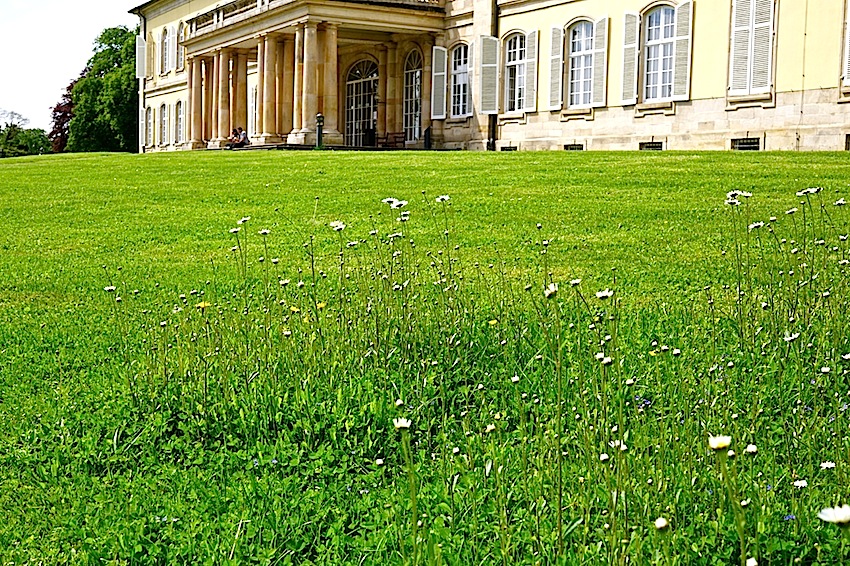
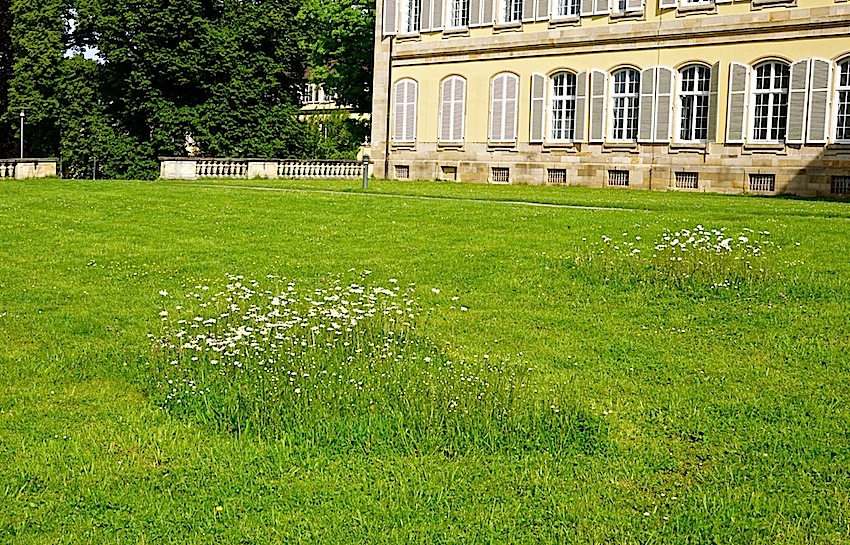
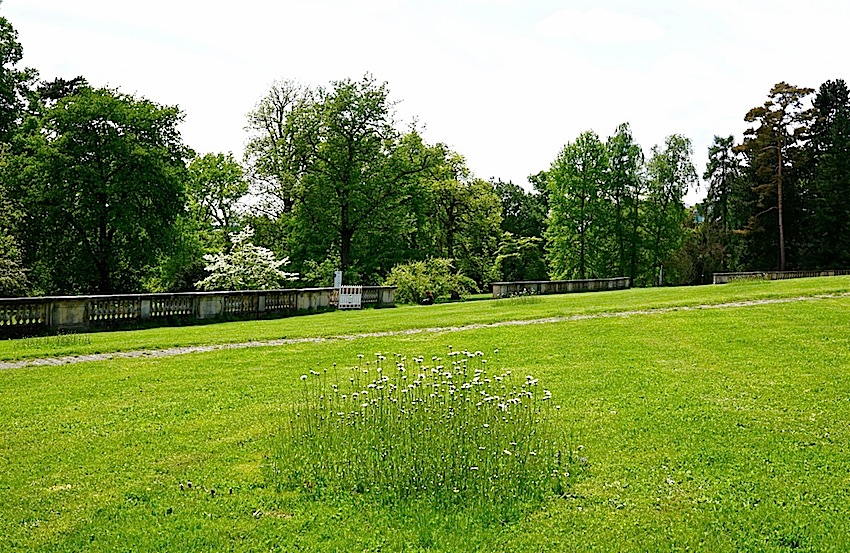
2) The front lawn of the 18th century schloss (palace) of Hohenheim (near our house in the southern suburbs of Stuttgart) — it’s part of the University of Hohenheim, which specializes in agriculture and natural sciences.
The grass is cut short, except for five or six unmown islands.
No doubt, the university is also trying to add some pattern and texture with low effort and cost.
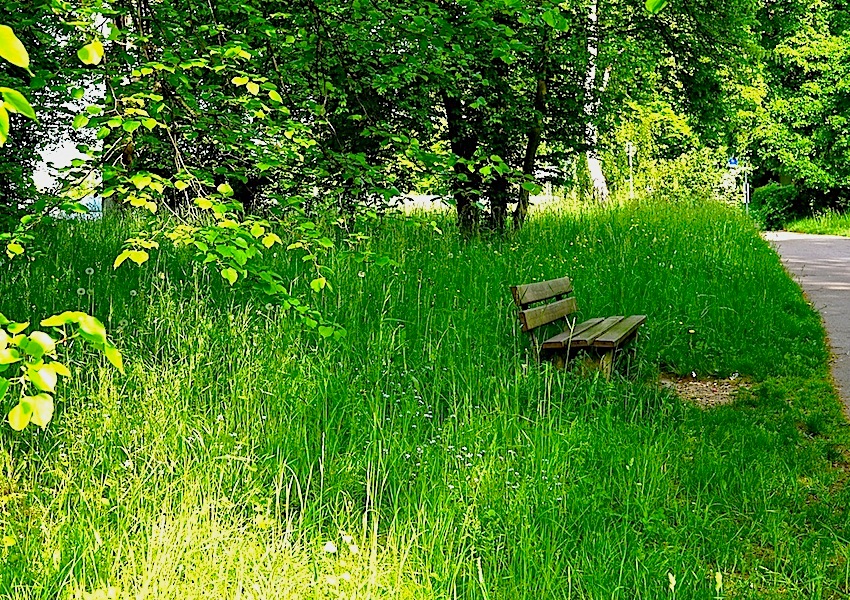
3) The public “hell” strips and other intermediary spaces along streets and sidewalks in nearby towns. They have been left uncut and have grown into really beautiful urban meadows. The area in the photo above was sprinkled with blue forget-me-nots a week ago.
4) Paths and patterns cut through long grass — and labyrinths. Here and here are a couple of images of a garden by Mien Ruys.
This is what I did about a week ago:
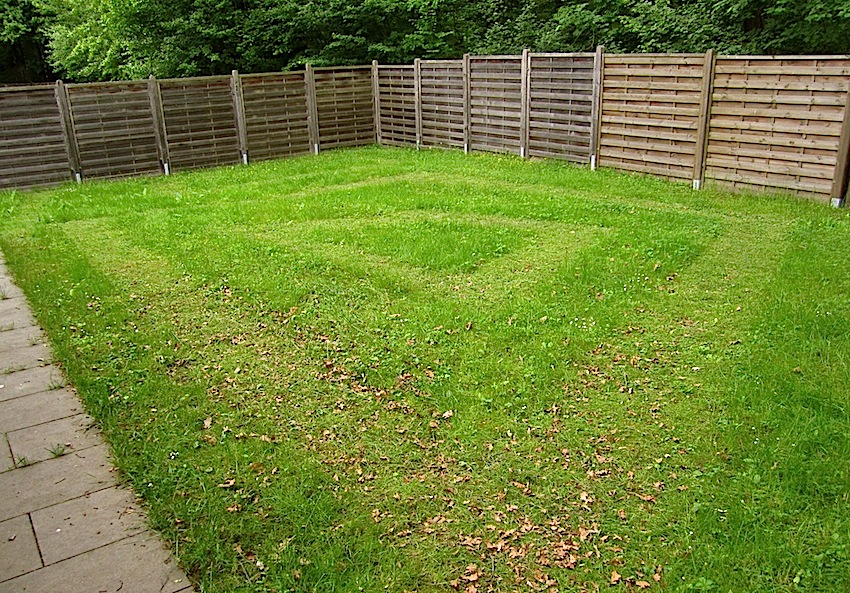
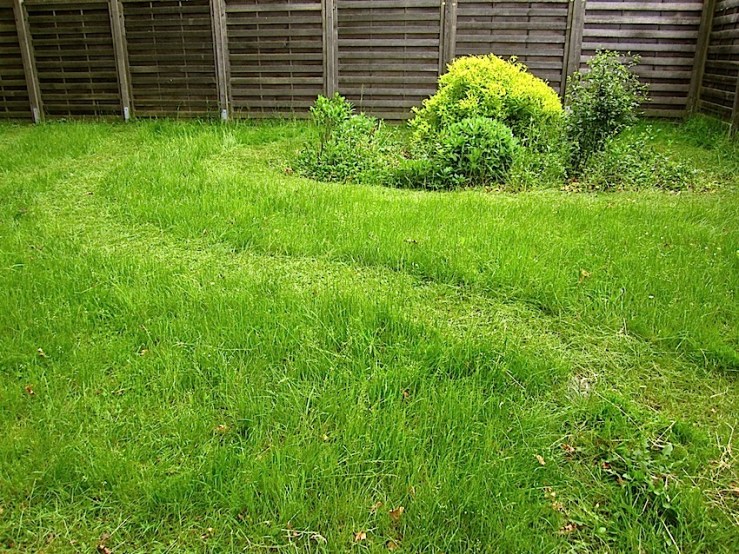
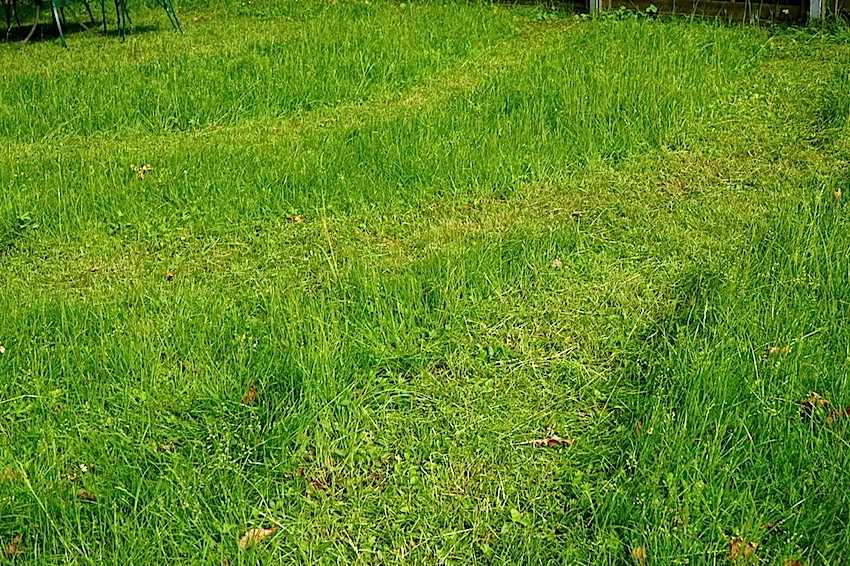
Using my antique reel mower and some clippers, I cut patterns through the grass, which has only been mowed once this spring.
This slideshow requires JavaScript.
I just “free-handed” it, starting with a patchwork-type design on the north side.
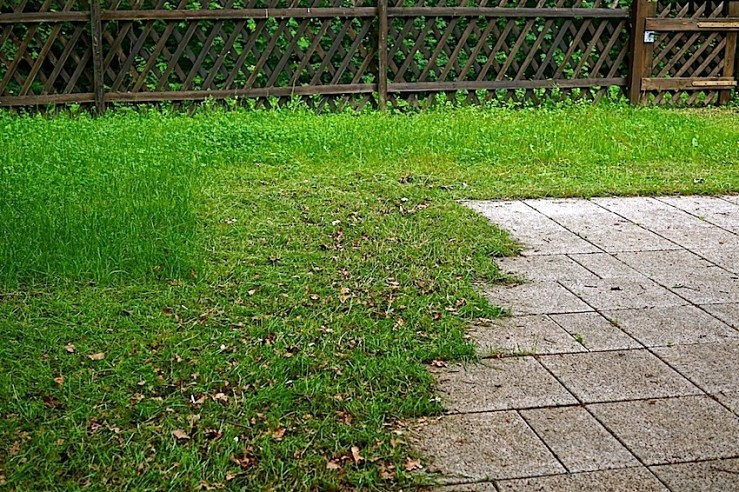
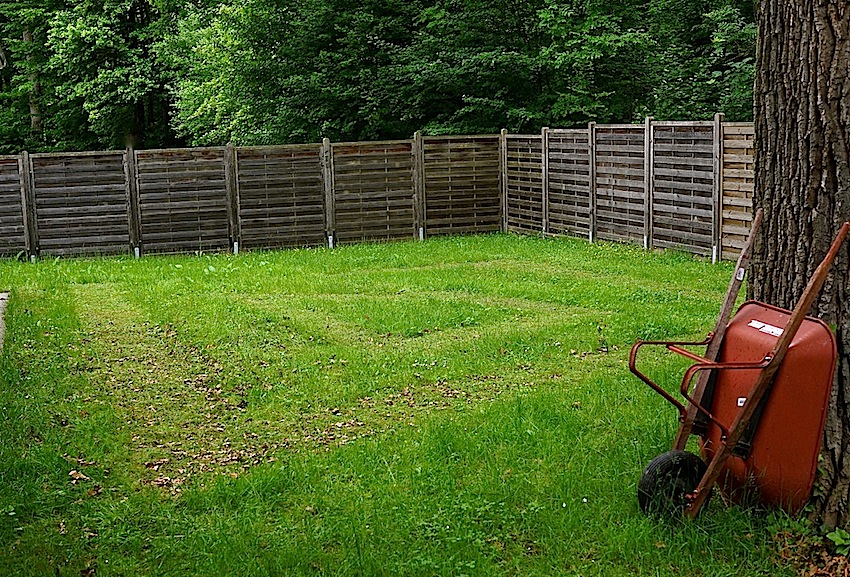
Then, I mowed a border around the patio and made a short path to the back gate.
On the south side, my main concern was the planting bed, the shape of which does not even rise to that of a kidney.
First, I mowed around it, enlarging it and cleaning up the edges (weeding it will come one of these days — it’s not really in our line of sight when we sit on the patio). Then I matched it by making a similar shape on the other end of the same side of the yard, under one of the trees.
I put our old table and chairs there (painting them is another chore for the future).
Then, I mowed two curvy paths out from each oval, so they cross in the center.
Then, I sat down to rest and admire my work.
Admittedly the results are, let’s say, “understated.” But I have made my mark and I’m happier about the place.
The wheelbarrow is entirely ornamental.
For the rest of the warm months, I just have to mow the paths from time to time. I may plant some bulbs in the grass in the fall. And I’ve thought of wrapping the tree trunks in fairy lights.
In late fall (or should I do it in late winter?), I will need to knock down the long grass — which I’m afraid will involve me and a pair of long shears. There is always something. . . .



 enclos*ure