Life in gardens: dance!

This slideshow requires JavaScript.

It’s the first day of the last month of summer.

In observance of this moment, you might want to put on something gauzy, go outdoors, and cavort {gambol, caper, dance, frisk, frolic, rollick, romp, leap and skip about playfully} — as many were apparently wont to do in the first decades of the 20th century.

These performers were certainly influenced by American dancer Isadora Duncan, who, by 1900, was performing and teaching a “natural” modern dance. “With free-flowing costumes, bare feet, and loose hair, she took to the stage inspired by the ancient Greeks, the music of classical composers, the wind and the sea,” according to the Isadora Duncan Dance Foundation.

All photos here via Library of Congress Prints and Photographs Division, except for “Sisters of the Sun,” which is via Shorpy.

What mattered in Isadora’s Hellenic dances was not the Greek themes or the gauzy costumes, but the uninhibited vitality, the sense of a glorious nakedness.”

— Lewis Mumford, 1905
The Sunday porch: the portico

This slideshow requires JavaScript.

A late afternoon gathering on the south portico (or back porch) of the White House, probably between 1890 and 1910, photographer unknown, via the Library of Congress Prints and Photographs Division.

Encyclopedia Britannica defines ‘portico’ as a “colonnaded porch or entrance to a structure, or a covered walkway supported by regularly spaced columns. Porticoes formed the entrances to ancient Greek temples.”

The south portico of the White House was built in 1824, principally from an 1807 design by architect Benjamin Henry Latrobe, then Surveyor of Public Buildings.  Latrobe was appointed and supervised by Thomas Jefferson, who loved  neoclassical design and called Palladio’s books “the bible.”

The South of France

Roman temple
“simple and sublime”

Maria Cosway
harpist
on his mind

white column
and arch

Lorine Niedecker, from “Thomas Jefferson

Life in gardens: the Ellipse

What means this tumult in a vestal’s veins? . . .*

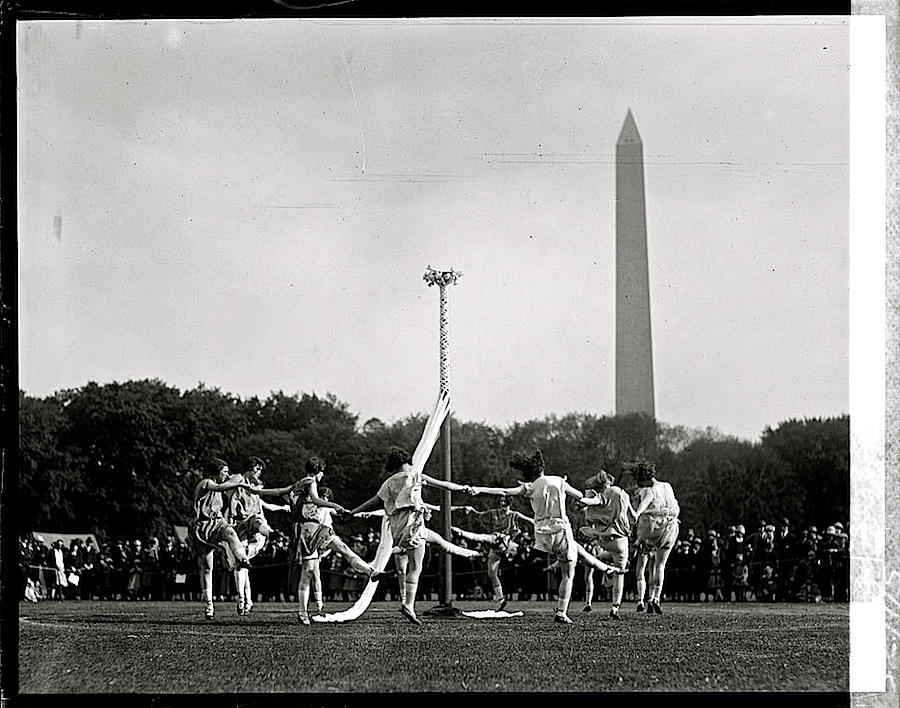
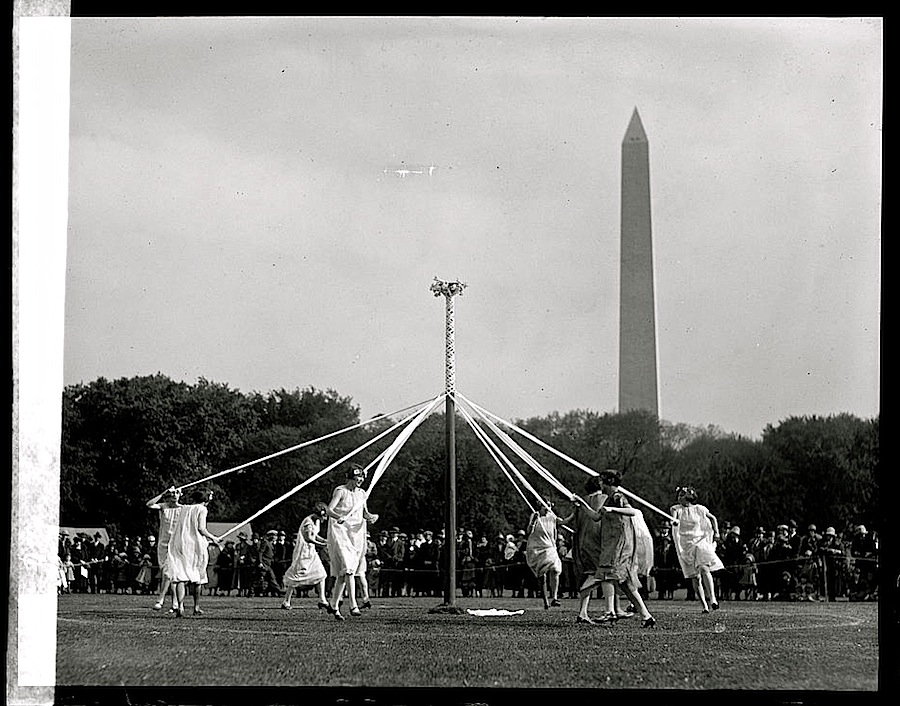
Maypole, 1925, Library of CongressMay pole dancing on the Ellipse, Washington, D.C., May 1, 1925, by National Photo Company, via Library of Congress Prints and Photographs Collection.

Maypole dance, 1925, via Library of CongressClick on the photos for larger views.


*Alexander Pope, from “Eloisa to Abelard

Vintage landscape: Meridian Hill Park

Orpheus with his lute made trees. . .*

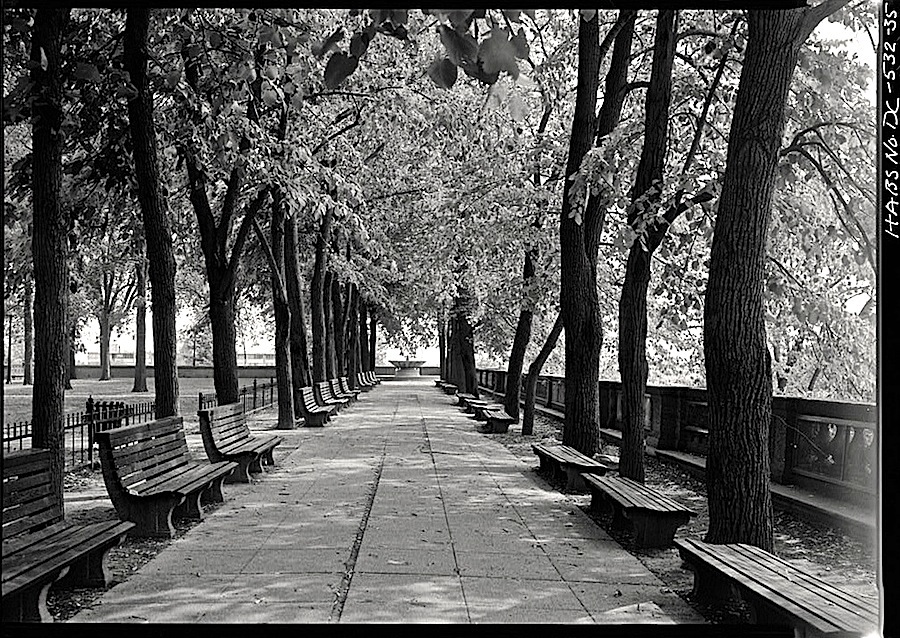
Vintage landscape/enclos*ure: Meridian Hill Park, D.C., 1976, via Library of CongressThe Linden Walk, Meridian Hill Park,* Washington, D.C., August 1976, by Jack Boucher for an Historical American Buildings Survey (HABS), via Library of Congress Prints and Photographs Division.

This HABS has photos from 1976 and 1985. The report, which contains a very detailed description and history of the park’s design, was completed in 1987.

Unfortunately, the report notes that the linden trees shown above had to be cut down between 1976 and 1985 because they were threatening the 16th St. retaining wall (on the right side). They were replaced quickly, however, as you can see here.

The HABS report summarizes the importance of Meridian Hill Park this way:

One of the first public parks in the United States to be designed as a formal park, generally considered to be in the continental tradition, rather than in the “natural” mode associated with the English park; Meridian Hill Park was constructed [from about 1914 to 1936]. . . . Under the guidance of the Commission of Fine Arts, the park benefited from the finest criticism of the day. The technologically innovative use of exposed aggregate concrete provided a facsimile of the stone and mosaic masonry traditionally employed in the Italian Garden. The Park represents an effort in a democratic society to match the major European city park.

Today, the last Friday in April, is Arbor Day in many states in the U.S. The day was established to encourage people to plant and care for trees.

The words themselves are a delight to learn,
You might be in a foreign land of terms
Like samara, capsule, drupe, legume and pome,
Where bark is papery, plated, warty or smooth.

Howard Nemerov, from “Learning the Trees


*Meridian Hill Park is bounded by Fifteenth, Sixteenth, Euclid and W Streets, N.W.  The quote above the photo is by William Shakespeare, from Henry VIII.

Life in gardens: Easter Monday

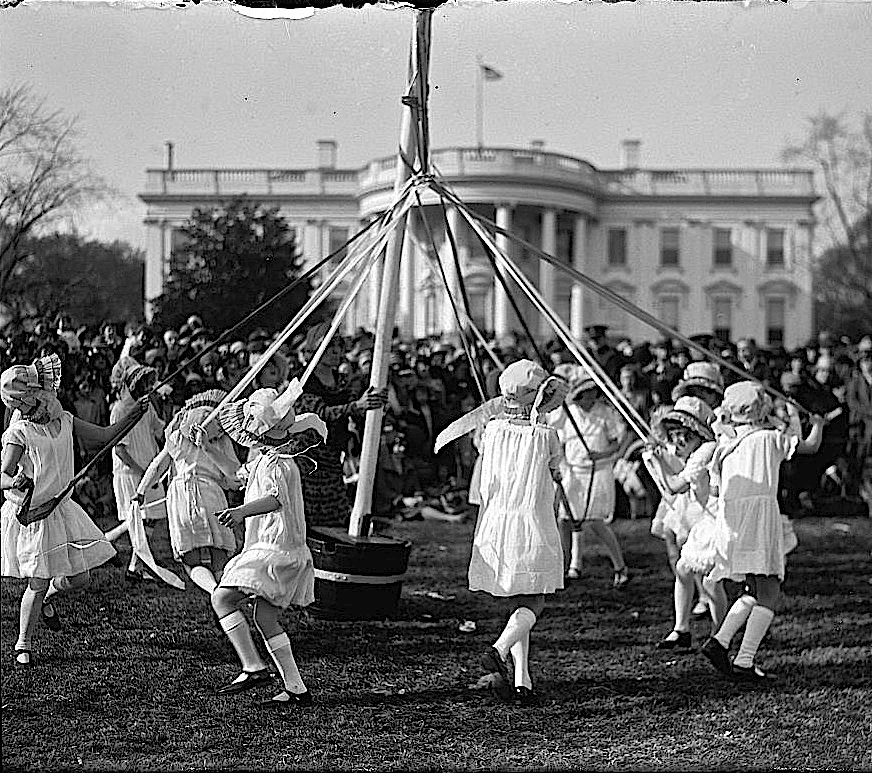
Life in gardens/enclos*ure: may pole dancing at WH, 1929, Library of CongressMay pole dance at the White House Easter Egg Roll, Monday, April 1, 1929, National Photo Company Collection, via Library of Congress Prints and Photographs Division.

First Lady Lou Hoover added May pole and folk dancing to the annual event — but only briefly.  Apparently, the Depression was bad enough on its own.

(If you click on the photo and enlarge it, you can see the wonderfully fierce expression of one of the girls on the right side.)