
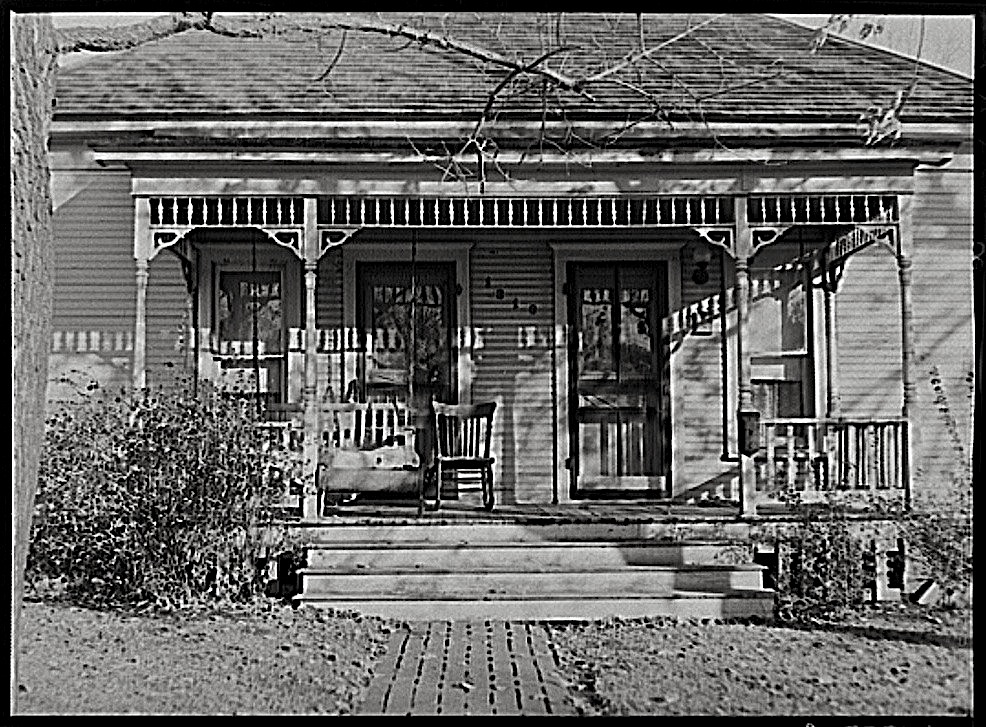
Front porch, Chanute, Kansas, November 1940, by John Vachon for the U.S. Office of War Information, via Library of Congress Prints and Photographs Division.
Front porch, Chanute, Kansas, November 1940, by John Vachon for the U.S. Office of War Information, via Library of Congress Prints and Photographs Division.
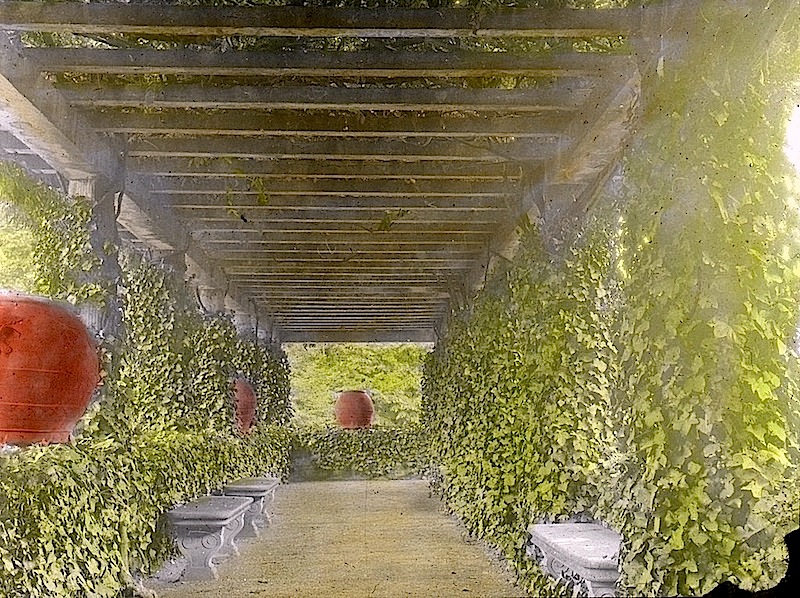
Pergola covered in wisteria and ivy in a garden of Villa Palmieri, Florence, ca. 1915, from the Arthur Peck Collection, via Oregon State University (OSU) Special Collections & Archives Commons on flickr.
The 14th century Villa Palmieri is credited with being the story-telling setting for Boccaccio’s Decameron.
To see this garden, its handsome ordering, the plants, and the fountain with rivulets issuing from it, was so pleasing to each lady and the three young men that all began to affirm that, if Paradise could be made on earth, they couldn’t conceive a form other than that of this garden that might be given it.
However, the garden was completely restructured in 1697 and then partially redesigned several times thereafter, according to current fashions, through to the 1920s.
Since 1986, the villa has been owned by the Italian government and houses part of the European University Institute.
Arthur Peck was a Professor of Landscape Architecture at the Oregon Agricultural College from 1908 to 1948. During his long career, he created a teaching library of 24 boxes of glass lantern slides — now in OSU’s archives.
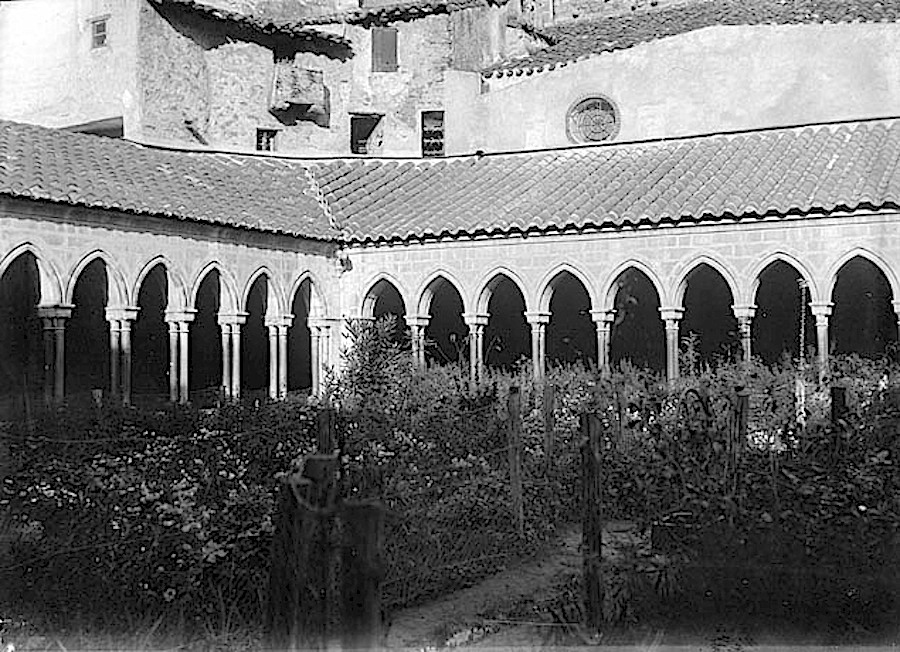 Interior garden of Abbaye Sainte-Marie, 13th. century cloister, Arles-sur-Tech, France, November 1902, by Eugène Trutat, via Bibliothèque de Toulouse Commons on flickr.
The garden is far more formal now, with a clipped boxwood parterre in a geometric pattern around a fountain. There’s a more recent photo here.
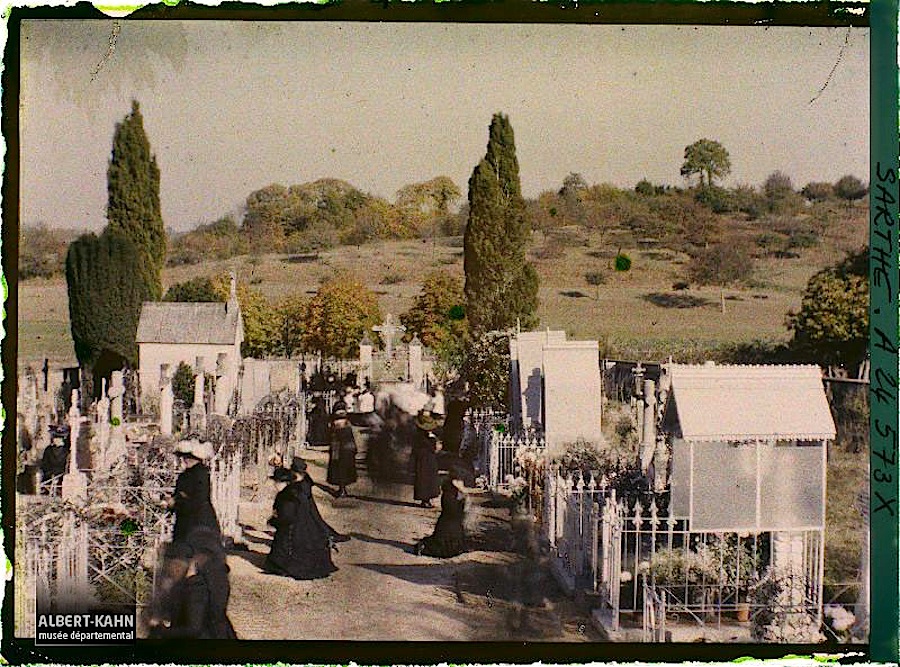
“Procession at the cemetery of Verneuil-le-Chétif” (Sarthe, Pays de la Loire), France, November 2, 1920, by Roger Dumas, via Archives of the Planet Collection – Albert Kahn Museum /Département des Hauts-de-Seine.
The image is labeled “2 novembre,” but I wonder if it was actually taken the day before, on All Saints’ Day, a day for visiting family graves and leaving chrysanthemums.
This autochrome is one of about seventy-two thousand that were commissioned and then archived by Albert Kahn, a wealthy French banker and pacifist, between 1909 and 1931. Kahn sent thirteen photographers and filmmakers to fifty countries “to fix, once and for all, aspects, practices, and modes of human activity whose fatal disappearance is no longer ‘a matter of time.'”* The resulting collection is called Archives de la Planète and now resides in its own museum at Kahn’s old suburban estate at Boulogne-Billancourt, just west of Paris. Since June 2016, the archive has also been available for viewing online here.
*words of Albert Kahn, 1912. Also, the above photo (A 24 573 X) is © Collection Archives de la Planète – Musée Albert-Kahn and used under its terms, here.
 Baby in a hollowed out pumpkin, Gippsland, Victoria, 1906, by John Flynn, via National Library of Australia Commons on flickr.
 enclos*ure