Vintage landscape: Pasadena garden

I do think a garden should be seductive. The strength of any garden is its ability to take you away.

— David L. Culp, in “3,000 Plants, and Then Some,” The New York Times.

1930 Pasadena garden, Archives of American Gardens, Smithsonian Institution Unidentified garden in Pasadena, California, 1930, by Diggers Garden Club, via Archives of American Gardens, Garden Club of America, Smithsonian Institution Commons on flickr.

Simple, elegant, and a little mysterious. . .

The Diggers Garden Club was founded in 1924 and still exists today.  It is a member of the Garden Club of America, which is celebrating its centennial this year.

At its 75th anniversary, the GCA donated 3,000 glass lantern slides (of which this is one) and over 30,000 film slides to the Smithsonian Institution’s Archives of American Gardens.  Its members continue to contribute to the collection, which now has over 60,000 images.

Many of the gardens pictured in the Archives’ slides are unidentified.  The Smithsonian is asking the public’s help in finding names and locations.  Click here to view its “Mystery Gardens Initiative.”
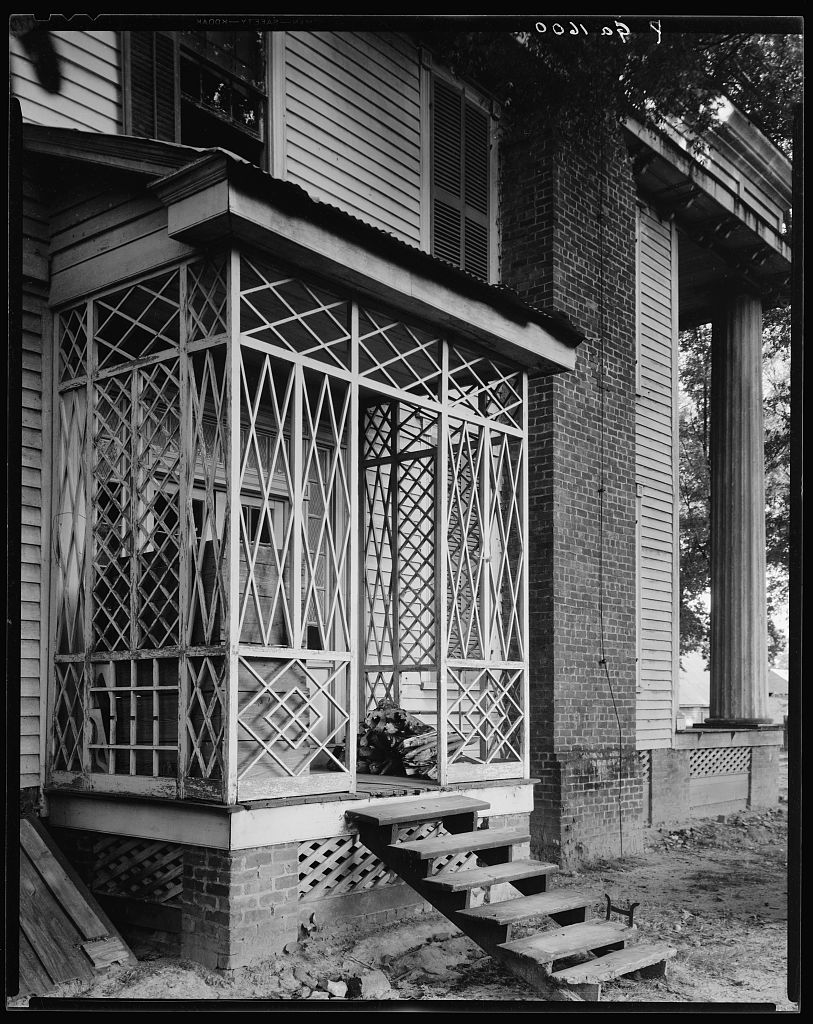
Vintage landscape: small side porch

Latticework on side porch in Georgia, 1939 or 1944, by F.B. Johnston, Library of Congress/enclos*ure

Hill Plantation, Wilkes County, Georgia, 1939 or 1944, by Frances Benjamin Johnston, via Library of Congress Prints and Photographs Division.

I love the latticework on this old side porch.

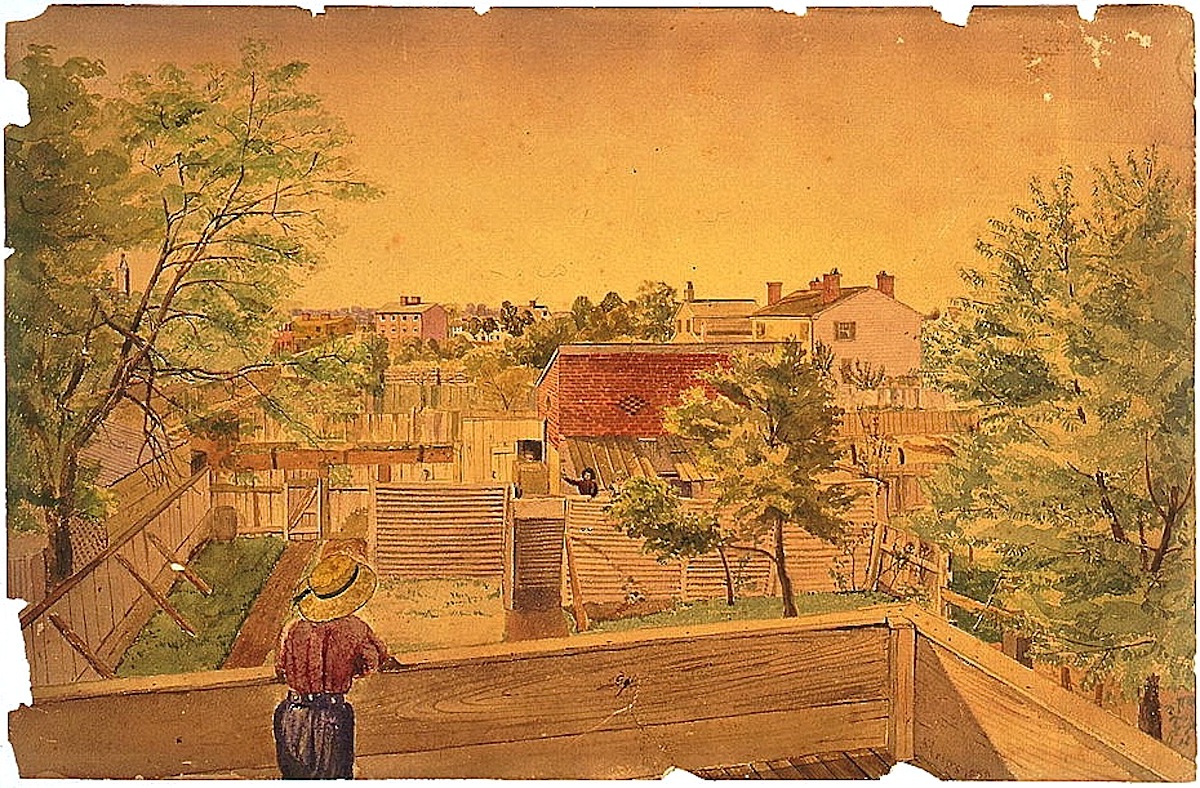
K Street in 1850

K St. backyards, Washington, DC, Library of Congress/enclos*ureView from the second story of the home of Mrs. John Rodgers at Franklin Row, K Street, N.W., between 12th and 13th Streets, in Washington, D.C.

The watercolor* depicts the backyard and adjacent neighborhood and shows children standing on balconies.

It was painted by Montgomery C. Meigs.  Mrs. Rodgers was Meigs’s mother-in-law and the widow of Commodore John Rogers, a naval hero.

Despite the modest appearance of the yard and surroundings, Mrs. Rodgers was wealthy and socially well-connected.   Even well-to-do Washington in the 1850s seems to have had a somewhat ramshackle look.

You will need to click on the image to get a larger view.  Here’s what the downtown city block looks like now.

As a military engineer, Meigs left his mark on the capital.  In the 1850s, he supervised the building of the Washington Aqueduct and the Union Arch Bridge, as well as the wings and dome of the Capitol Building.  He also played an important role in the early design of Arlington National Cemetery, and he designed and supervised the construction of the Pension Building (now the National Building Museum).


*Via Library of Congress Prints and Photographs Division.

Vintage landscape: berry season

Fruit jars on fence, 1938, Dorothea Lange, Library of Congress/enclos*ure

“Fruit jars being sterilized on old lady Graham’s back fence in berry season. Near Conway, Arkansas,” June 1938, by Dorothea Lange, via Library of Congress Print and Photographs Division.

We just gather and can peas, beans, berries, and sausage when we butcher the hogs in the winter. We put up seventy-five quarts of berries, sixty of beans, sixty of kraut, thirty of grapes and twenty of peaches. I swapped two bushels of grapes and got two bushels of peaches and I swapped one bushel of grapes for one bushel of apples.

— Mrs. Graham (?), Library of Congress online catalogue

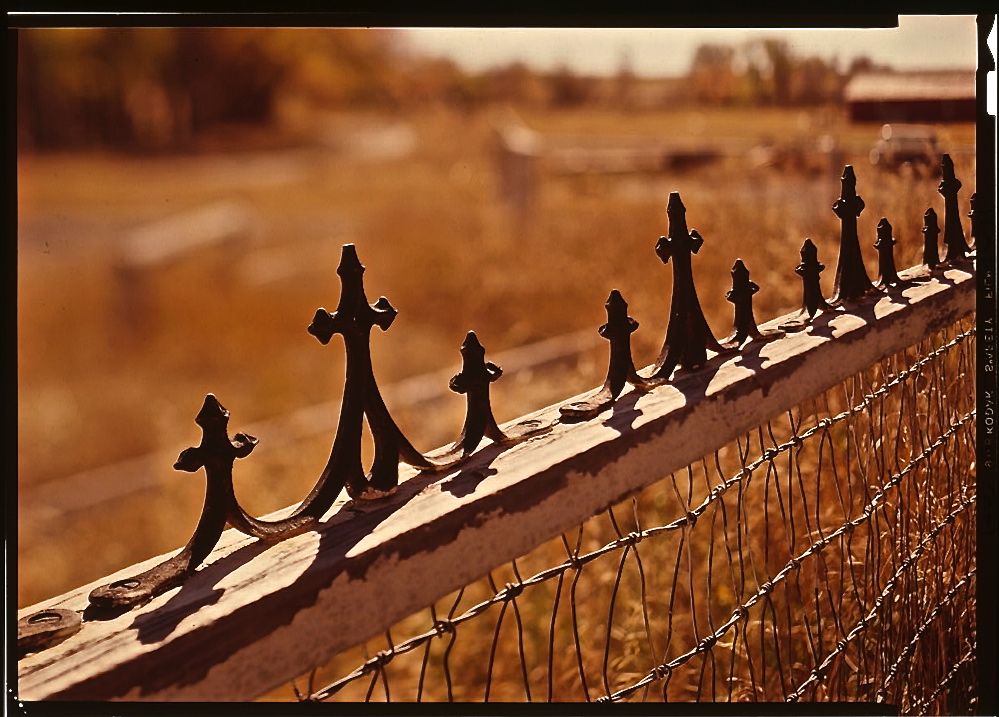
Wyoming ranch fence

Cast iron fence detail, photo by Jack Boucher, Library of Congress/enclos*ure
Cast iron fence detail, by Jack Boucher, via Library of Congress Prints and Photographs Division.

The photo is part of a 1974 Historic American Buildings Survey (HABS) of Swan Land and Cattle Company, Platte County, Wyoming, a large cattle ranch operation founded in 1884.