The Sunday porch: behind Randolph Street

This slideshow requires JavaScript.

Looking through a “slat screen” from the back porch of a house on Randolph Street (probably N.W.), Washington, D.C., May 1942, by John Ferrell, via Library of Congress Prints and Photographs Division.

OK, it’s possible that I’m easily amused.

Also, I have holiday shopping to do. . . and it’s Bloom Day.  (So more later.)

John Ferrell was a photographer for the Farm Security Administration when he took these photos.

Randolph Street, N.W., runs east-west through the Petworth neighborhood of Washington, D.C.

I’ve stayed in the front yard all my life.
I want a peek at the back.  .  .

— Gwendolyn Brooks, from “a song in the front yard


Vintage landscape: the homesteaders’ garden

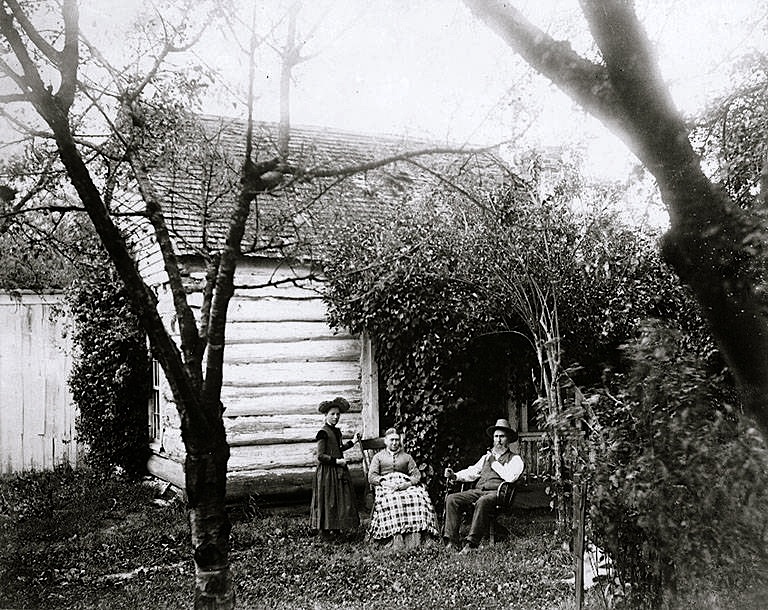
Vintage landscape/enclos*ure: family in garden via UW CommonsHomesteaders seated outside in garden surrounding house, probably [in] Washington State,” ca. 1905, by Albert Henry Barnes, via University of Washington Commons on flickr.

This photo was taken by the same photographer as Monday’s picture of repeating haycocks in an apple orchard.

There may be a little porch underneath the vines*, but it’s hard to tell. There is one fairly large window at the end of the house.   In order for settlers to acquire a homestead, “[t]he law stipulated that a domicile suitable for permanent residence of at least 10 by 12 feet with a minimum of one window must occupy the property,” according to the Center for the Study of the Pacific Northwest.


*It looks like English ivy, which is now terribly invasive in the state of Washington.

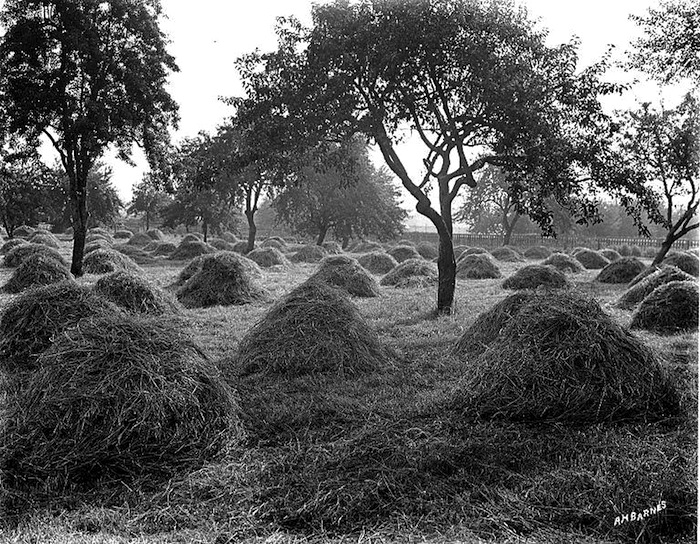
Vintage landscape: repetition

Haycocks in apple orchard, c. 1910, by Albert henry Barnes, via University of Washington Digital CollectionsHaycocks in apple orchard near Parkland, Washington, c. 1910, by Albert Henry Barnes, via University of Washington Commons on flickr.

I feel like this picture could inspire an interesting ornamental garden.

Here is a little further inspiration with another repeating shape.

The Sunday porch: Georgia

While he was a professor of sociology at Atlanta University, W. E. B. Du Bois compiled 363 photographs of African American life in Georgia into several albums — which he displayed at the 1900 Paris Exposition Universelle.

The pictures* here, taken in 1899 or 1900, were part of his collection. Click on any thumbnail in the gallery to scroll through larger photos.

Du Bois’s exhibited albums particularly featured middle-class African Americans and their homes and institutions, and dozens of fine individual portraits were included.

“The photographs of affluent young African American men and women challenged the scientific ‘evidence’ and popular racist caricatures of the day that ridiculed and sought to diminish African American social and economic success,” according to the Library of Congress’s online catalogue.

In 2003, the Library of Congress published a book of 150 of the images, entitled A Small Nation of People.  You can listen to a good NPR interview with its co-author, historian Deborah Willis, here.  In it, she mentions porches being photographed for the exhibit, as places “central to family gatherings.”


*All via Library of Congress Prints and Photographs Division.

Vintage landscape: garden of the mind

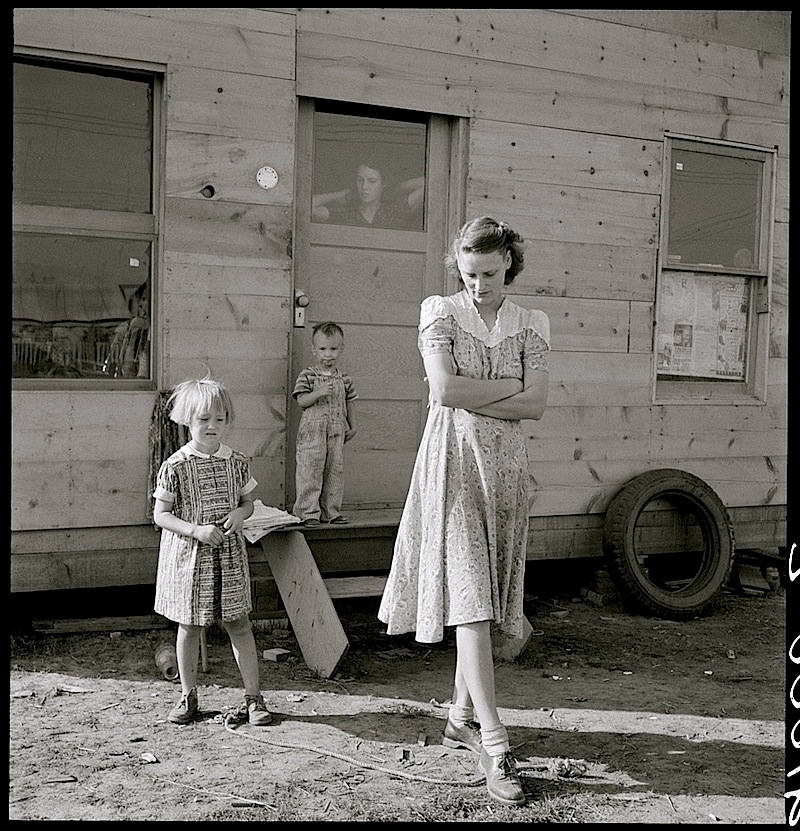
Young mother in squatter camp dreams of a garden, Sept. 1939, by Dorothea Lange, via Library of Congress“Young mother, twenty-five, says, ‘Next year we’ll be painted and have a lawn and flowers,’ rural shacktown, near Klamath Falls, Oregon,” September 1939.

Photo and caption by Dorothea Lange for the U.S. Farm Security Administration, via Library of Congress Prints and Photographs Division.
‘Established’ is a good word, much used in garden books,
‘The plant, when established’. . .
Oh, become established quickly, quickly, garden!
For I am fugitive, I am very fugitive —

Mary Ursula Bethell, from “Time