Snapshots: Istanbul

After visiting Prague, we spent Christmas Eve, Christmas, and Boxing Day in Istanbul. It was wonderful, of course, as everyone said it would be.

Here are some snapshots and a few travel tips.

This slideshow requires JavaScript.

(If you would like to scroll through larger versions of the images, click on ‘Continue reading’ below and then on any thumbnail in the gallery.)

We took a taxi from the airport to our hotel.  Going on public transportation would have involved a bus and then a tram.  It sounded do-able, but would have taken about an hour and a half, and we arrived rather late in the day.

We stayed at the Hotel Ibrahim Pasha, which I loved for its tasteful, comfortable decor and the thoughtful approach of its staff.  It’s a small place on a side street along the south side of the Museum of Turkish and Islamic Art, steps from the Hippodrome and the Blue Mosque.  Downstairs in front of the sofas, the fireplaces were lit all the time.  Books were everywhere.  The standard rooms are very small (think Paris small), but well designed. Breakfast was delicious.

We practically levitated off the bed every morning at about 6:00 a.m. when the call to prayer began, but I enjoyed it — and also listening to the sunset call from the rooftop, while looking at the Blue Mosque and the Sea of Marmara. Upon arrival, the hotel provided us with a map and their own lists of recommended restaurants, shops, and walking routes.  Everything we tried was excellent.  They also have their own app for iPhone and Android.

Really, if I ever run away from home, you will find me at the Hotel Ibrahim Pasha.

We really enjoyed the food at Khorasani,* a kebab restaurant very near the hotel.  We had dinner there twice (the kebabs “marinated” in pistachios were my favorite).  In Karaköy, the wharf area just to the east of the north end of the Galata Bridge, we had a lunch of mezes at Karaköy Lokantasi. It has a decor “reminiscent of the Turkish Republic of the 1930s,” in the words of the Ibrahim Pasha.

When eating in Sultanhmet, have your hotel make you reservations at your chosen restaurants, so that when you are lost, and the waiters of all the other eateries are trying to pull you in, you can say, “Sorry, we have reservations.”  Then, they will kindly guide you.

[Addendum:  If you are vegan or vegetarian, you might appreciate this guide to eating in Istanbul.]

Do buy your Turkish Delight candy** at a stall in the Spice (Egyptian) Market (rather than pre-packaged at the airport), so that  it will be fresh and you can choose the flavors (and taste samples). The best of it is so good. Get the kind made with honey and flavored with pomegranates, cherries, or pistachios.  We bought some rolled in chopped rose petals. (The merchants can vacuum seal your boxes.)

The only guidebooks we bought before leaving home were the e-book versions of DK’s Top 10 Prague and Top 10 Istanbul.  I think they were 99¢ each, which was about right.  After perusing the shelves at the hotel, I would recommend Istanbul: Memories and the City (a personal memoir) by Orhan PamukIstanbul’s Bazaar Quarter: Backstreet Walking Tours by Edda Renker Weissenbacher and Ann Marie Mershon, and Strolling Through Istanbul: The Classic Guide to the City by Hilary Sumner-Boyd  and John Freely.

Cornucopia magazine and its blog are also interesting.  There are some beautiful old photographs of Istanbul by Pierre Loti in a recent post, here.

When necessary, we had no problem finding people who spoke English or signs in English.


*Khorasani is at Divanyolu Caddesi Ticarethane Sokak, No. 39/41 Sultanahmet. Karaköy Lokantasi is at Kemankes Caddesi 37/A, Karaköy.
** I think it’s actually a requirement of your visa that you take home several boxes.  You will see crates of it at the airport.
Continue reading “Snapshots: Istanbul”

Snapshots: Prague

We spent the week before and just after Christmas in Prague and Istanbul this year. In recent years, we’ve found that we like traveling during the cold-weather months, when the streets, museums, and restaurants are so much less crowded.

I loved the low, slightly hazy light in both cities (OK, I live near the equator the rest of the time).  And although the temperatures were between about 27°F and 40°F  (-3°C to 4°C), there was practically no wind and no rain or snow.  Maybe we were very lucky, but honestly, I’ve been colder in Amsterdam in July.

Below are some snapshots and a few travel tips for Prague.  Do not adjust your set:  with some pictures I got a bit carried away with the ‘Effects’ buttons on iPhoto.

This slideshow requires JavaScript.

(If you want to scroll through larger versions of the images, click on ‘Continue reading’ below and then on any of the thumbnails in the gallery.)

At the airport, just before you exit for the bus area, you will find a booth selling public transportation tickets.  We bought 3-day passes for about $15 each. They allowed us unlimited use of the metro (subway), bus, and tram lines.

If you like, you can take the 119 bus from the airport to the end of its line at Dejvicka (about 30 minutes) and then transfer to the green metro A  line.  (You could also buy tickets on a private bus line that will take you to any hotel in the Old City area.)

We stayed at the Courtyard Marriot (collecting points), which was not very atmospheric, but comfortable and the staff were friendly.  The hotel is in the neighborhood of Zizkov and is very convenient to the green metro line and tram lines to the Old City.

It is also near the huge and interesting Olšany Cemetery (1680 to today) — which you will find if you accidently walk in the opposite direction of the Old City, which we did first thing for about a half mile.

For some reason, we never chose the right direction in Prague, and we were lost just about every minute in the Old City and the Mala Strana.  This was not very important as those parts of the city are relatively small.  Eventually, we would stumble over the right tram line (and then take it going the wrong way).

(If the Prague tourism office is reading: “you are here” maps placed on the streets about every 5 or 6 blocks would be great.)

English is widely spoken in the parts of Prague where a visitor is likely to be, and there are signs in English everywhere.

We just wanted to wander around for two days enjoying the old architecture and the Christmas markets,* so the only museum we visited was the Prague City Museum.  My husband wanted to see the 19th century model of the city, which was remarkable — especially because they show a short 3D  movie where the camera “flies” over the town.  It’s a rather sleepy attraction, but I loved it.

The Czech food we ate was, well, filling.  Our meals consisted of a big piece of pork or duck, braised cabbage (very good), and potato and bread dumplings. Bread dumplings are really just steamed white bread.  The potato dumplings were something like gnocchi.  I can’t recommend any particular restaurants.

There were classical music concerts in churches all over the Old City.  We went two nights in a row to the 12th century St. Martin in the Wall Church to listen to, first, organ and violin and a soprano and, then, a string quartet.  The 5:00 p.m., one-hour performances were of a very high quality for about $25/ticket. Brochures** about these concerts are available all over town and at hotels.

There is a little more on the sidewalks of Prague here.

Next:  Istanbul.


* I bought small, 1″ to 2″ traditional Czech glass ornaments for about $2.50 to $3 each; they all made it home intact.

** The venue was advertised as “heated.”  I would say the translator did not fully understand the word.  We kept our coats on but were happy nonetheless.

Continue reading “Snapshots: Prague”

A Sunday in the streets of Brussels

On the first day of our recent travels, we were lucky enough to arrive in Brussels on its annual “Car Free Sunday.” The streets of the city were closed to “all traffic with an engine”* from 9:00 a.m. to 7:00 p.m.

The streets were full of happy bikers, skaters, skateboarders, and walkers — in about that order. In addition, stands devoted to regional food and drink, organic farming, and ecology were set up from the Grand’Place to the Royal Palace and Brussels Park.

This slideshow requires JavaScript.

I like this garden (above slides) at the Mont des Arts. Like so many outdoor spaces in Brussels, its design successfully encompasses many centuries.

Under the rows of pleached trees, there were booths selling food and wine from France, so, bien sur, we had fois gras sandwiches for lunch.

This slideshow requires JavaScript.

A little farther east, on the street between the Royal Palace (above slides) and Brussels Park, sod had been put down over the stone block paving, and people were picnicking on every kind of organic cuisine.

I also really like Brussels Park (below slides).  It has very formal wide gravel walkways laid out in the shape of the Free Masonry symbol of an architect’s compass. Two rows of espaliered trees surround its perimeter.  But inside, there are forest-style groupings of very tall trees, long berms planted in a natural way with a variety of shrubs, and some well-used grass.

This slideshow requires JavaScript.

In the afternoon, we went back to our hotel for a rest and found that the street under our window had been blocked off for children’s activities. A local radio station had set up a stage, and, for the length of our planned nap, it featured a teenage punk rock band. I must admit they sang and played (what seemed like) their one song over and over again with some proficiency (I guess).

We ended our lovely day of walking in the neighborhood of Dansaert, along Rue de Flandre (or Vlaamsesteenweg), where the shops and residents were having a street-long yard sale/block party. At no. 17, we ate traditional Belgian food at the restaurant Viva M’Boma** (long live grandmother), which we highly recommend — as long as you eat meat.

To scroll through larger versions of all the photos above, click on ‘Continue reading’ below.


*Except for buses, taxis, some delivery vans, police, and ambulance.  The event is always in September, to coincide with the  European Week of Mobility.  I found one webpage indicating that it will be on September 16 in 2014.

**But they are normally closed on Sundays — and Wednesdays.  Main courses are between 11€ and 18€.


Ruzizi Tented Lodge at Akagera National Park

After our recent drive to the southeast corner of Rwanda, we backtracked and then headed north to Akagera National Park to spend the night.

Picnic table, welcome center, Akagera Nat'l. Park in Rwanda:enclos*ure

It was about 4:30 p.m. when we arrived at the park’s welcome center, and I was anxious to get some photos before the light disappeared.  Here, near the equator, dark comes between 6:00 and 6:30 all year round.  No extra long summer days for us.

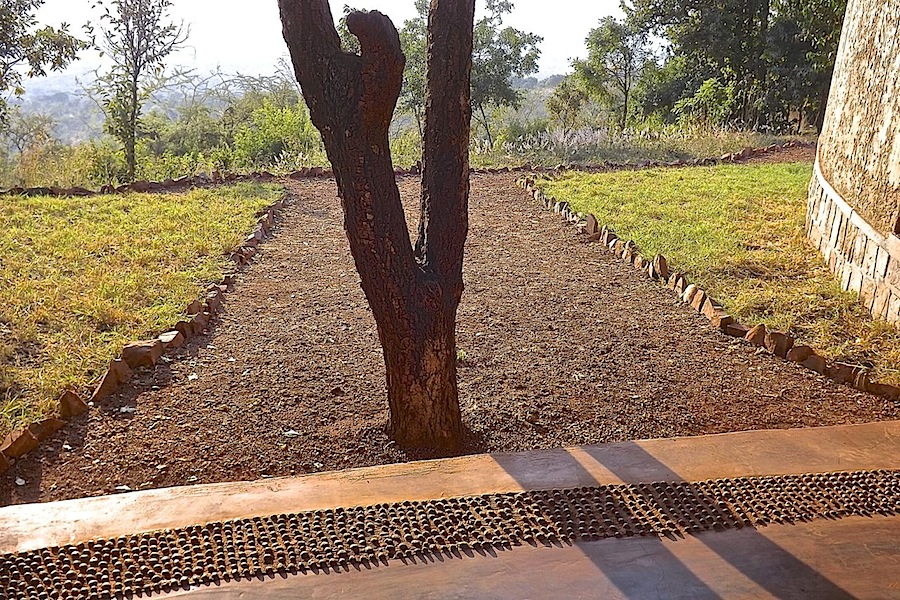
Pebble floor border, welcome center, Akagera Nat'l. Park in Rwanda:enclos*ure

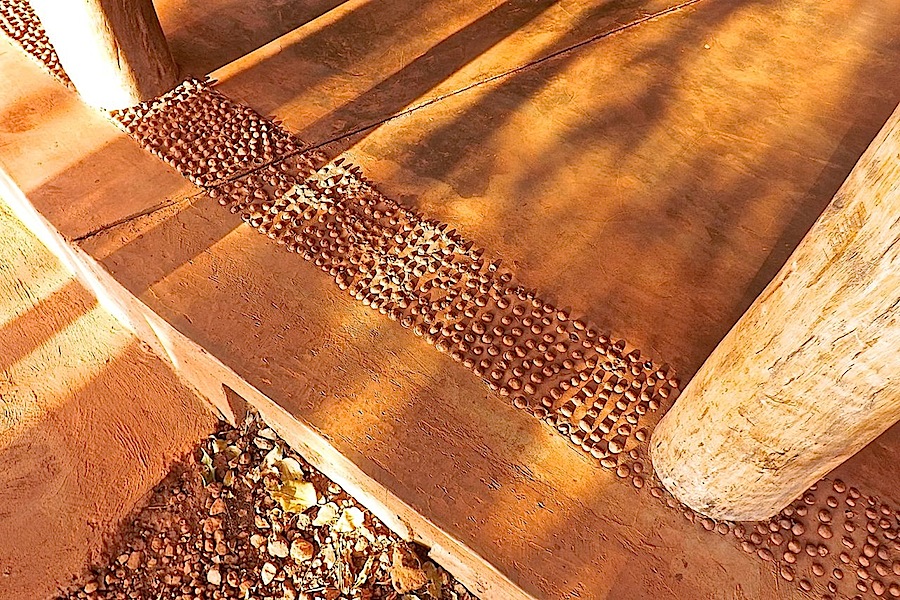
I liked the pebble border to the welcome center’s concrete floor, which had been colored red, like the surrounding dirt.

Pebble floor border, welcome center, Akagera National Park, Rwanda:enclos*ure

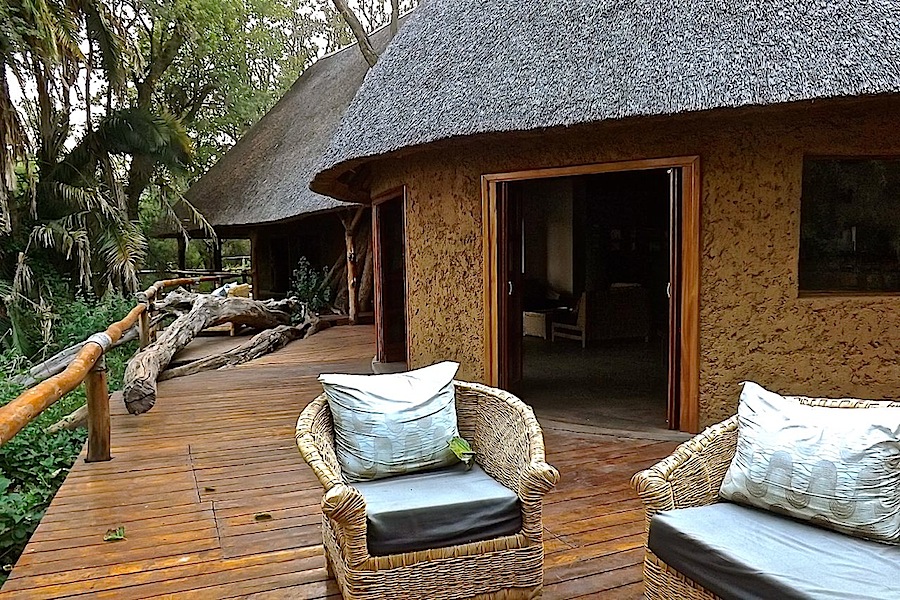
The attractive building, which for some reason I failed to photograph, was stone and stucco and had a thatched roof, like the lodge pictured below.

Long-neck weaver bird nest, Akagera Natl. Park, Rwanda:enclos*ure

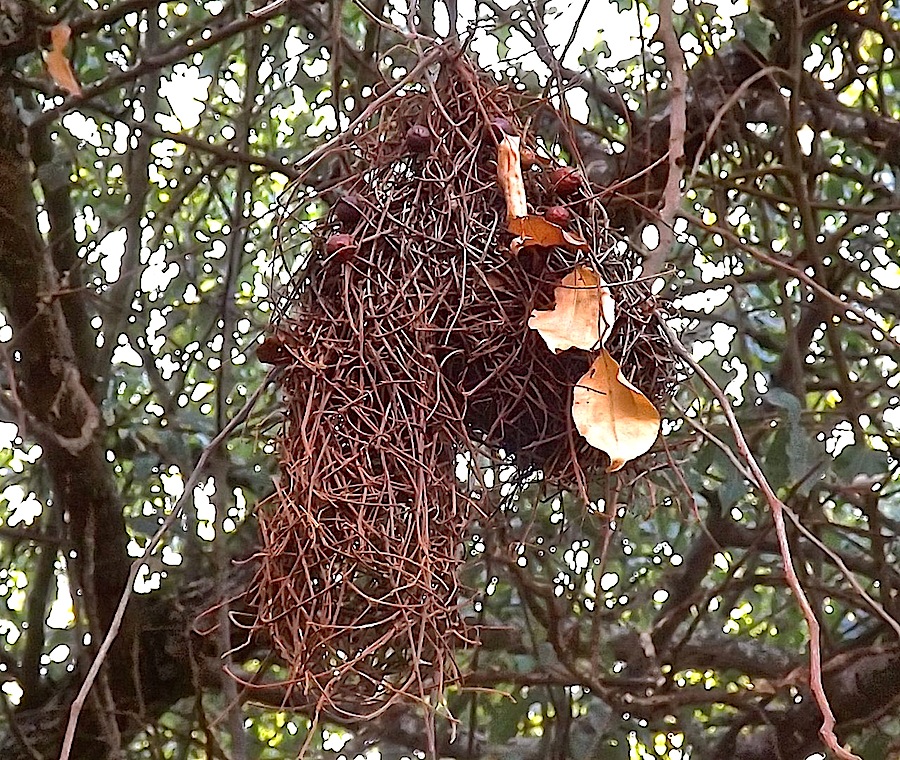
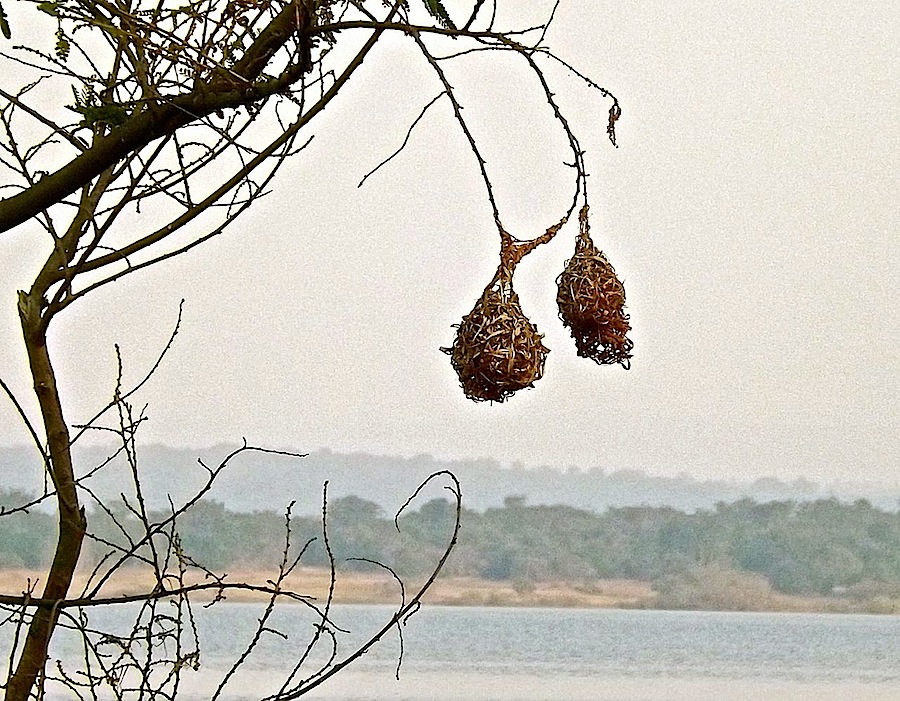
In a tree just outside the welcome center, there was a weaver bird nest (above) — this one with a very long entrance tunnel, a protection against predators.

Main lodge, Ruzizi Tented Lodge, Akagera Nat'l. Park, Rwanda:enclos*ure

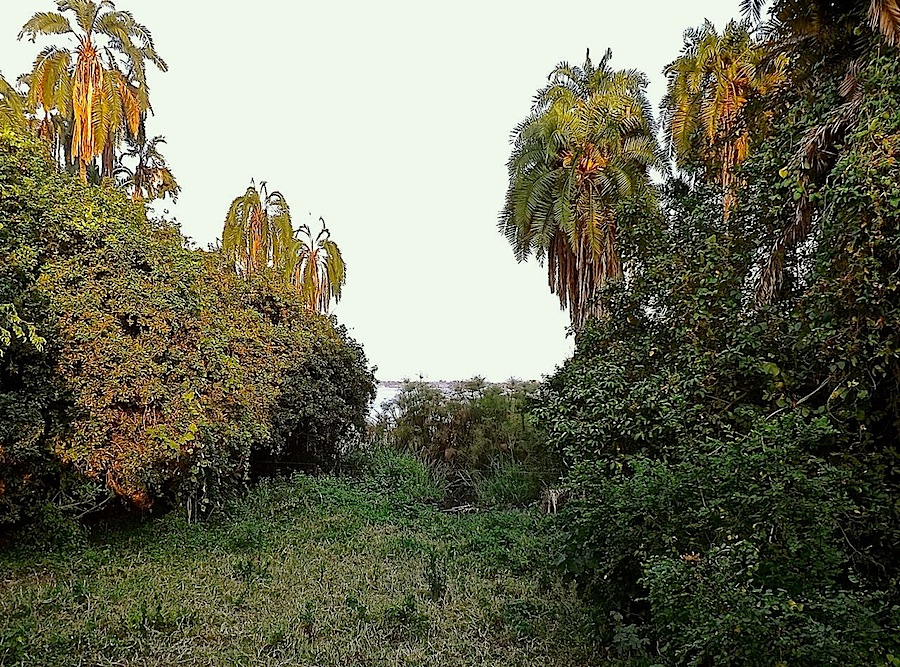
The Ruzizi Tented Lodge — which opened inside the park just this year — is on a small strip of largely undisturbed land along the edge of Lake Ihema.

Boardwalk, Ruzizi Tented Lodge, Akagera Nat'l. Park in Rwanda:enclos*ure

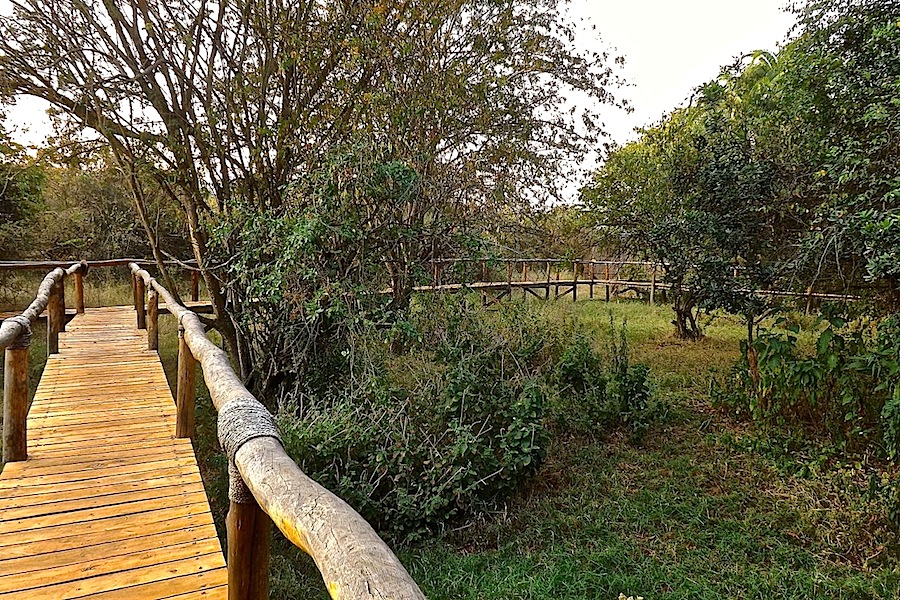
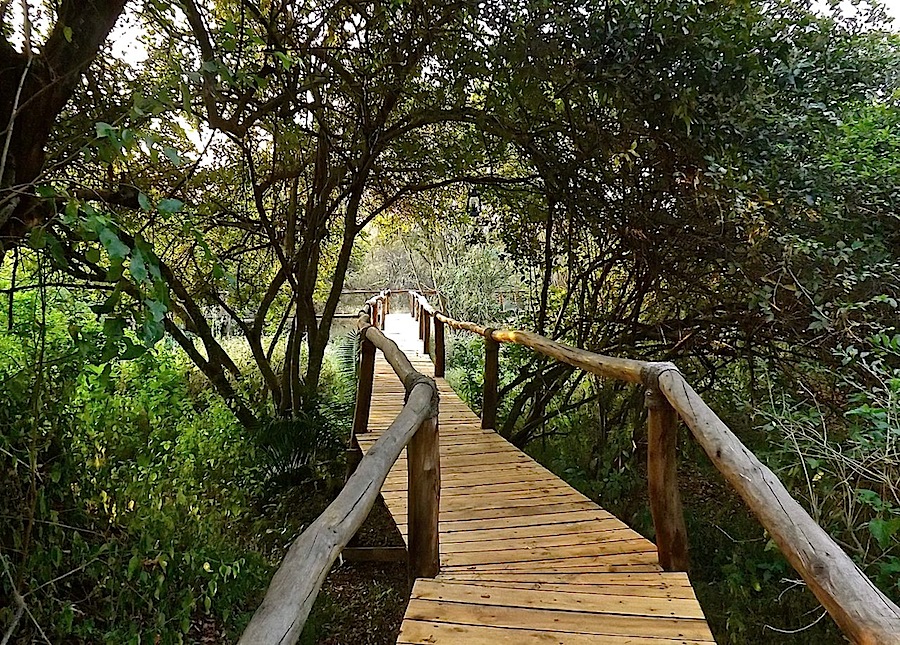
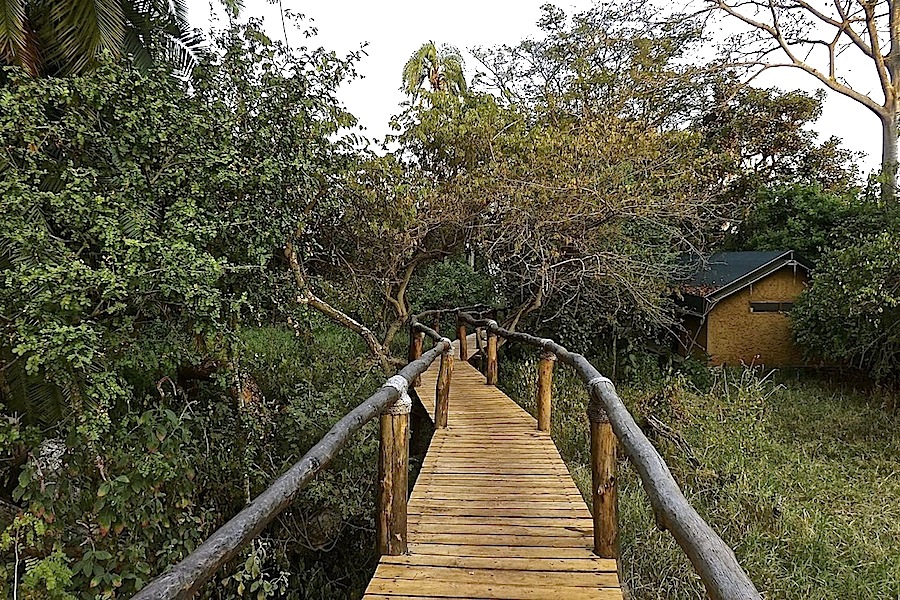
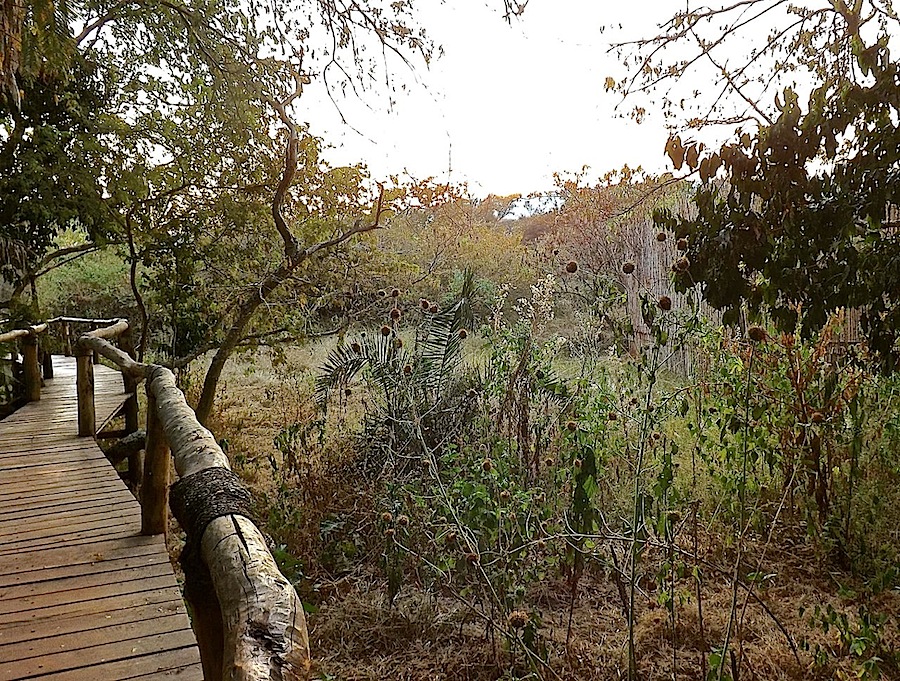
Boardwalks keep visitors off the native plants, not to mention away from the equally native crocodiles and hippos.  (An electric fence keeps other large animals out on the inland side of the lodge.)

Boardwalk, Ruzizi Tented Lodge, Akagera National Park, Rwanda:enclos*ure

Boardwalk to tent, Ruzizi Tented Lodge, Akagera Natl. Park in Rwanda:enclos*ure

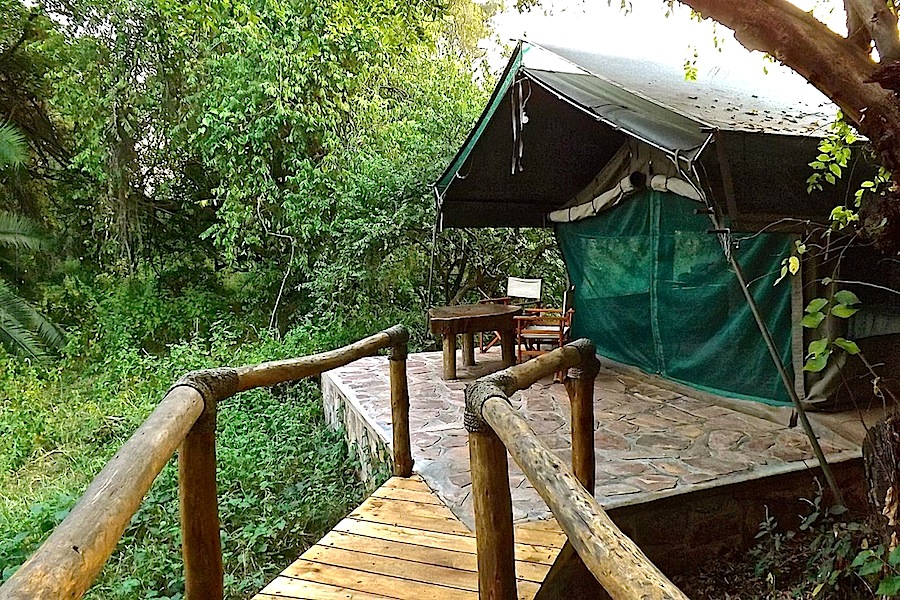
The camp has seven tented cabins, each with a full bath, one or two real beds (with reading lamps), and an outlet for recharging phones.

Tent cabin, Ruzizi Tented Lodge, Akagera Natl. Park, Rwanda:enclos*ure

Below is our tent’s “front yard,” which was quite close to the water’s edge.  That night, we heard, but did not see, hippos near our tent.

Marshy edge of Lake Ihema at Ruzizi Tented Lodge, Akagera National Park, Rwanda:enclos*ure

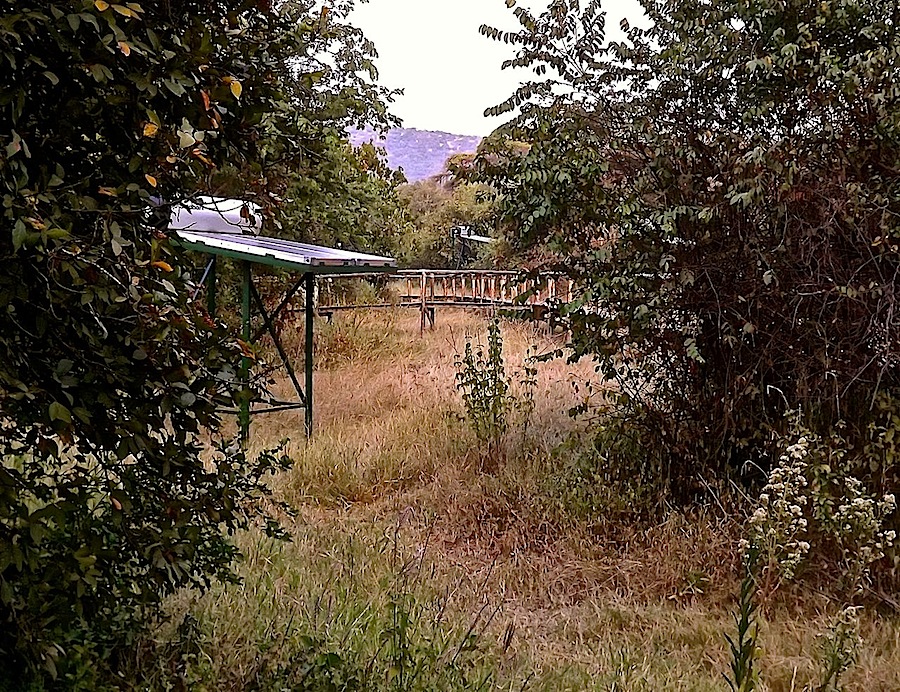
Solar panels for tents, Ruzizi Tented Lodge, Akagera National Park, Rwanda:enclos*ure

Each tent has a solar panel for lights and hot water — shown above.

Wildflowers and boardwalk, Ruzizi Tented Lodge, Akagera National Park in Rwanda:enclos*ure

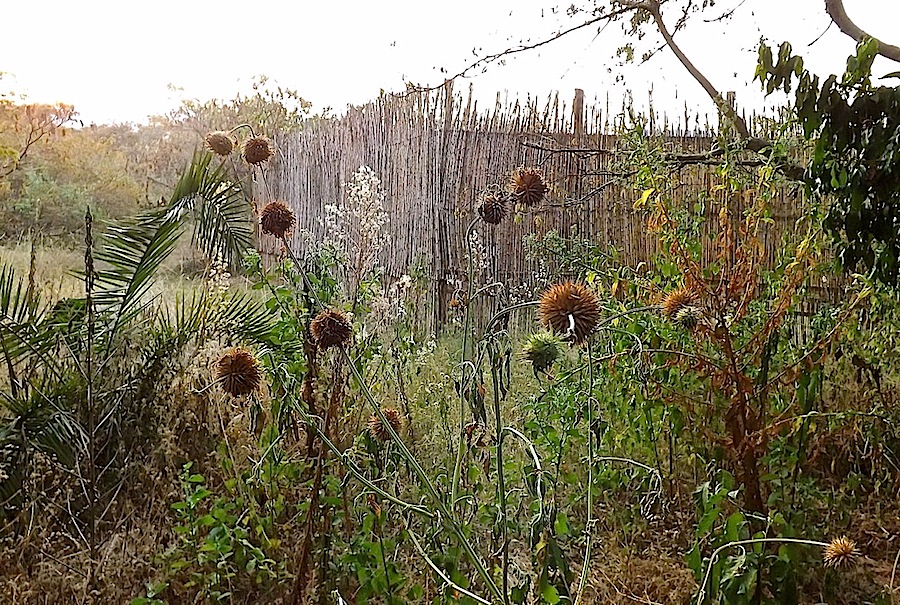
Even in the dry season, there were some wildflowers catching the last of the day’s light.

Wildflowers, Ruziz Tented Lodge, Akagera National Park, Rwanda:enclos*ure

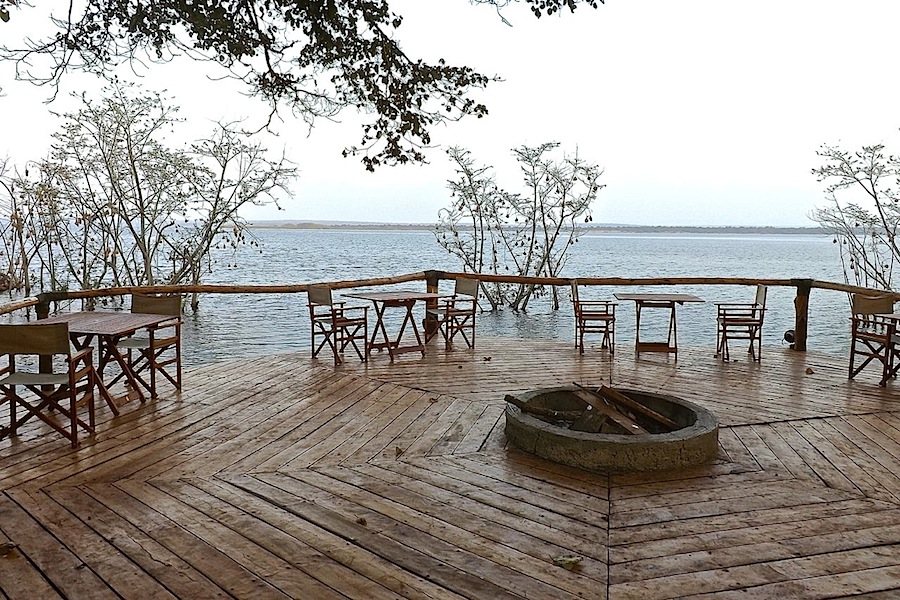
In the evening, we had cocktails around a fire on the riverside deck, below.

Lakeside eating area, Ruzizi Tented Lodge, Akagera National Park, Rwanda:enclos*ure

Breakfast was also served there — while monkeys ate fruit off a big tree above us.

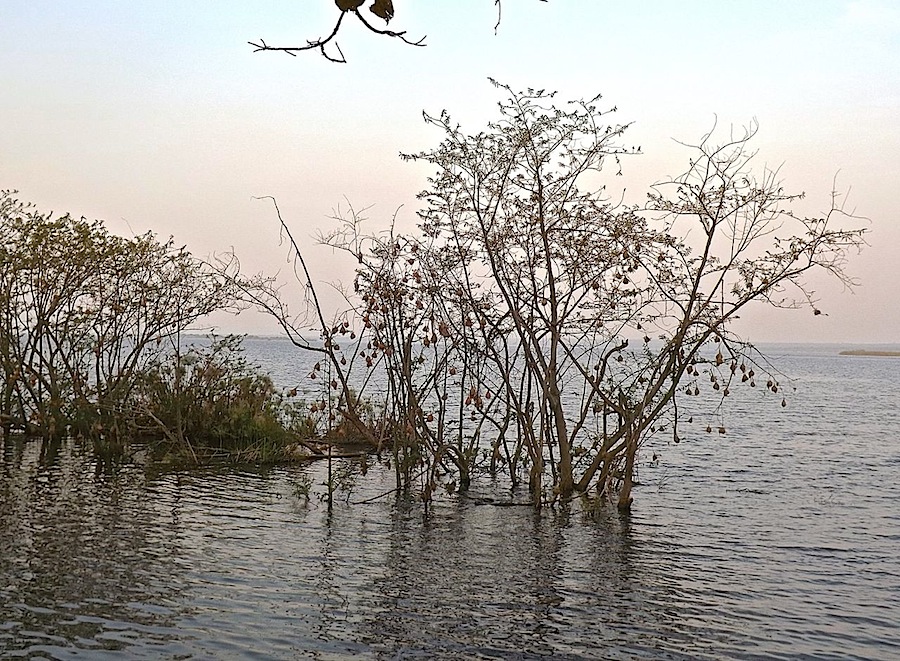
Weaver birds' nests at dusk, Ruzizi Tented Lodge, Akagera National Park, Rwanda:enclos*ure

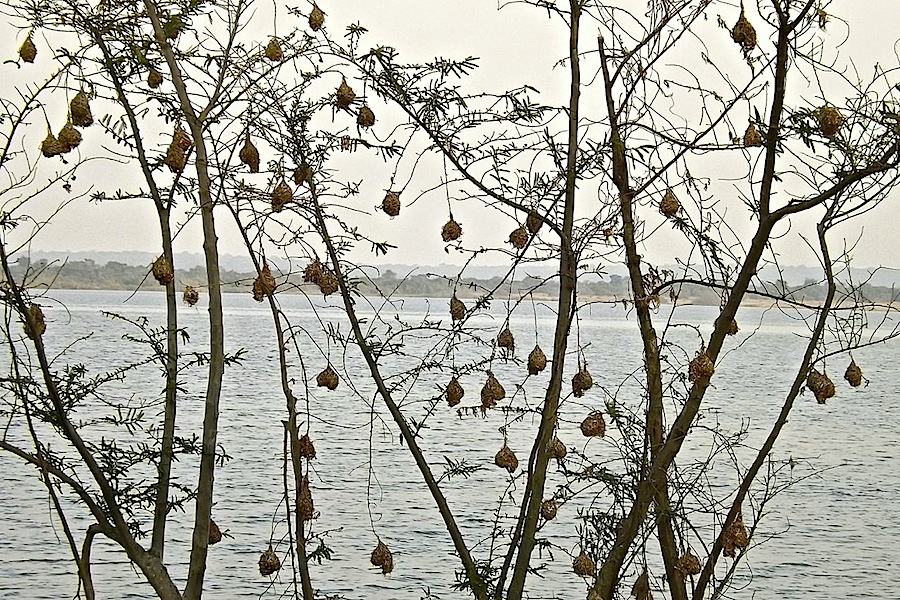
In the shrubby trees just beyond the deck, there were dozens of (empty) weaver birds’ nests.

Weaver birds' nests, Akagera Nat'l Park, Rwanda:enclos*ure

Weaver birds' nests, Ruzizi Tented Lodge, Akagera Natl. Park in Rwanda:enclos*ure

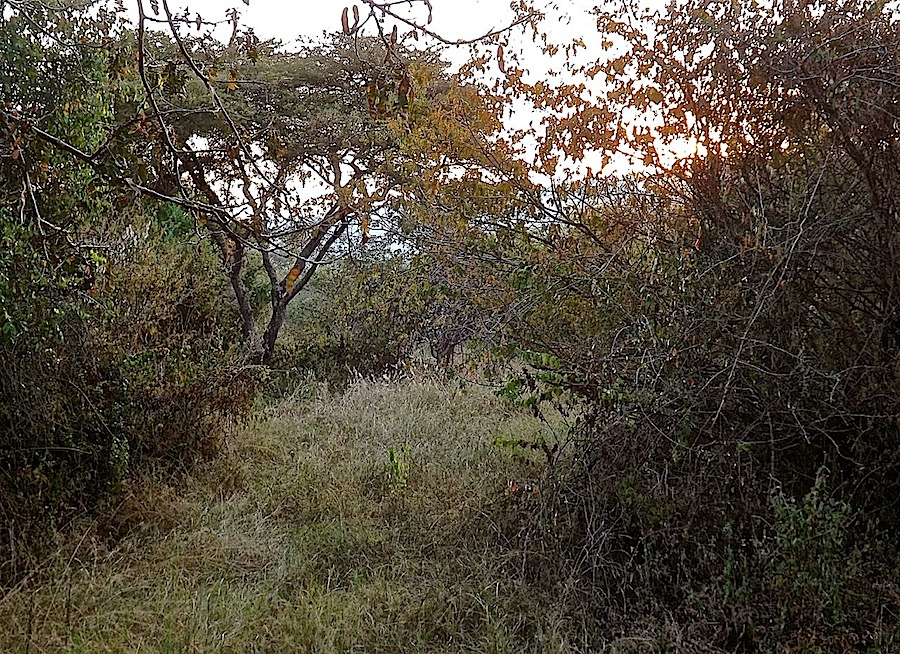
Located along Rwanda’s eastern border with Tanzania, Akagera National Park presents quite a different landscape from the mountainous forests and farms of western and central Rwanda. (It is one of four large national parks in the country.)

“[I]ts undulating plains support a cover of dense, broad-leafed woodland interspersed with lighter acacia woodland and patches of rolling grassland studded evocatively with stands of the superficially cactus-like Euphorbia candelabra [aka E. ingens] shrub,” according to the Bradt guide to Rwanda.

Grass and shrubs near Ruzizi Tented Lodge, Akagera Natl. Park, Rwanda:enclos*ure

There are also large wetlands surrounding several lakes and the channels of the Akagera River, which runs along the border between the two countries.

The game-viewing is not up the standards of the great savanna parks in neighboring countries, but every visitor I have talked to recently has seen elephants, hippos, zebra, and giraffes, as well as antelopes and impalas.  (Unfortunately, we did not have time to tour the park during our stay.)

Currently, there may or may not be lions and leopards in small numbers, but there are reportedly plans to restock them — and add black rhinos — eventually.

According to the Bradt guide, the birdlife is “phenomenal.”  The landscape is particularly scenic, with forests, lakes, swamps, and low mountains.  Perhaps best of all, the park is fairly empty of other tourists.

Camping (in real tents) is allowed in various locations.  It is also possible to take boat safaris on Lake Ihema.

The canopy walk, Nyungwe Forest

13 Moss on tall tree, Nyungwe Park, Rwanda:enclos*ure

Last February, I wrote about our stay at the Nyungwe Forest Lodge.  Recently, however, I realized that I have never given you a look inside the forest.

The Nyungwe National Park, in the southwest of Rwanda, is 393 square miles of mountain forests, swamps, and moorland.

It has over 80 miles of constructed trails, but during our two-night stay at the lodge, we mainly wanted to relax — so we decided to walk the 1.3 mile Igishigishigi Trail, which includes a canopy walkway suspended 197′ above the ground.

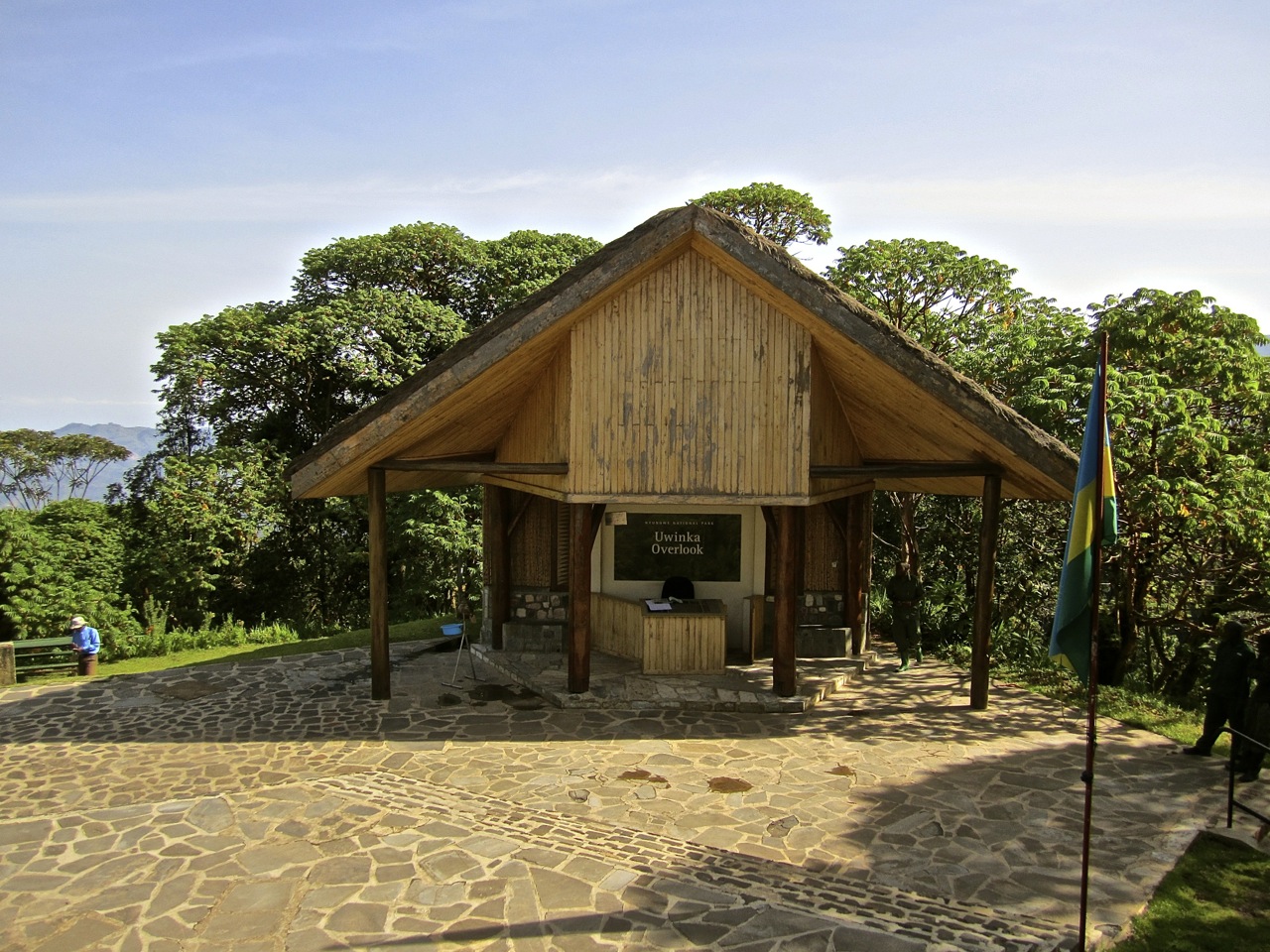
The Uwinka Visitor Center

The trail begins at the Uwinka Visitor Center, which was renovated three years ago with U.S. assistance.

The center’s  interpretative display features panels on the mountain rainforest and Nyungwe’s biodiversity, its people, and its role in the Congo-Nile watershed.  The text is in Kinyarwanda, English, and French.

2a Uwinka Visitor Center, Nyungwe Park, Rwanda:enclos*ure

Below are the steps leading to the Igishigishigi Trail.  The shadow with the camera was me, the one on the left was our visiting daughter, who was wondering what she had gotten herself into.

3 Steps to Igishigishigi Trail, Nyungwe Park, Rwanda:enclos*ure

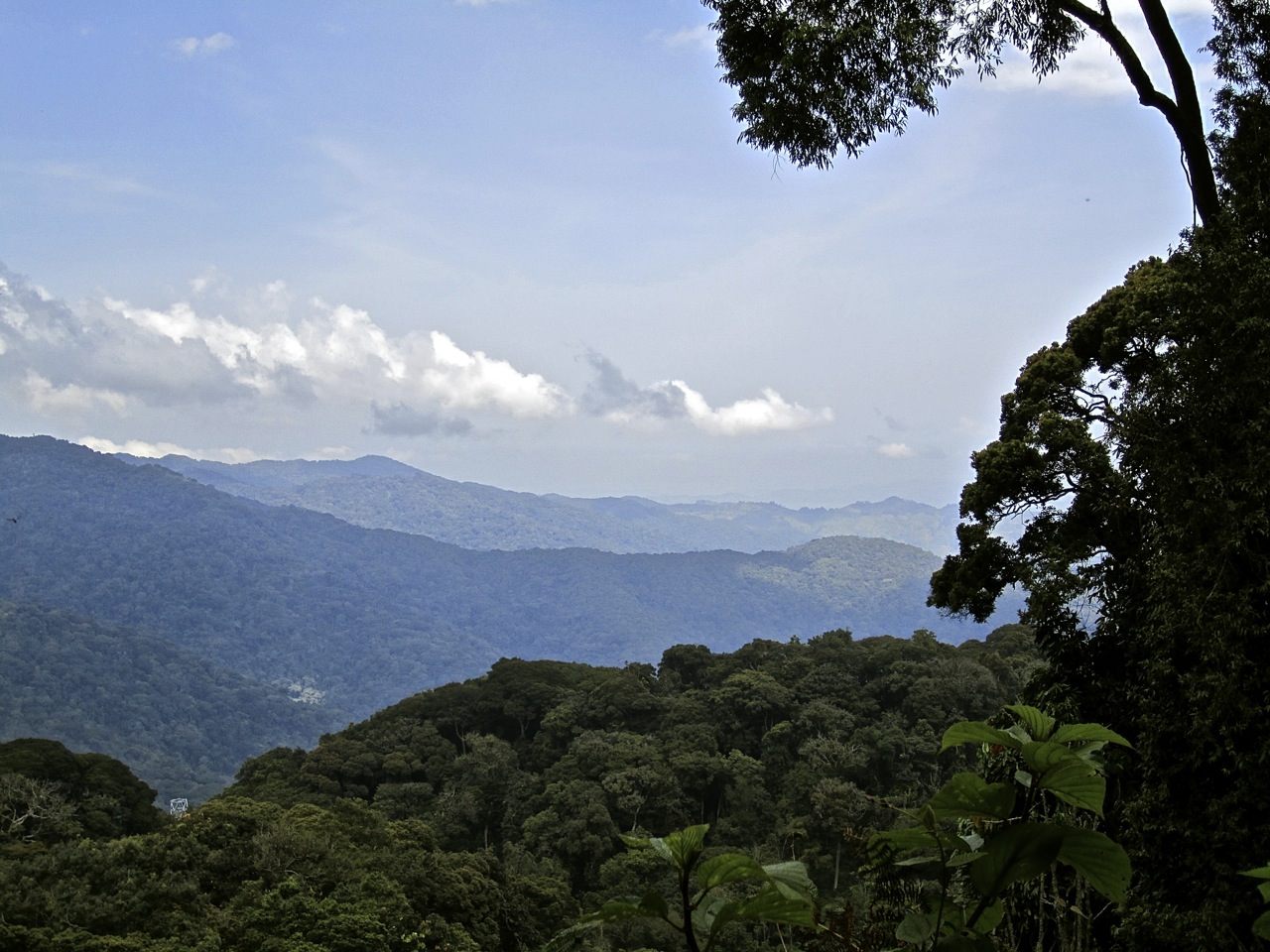
The view near the beginning of the trail is wonderful. Uwinka is at one of the highest points in the park.

7 View, Nyungwe Park, Rwanda:enclos*ure

In the left lower corner above, you can just see one of the towers that support the canopy walk.

Below is the trail,

7c Igishigishigi Trail, Nyungwe Park, Rwanda:enclos*ure

which includes several sections of steps.  The trail begins at 8,038′ and descends to 7,530′.

7d Trail steps, Nyungwe Park, Rwanda:enclos*ure

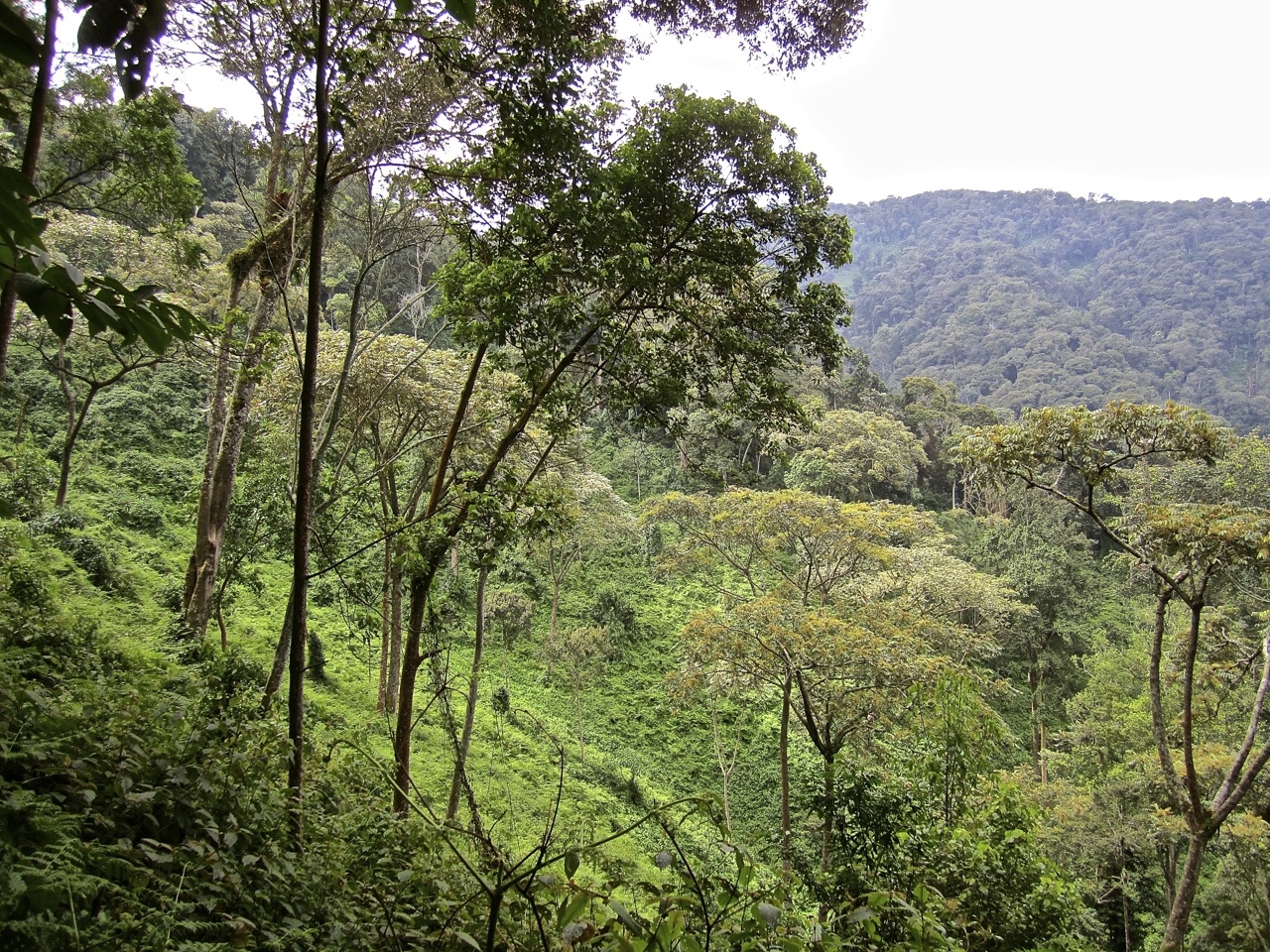
It sometimes passes along more open woodland, below.

7ba Hillside, Nyungwe Park, Rwanda:enclos*ure

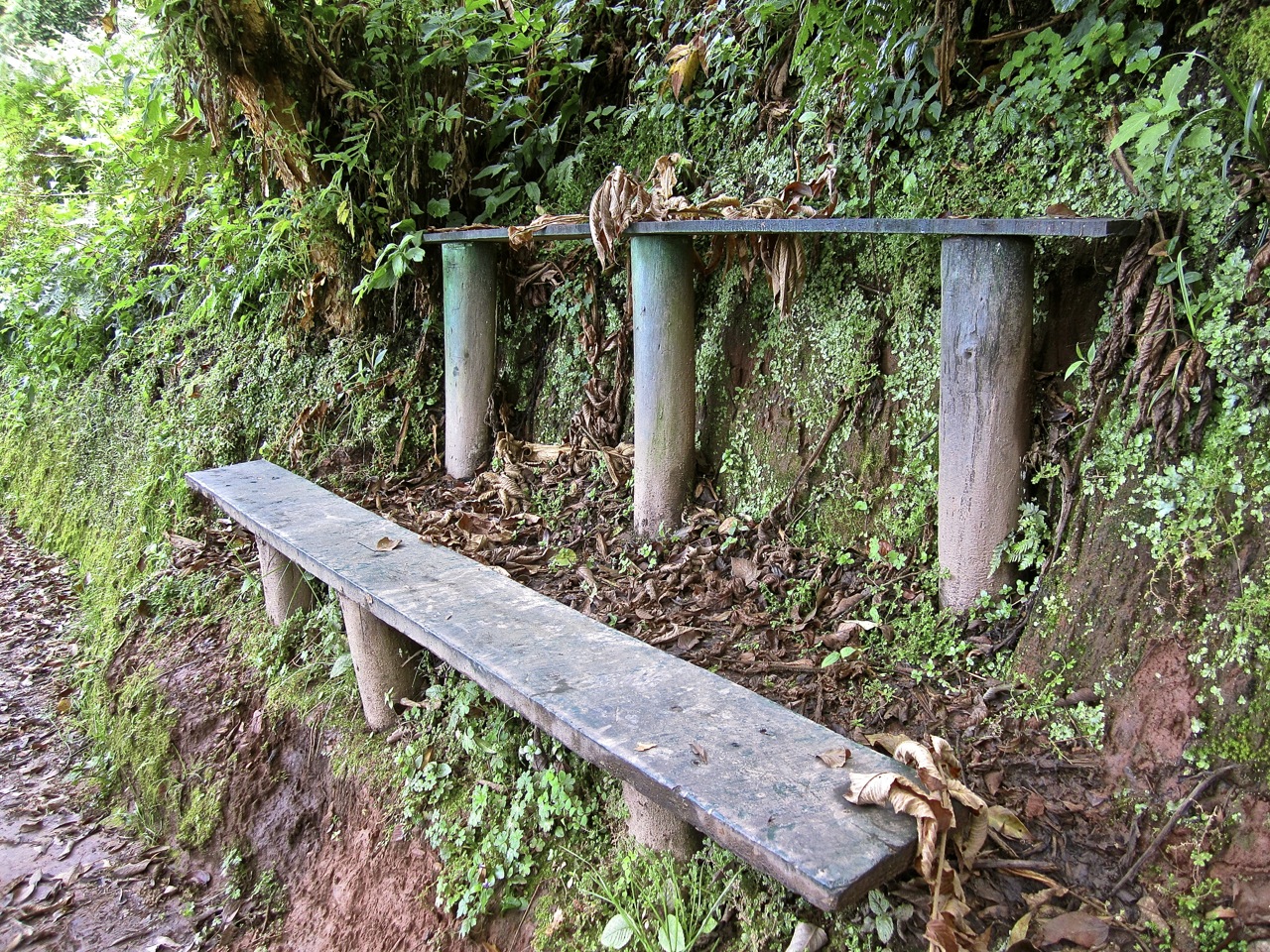
We came across benches from time to time, although this double arrangement, below, didn’t look very comfortable.

14 Trail benches, Nyungwe Park, Rwanda:enclos*ure

Several species of trees are labeled like this one.

8 Labeled tree, Nyungwe Park, Rwanda:enclos*ure

The Parinari excelsa (or Umunazi in Kinyarwanda) grows to heights of 82′ to 131′ with a thick, cauliflower-shaped crown,

8a Parnari excelsa, Nyungwe Park:enclos*ure

way up there.

An assortment of ferns, mosses, lichens, and orchids live on the magnificent trees

13b Moss on tree, Nyungwe Park, Rwanda:enclos*ure

and on the forest floor.

13c Forest floor, Nyungwe Park, Rwanda:enclos*ure

One of the more common, and easily recognizable, plants along the trail is the giant lobelia, below.

1 Giant lobilias in the Nyungwe Park, Rwanda:enclos*ure

There are two species of giant lobelias in the park.  I think these are Lobelia gibberoa (or Intomvu in Kinyarwanda).

After the explorer Johannes Mildbraed first saw this plant in Nyungwe in 1907, he wrote:

[It] would have awakened the interest of the veriest dullard at botany. . . .  When I first espied these strange shapes. . . my heart beat fast at the realization of a long-hoped-for sight, a feeling that is comparable only to that of a hunter at the first sight of some rare game.

13c Giant lobelia, Nyungwe Park, Rwanda:enclos*ure

The one above was only a few feet tall, but more mature specimens towered over our heads.

13d Giant lobelias, Nyungwe Park, Rwanda:enclos*ure

After about 45 minutes, we arrived at the canopy walk.

14a Canopy walk, Nyungwe Park, Rwanda:enclos*ure

In the photo below, our guide was explaining to us how the suspended bridges can support two cars, or twenty cars, or five elephants, or something like that.

15a Canopy walk, Nyungwe Park, Rwanda:enclos*ure

Oh, why not. . .

16b Canopy walk, Nyungwe Park, Rwanda:enclos*ure

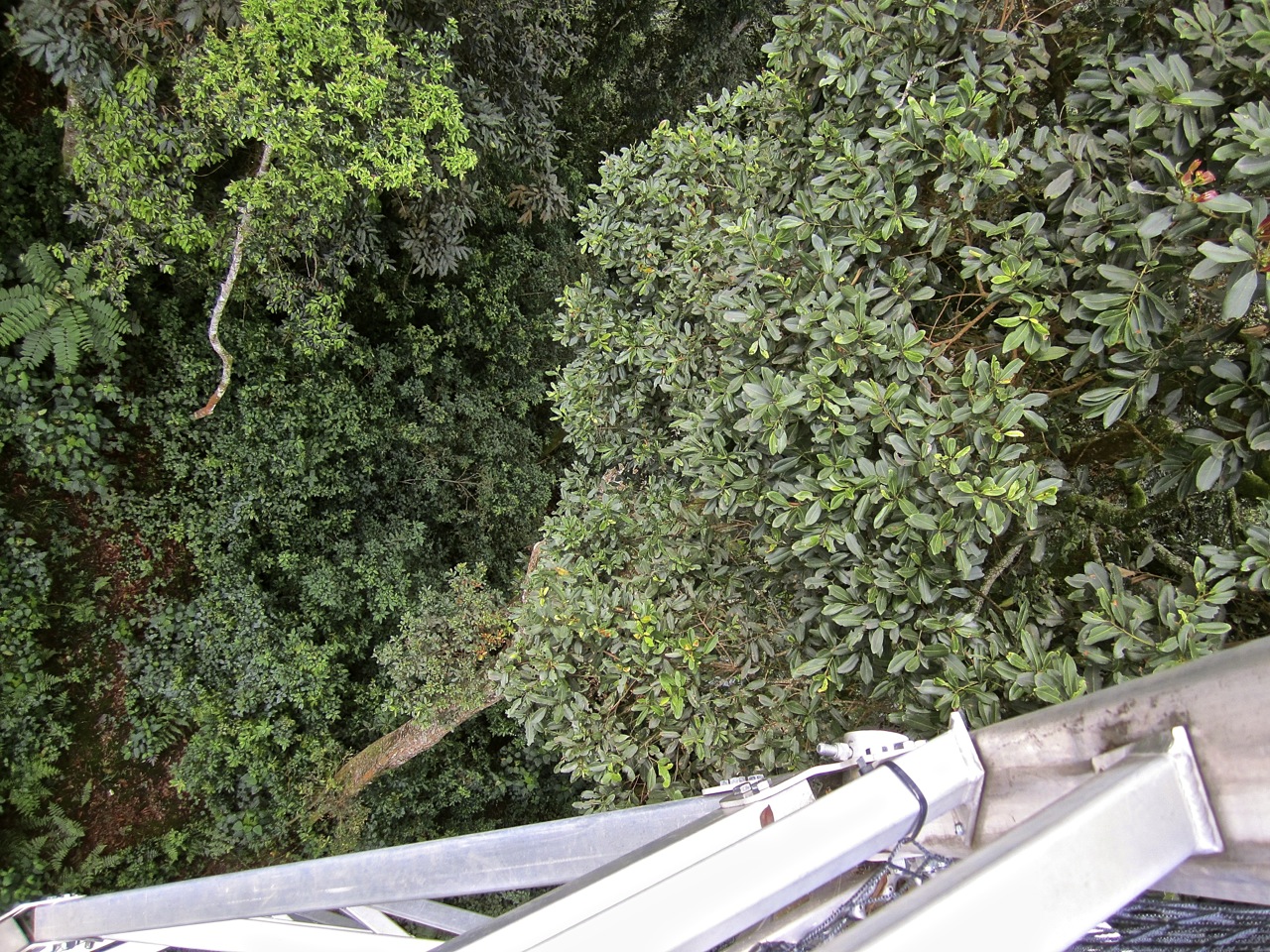
Below:  looking down from the platform of the first tower. . .

18 Look down, Canopy walk, Nyungwe Park, Rwanda:enclos*ure

Below, we started out onto the middle and highest section. . .

19 Treetops, canopy walk, Nyungwe Park, Rwanda:enclos*ure

and began to look down.

20 Look down, Canopy walk, Nyungwe Park, Rwanda:enclos*ure

22 Look down, Canopy walk, Nyungwe Park, Rwanda:enclos*ure

23 Look down, Canopy walk, Nyungwe Park, Rwanda:enclos*ure

It is unsurprisingly difficult to take pictures while standing on a 12″ wide swaying walkway.

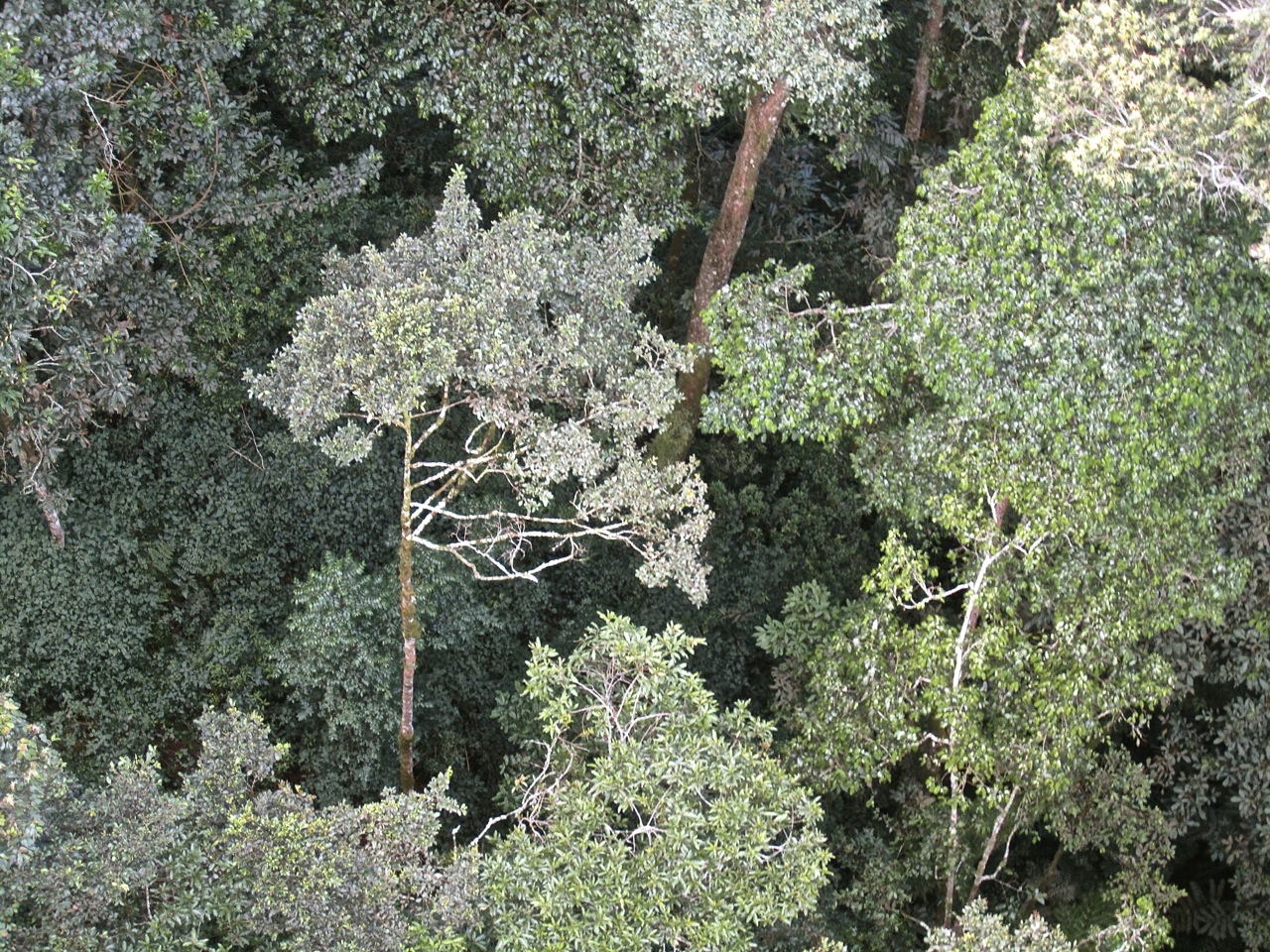
Below, you can see the tops of tree ferns, for which the trail is named (in Kinyarwanda), and we could hear water from a hidden stream.

25Look down, Canopy walk, Nyungwe Park, Rwanda:enclos*ures

A park guidebook says, “The walkway is strong and secure but will provide the visitor with a definite burst of adrenaline.”

26 View from canopy walk, Nyungwe Park, Rwanda:enclos*ure

In the photo above, taken from the walkway, you can see what I think are the young reddish-rose leaflets of Carapa grandiflora.  There is a wonderful full-color field guide on the plants of the park (here*), but, of course, mine was sitting back home on my desk during our trip.  However, I’m sure this was the best thing for my relationships with my husband and daughter, not to mention the guide.

Although the forest is home to many species of birds and monkeys, we did not see any along this trail — possibly because the popular walk is a bit noisy with humans talking.  But we saw both blue and L’Hoest’s monkeys along the road on the drive back to the lodge and from the balconies of our rooms.  And there is another park trail that features groups of chimpanzees.

And the next day, when we were almost out of the park, we spotted this guy, below, and a friend walking along the side of the road (photo by M. Koran).

Baboon in Nyungwe National Park. Photo by M. Koran/enclos*ure

To scroll through larger version of the images, click on ‘Continue reading’ below and on any thumbnail in the gallery.

*Sometimes you can find it here in Rwanda at bookstores or museum shops.  However, they were not selling it at the park or lodge when we were there.
Continue reading “The canopy walk, Nyungwe Forest”