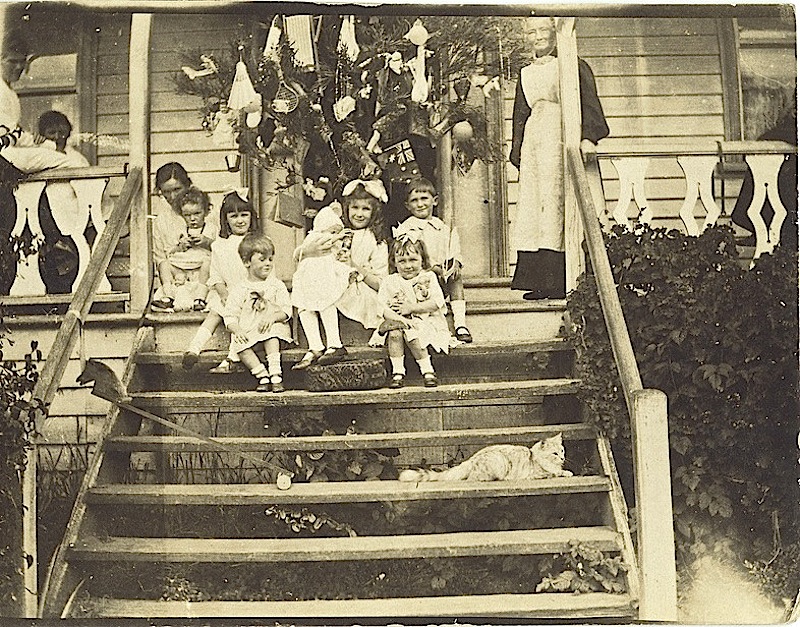
The Sunday porch: Tasmania

Christmas scene on porch, via Tasmanian Archives on flickr“Children beside a Christmas tree,” ca. 1910s, via Tasmanian Archive and Heritage Office Commons on flickr.
I think this snapshot may have been taken by a child — the focus is as much on the toy horse and the cat as on the other children and the tree.

The Sunday porch: the Berry’s

The Berry house“Berry’s house,” between 1910 and 1925,* probably near Selma, California, by National Photo Company, via Library of Congress Prints and Photographs Division (all photos here).

I think this is the farm that Ethel and Clarence Berry bought near her parents’ home in Selma after they became millionaires in the Klondike gold rush.

Ethel was one of the first women miners to go to Alaska, leaving right after her wedding in 1896. The next spring, the couple struck it amazingly rich on the Eldorado and Bonanza Creeks.

When she arrived in Seattle that summer — headed to the bank alone with $100,000 in gold that she’d kept hidden in her bedroll — she was immediately embraced by the popular press as the “Bride of the Klondike.”

The Berrys invested their money in more Alaskan mines (and in oil) and stayed rich.  They moved between the farm in Selma and a home in Alaska until Clarence’s death in 1930. Ethel then moved to Beverly Hills.  She died there in 1948.


*I suspect the photos were taken closer to the earlier year given, judging from the photo of Ethel and her sister (after ‘Continue reading’). Ethel would have been 37 years old in 1910.

Continue reading “The Sunday porch: the Berry’s”

The Sunday porch: lattice and brick

This slideshow requires JavaScript.

“William Windom house, 1723 de Sales Place, Washington, D.C., Terrace,” ca. 1925, four hand-colored glass lantern slides by Frances Benjamin Johnston, via Library of Congress Prints and Photographs Division.

Johnston used these slides in her “Gardens for City and Suburb” lectures. (You can scroll through larger version by clicking on ‘Continue reading’ below.)

De Sales Place (now Row) is an alleyway between L and M Streets, N.W. (It connects 18th and 19th Streets.) The house is gone; an office building occupies the site.

The William Windom who gave his name to the home was twice Secretary of the Treasury, as well as a Congressman and Senator from Minneasota. He died in 1891. His son, also a William, may have been living in the house at the time of these photos.  He died in 1926.

[We] usually learn that modesty, charm, reliability, freshness, calmness, are as satisfying in a garden as anywhere else.

— Henry Mitchell, from The Essential Earthman

Continue reading “The Sunday porch: lattice and brick”

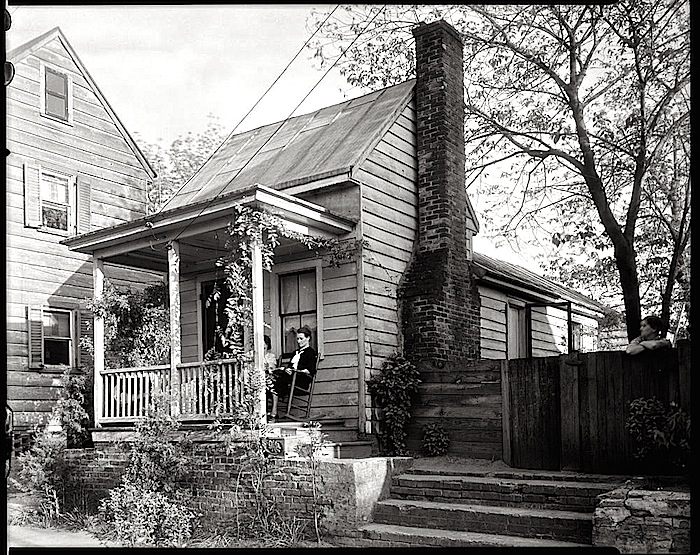
The Sunday porch: small house

Wide enough for two rocking chairs, at least. . .

Small house, via LoCNew Bern, North Carolina, 1936, by Frances Benjamin Johnston, via Library of Congress Prints and Photographs Division.

The Sunday porch: Washington, D.C.

This slideshow requires JavaScript.

Rowhouses,  Southwest Washington, D.C., between 1941 and 1942, by Louise Rosskam on Kodachrome color film, via Library of Congress Prints and Photographs Division.

The photos show cast iron stoops and steps, which were typical in many D.C. neighborhoods after the city’s building boom of the 1870s.

“Iron was strong, inexpensive to produce, manufactured quickly, and easily assembled with little on-site labor,” according to an interesting pamphlet by the Capitol Hill Restoration Society on the history and care of old cast iron and wrought iron.

“Washington had five foundries in 1870 and fifteen most years from 1895 to 1905,” according to the pamphlet.  Because of the industry’s dependence on water (or rail) connections to obtain raw materials, they “were usually in Georgetown, near the canal terminus, or along Maine Avenue on the Potomac River Waterfront.”

At first, I thought that both of the photographs above were of the same two houses.  Then I realized that the screen doors are different and that the brickwork over the windows is painted white in only one of the pictures.

The narrow open passageway between both sets of houses is interesting.

You can see what the corner of N and Union (now 6th) Streets, S.W., looks like today here.

In the windows of the houses with the children on the steps, you can just see the families’ Blue Star service flags (put your cursor on the slideshow to pause it). They reveal that the family on the left had one son in the war and the family on the right had two. (A gold star on a window flag would indicate that a son had been killed.)