The Sunday porch: wedding party

Sanders-Eckles wedding party, Lincolnville, Florida, ca. 1925, from the Richard Twine Collectionvia Florida Memory (State Archives and Library of Florida) Commons on flickr.

Lincolnville is an historically African-American neighborhood of St. Augustine. It was established after the Civil War, in 1866, by several freedmen and women who leased the land for $1 a year.  By the 1880s, it had begun to grow and “was characterized by narrow streets, small lots, and houses built close to the street line, similar to the colonial St. Augustine style and land-use pattern,” according to Wikipedia. By the 1930s, it was an important subdivision of the city in size and in political participation of its residents, and by the 1960s, it drew national attention for its role in the Civil Rights Movement.

In 1991, Lincolnville was listed on the National Register of Historic Places for its many late Victorian Era buildings and its place in African-American history. It is now known as the Lincolnville Historic District.

The Sunday porch: Vincennes, Indiana

Sunday afternoon on the front porch, Vincennes, Indiana, July 1941, by John Vachon, via Library of Congress Prints and Photographs Division.

Nice striped socks.

Interrupted by visitors.
At least it looks like he didn’t have to leave his book and go inside with them.

The Sunday porch: Hill End


“Two women on veranda of rendered* cottage with shingle roof and front garden, Hill End, New South Wales, ca. 1872,” by Charles Baylissvia National Library of Australia Commons on flickr.

Hill End was a gold rush town. At the time of this photo, “it had a population estimated at 8,000 served by two newspapers, five banks, eight churches, and twenty-eight pubs,” according to Wikipedia. The rush was over by the early 20th century. In 2006, the town was down to 166 people.

The photographer came to Hill End as an assistant to a traveling photographer who had been contracted to take pictures of the area that could be used to advertise the mining colony and attract new residents.


*Render is stucco.

The Sunday porch: County Armagh

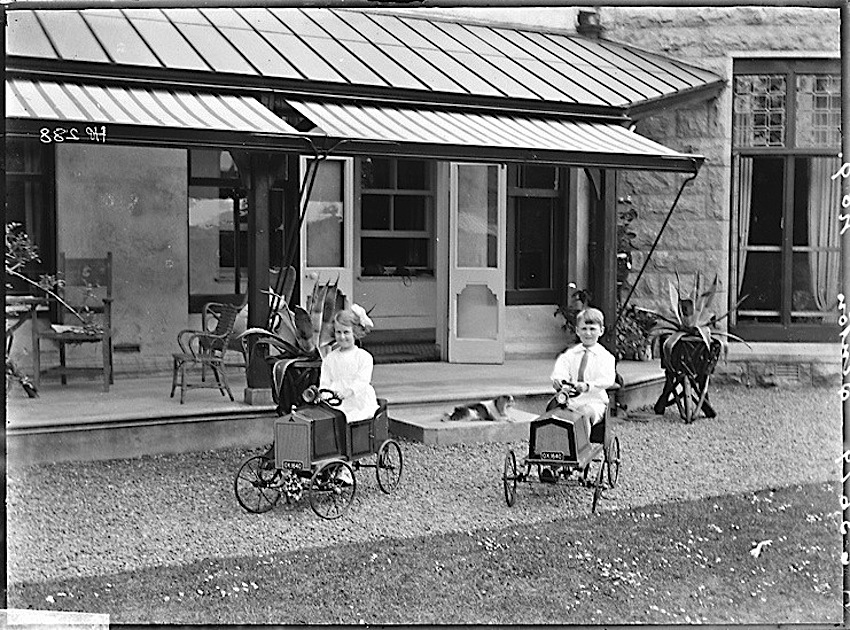
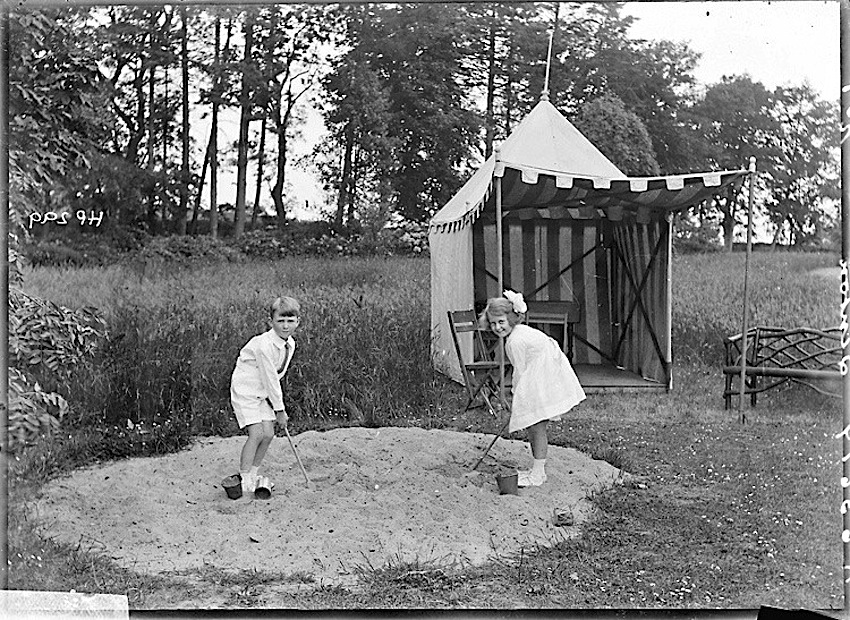
Bridget and Maynard Sinton at their family home of Ballyards, County Armagh, June 17, 1921, by H. Allison & Co. Photographers, via Public Record Office of Northern Ireland Commons on flickr.

That retractable striped awning emerging from the terrace roof looks very sleek and was brand new.  A ca. 1920 photo of the house in this biography of the children’s father shows the terrace with no cover. (You can read a brief history of awnings here.)

Ballyards was built in 1872 and sold to the father, a linen manufacturer, in 1908. He almost doubled its size and called it “Ballyards Castle.”

The children playing in a sandpile. (This photo has been printed in reverse from the others.)

Maynard was killed in WWII, but Bridget (age 7 in these photos) lived until 1975.

The Sunday porch: Estero, Florida


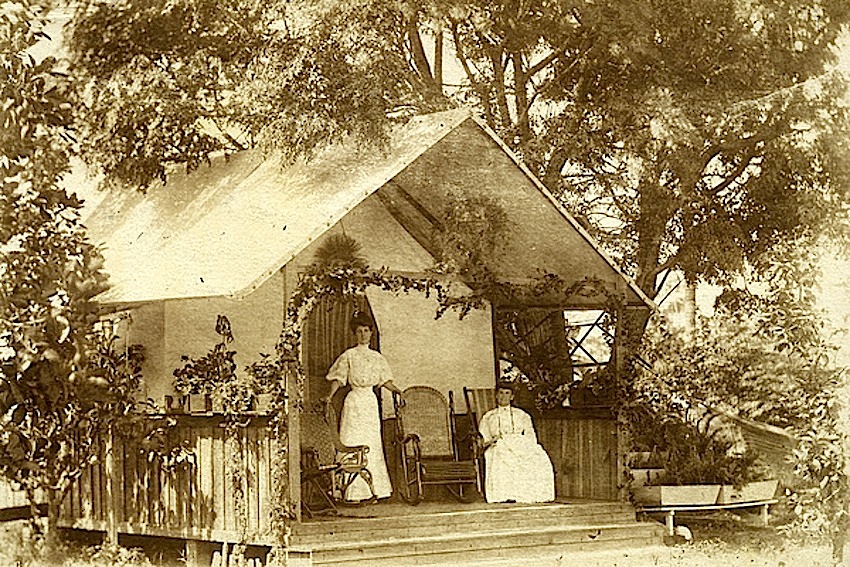
“Tent house on Koreshan property in Estero, Florida,” 1895, via Koreshan Unity Collection, Florida Memory Commons on flickr (State Library and Archives of Florida).

The Koreshan Unity was a late 19th and early 20th century utopian community whose members believed in a god that was both male and female, as well as in reincarnation, celibacy, collectivism, equality of the sexes, and cellular cosmogony.* It was founded by Cyrus Teed in upstate New York in the 1870s, and later there were also followers in Chicago and San Francisco. In 1894, the community began moving to a donated 320-acre property in Estero, Florida. During the next decade, it purchased over 5,000 additional acres and began building a settlement that “included a sawmill, cement works, bakery, machine shop, general store, art gallery, symphony, theater troupe, plant nursery and more,” according to USA Today. Its population peaked at 250 residents between 1903 and 1908; the majority were well-educated middle-class women, seven of whom managed the day-to-day affairs of the commune.

When Teed died in 1908 — and his body was not resurrected as he had promised — the commune began to decline; there were 10 members left in 1948. The last Koreshans deeded the site of its village to the state of Florida in 1961. It is now a state park.


*”Among the most interesting beliefs of Koreshan Unity was the cellular cosmogony, or the hollow earth,” according to Florida Memory.  “According to the cellular cosmogony, the earth was not a convex sphere but instead a hollow, concave cell containing the entire universe with the sun at its center and Earth’s populace living on the inside surface of the hollow cell.”