Vintage landscape: Los Angeles

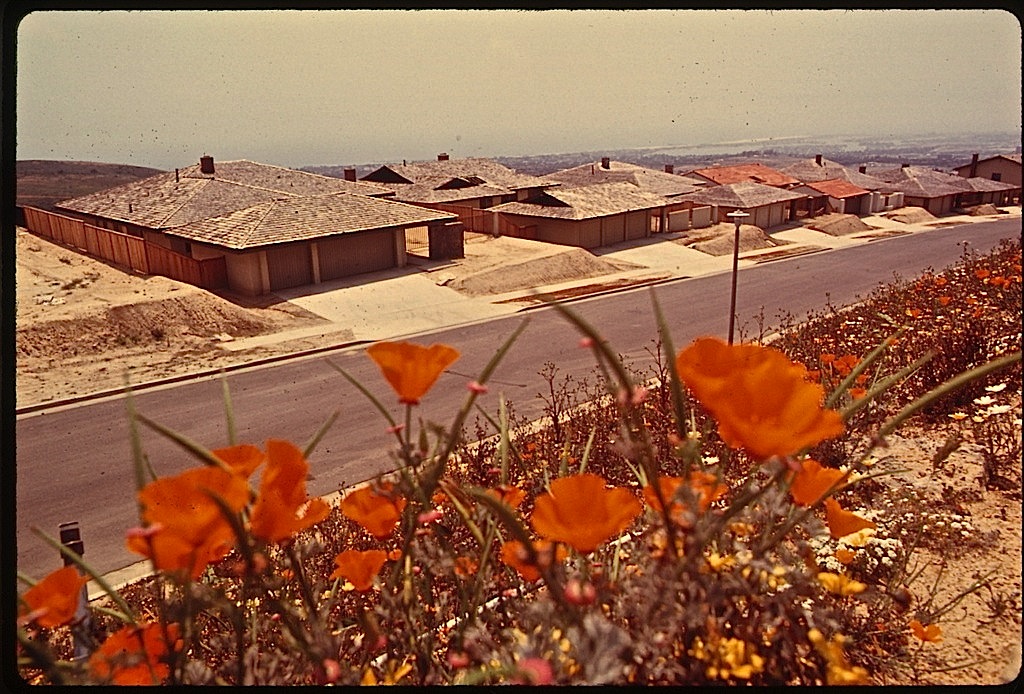
L.A. houses, DOCUMERICA, National ArchivesFlowers planted around Spyglass homes built on a terraced hillside[, Los Angeles], May 1975.”

This photo was taken by Charles O’Rear for DOCUMERICA,  a 1970’s photography program of the Environmental Protection Agency.

There are more pictures from DOCUMERICA here.

Another May

Poem on window pane (detail), HABS, Library of Congress

Another May new buds new flowers
Ah why has happiness no second spring

Scratched into a sitting room window pane of Borough House, which was built between 1758 and 1821 in Sumter County, South Carolina.

The words (with slight variations) are from “Sonnet II” by Charlotte Smith  — whose poems were praised by her contemporaries Wordsworth and Coleridge.

I have not been able to find out who might have put them on the window.

Borough House, S.C., HABS, Library of CongressBorough House is architecturally noteworthy because it is partly constructed with rammed earth — an unusual building material in the United States.  (There is more about the house here.) It still stands today, in private ownership.

(I believe that the window with the poem is one of the two left of the front door.)

The photos here are part of an Historic American Buildings Survey (HABS), May 1985, via Library of Congress Prints and Photographs Division.

Bloom Day in May: Mugongo

This slideshow requires JavaScript.

My parents were visiting us last week, and we took an overnight trip to the north of Rwanda. We made a stop at Mugongo, the former home and plantation of long-time American resident Roz Carr, who founded Imbabazi Orphanage in 1994, reworking her old farm buildings.

You can read about Roz’s life in Rwanda, from 1949 to 2006, here.

The long English-style flower borders looked particularly colorful as we near the end of the rainy season. Among the many plants blooming were calla lilies, hybrid tea roses, crocosmias, cannas, calendulas, fuchsias, violets, ageratum, hydrangeas, borage, sedum, Santa Barbara and Shasta daisies, azaleas, irises, dahlias, begonias, and day lilies.

It is a credit to Roz’s good strong design and to the continuing dedication of the gardeners she trained that the garden is still so beautiful, almost eight years after her death.

Click here for more information about the Imbabazi Foundation and how to visit the Mugongo garden.

You can scroll through more (and larger) photos by clicking on ‘Continue reading’ below and then on any of the thumbnail images.

Thanks to Carol of May Dreams Gardens for hosting Garden Bloggers’ Bloom Day (the 15th day of every month). Continue reading “Bloom Day in May: Mugongo”

Vintage landscape: Hawthorne Lane

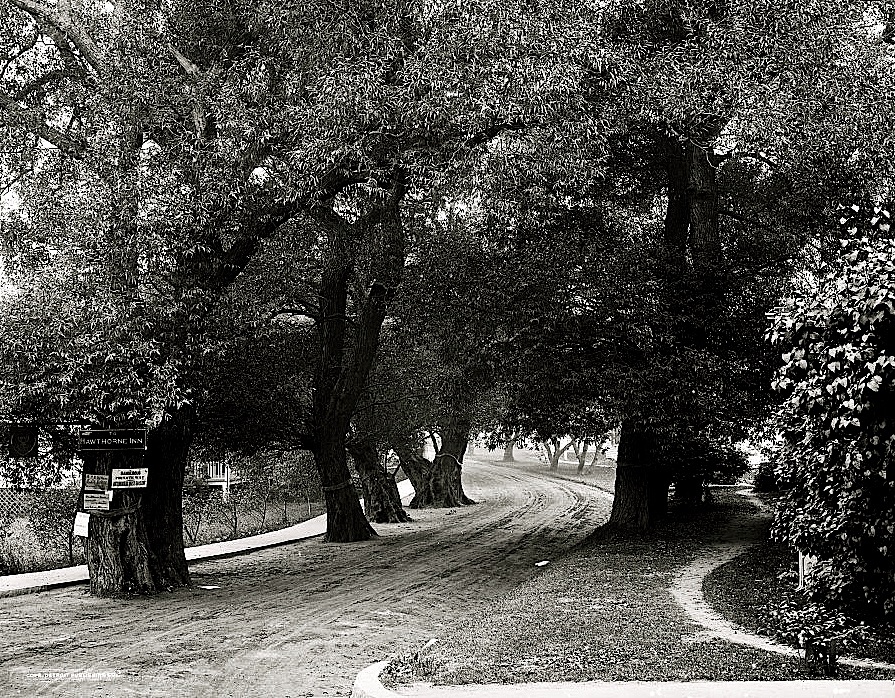
Vintage landscape/enclos*ure: Hawthorne Lane, Mass., early 20th c., via Library of CongressHawthorne Lane, East Gloucester, Massachusetts, between 1900 and 1920, by Detroit Publishing Co., via Library of Congress Prints and Photographs Division.

The signs on the tree: Direct to Hawthorne Inn (to the right), A.P.T. deHaas Gate Lodge (to the left), and Miss Willard’s Studio.

Vintage landscape: Meridian Hill Park

Orpheus with his lute made trees. . .*
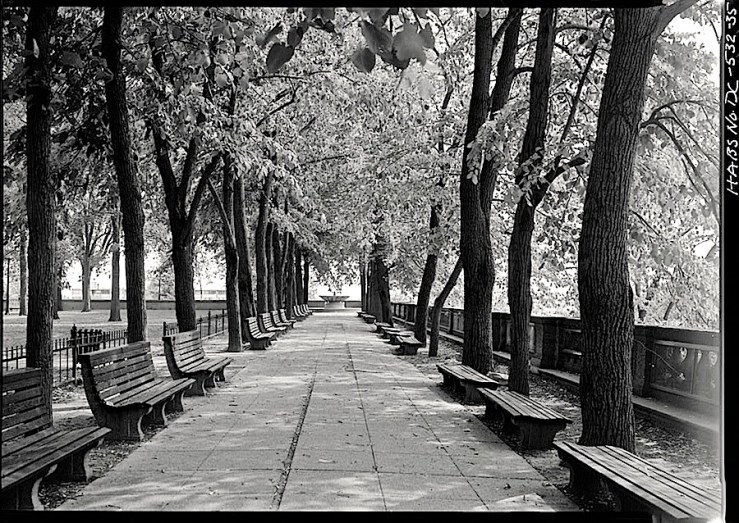
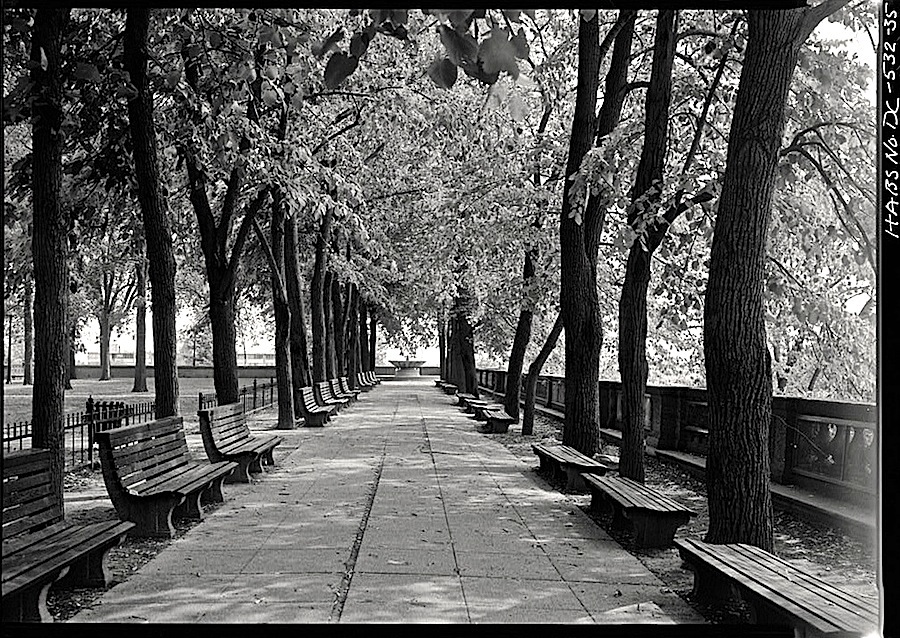
Vintage landscape/enclos*ure: Meridian Hill Park, D.C., 1976, via Library of CongressThe Linden Walk, Meridian Hill Park,* Washington, D.C., August 1976, by Jack Boucher for an Historical American Buildings Survey (HABS), via Library of Congress Prints and Photographs Division.

This HABS has photos from 1976 and 1985. The report, which contains a very detailed description and history of the park’s design, was completed in 1987.

Unfortunately, the report notes that the linden trees shown above had to be cut down between 1976 and 1985 because they were threatening the 16th St. retaining wall (on the right side). They were replaced quickly, however, as you can see here.

The HABS report summarizes the importance of Meridian Hill Park this way:

One of the first public parks in the United States to be designed as a formal park, generally considered to be in the continental tradition, rather than in the “natural” mode associated with the English park; Meridian Hill Park was constructed [from about 1914 to 1936]. . . . Under the guidance of the Commission of Fine Arts, the park benefited from the finest criticism of the day. The technologically innovative use of exposed aggregate concrete provided a facsimile of the stone and mosaic masonry traditionally employed in the Italian Garden. The Park represents an effort in a democratic society to match the major European city park.

Today, the last Friday in April, is Arbor Day in many states in the U.S. The day was established to encourage people to plant and care for trees.

The words themselves are a delight to learn,
You might be in a foreign land of terms
Like samara, capsule, drupe, legume and pome,
Where bark is papery, plated, warty or smooth.

Howard Nemerov, from “Learning the Trees


*Meridian Hill Park is bounded by Fifteenth, Sixteenth, Euclid and W Streets, N.W.  The quote above the photo is by William Shakespeare, from Henry VIII.