
My Bloom Day tulips from Wednesday have faded into orchid-like shapes this morning.
And shall we not part at the end of day,
With a sigh, a smile?— Ernest Dowson, from “April Love“
My Bloom Day tulips from Wednesday have faded into orchid-like shapes this morning.
And shall we not part at the end of day,
With a sigh, a smile?— Ernest Dowson, from “April Love“
So thou dost riot through the glad spring days. . .*
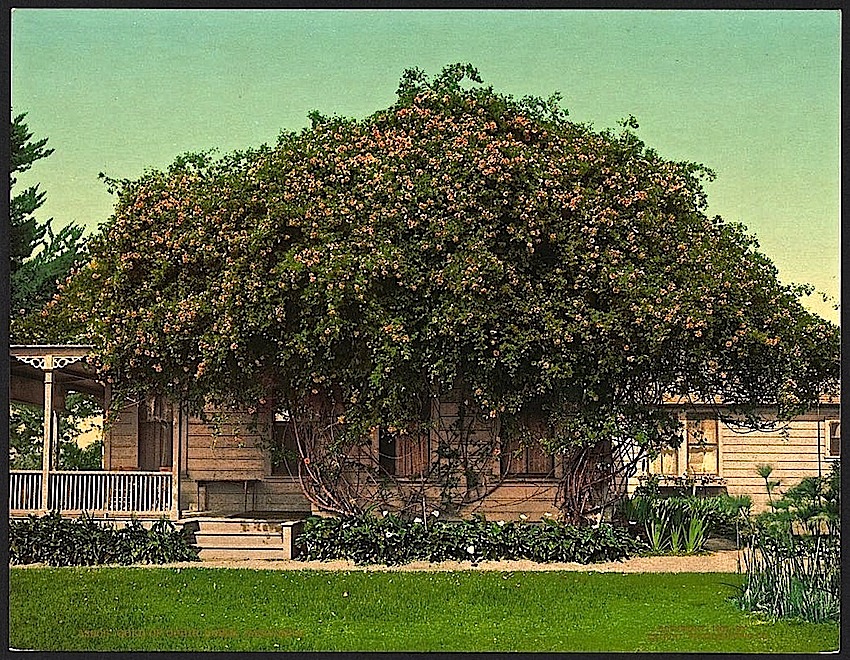 “Gold of Ophir roses, Pasadena[, California,]” ca. 1902, a photochrom by Detroit Photographic Co., via Library of Congress Prints and Photographs Division.
The climber Gold of Ophir — also known as Fortune’s Double Yellow and Beauty of Glazenwood — moved to southern California with the settlers and flourished there.
“I remember great heaps of them in every backyard, blazing like moons on fire, yellow, gold, pink. . .,” wrote M. K. Fisher in her introduction to Growing Good Roses by Rayford C. Reddell.
* from “Gold of Ophir Roses” by Grace Atherton Dennen, editor/publisher of The Lyric West
A previous occupant of our house left us three or four clumps of orange-red and dark pink tulips. I’m enjoying the colors in our kitchen window and in the living room.
To see what’s blooming today for other garden bloggers, visit Carol at May Dreams Gardens.
 Driveway, Castle Hill, Charlottesville, Virginia, 1926, by Frances Benjamin Johnston, via Library of Congress Prints and Photographs Division.
The original house on the plantation of Castle Hill was built in 1764 by Dr. Thomas Walker and his wife Mildred. Walker was a friend of Peter Jefferson and later guardian to his son,Thomas.
At the time of this photo, the property was owned by his descendant, Amélie Louise Rives Troubetzkoy, a novelist married to a Russian prince who eventually ran somewhat short of funds.
By the fall of 1938, when future novelist Louis Auchincloss, then a law student at the University of Virginia, came to have tea with the aging princess, he found her living in “romantic, impoverished isolation in a decaying manor house.” To get to the house, he had to find his way through a double row of aromatic box hedges that rose up three stories high and were so enormous that his bulky Pontiac could barely pass through. The awe-inspiring hedges even became the subject of one of Amélie’s poems, which she wrote in middle age. She ends the poem with “Hedges of Box,/Hedges of Magic./…Behind your barrier of glad enchantment/I have rediscovered reality.” The reality Amélie envisioned had herself within the encircling wall of boxwood, still a young beauty of twenty-one, seated on the back of a unicorn.
— Donna M. Lucey, from “The Temptress of Castle Hill,” Garden and Gun
Today, the estate is still privately owned. Its remaining 1,203 acres (from the original 15,000) have been permanently protected against development by a conservation easement with The Nature Conservancy.
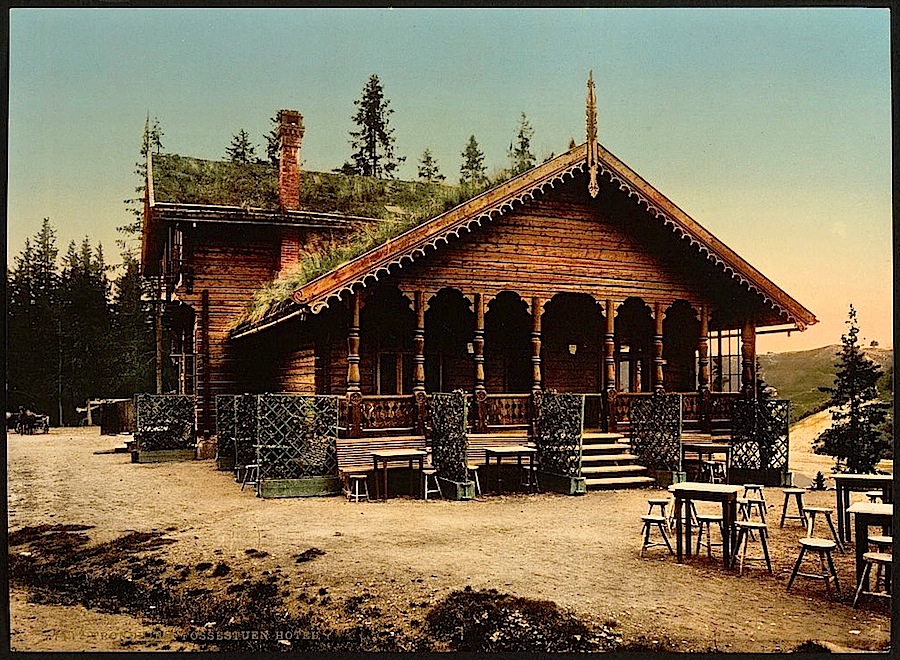 Fossestuen Hotel, Trondhjem, Norway, between ca. 1890 and ca. 1900, a photochrom by Detroit Publishing Co., via Library of Congress Prints and Photographs Division.
Click on the photo to get a better look at the building’s green roof and outdoor restaurant seating divided by planters and latticework.
Nestled in the mountains near the lower tier of the Lienfoss waterfalls, the Fossestuen Hotel drew many foreigners to this picturesque region of Norway. Built in 1892, the hotel was actually a restaurant that served dinner and refreshments to tourists. The building reflects the traditional wooden architecture of Norway, with the sod roof a source of insulation against the harsh winter cold.
— from the image’s page on World Digital Library, a project of the Library of Congress.
 enclos*ure