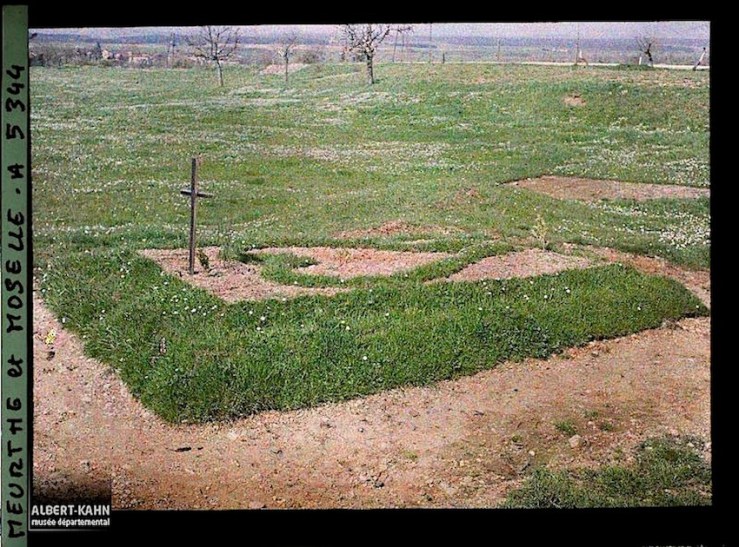
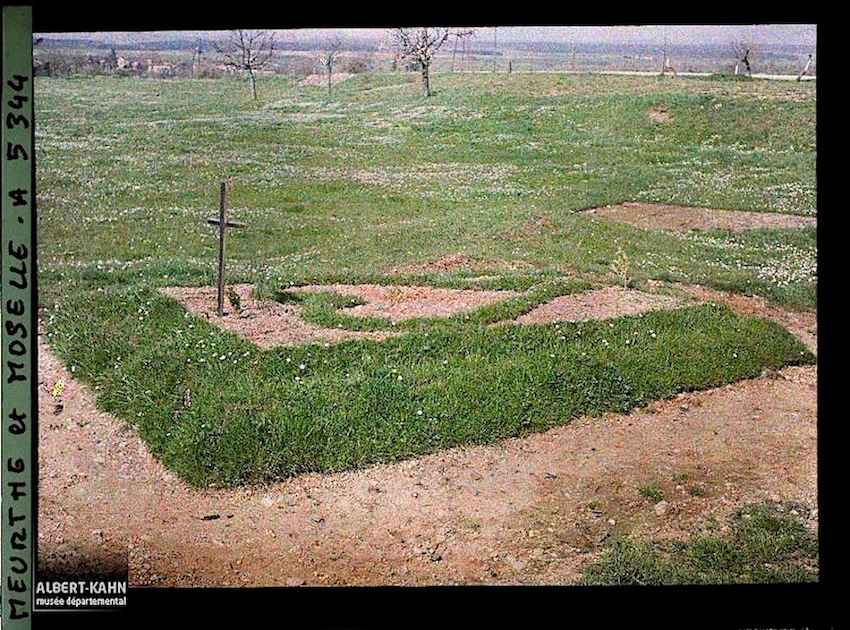
 “La Tombe des Coloniaux, a heart of grass, near Gerbéviller,” April 28, 1915, by Georges Chevalier, via Archives of the Planet Collection – Albert Kahn Museum /Département des Hauts-de-Seine.
This seems to be the grave of a soldier (or perhaps soldiers) from one of the French Colonial Infantry Regiments. He probably fell in the Battle of Lorraine about seven or eight months before the photo was taken. Such men, called “Marines,” were recruited from both France and the white settler and indigenous populations of the French colonial empire.
The town of Gerbéviller itself had been caught in the same battle’s crossfire. German troops had systematically burned over 400 houses and killed over 60 inhabitants. It became “Gerbéviller-la-Martyre” in the press and a kind of pilgrimage site.
Today, there are both French and German WWI cemeteries in Gerbéviller.
This autochrome is one of about seventy-two thousand that were commissioned and then archived by Albert Kahn, a wealthy French banker and pacifist, between 1909 and 1931. Kahn sent thirteen photographers and filmmakers to fifty countries “to fix, once and for all, aspects, practices, and modes of human activity whose fatal disappearance is no longer ‘a matter of time.'”* The resulting collection is called Archives de la Planète and now resides in its own museum at Kahn’s old suburban estate at Boulogne-Billancourt, just west of Paris. Since June 2016, the archive has also been available for viewing online here.
*words of Albert Kahn, 1912. Also, the above photo (A 5 344) is © Collection Archives de la Planète – Musée Albert-Kahn and used under its terms, here.


 enclos*ure