First, let me give you a very quick, belated GB Bloom Day. I was too wiped out to post yesterday. I spend most of the day transplanting some shrubs and a bunch of Gerbera daisies and asters. They needed dividing, and it was fiddily work pulling apart all the little roots. And there seemed to be a battalion of ants everywhere I wanted to put them.
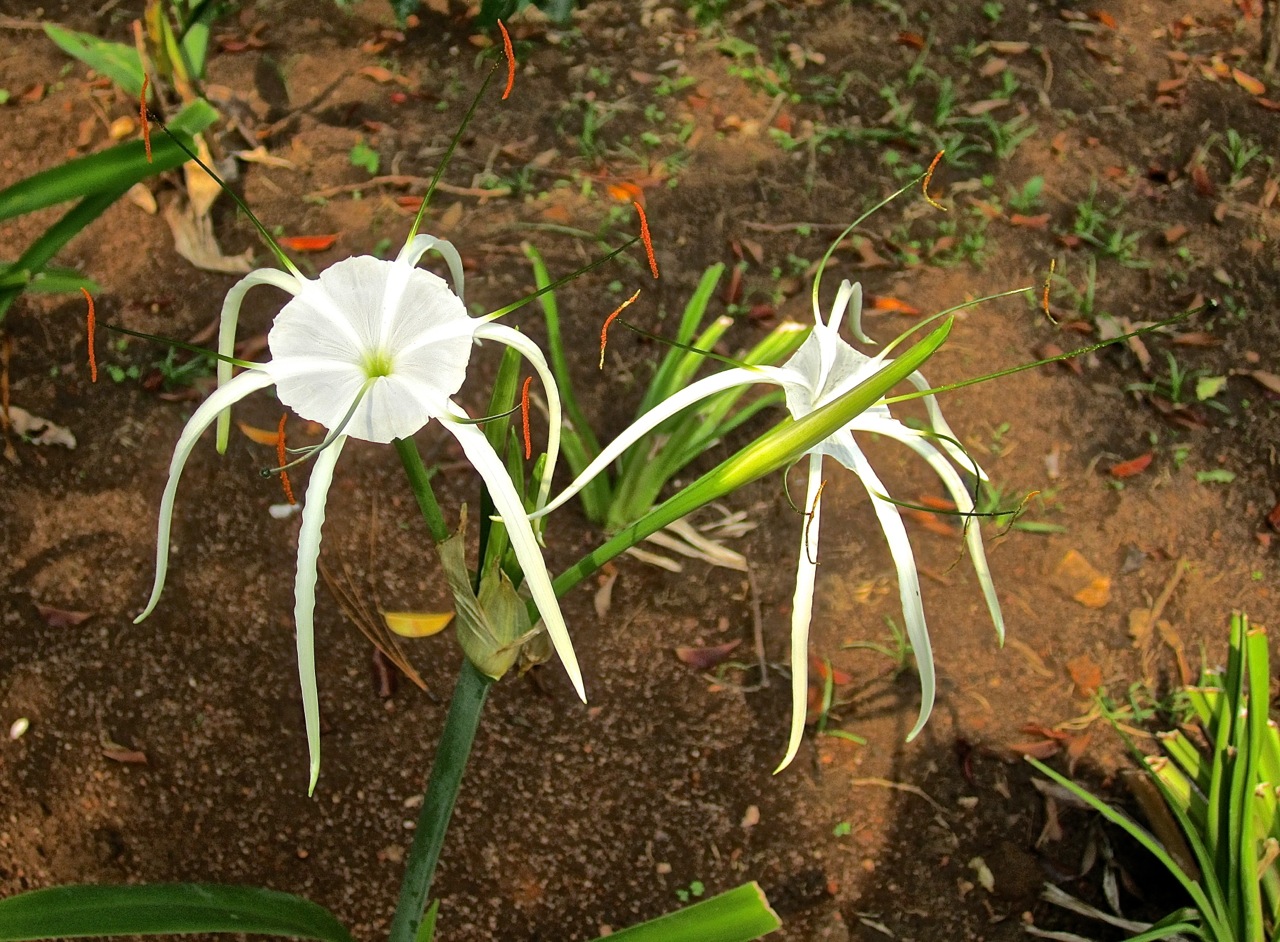
In the last month, as we’ve been renovating the garden, we’ve pulled out about 50 of these beach spiderlilies (Hymenocallis littoralis) from under old bushes and moved them to the front of the newly widened planting beds along the front lawn. They started blooming right away, although they’re a bit sad, since we cut off their leaves as we set them out.
Beach spiderlilies are native to southern Mexico, the west coast of Florida, and Central America, but somehow they made it to Rwanda, where they’re a common garden flower.
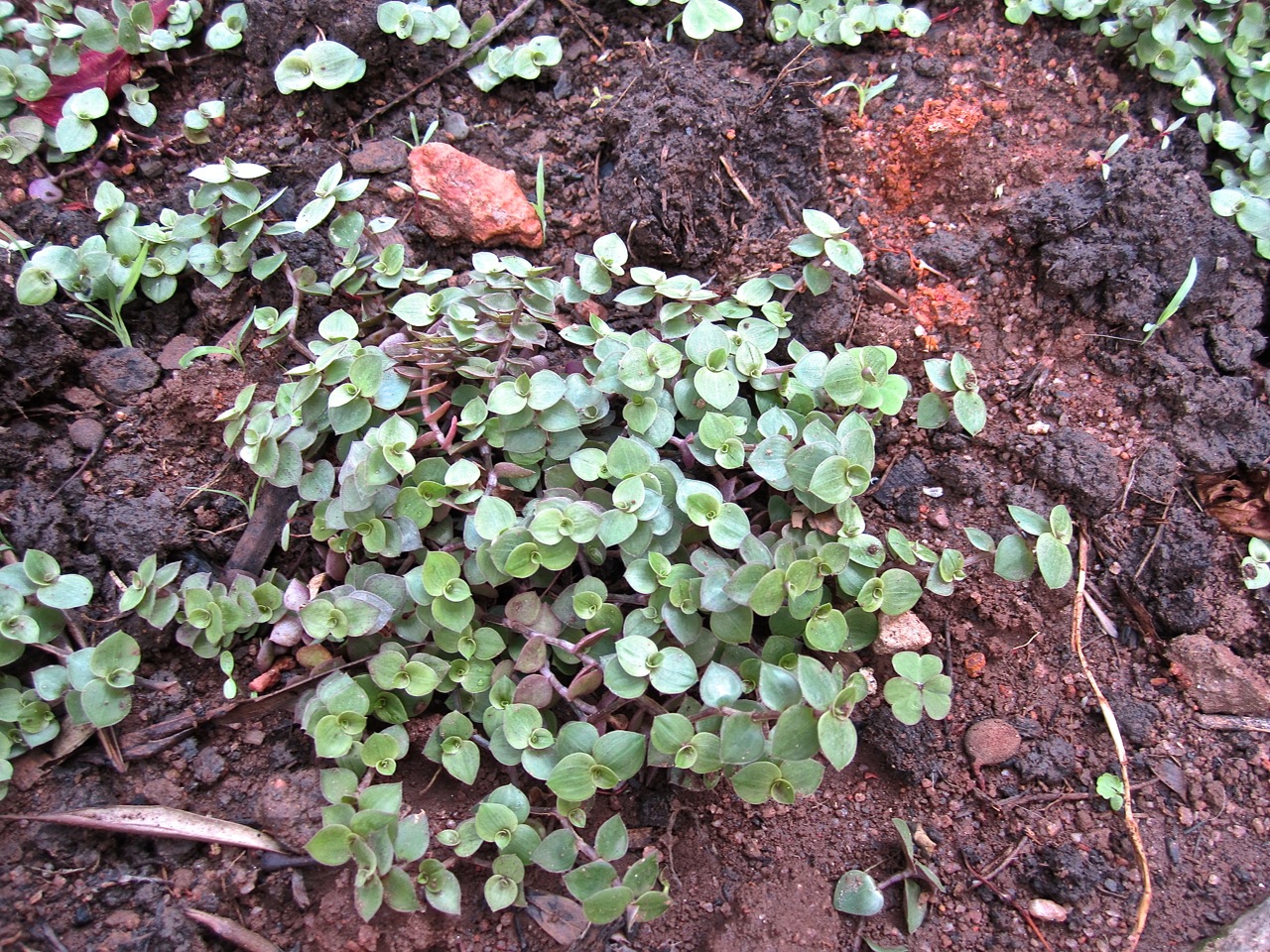
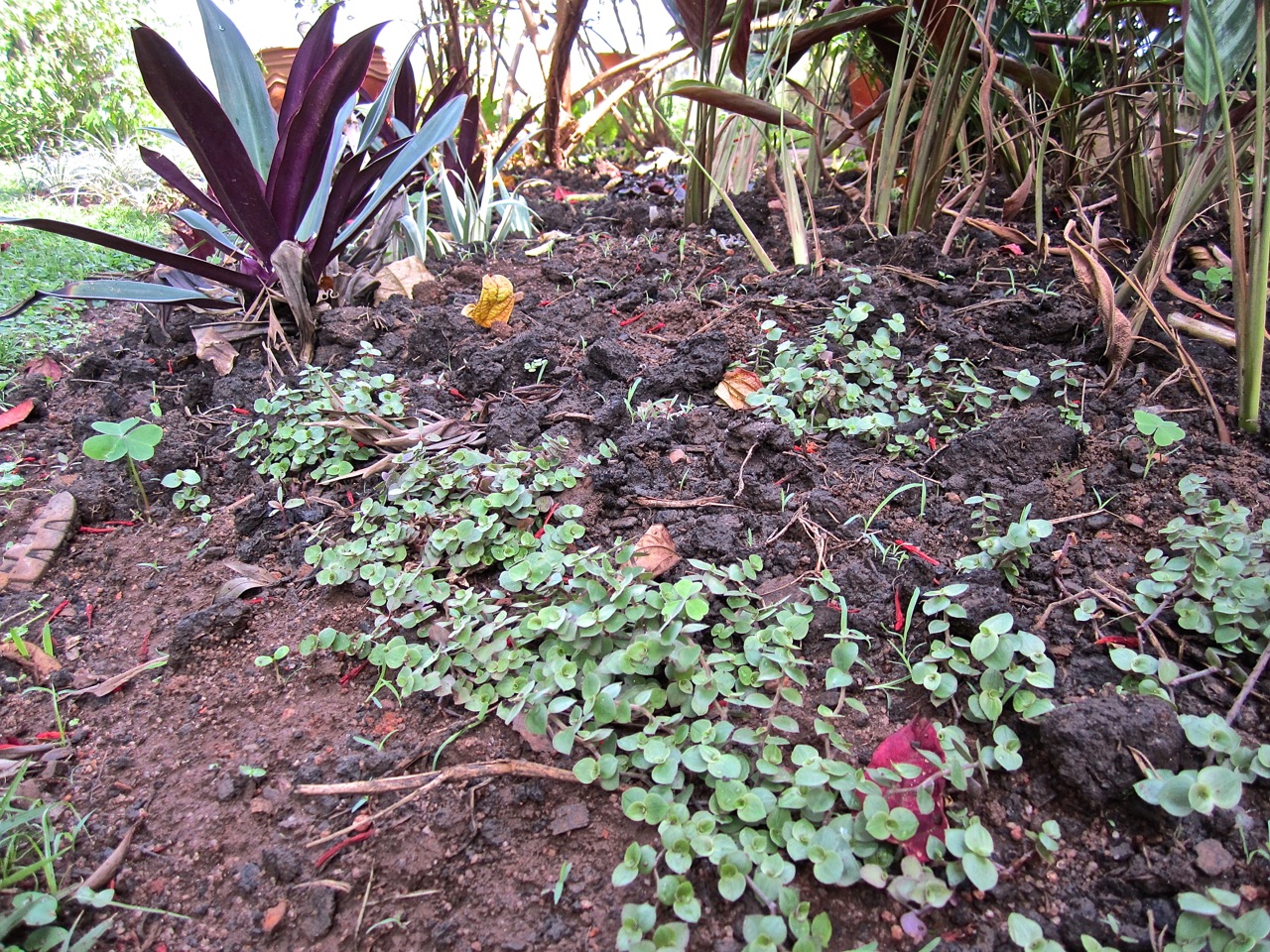
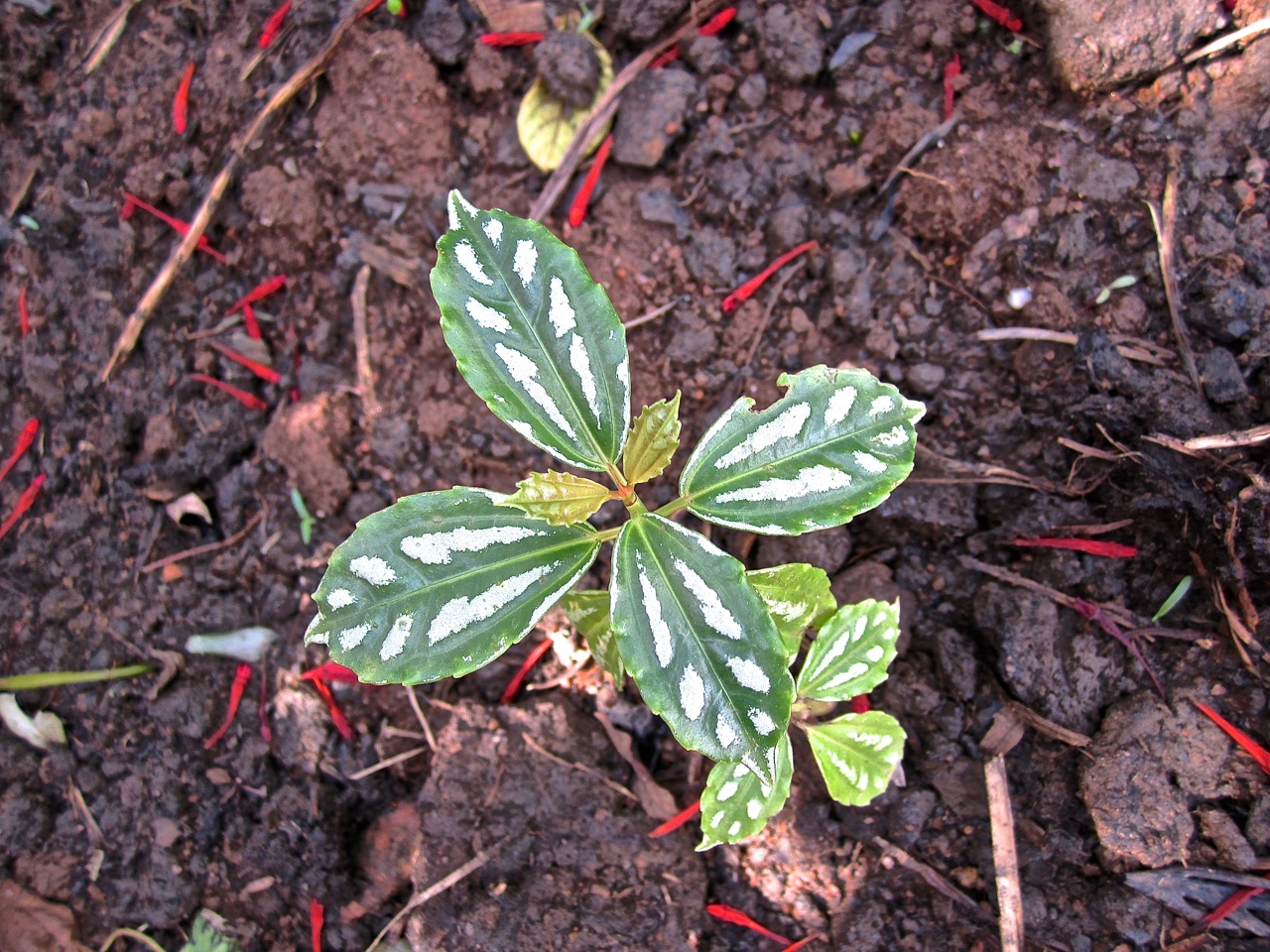
Now on to foliage: the little creeping plant below is a real lifesaver here where you can’t buy that nice bagged mulch to cover all the bare dirt in a newly planted area. I don’t know its name, but we had it in Niger as well. It may be a sedum.
It’s very shallow-rooted, so it’s easy to scoop up a handful, tease it apart a little, and then press it into loose soil under taller plants that need some time to fill out.
It’s grow-your-own mulch. It spreads quickly and can actually get out of hand, but I’ll always be tearing off the overflow for another spot. Or just tossing it — grow-your-own compost too.
In Washington, D.C., I had a spreading stonecrop sedum that served much the same purpose.
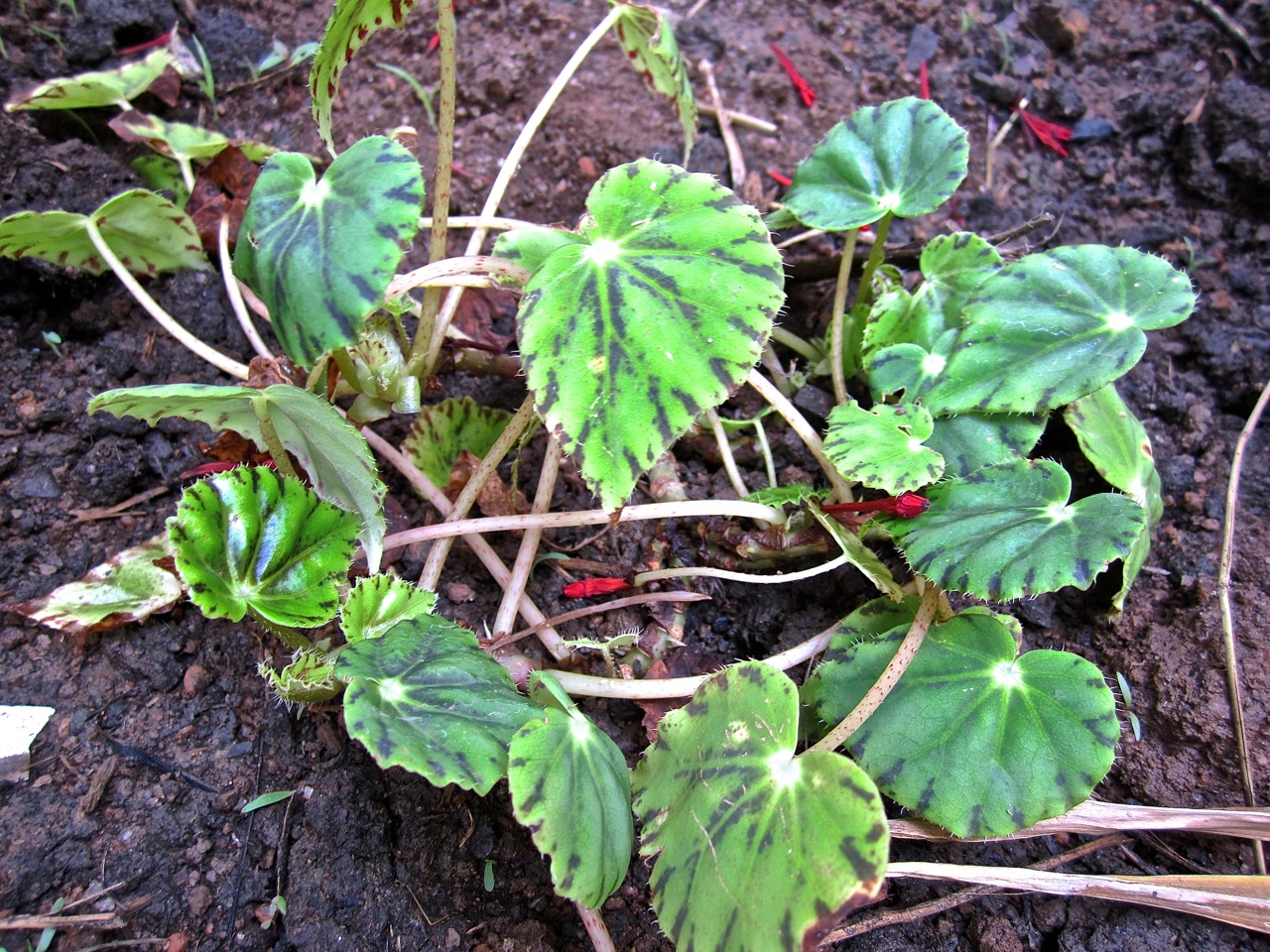
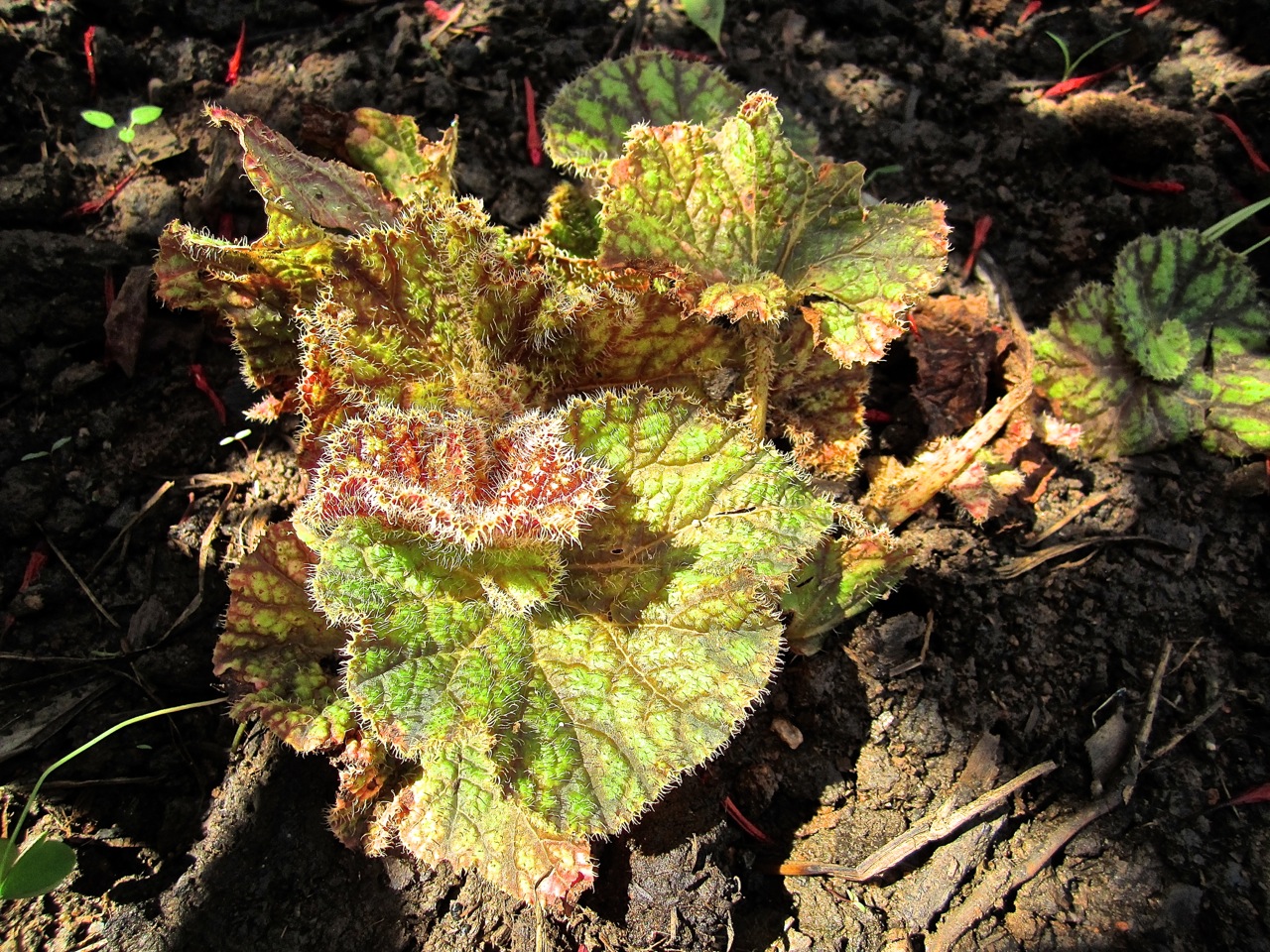
This month, I’ve also been pulling various begonias out of pots and re-planting them in semi-shade as ground cover. They won’t spread as fast as the sedum, but they should make a nice tapestry eventually.
I’m not going to try to name these varieties.
I think there as many different types of begonias as daylilies.
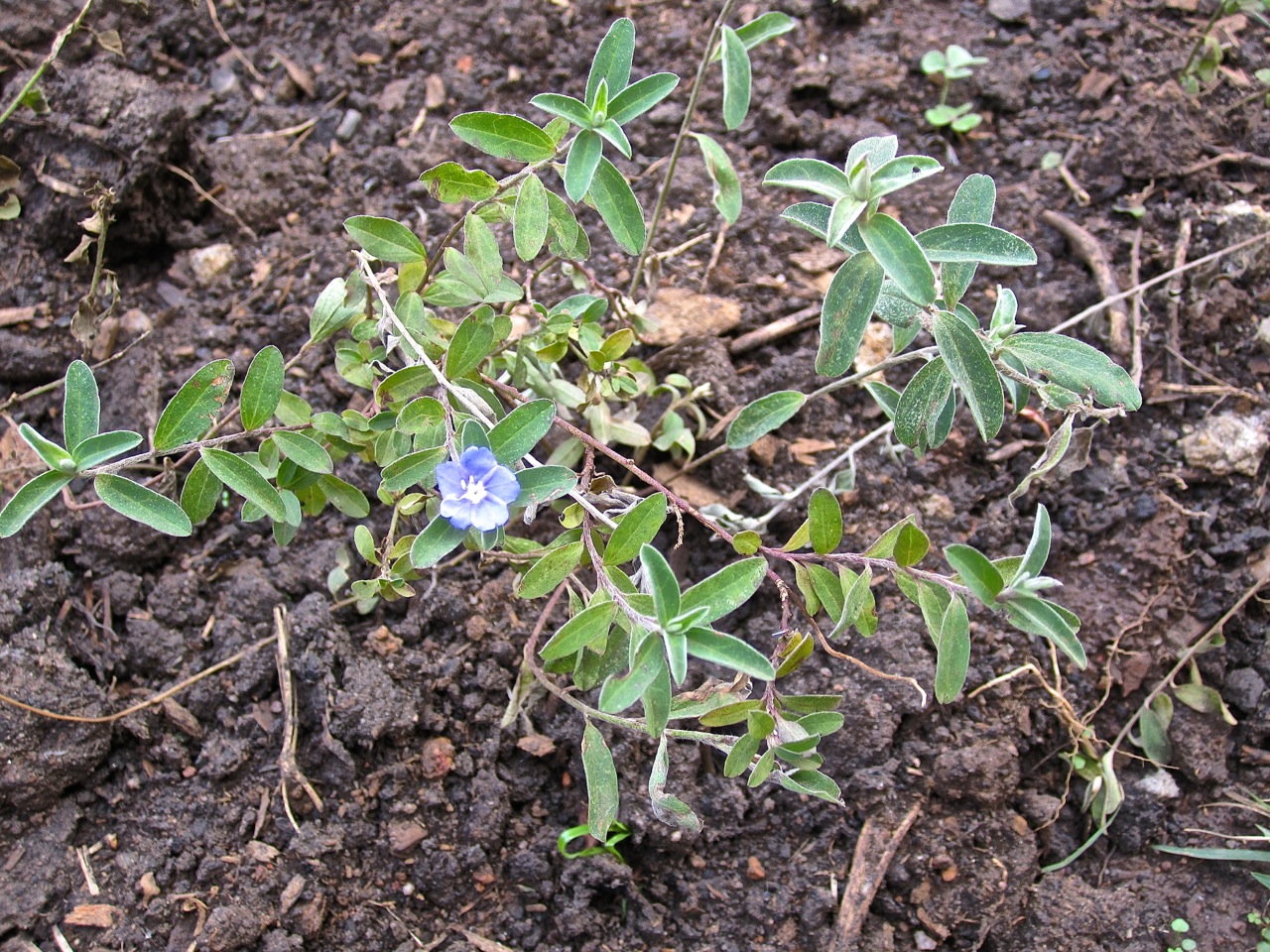
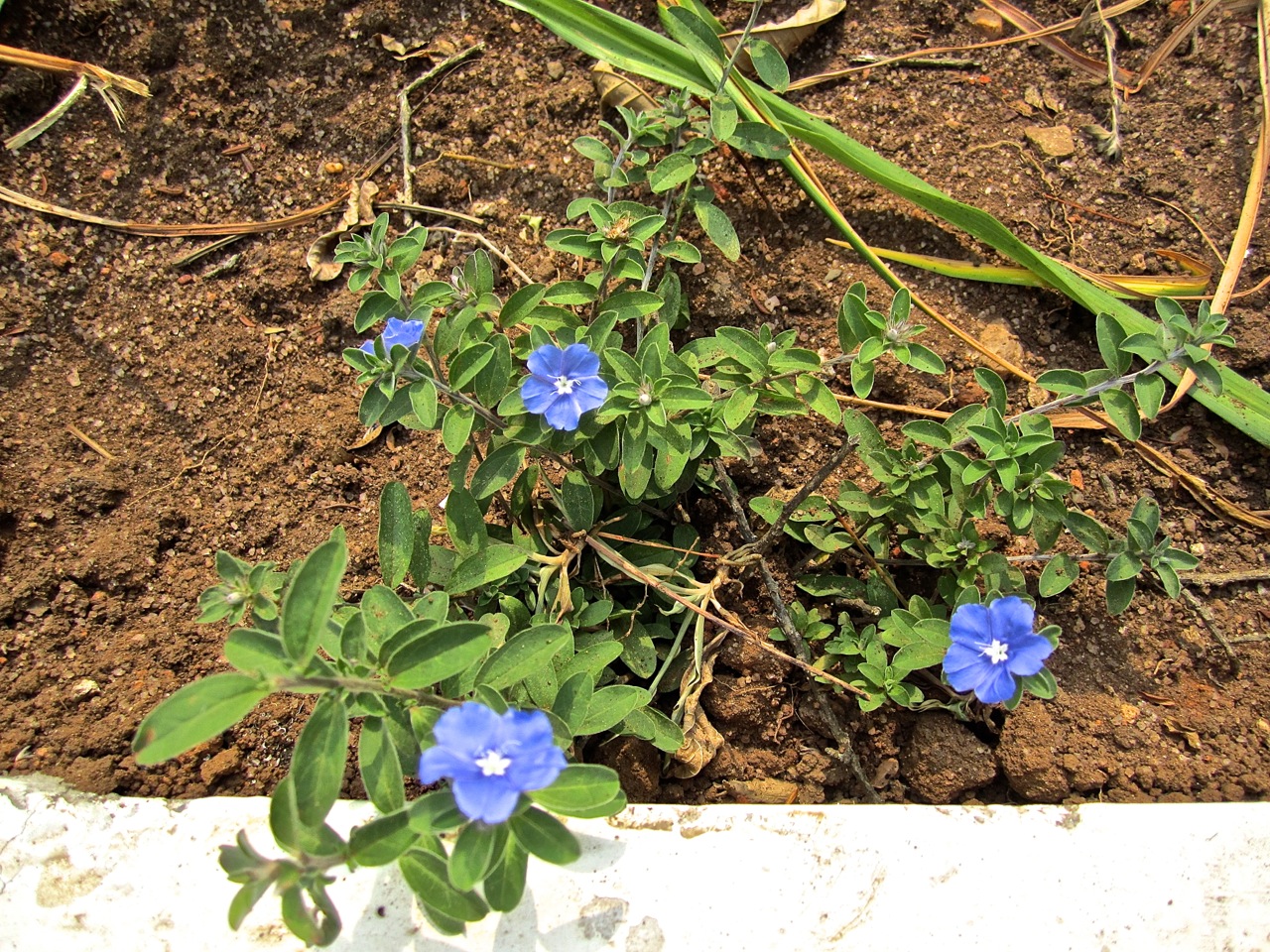
Below is great spreading plant for which I don’t yet have a name. I found it behind the back parking area, hidden by the curb. I’ve been dividing and planting it everywhere.
It has true blue flowers.
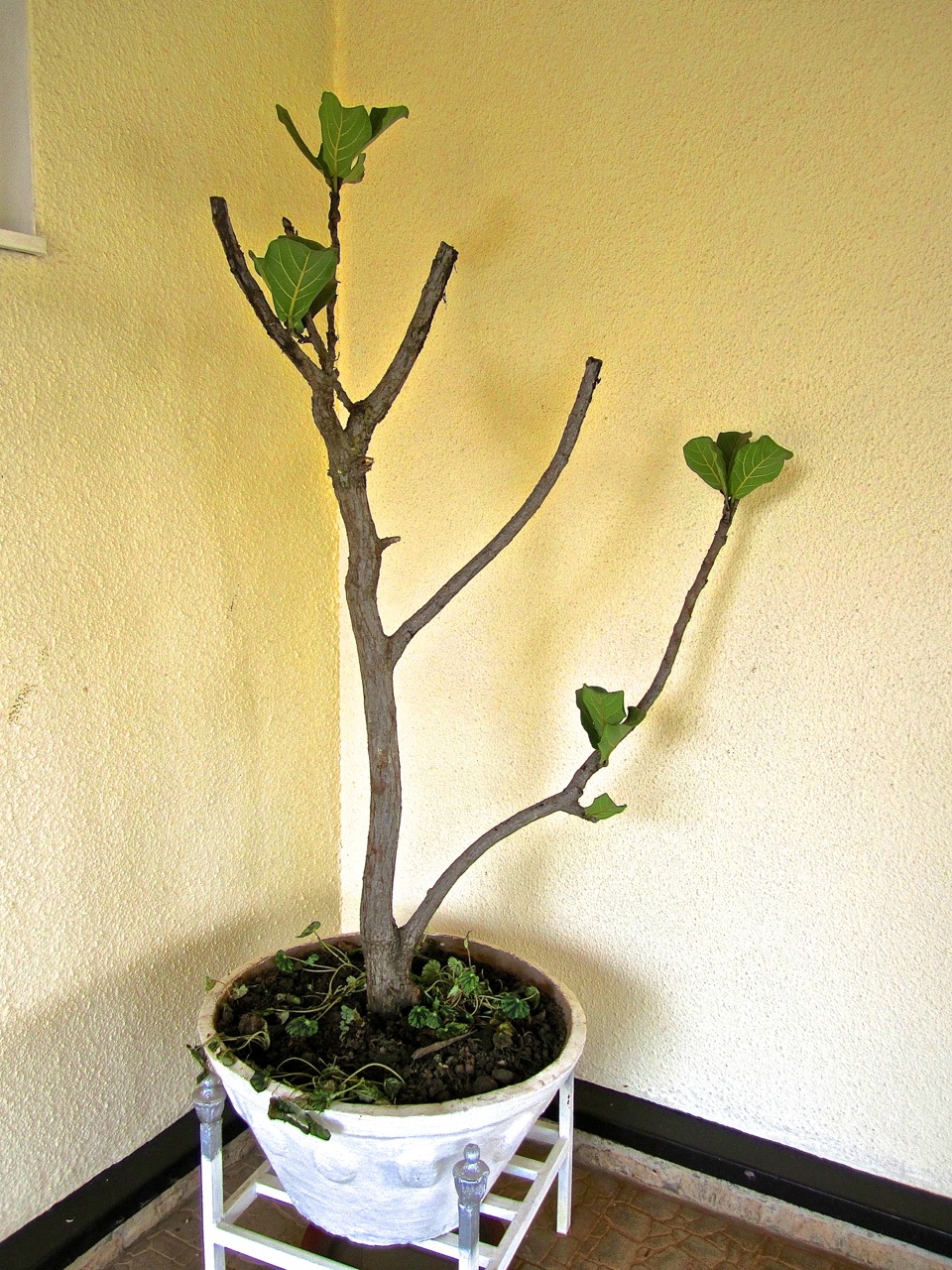
I’m not really a pots person. In the last couple of months, I’ve mostly been removing the plants from a lot of the old pots that I’ve found all around the house and putting them in the ground. However, I did recently create this rather pitiful arrangement.
The tree — one of those big-leafed Ficus that you see in chic rooms in House Beautiful — was in another pot at the side of the house, baking in full sun. We pulled it out and pruned its roots and top. Then, we put it in this prettier pot in the bright shade of the terrace, underplanted with the little round-leafed begonia shown above.
I’ve got my fingers crossed that it will eventually put out new leaves. [UPDATE: It recovered beautifully.]
To see what’s blooming in other garden bloggers’ gardens, check out May Dreams Gardens, and thanks to Pam at Digging for hosting Garden Bloggers’ Foliage Follow Up the 16th of every month.
I’m afraid I’ve let all the work we’ve done on our Kigali garden recently move well ahead of writing posts about it.
We — the gardener, two temporary workers, and I — made some substantial changes during June. So much so that we’re now taking a week or so of relative rest before the gardener and I start phase two. (When I got up in the middle of the night about a week ago, I thought I was going to die, my muscles were so sore.)
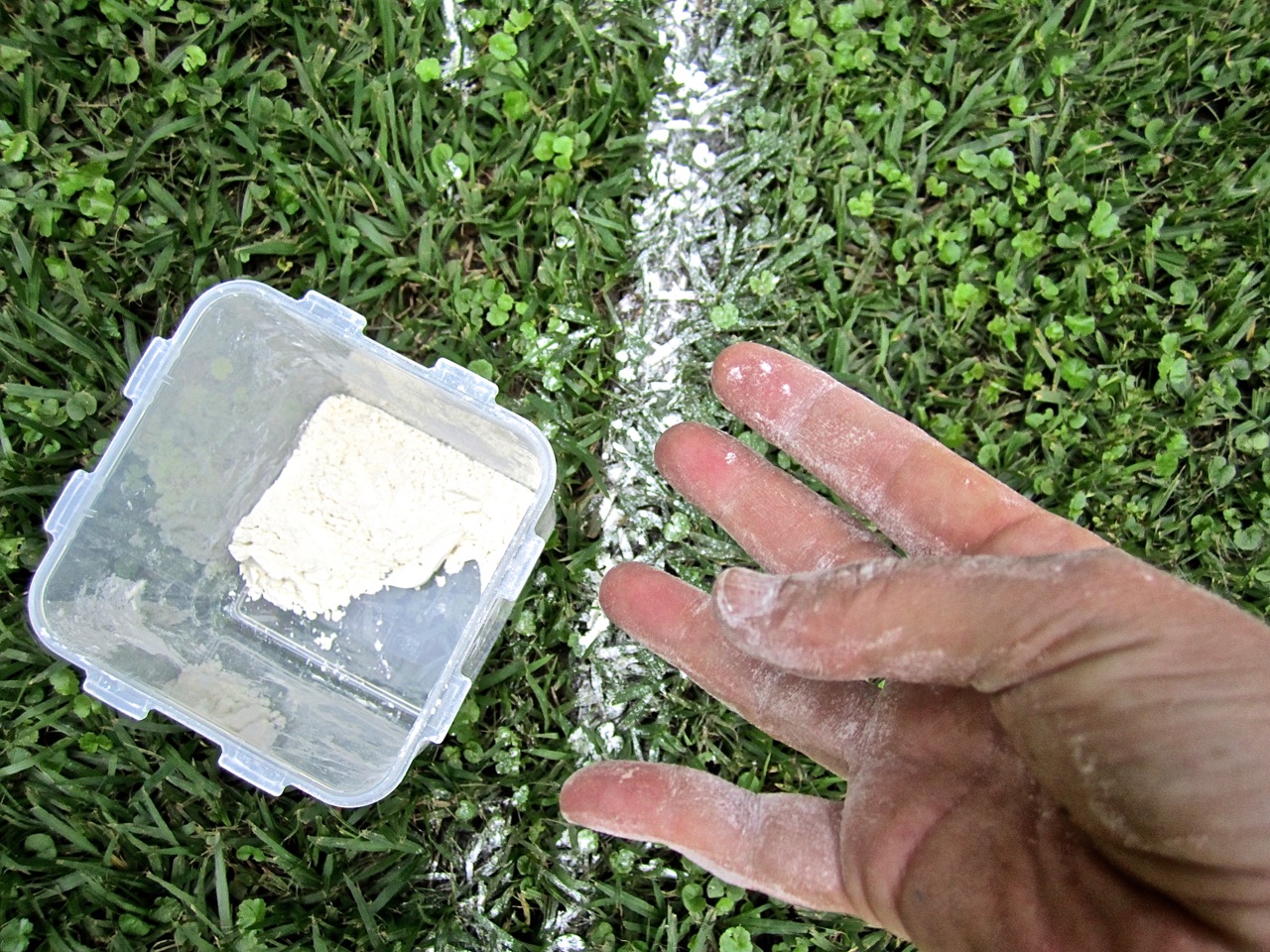
Hint: I’ve been using flour to mark the new outlines of planting beds.
So while we pause, I’ll back up and give you some “before” pictures and a little site analysis.
(I’m going to use the present tense while describing the old garden features, so as not to give away the changes we’ve made).
This is a good-sized, “working” diplomatic garden that hosts two or three receptions or ceremonies a month. It’s very pretty and lush, with mature trees and many flowering shrubs. But it also has some problem areas — places where purpose is ill-defined, opportunities for drama or charm are missed, transition points are weak, and many plants are too old or badly pruned or overcrowded.
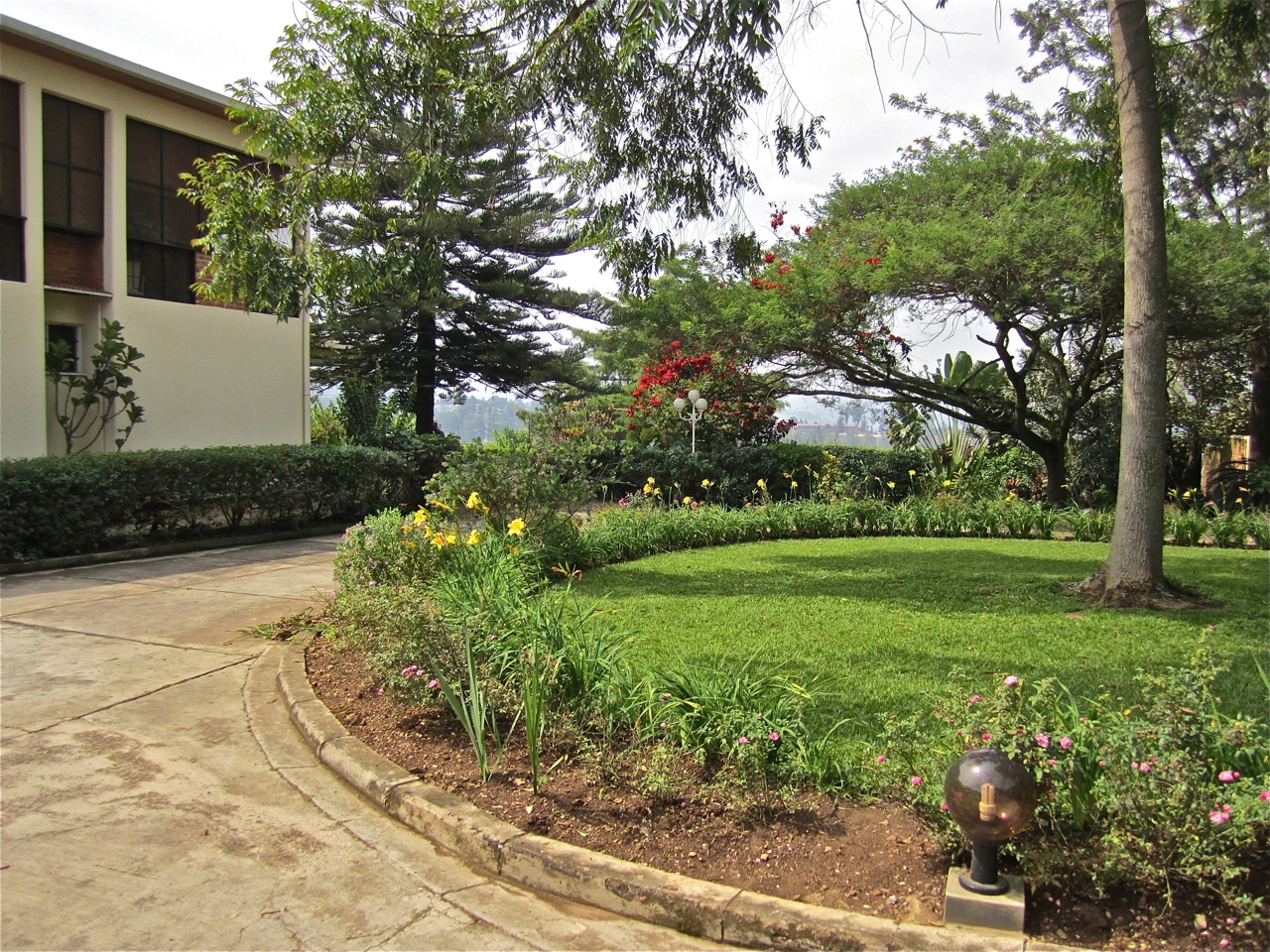
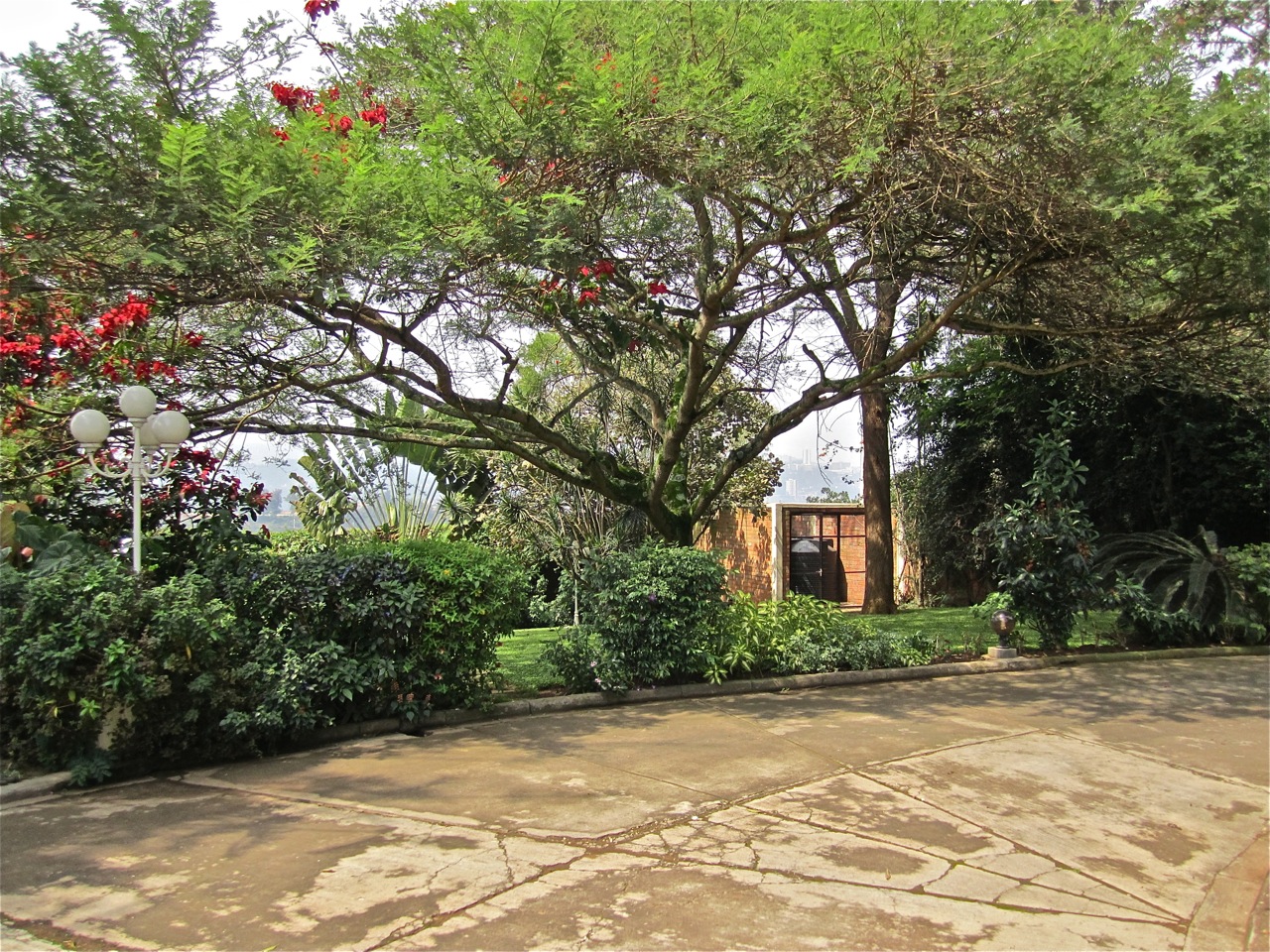
The first photo below shows the view when you enter the gate to the property: one end of the house, the circular driveway, and a semicircle of grass edged by day lilies and miniature roses. (If you look left, you see the back of the house and a parking area.)
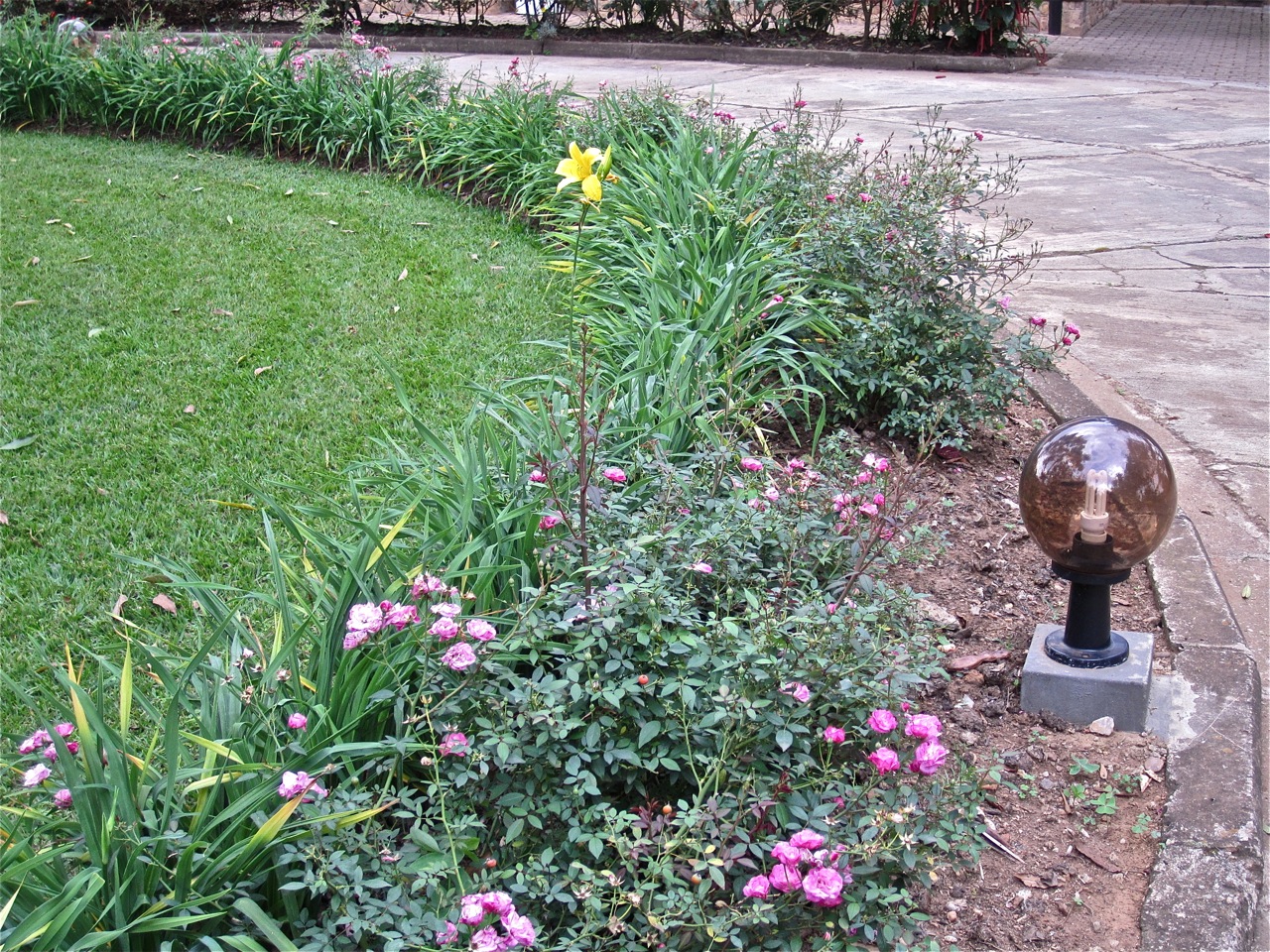
In the semi-circle, shown above and below, the miniature pink shrub roses (possibly “The Fairy” variety) are planted in a line along the curb, and the yellow day lilies are lined up right behind them. I’m not fond of the yellow/pink combination, but my main concern is that the single-file arrangement — the first thing you see when you walk or drive into the enclosure — is skimpy and makes a weak impression.
Looking right across the semi-circle, below, you see a beautiful spreading acacia tree, but its impact is obscured by the shrubs and plants growing along the edge of the drive.
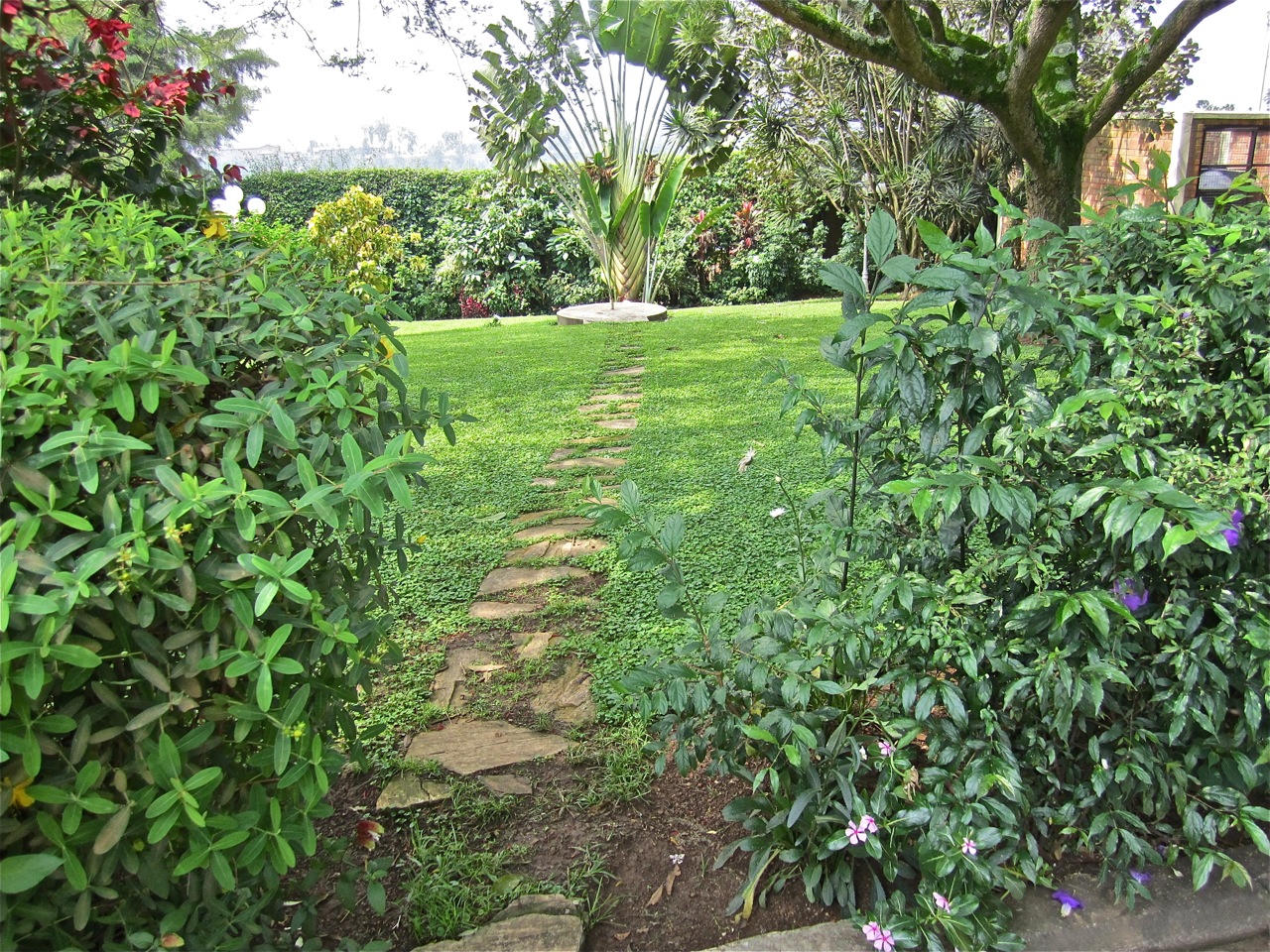
If you slip in a small space between a couple of those shrubs, as in the photo below, you find an old stone path leading to a no-longer-used concrete flagpole base. And to the left of the concrete base are steps to the long front lawn.
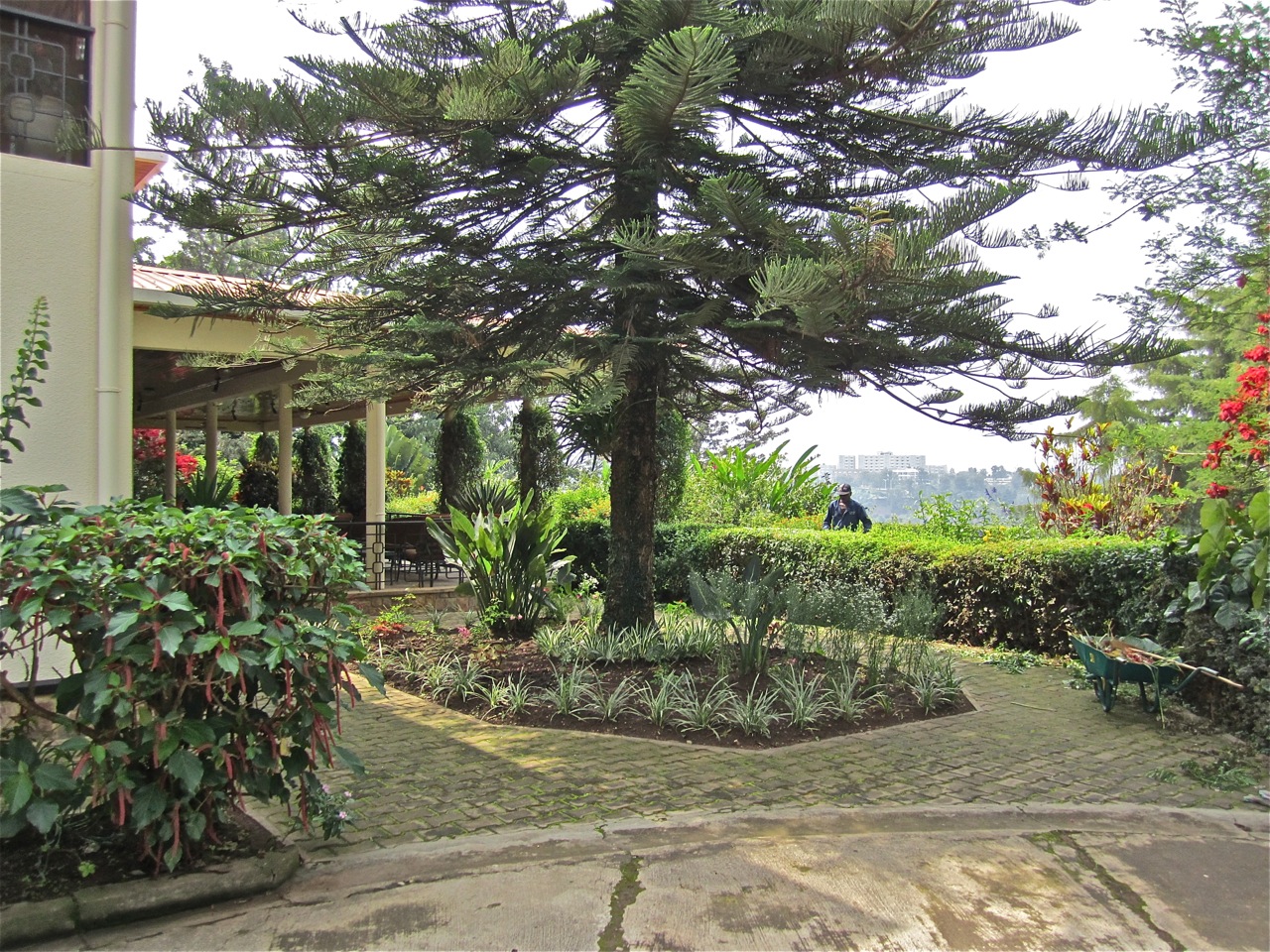
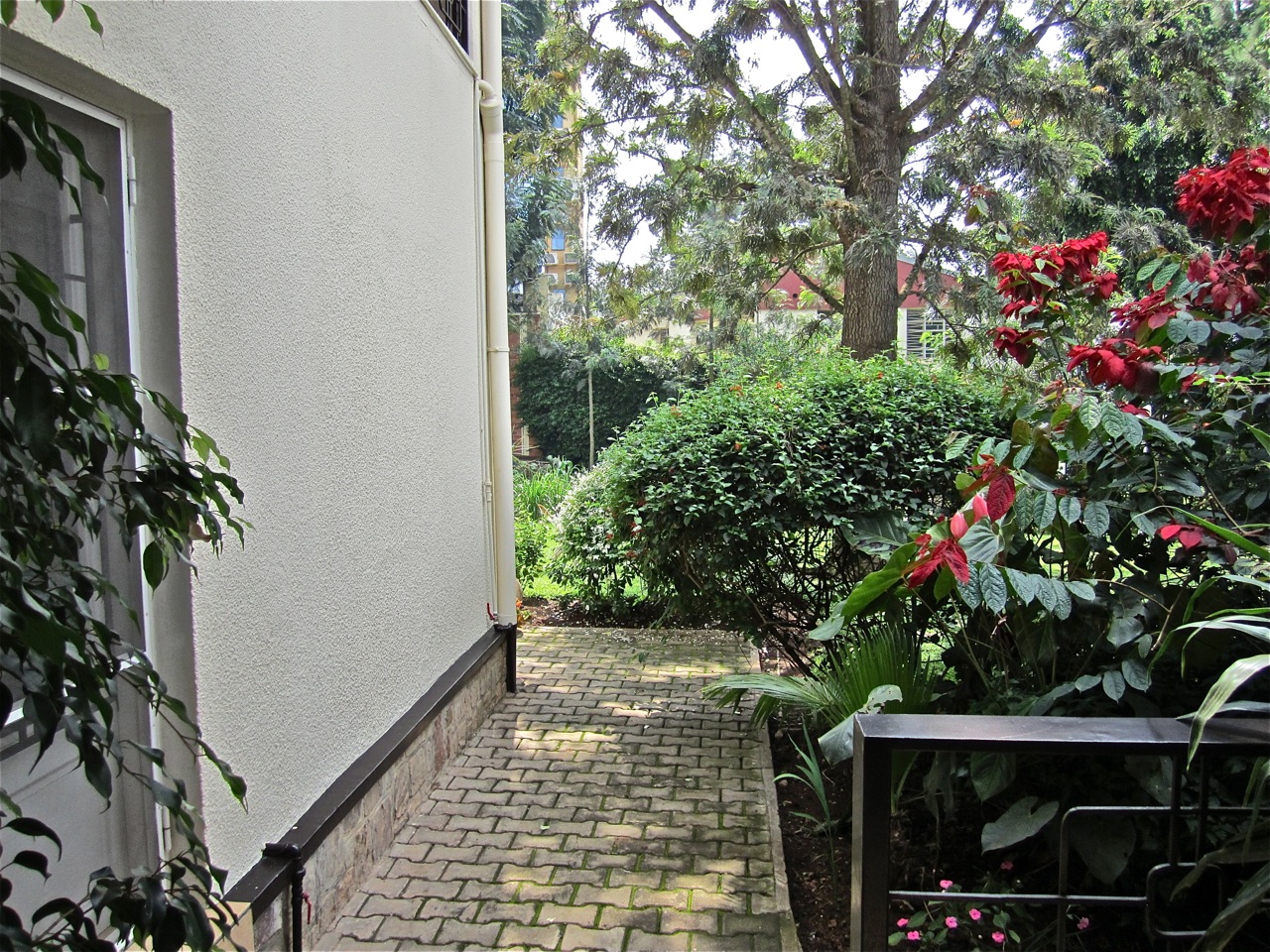
Below, the photo shows the side entrance to the front terrace. (If you back up to the starting point in the first photo above, walk down the drive along the side of the house, you reach this point.) This is where we welcome guests. Because of the planting bed in the center, and the clipped hedges at the edge, the paved walkways only comfortably allow for two people to stand side by side.
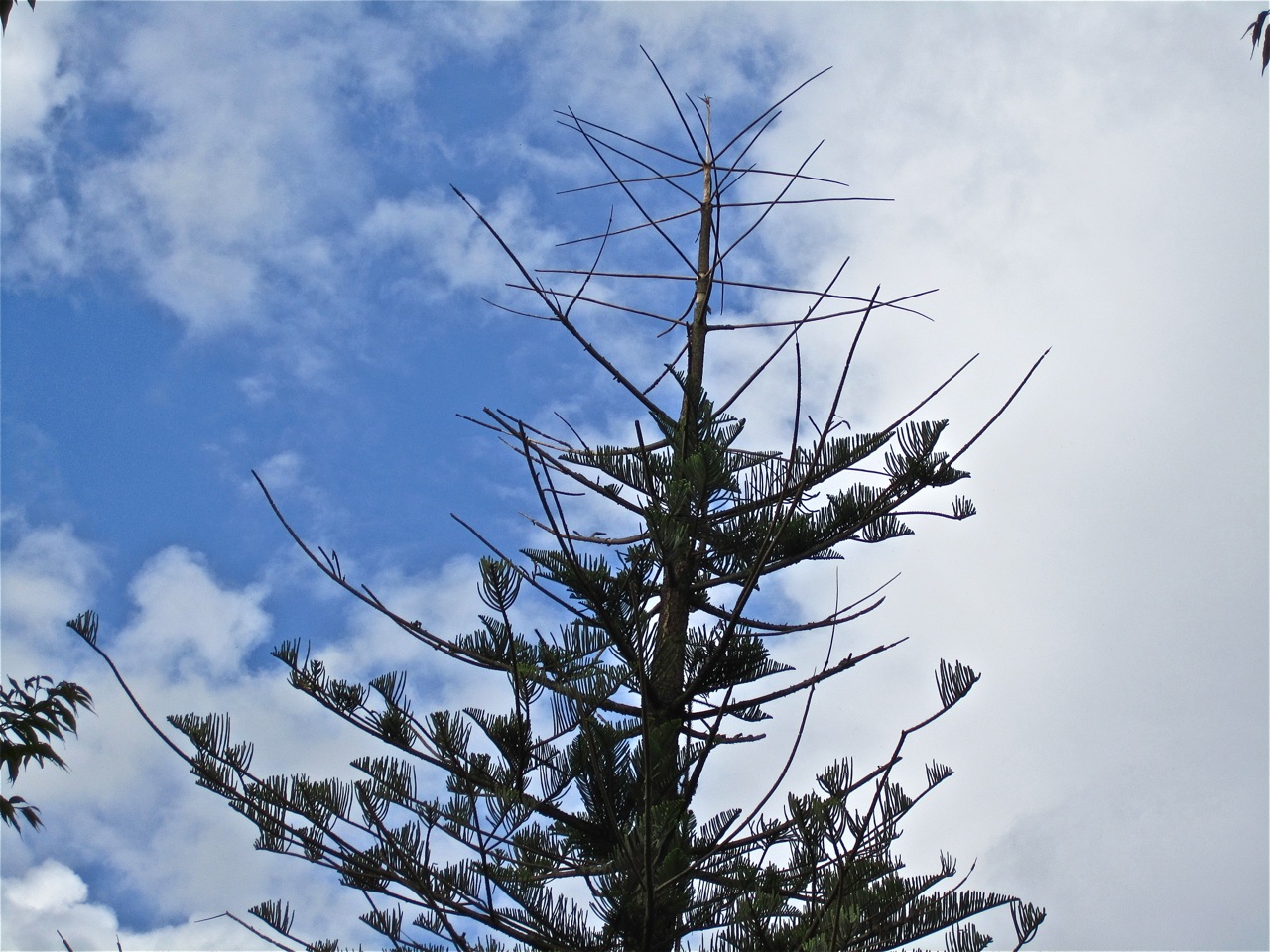
The hedge is made up of plumbago, lantana and other flowering plants, but the blooms are mostly sheared off. In center of the planting bed is a tall Norfolk pine and a rather skimpy assortment of small roses, asters (I think), lirope, coleus, and a bird of paradise.
Unfortunately, the tree is dying.
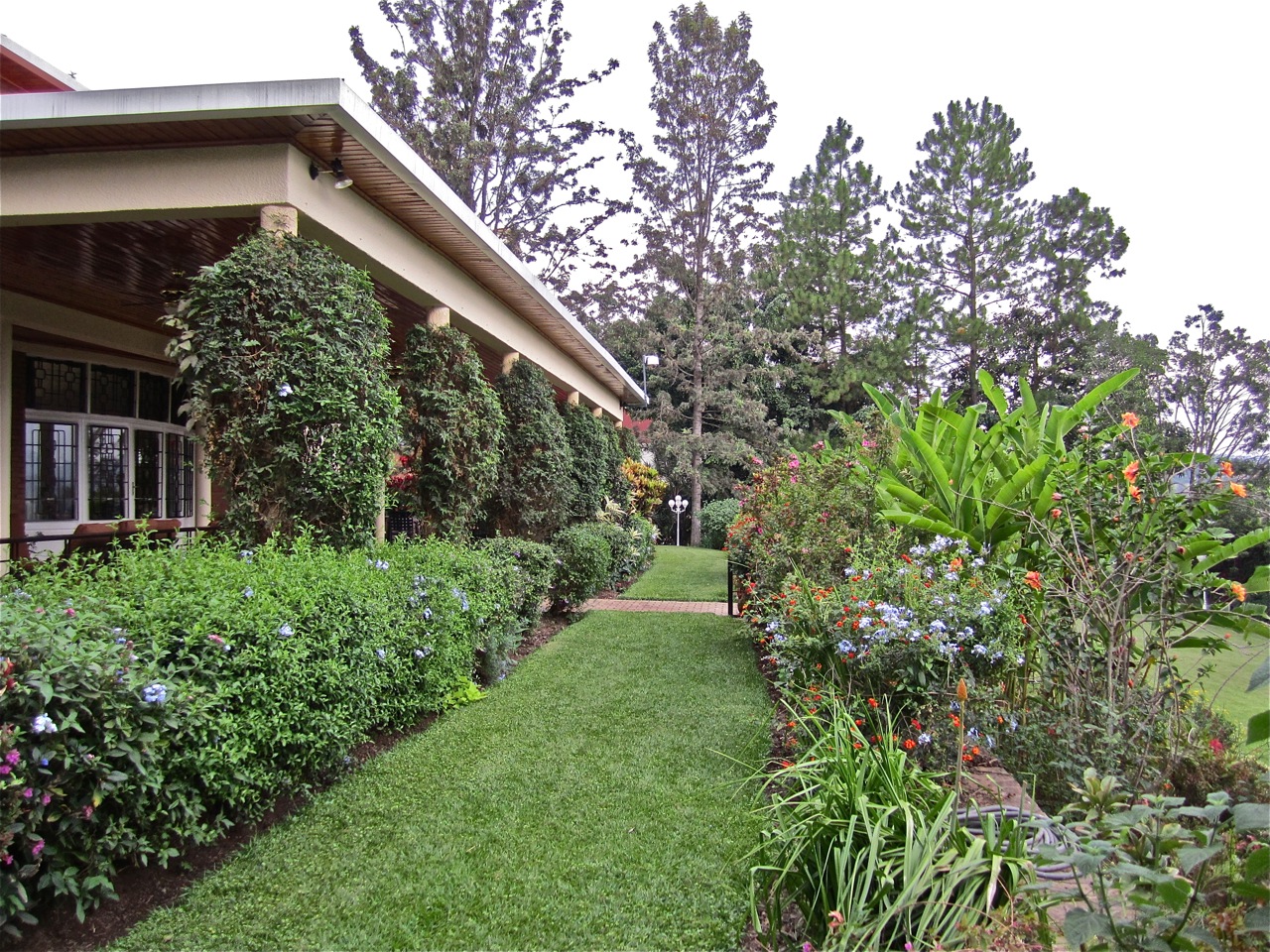
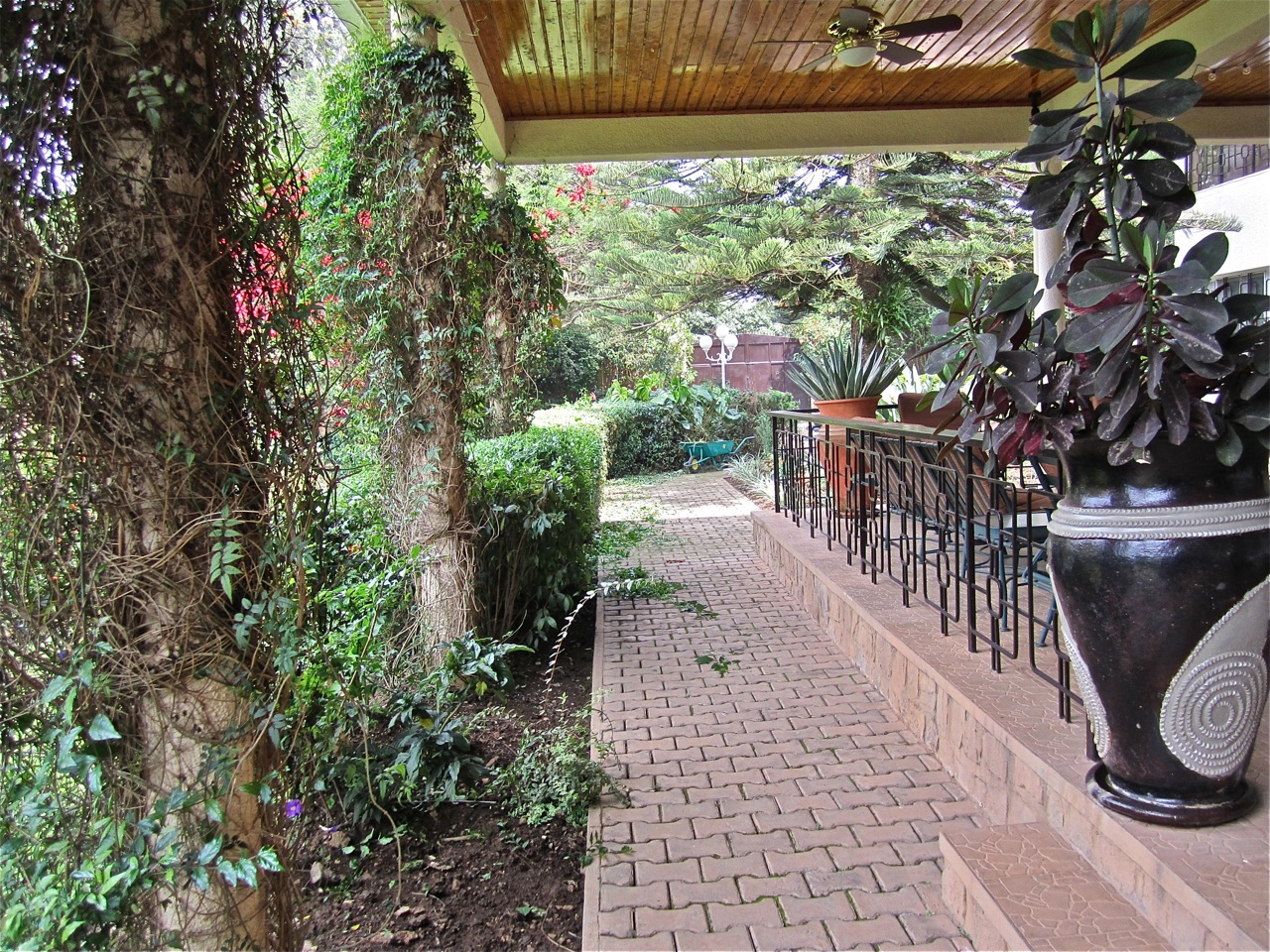
If you step through this area, you’ll be on a long terrace along the front of the house. As you can see in the photo below, in front of the terrace are two rows of (mostly) clipped shrubs and a path of grass between them. Plumbago and jasmine are growing up the house columns. The vines and shrubs attract colorful little birds right up to the terrace. However, the vines on the backsides of the columns are bare and brown from constant shearing and a lack of light.
The shrubs right along the terrace make it feel closed in, and I believe that mosquitoes hide in there in the evening.
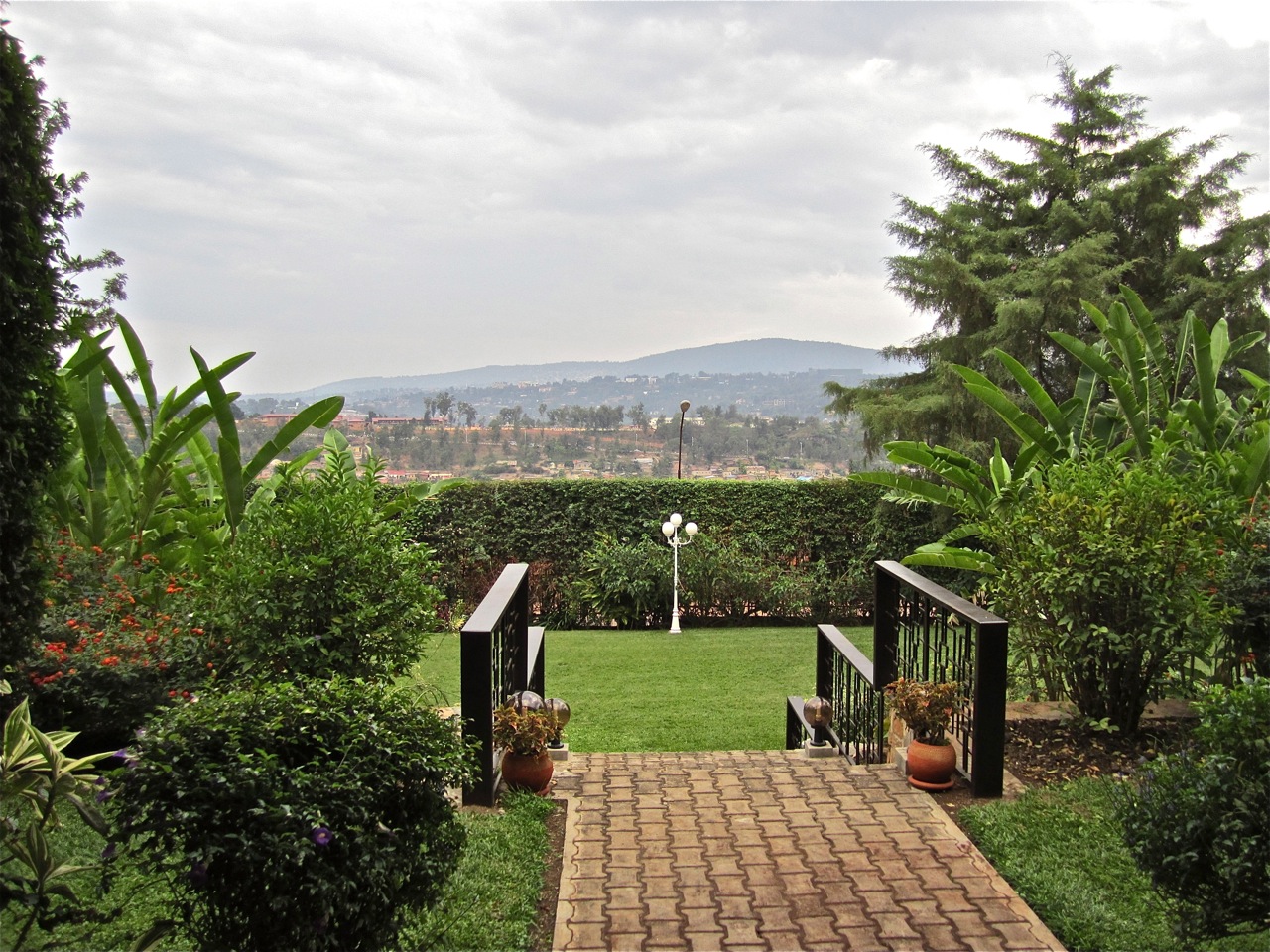
While the arrangement is rather pretty, the grass path serves little purpose — it’s mostly blocked by the shrubs on one end, and it’s too narrow for seating. The tall plants on the right in the picture above — particularly the 6’+ lobster claws (Heliconia rostrata) — obscure the view of the hills and the city.
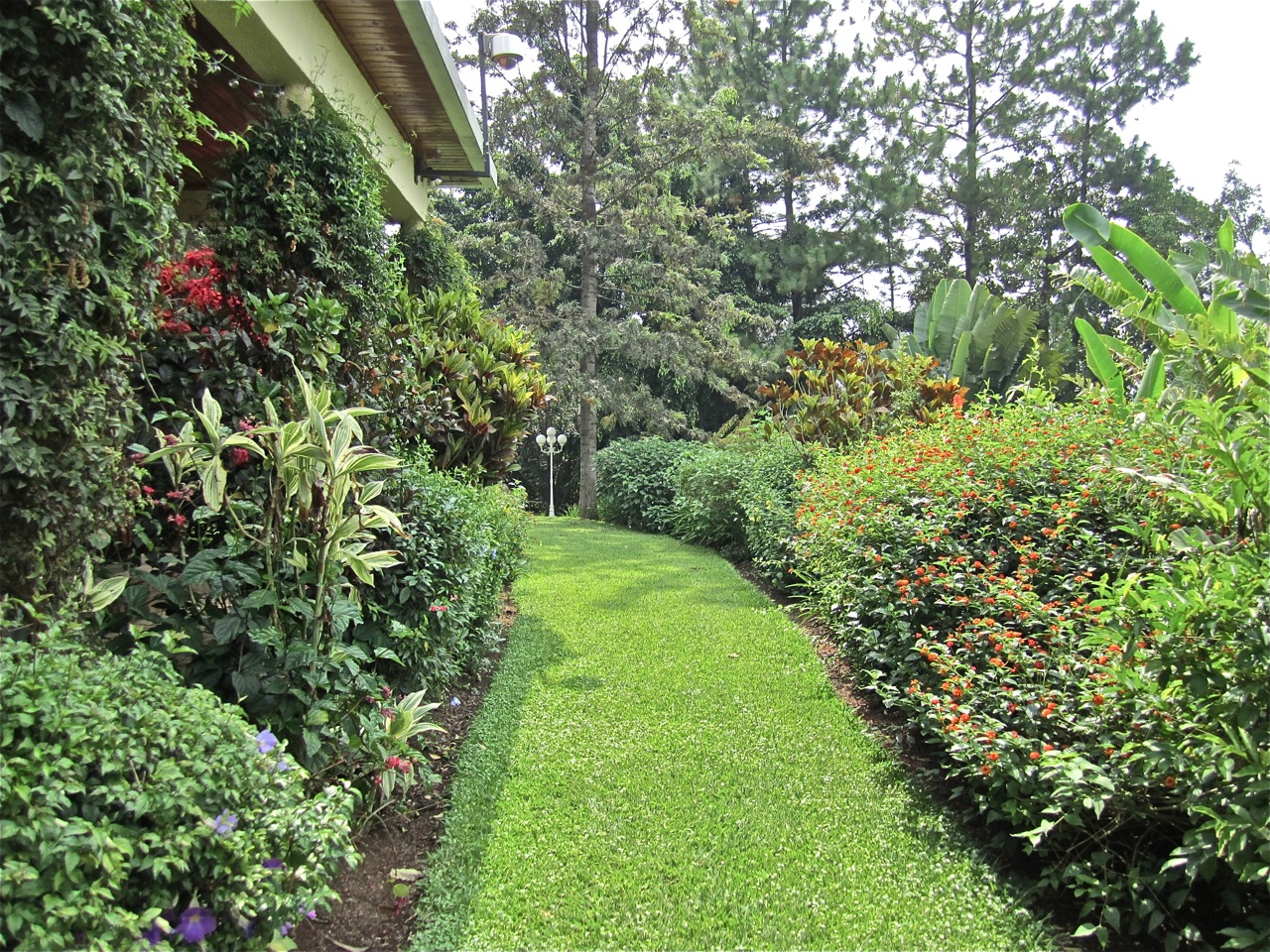
There are a lot of great plants in the beds on either side. And I always imagine Alice running through some part of Wonderland when I look down this side of the path (above).
Unfortunately, the terrace side of this strip (above) gives me an unpleasant crowded feeling, and the leaves of the vines die off from lack of good light.
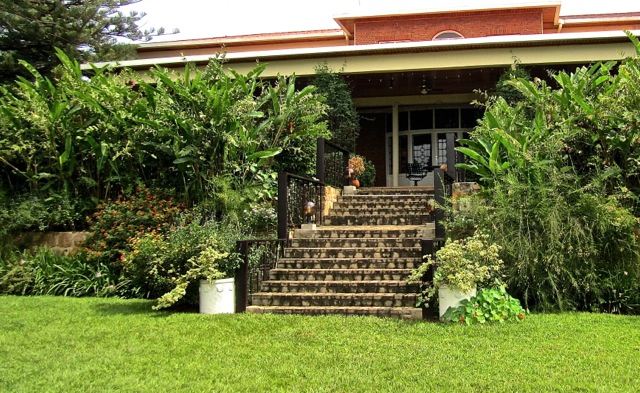
Above is the view from the center of the terrace. It’s somewhat blocked by the tall lobster claws on either side of the steps. Down those steps are two levels of stone retaining walls and then a long lawn.
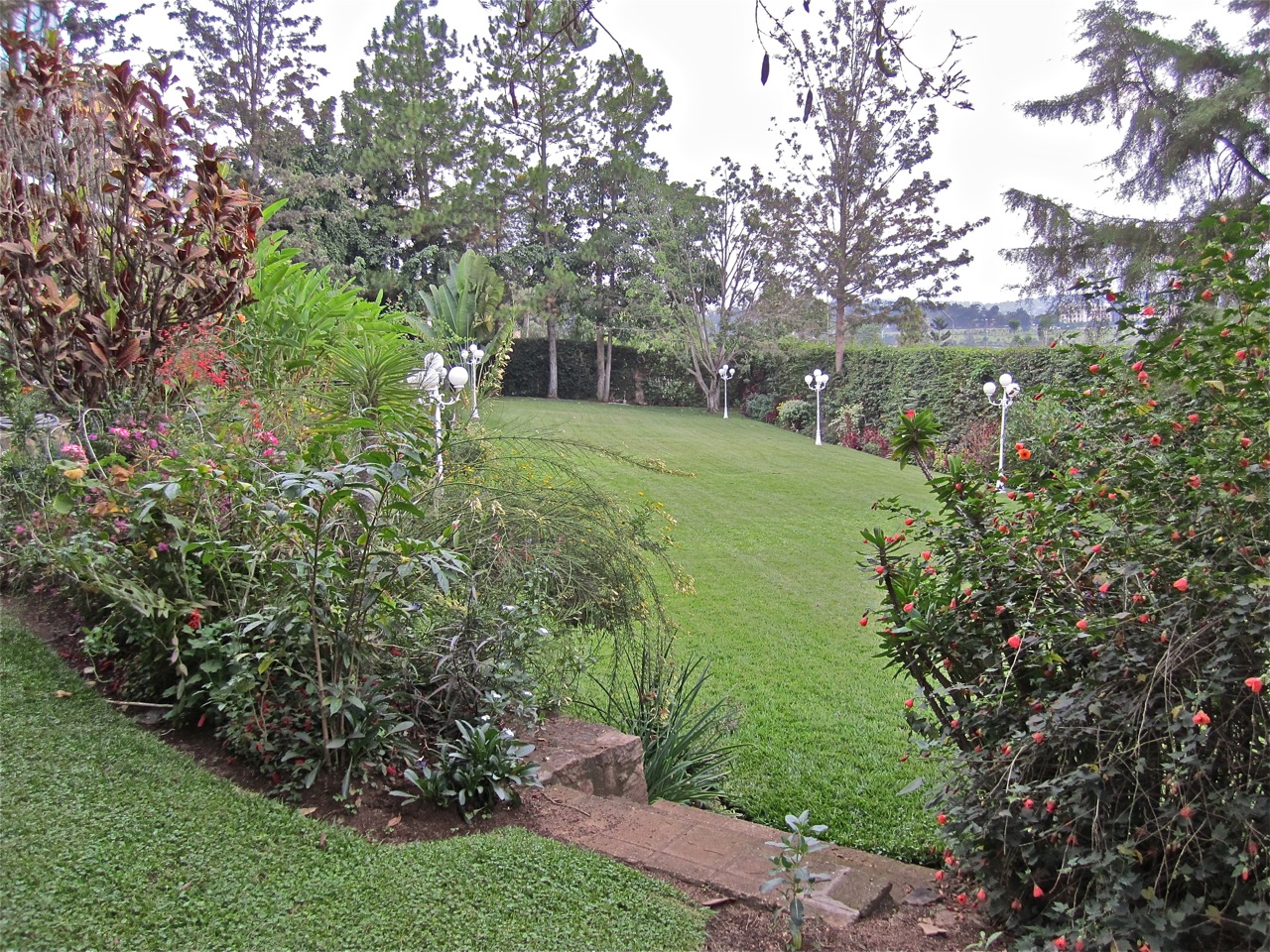
Above is a view of the lawn from one end (at the steps just to the left of the flagpole base in the earlier picture). When we entertain large groups, the embassy puts up one or two tents in the center of the lawn.
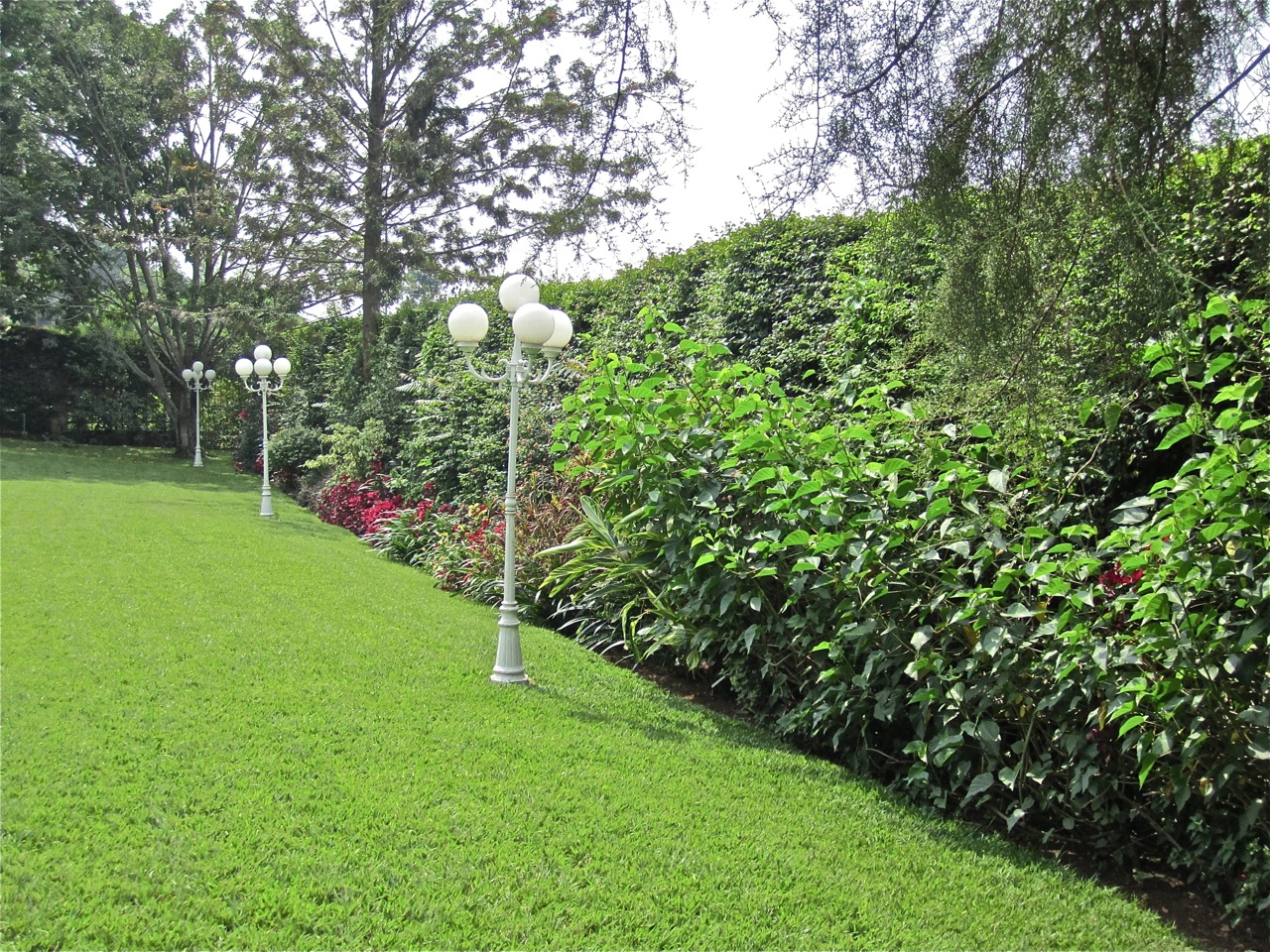
On the right side of the lawn, at the front of the property, there is a clipped bourgainvillea hedge and a variety of interesting shrubs and plants, all sharing a very narrow strip of ground. The slight dip at the edge of the lawn makes it look like the plants in front are sliding under the hedge.
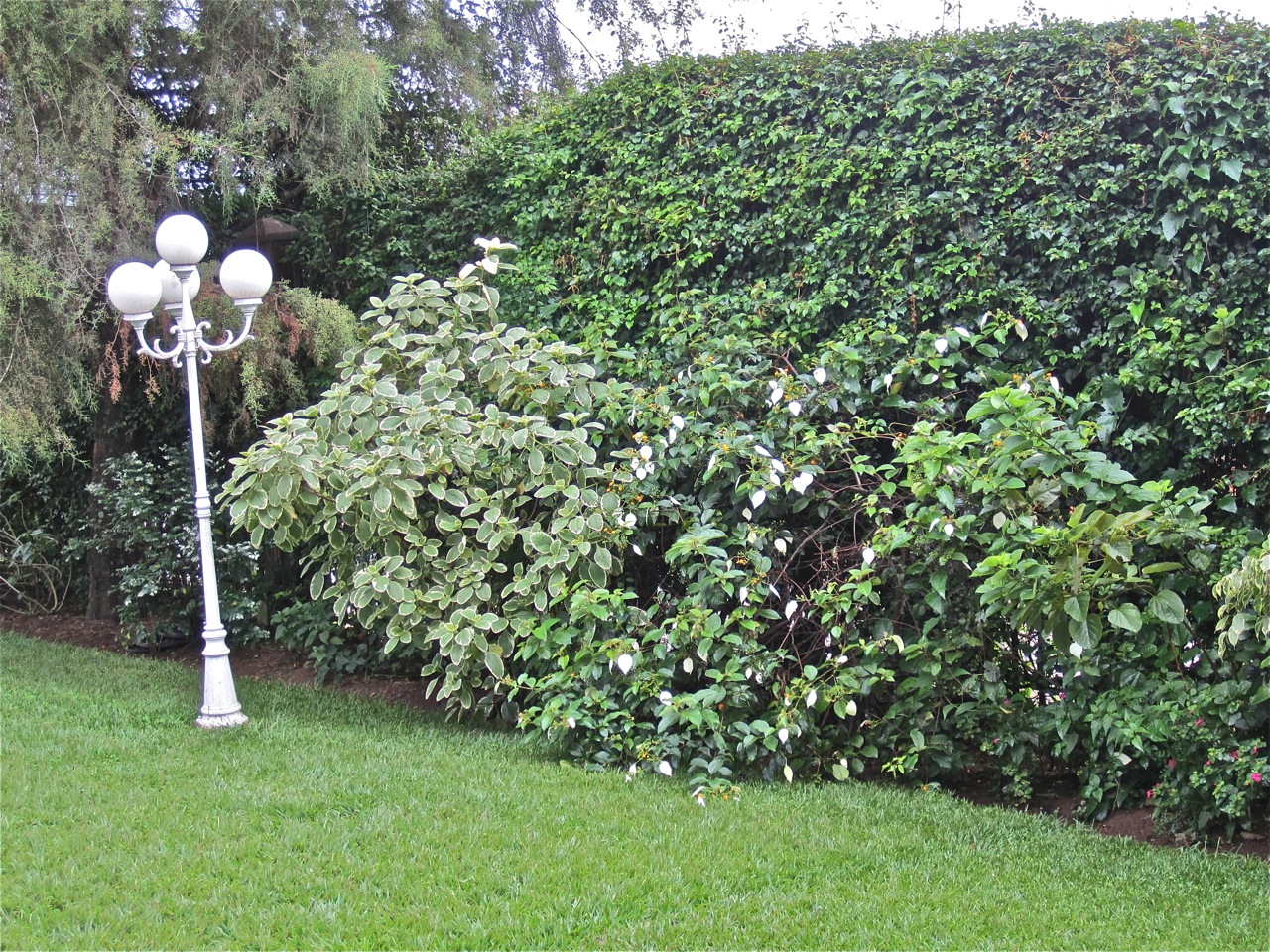
In the photo above, you can see how pretty the shrubs are, but again how little room they have. Since this picture was taken, the gardener has cut these bushes along their sides to keep them from intruding onto the grass. Now you see a lot of bare stems — not very attractive.
The white, curlicue, Victorian light posts in the above photos really bug me, I must admit, because, as you can see in the picture below, the lines of the house are attractively modern and simple.
Above is the view from the lawn at the bottom of the center terrace steps. You can see, to the right and left, how tall and thick the lobster claws are. (Are you getting the idea that maybe something’s going to happen to those plants?)
You can also see from this photo how the two levels of stone retaining walls that branch out from either side are an important feature of this part of the garden.
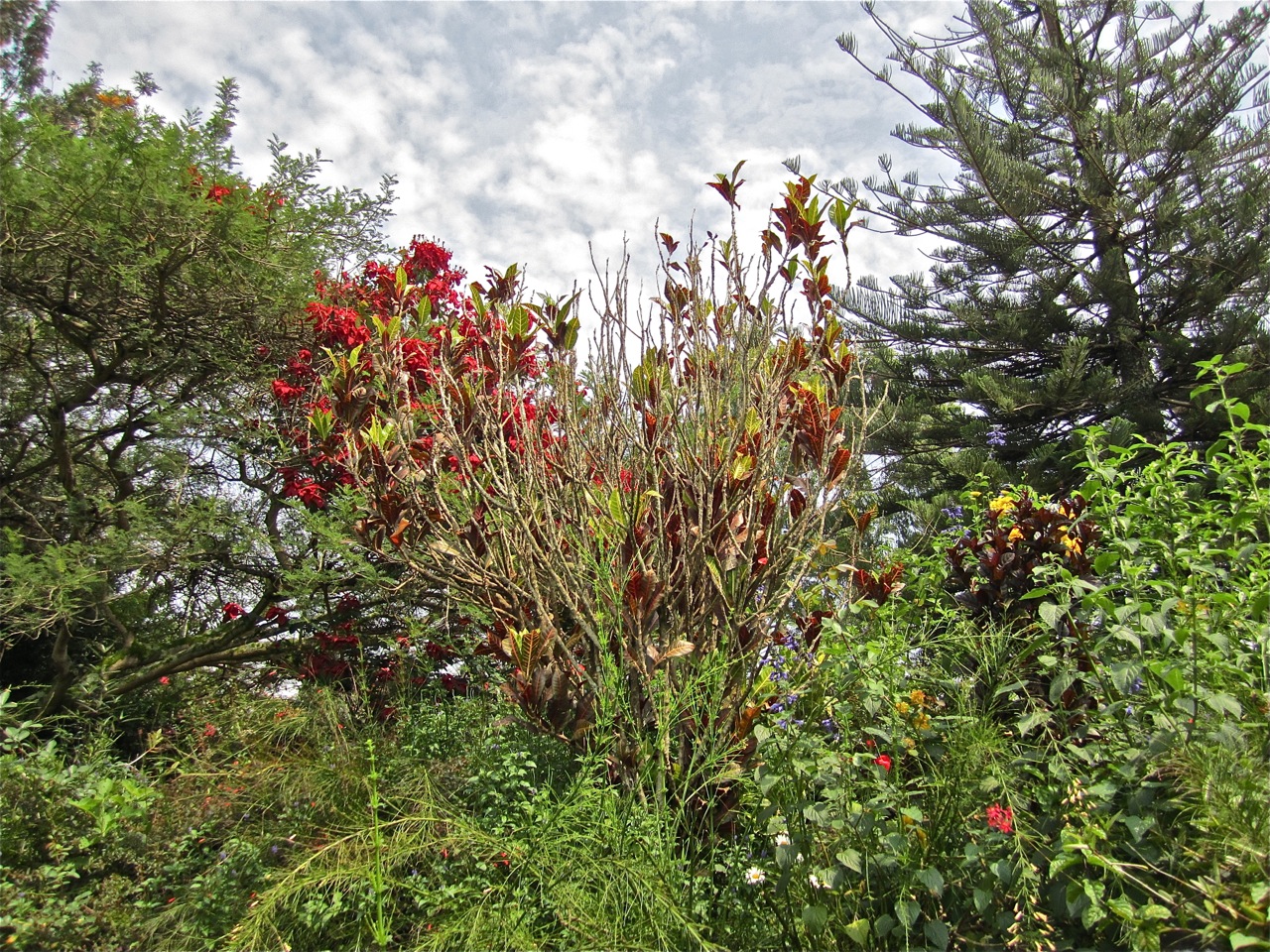
The planting beds at the top of the lower retaining walls are full of great plants, but it’s a real thicket in there. I have sometimes found three shrubs growing out of the same 8″ spot of ground. And this old croton (above) is so overgrown that it’s lost half its leaves. And at its current height, you look up onto the undersides of the remaining leaves, rather than down onto the colorful tops.
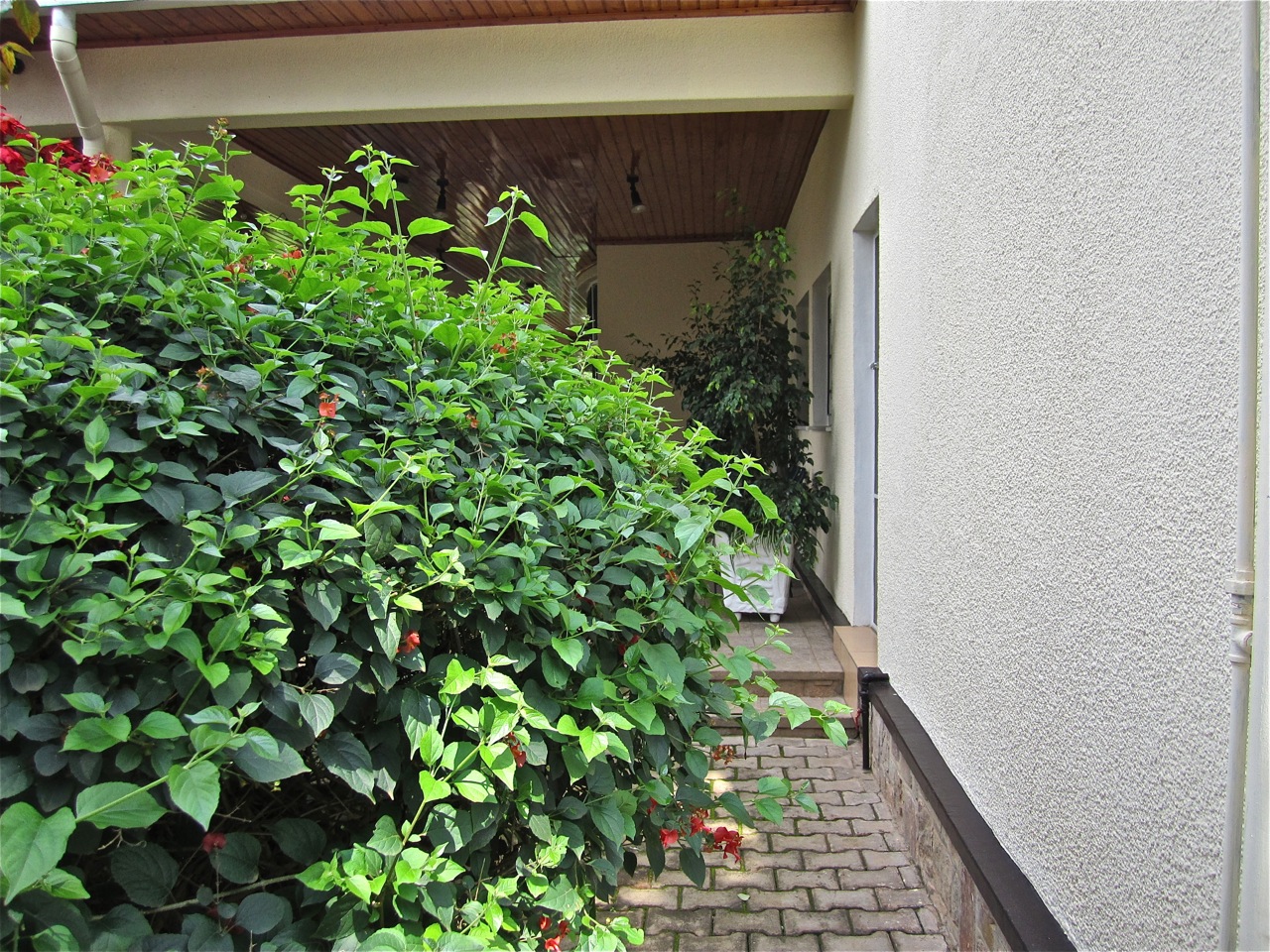
Above, going back up to the terrace and walking its length to the opposite end of the house, the path to the side yard is almost blocked by a very large, very clipped shrub (also shown below).
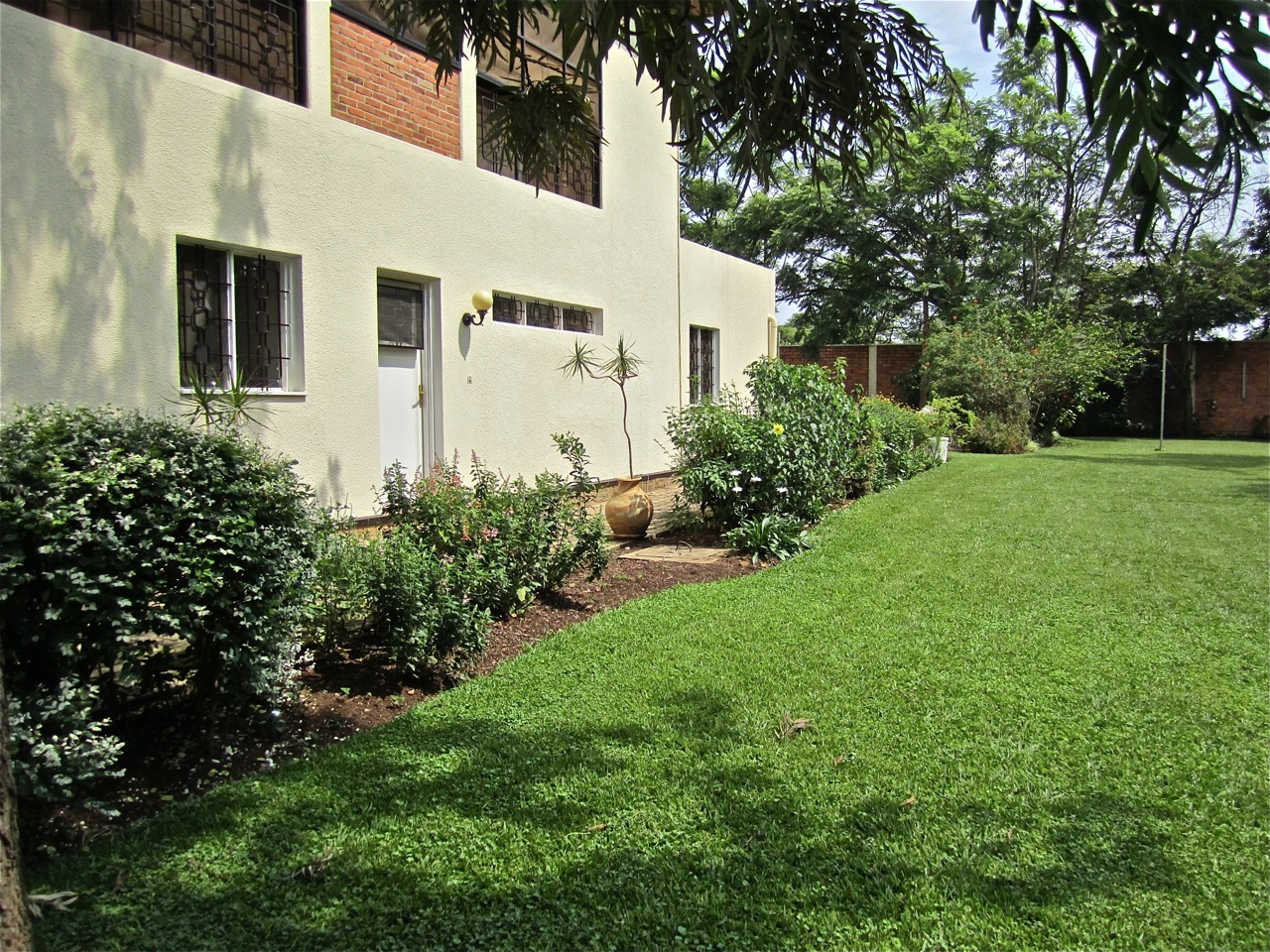
Squeezing past the bush, you come to the side yard and the other end of the house (below), which has a narrow planting strip along the sidewalk . . .
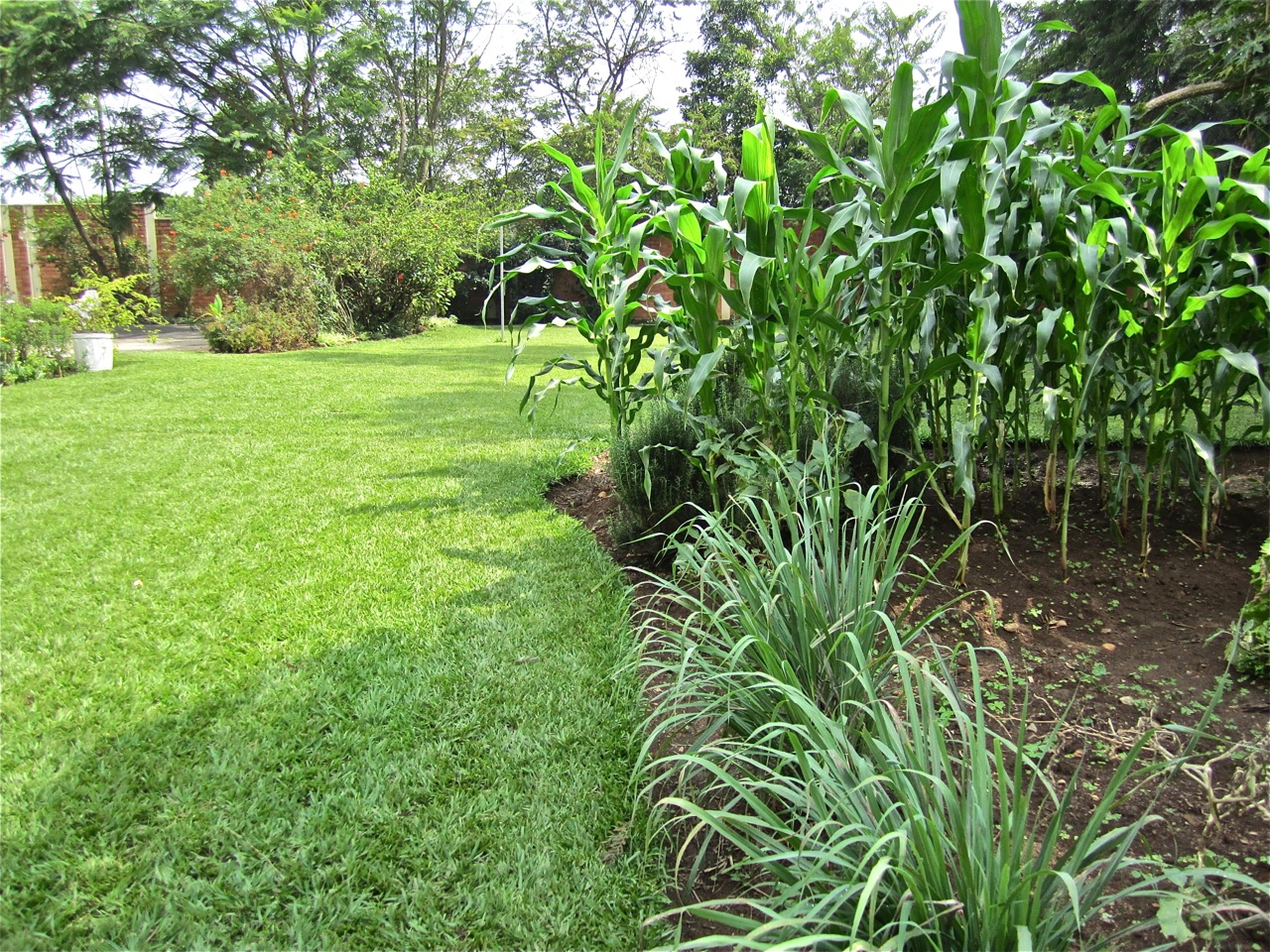
and, across from that (below), a large vegetable garden whose edges have become rather freeform over the years. There’s a lot of sunny grassy space between these two beds, which isn’t needed for entertaining.
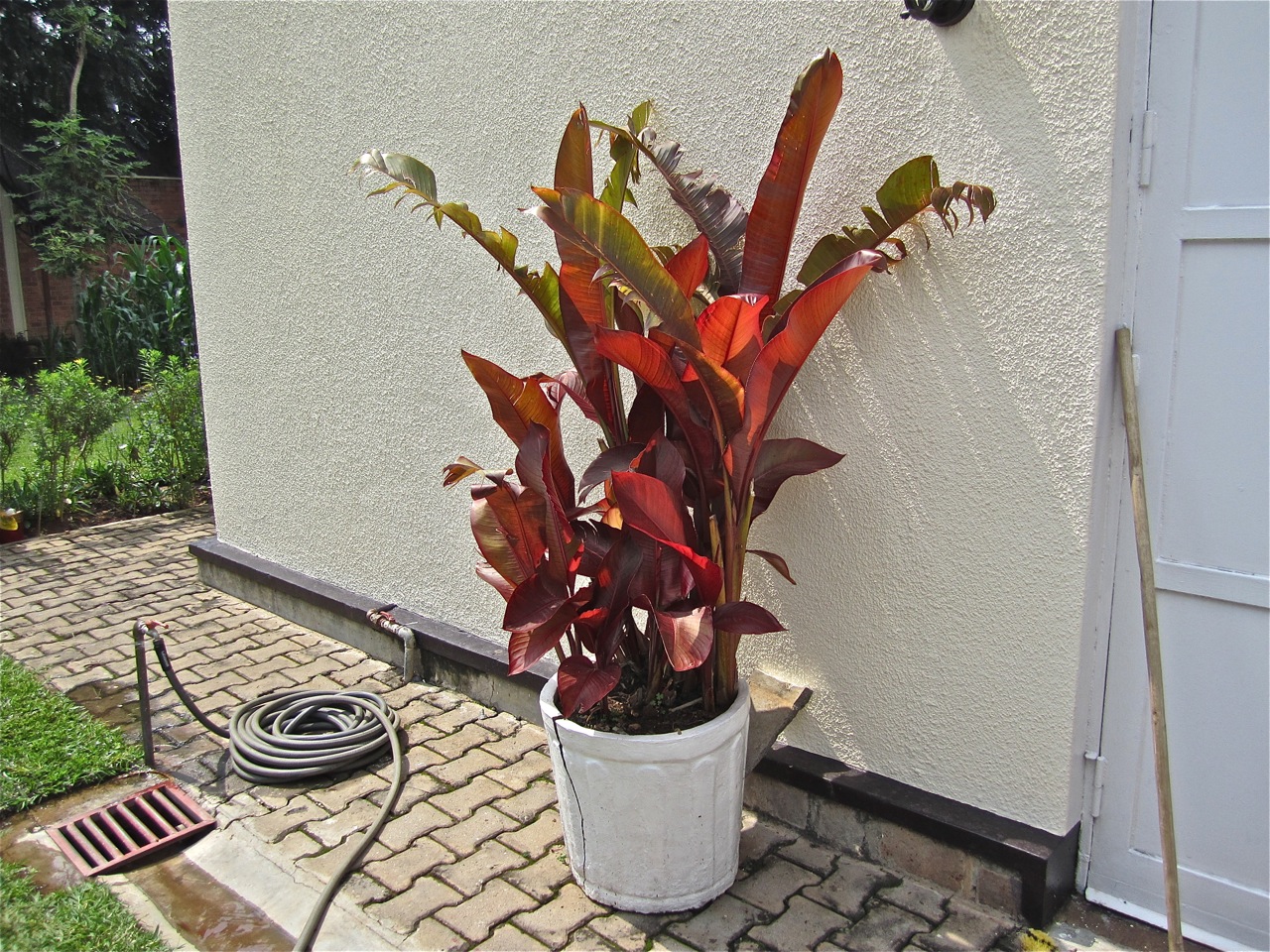
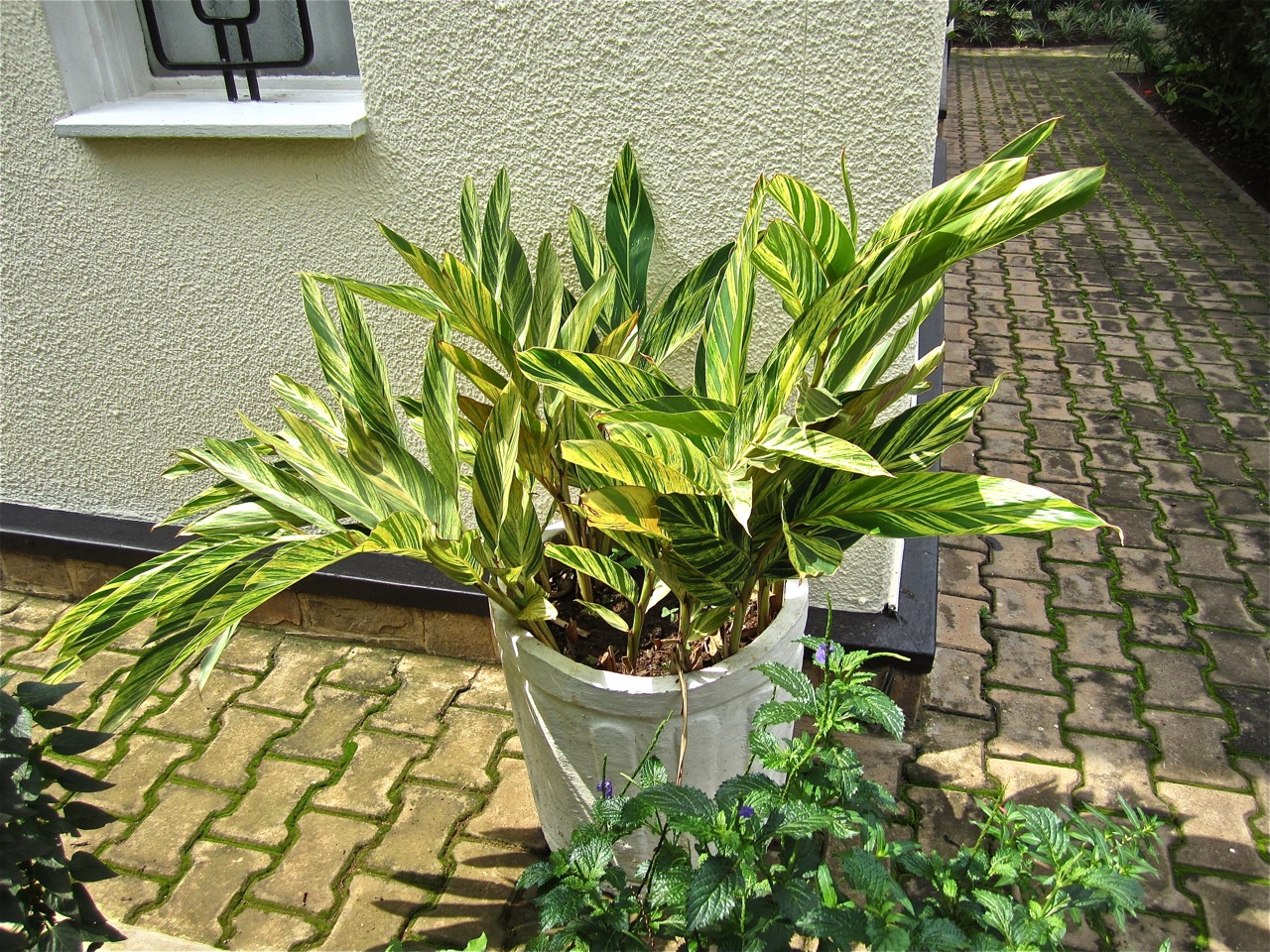
There are a number of potted plants in the garden, including these two (below), which have been left at the back of the house. They hold burgundy cannas (which are breaking their pot) and bright variegated gingers, but almost no one sees them. On the terrace, we also have variegated yuccas planted in very nice tall pots, but so deeply that only the ends of their squished up spiky leaves show (and they’re a bit dangerous at upper-body level).
I’ll take one more pass at the interesting photographs of the Library of Congress Matson Collection (American Colony of Jerusalem).
“Garden of Gethsemane in snow,” February 28, 1938.
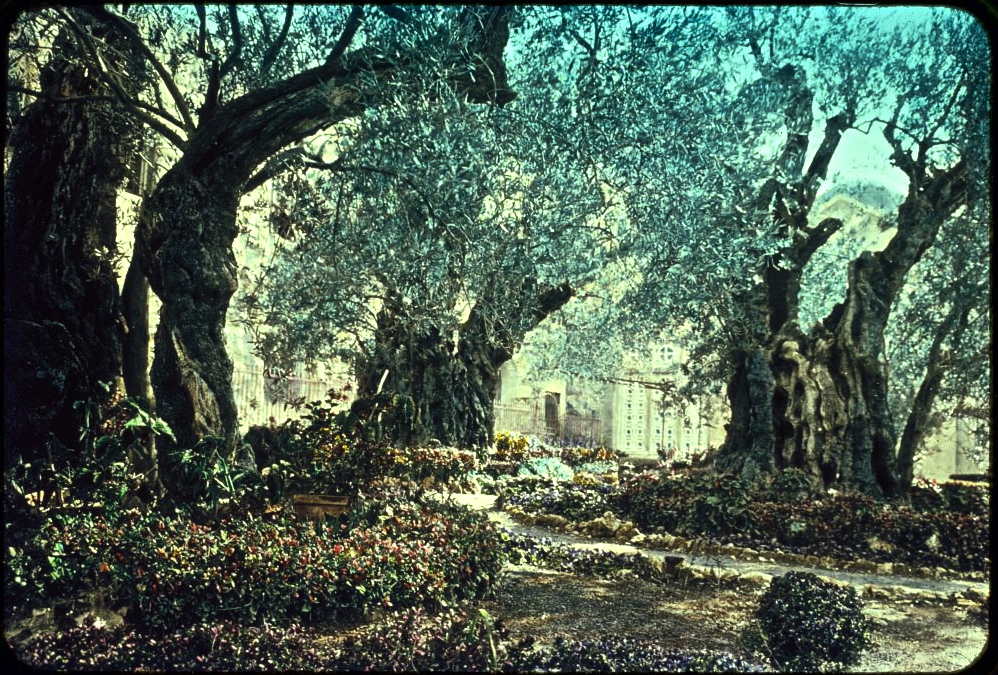
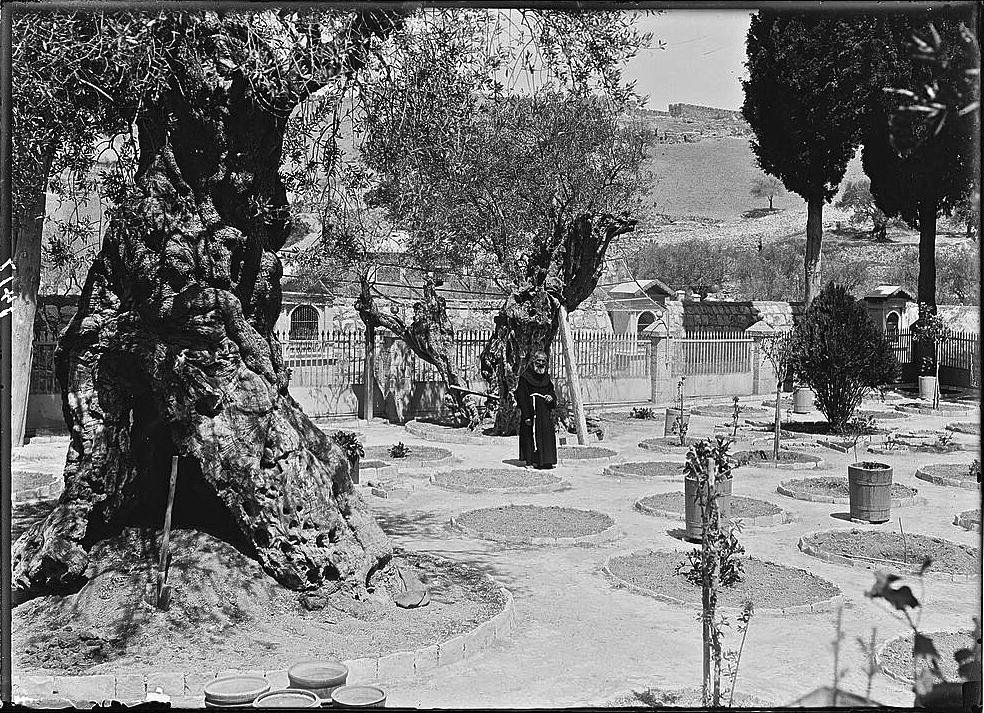
The American Colony photographers took many pictures of the Garden of Gethsemane during the first half of the 20th century. Presumably, they were big sellers in the Colony’s tourist shop near Jaffa Gate.
“Garden of Gethsemane semi-distant with overhanging olive branch,” c. 1898-1946. The garden is in the middle of the photo. Click the image to enlarge it.
‘Gethsemane’ is a Greek word derived from an Aramaic word for ‘oil-press.’ The Roman Catholic-administered garden is located at the foot of the Mount of Olives. It is one of four locations in the area currently claimed by different religions as the place where Jesus prayed the night before the crucifixion.
“Jerusalem. Gethsemane from convent roof showing city wall and Golden Gate.” Image hand-colored c. 1950 – 1970, but original black and white photo was probably taken earlier.
In the gospels of Matthew and Mark, it is called by a word meaning ‘place,’ ‘property,’ or ‘estate.’ In the gospel of John, the Greek word ‘kepos’ is used; it can mean ‘garden,’ but also ‘cultivated tract of land.’
“Garden of Gethsemane, inside enclosure.”
The first recorded pilgrimage to the site was made in 333 A.D. by the anonymous “Pilgrim of Bordeaux,” who recorded his travels in the Holy Land in Itinerarium Burdigalense.
“Jerusalem (El-Kouda, Garden of Gethsemane, interior),” c. 1898-1914.
The building attached to the garden, the Church of All Nations, was built in the 1920s. The garden’s olive trees are said to be 2,000, 1,000, or 900 years old, depending on the source.
“The terrible plague of locusts in Palestine, March-June 1915. The same garden after visitation by the locust.”
In 1915, a plague of locusts swept through Palestine, stripping areas — including the garden — of all vegetation. The American Colony was asked to photograph the devastation, which caused food shortages, by the Ottoman-Turkish governor for “Syria and Arabia.”
While looking through the online catalogue of the Library of Congress for photos of gardens and landscapes, I keep coming across pictures by the American Colony of Jerusalem.
Golden Gate and east wall of Jerusalem seen through group of century plants [agave], c. 1900-1920, by the American Colony, via Library of Congress.The American Colony was a Christian utopian society established in Jerusalem in 1881 by Americans Anna and Horatio Spafford. Its whole story is very interesting, but long, so you can read about it here and here and here.
Around 1898, a member of the colony, Elijah Meyers, began photographing places and events around the region and eventually formed a photography service that earned income for the group. He was later joined in the endeavor by Lewis Larsson and G. Eric Matson, among others. When the colony dissolved in the early 1930s, Matson and his wife took over the studio and its archives and renamed it the Matson Photo Service.
Wild flowers of Palestine. Flowers, c. 1898-1946.
Matson moved to California in 1946. He began donating negatives and contact sheets to the Library of Congress in the 1960s.
Among the over 20,000 images in the Matson Collection are about 200 photos of “wild flowers of Palestine.” In 1907, the Colony had published The Plants of the Bible and, in 1912, TheJerusalem Catalogue of Palestine Plants. The group also sold photographs and stereographs from its Jerusalem store and contributed pictures to National Geographic articles.
Wood-mallow (Malva sylvestris L.), c. 1900-1920.
The photos that I’ve chosen are best seen in a larger size, so please click on the first thumbnail below to scroll though them. The plant names come from the images’ original labels.
Wild flowers of Palestine. Wood-mallow (Malva sylvestris L.), 1900-1920 by the American Colony, via Library of Congress.
Agriculture, etc. Various shades of anemones. Colours ranging from snow white to all shades of pink, dark purple and blue, c. 1930-1933.
Flowers [Maritime squill — Urginea maritima Baker), September 21, 1915.
Flowers [cyclamen], c. 1898-1946.
Flowers [cyclamen], c. 1898-1946.
Flowers, c. 1898-1946.
Flowers [wild pink onion — Allium trichocoleim Bonm.), c. 1898-1946.
Flowers [wild garlic — Allium ampeloprasum L.], c. 1898-1946.
(Taken in their natural setting) “Lily of the field.” (Anemone — Anemone coronaria L.), c. 1898-1946.
Onopordon (cotton-thistle) (O. heteraconthum), c. 1900-1920.
Great carrot (Daucus maximus Desf.), c. 1900-1920.
Palestine arum (Arum palaestinum Boiss), c. 1900-1920.
Palestine arum (Arum palaestinum Boiss), c. 1900-1920.
Poison hemlock (Conium maculatum L.), c. 1900-1920.
Bethlehem-star (Ornithogalum fimbriatum Wild), c. 1900-1920.
Golden Gate and east wall seen through group of century plants [agave], c. 1900-1920.
Hand-colored transparency, “Pomegranate Tree in Fruit,” by the American Colony Photo Department (later Matson Photo Service), taken between 1925 and 1946, via Library of Congress.
I think about pomegranates, as I put the seeds on my oatmeal every morning. The tree in our garden has been producing fruit pretty steadily since September.
Wikipedia says, “In the Northern Hemisphere, the fruit is typically in season from September to February. In the Southern Hemisphere, the pomegranate is in season from March to May.” Perhaps because Rwanda is pretty much on the equator, we get both seasons.
Looking for poems about pomegranates, I found this poem by Billy Collins. It has only a little to do with the fruit, but it’s funny.






![Flowers [cyclamen], c. 1898-1946.](https://i0.wp.com/enclosuretakerefuge.com/wp-content/uploads/2012/05/14021v.jpg?ssl=1 "14021v")
![Flowers [cyclamen], c. 1898-1946.](https://i0.wp.com/enclosuretakerefuge.com/wp-content/uploads/2012/05/10199v.jpg?ssl=1 "10199v")


![Flowers [wild garlic -- Allium ampeloprasum L.], c. 1898-1946.](https://i0.wp.com/enclosuretakerefuge.com/wp-content/uploads/2012/05/10205v.jpg?ssl=1 "10205v")


![Golden Gate and east wall seen through group of century plants [agave], c. 1900-1920.](https://i0.wp.com/enclosuretakerefuge.com/wp-content/uploads/2012/05/19021v.jpg?ssl=1 "19021v")


