Our garden: site analysis

I’m afraid I’ve let all the work we’ve done on our Kigali garden recently move well ahead of writing posts about it.

We — the gardener, two temporary workers, and I — made some substantial changes during June.  So much so that we’re now taking a week  or so of relative rest before the gardener and I start phase two.  (When I got up in the middle of the night about a week ago, I thought I was going to die, my muscles were so sore.)
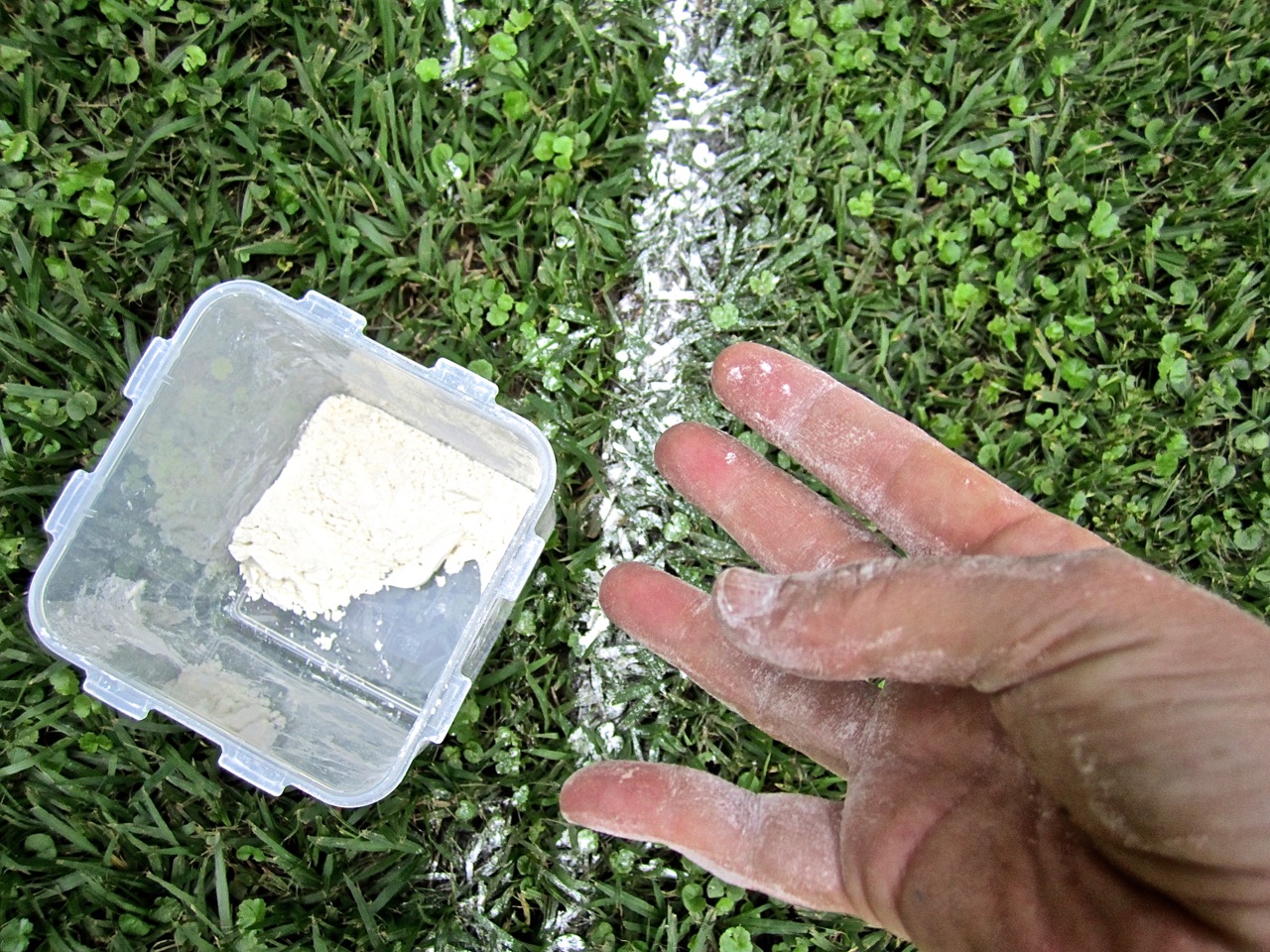
Hint: I’ve been using flour to mark the new outlines of planting beds.

So while we pause, I’ll back up and give you some “before” pictures and a little site analysis.

(I’m going to use the present tense while describing the old garden features, so as not to give away the changes we’ve made).

This is a good-sized, “working” diplomatic garden that hosts two or three receptions or ceremonies a month.  It’s very pretty and lush, with mature trees and many flowering shrubs.  But it also has some problem areas — places where purpose is ill-defined, opportunities for drama or charm are missed, transition points are weak, and many plants are too old or badly pruned or overcrowded.

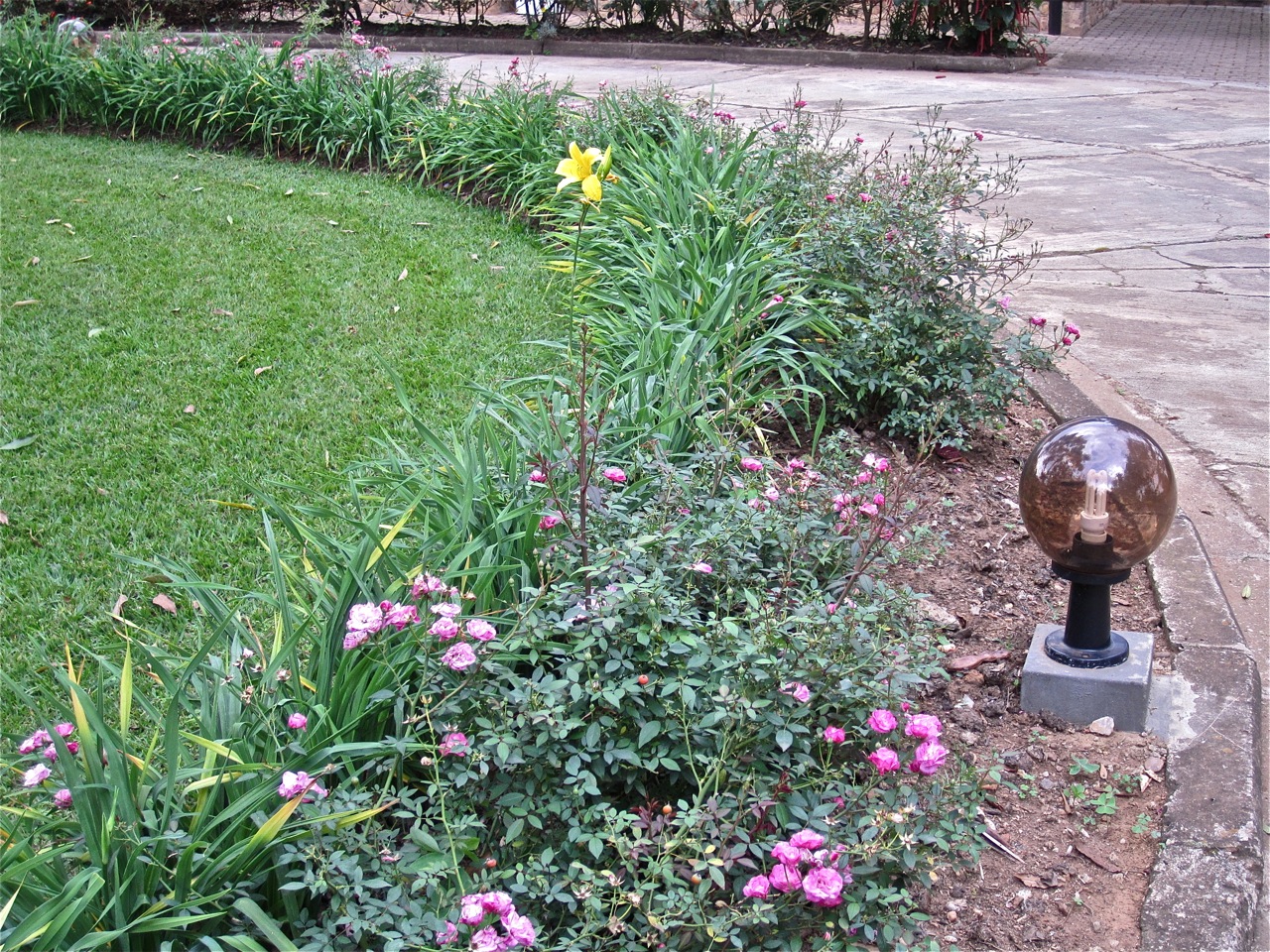
The first photo below shows the view when you enter the gate to the property: one end of the house, the circular driveway, and a semicircle of grass edged by day lilies and miniature roses. (If you look left, you see the back of the house and a parking area.)
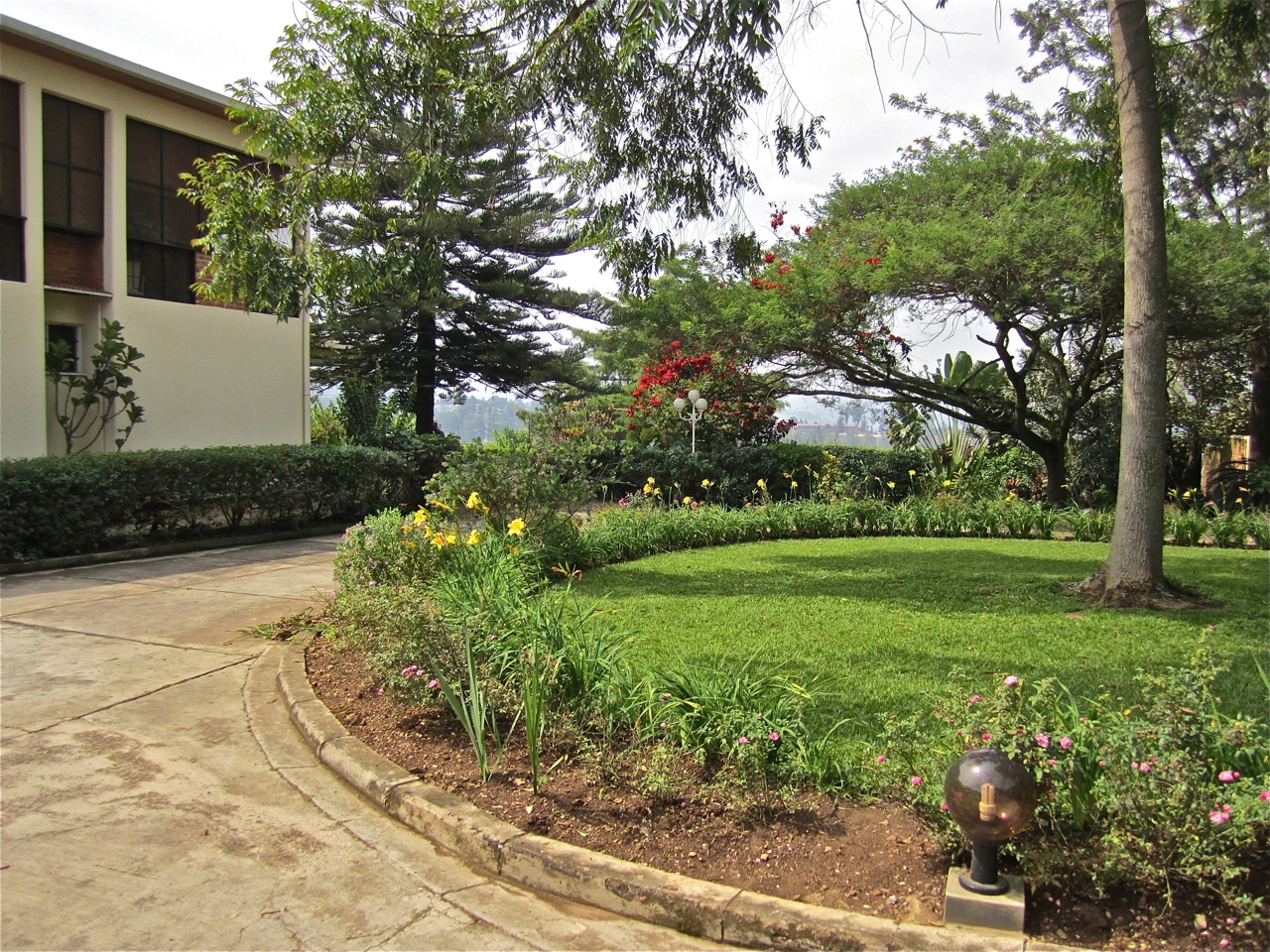
In the semi-circle, shown above and below, the miniature pink shrub roses (possibly “The Fairy” variety) are planted in a line along the curb, and the yellow day lilies are lined up right behind them.  I’m not fond of the yellow/pink combination, but my main concern is that the single-file arrangement  — the first thing you see when you walk or drive into the enclosure — is skimpy and makes a weak  impression.
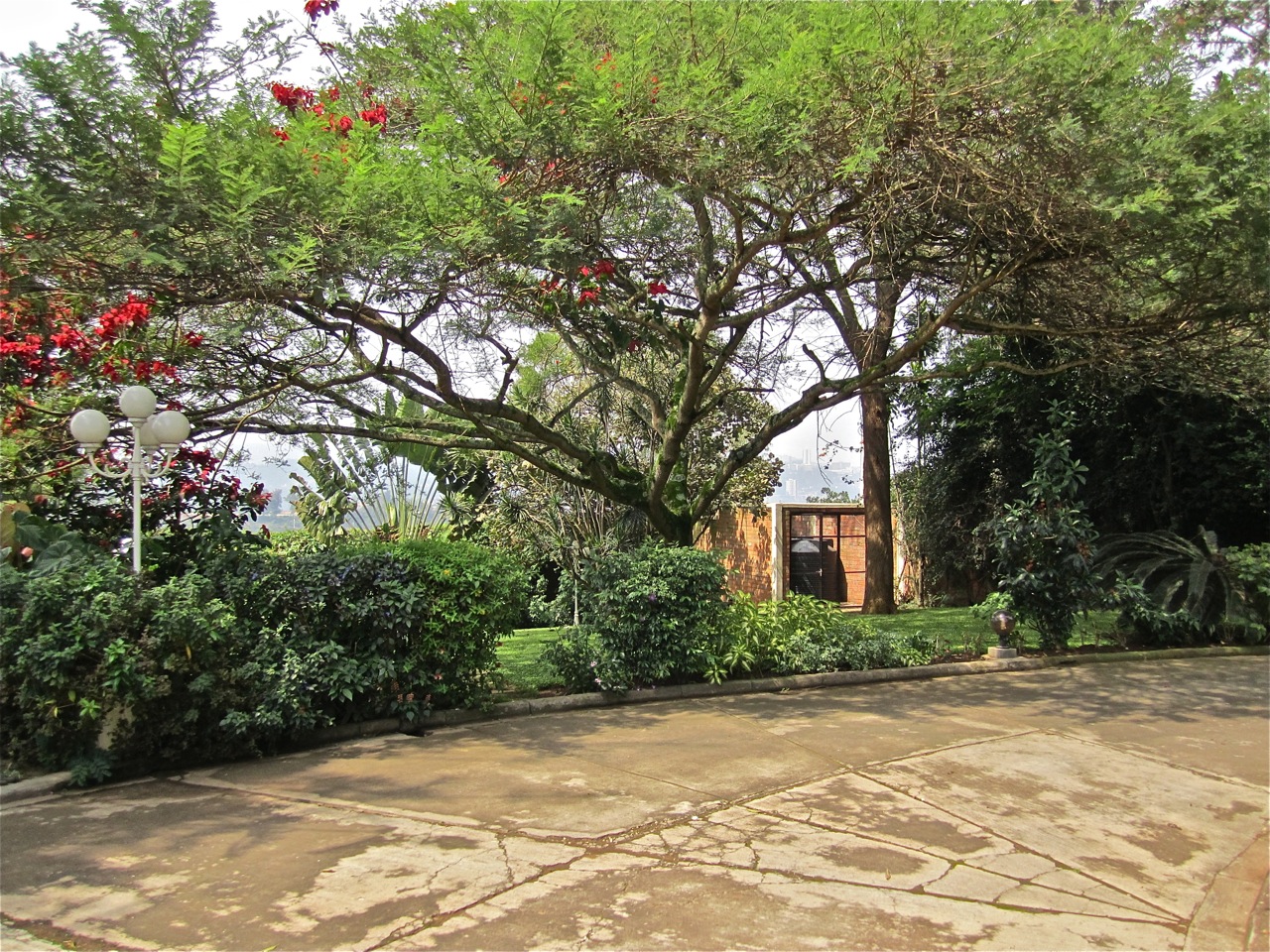
Looking right across the semi-circle, below, you see a beautiful  spreading acacia tree, but its impact is obscured by the shrubs and plants growing along the edge of the drive.
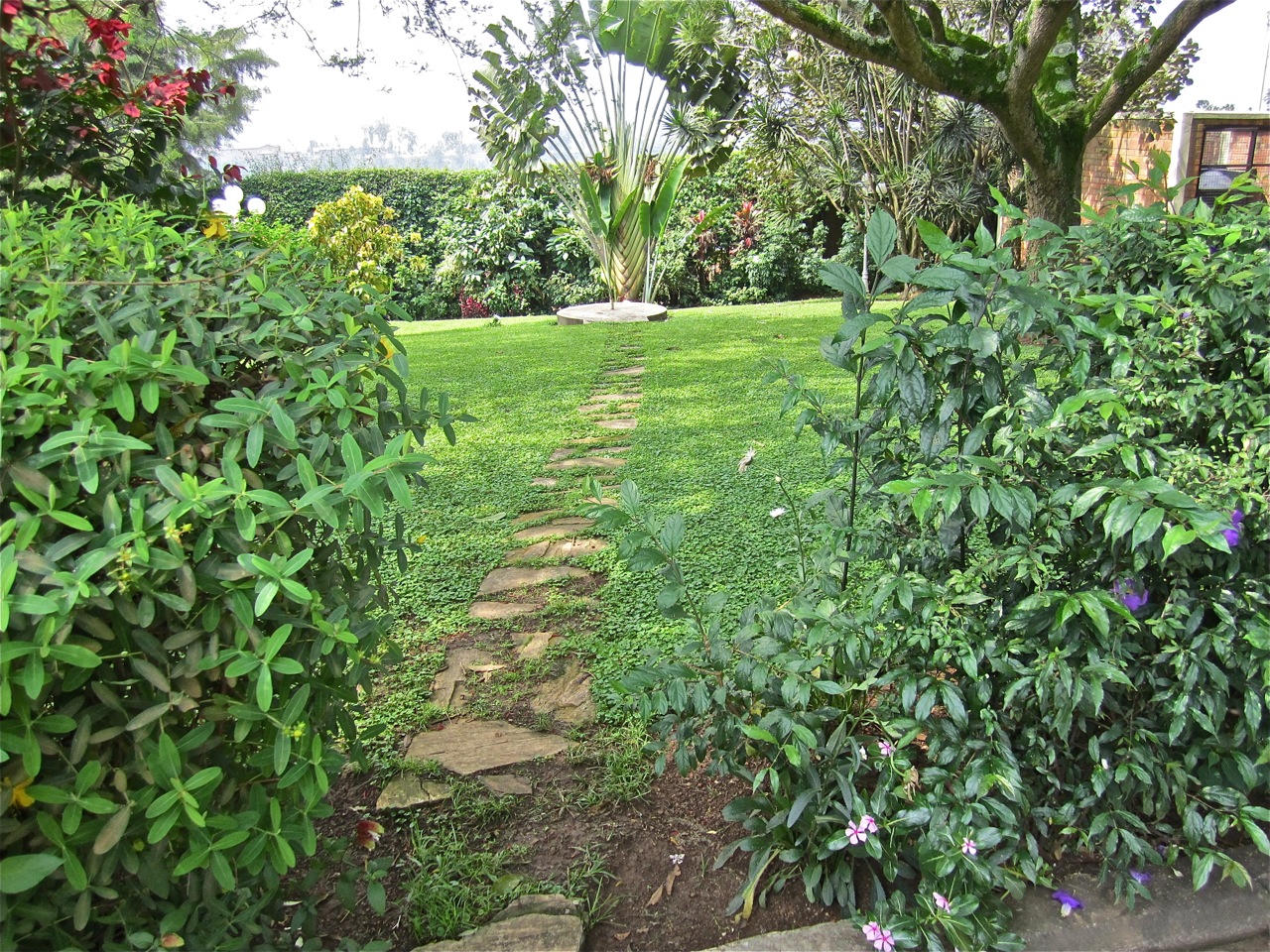
If you slip in a small space between a couple of those shrubs, as in the photo below, you find an old stone path leading to a no-longer-used concrete flagpole base.  And to the left of the concrete base are steps to the long front lawn.
Below, the photo shows the side entrance to the front terrace.  (If you back up to the starting point in the first photo above, walk down the drive along the side of the house, you reach this point.)  This is where we welcome guests.  Because of the planting bed in the center, and the clipped hedges at the edge, the paved walkways only comfortably allow for two people to stand side by side.
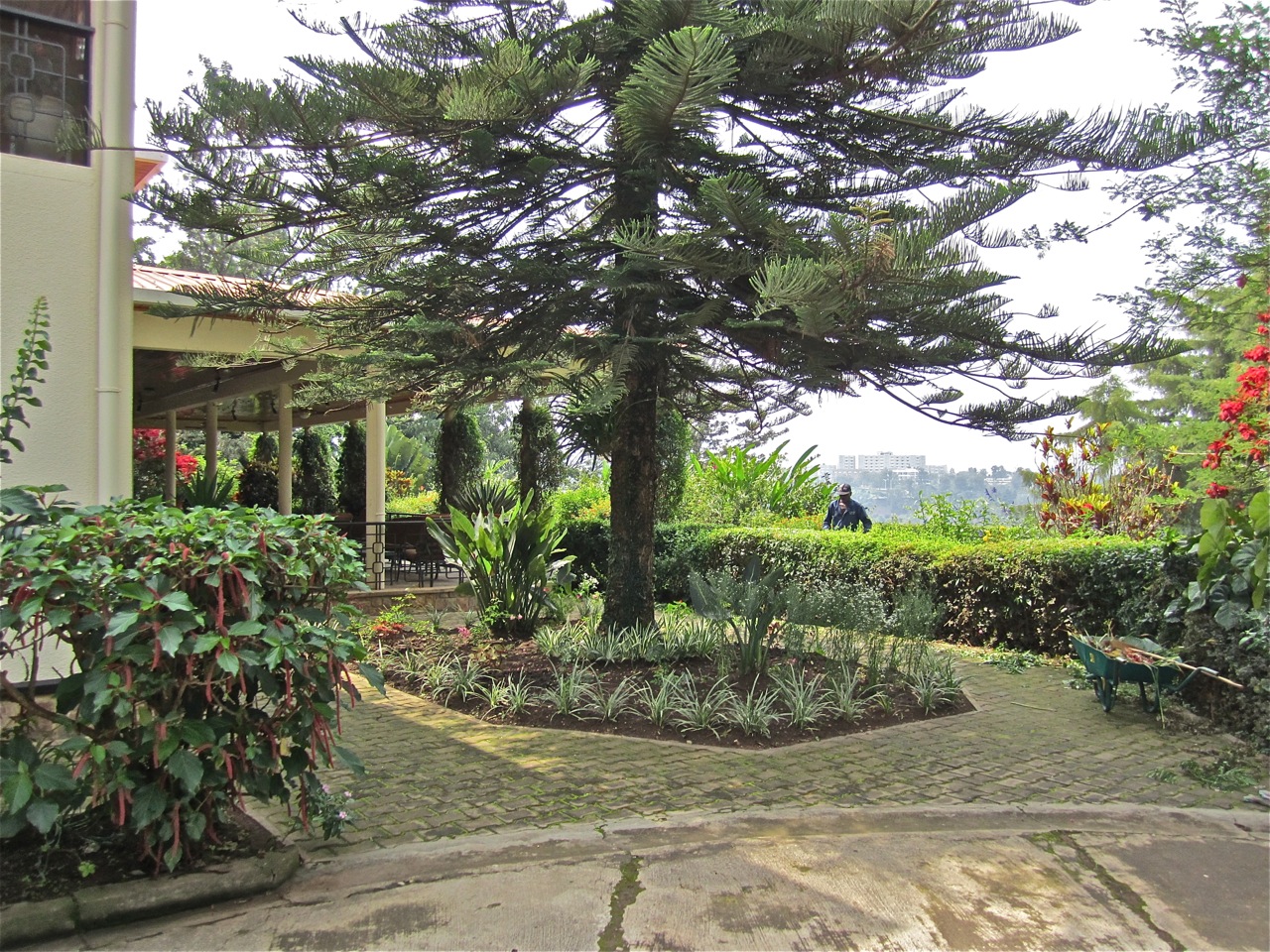
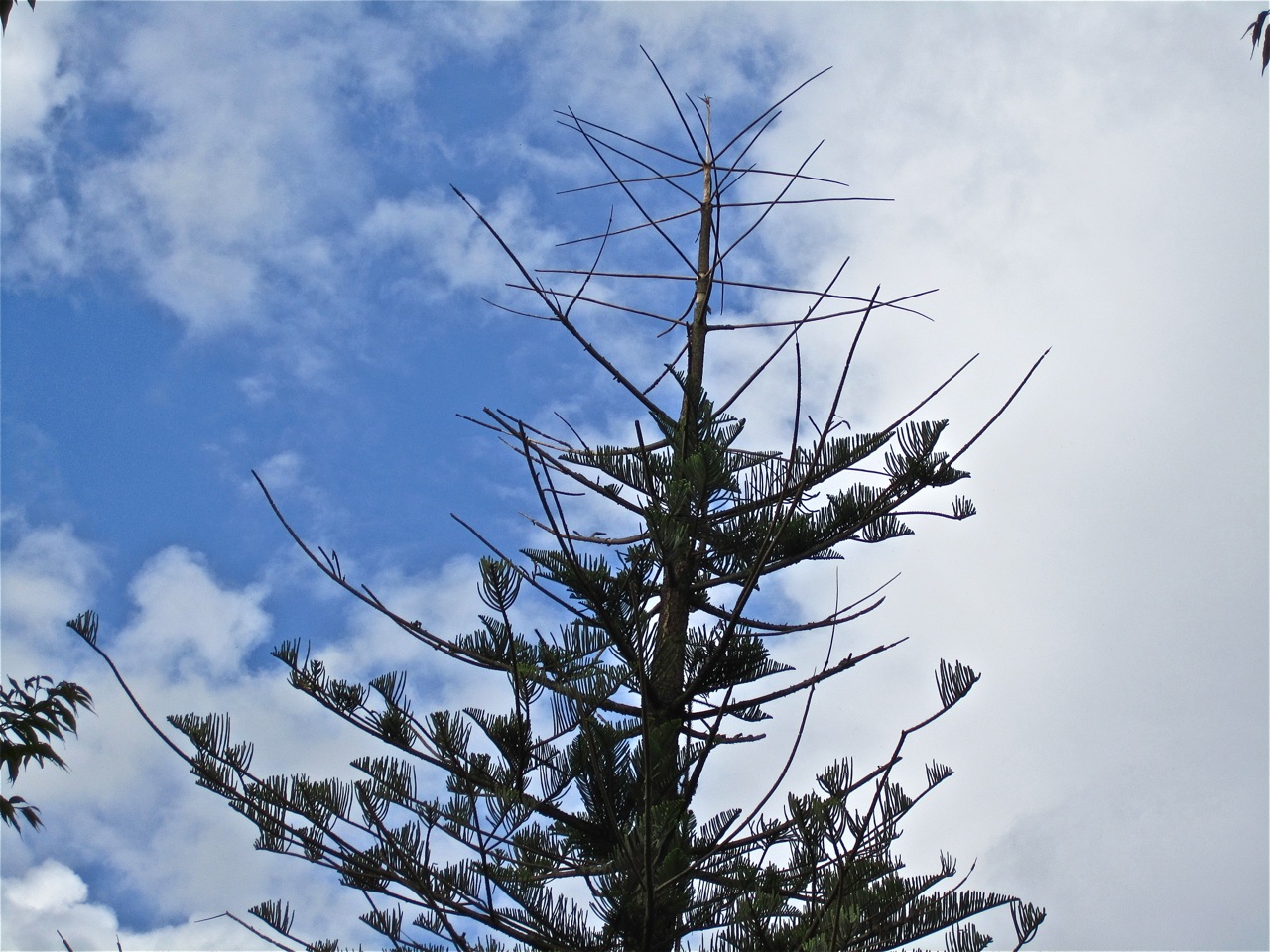
The hedge is made up of plumbago, lantana and other flowering plants, but the blooms are mostly sheared off.   In center of the planting bed is a tall Norfolk pine and a rather skimpy assortment of small roses, asters (I think), lirope, coleus, and a bird of paradise.

Unfortunately, the tree is dying.
If you step through this area, you’ll be on a long terrace along the front of the house.  As you can see in the photo below, in  front of the terrace are two rows of (mostly) clipped shrubs and a path of grass between them.  Plumbago and jasmine are growing up the house columns.  The vines and shrubs attract colorful little birds right up to the terrace.  However, the vines on the backsides of the columns are bare and brown from constant shearing and a lack of light.
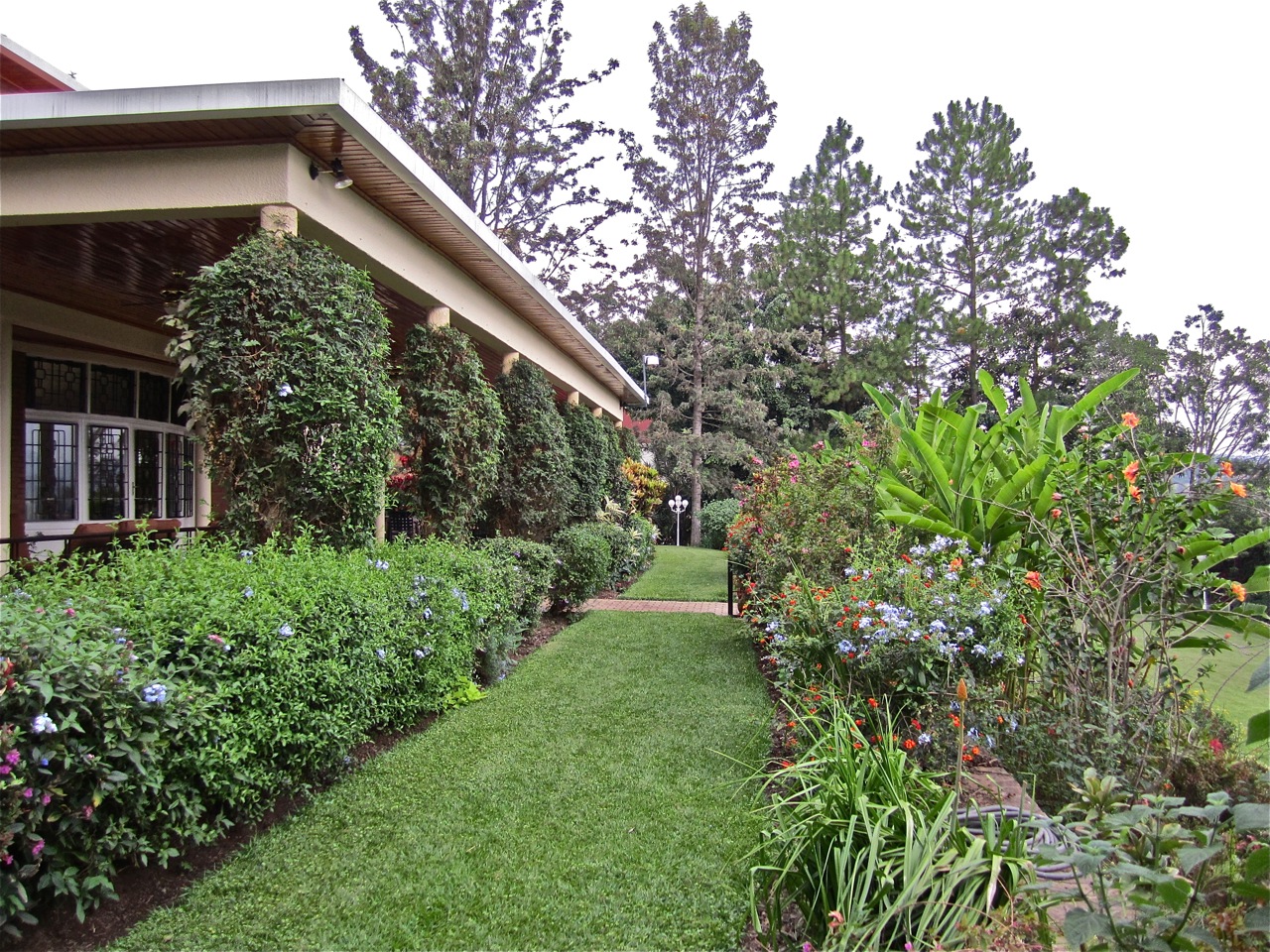
The shrubs right along the terrace make it feel closed in, and I believe that mosquitoes hide in there in the evening.

While the arrangement is rather pretty, the grass path serves little purpose — it’s mostly blocked by the shrubs on one end, and it’s too narrow for seating.  The tall plants on the right in the picture above — particularly the 6’+ lobster claws (Heliconia rostrata) — obscure the view of the hills and the city.
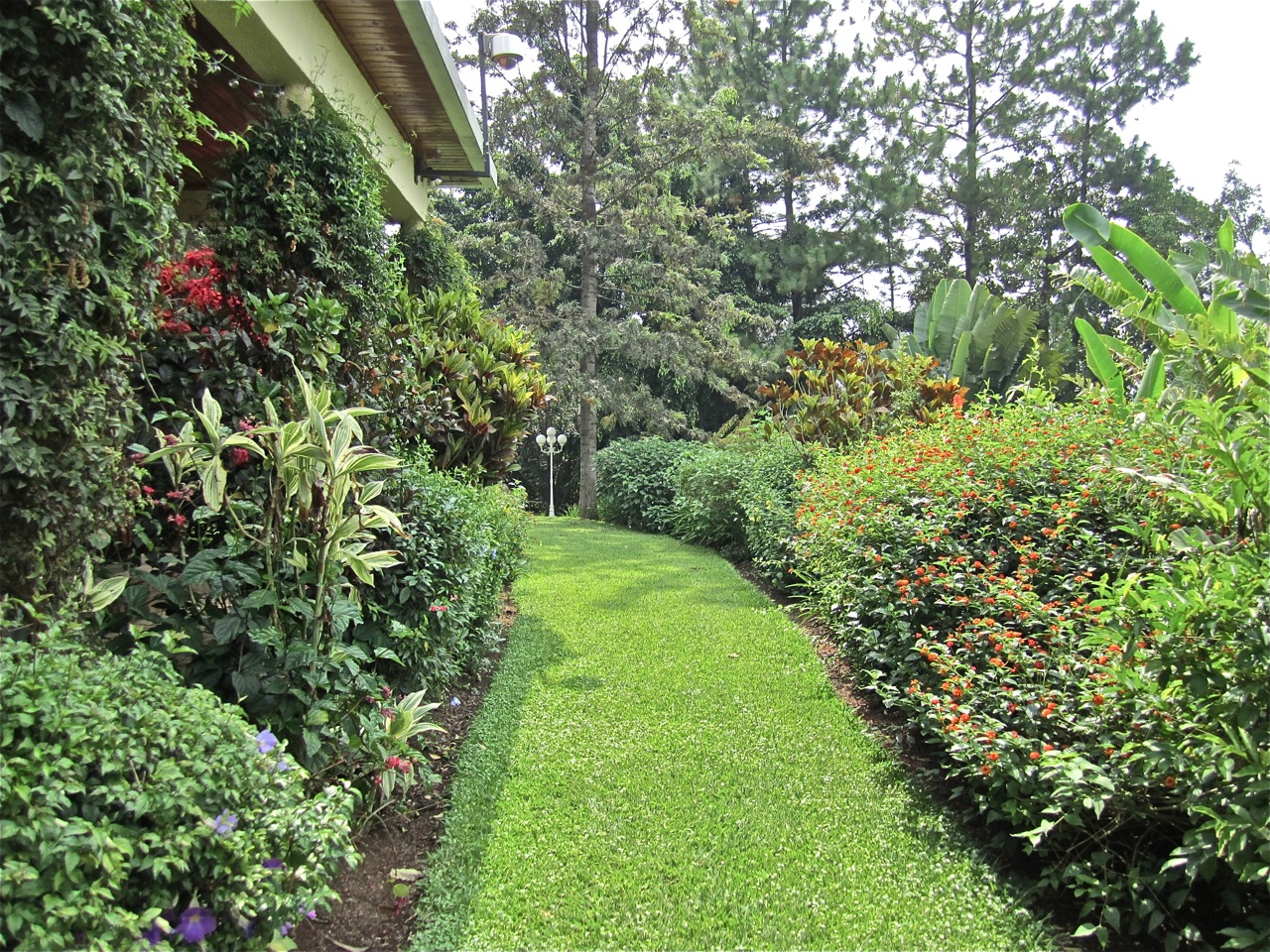
There are a lot of great plants in the beds on either side.  And I always imagine Alice running through some part of  Wonderland when I look down this side of the path (above).
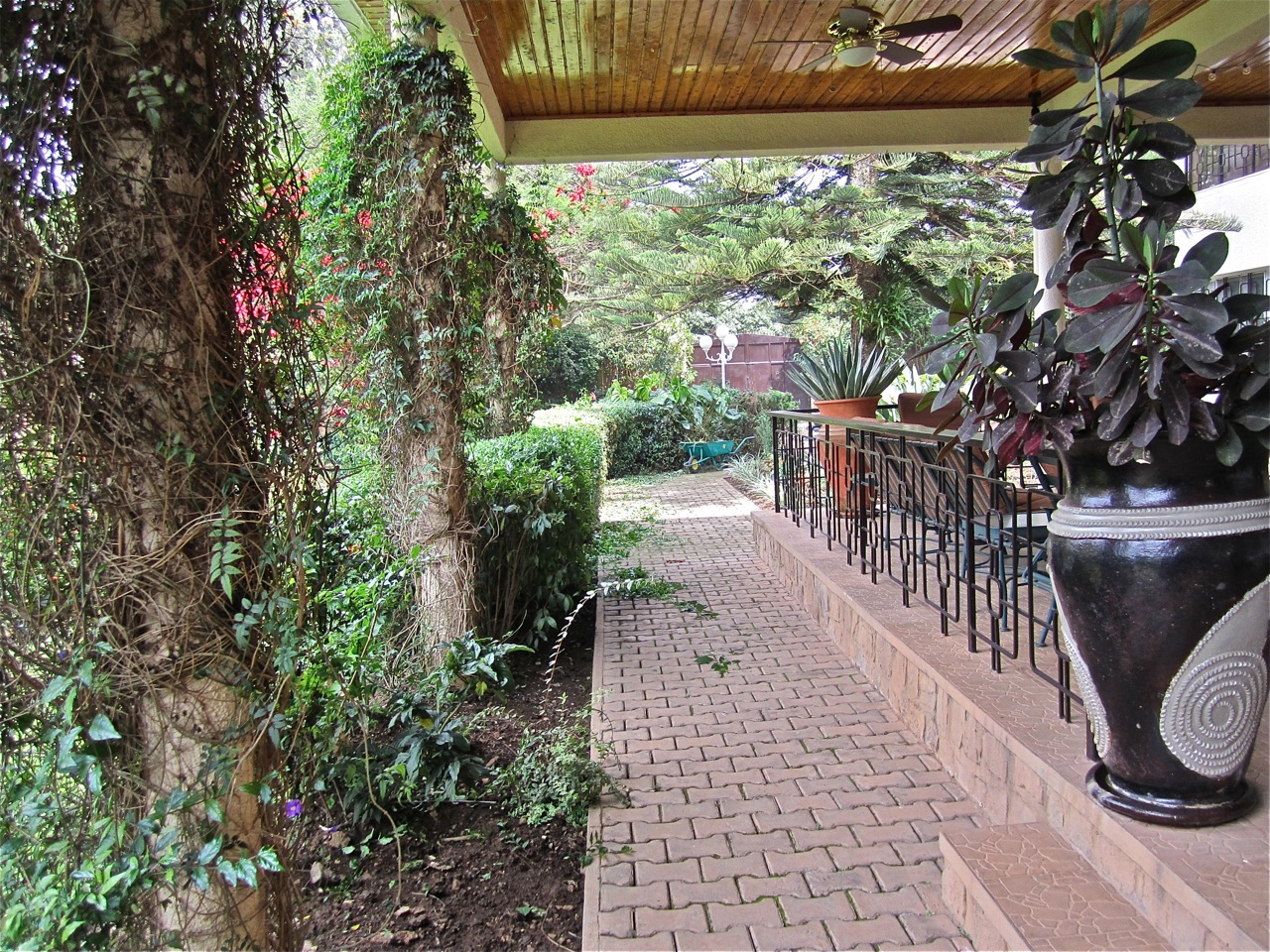
Unfortunately, the terrace side of this strip (above) gives me an unpleasant crowded feeling, and the leaves of the vines die off from lack of good light.
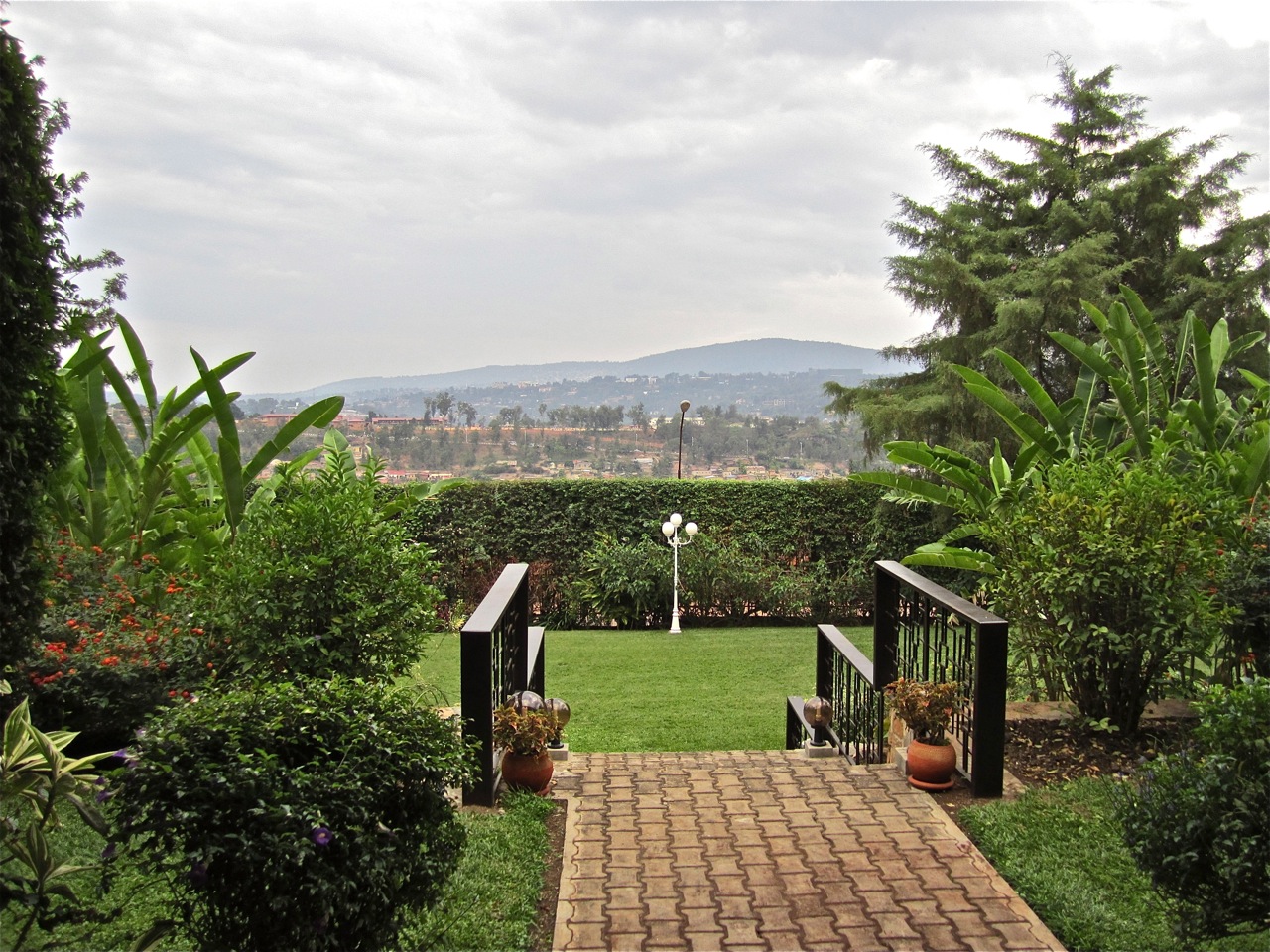
Above is the view from the center of the terrace.  It’s somewhat blocked by the tall lobster claws on either side of the steps.  Down those steps are two levels of stone retaining walls and then a long lawn.
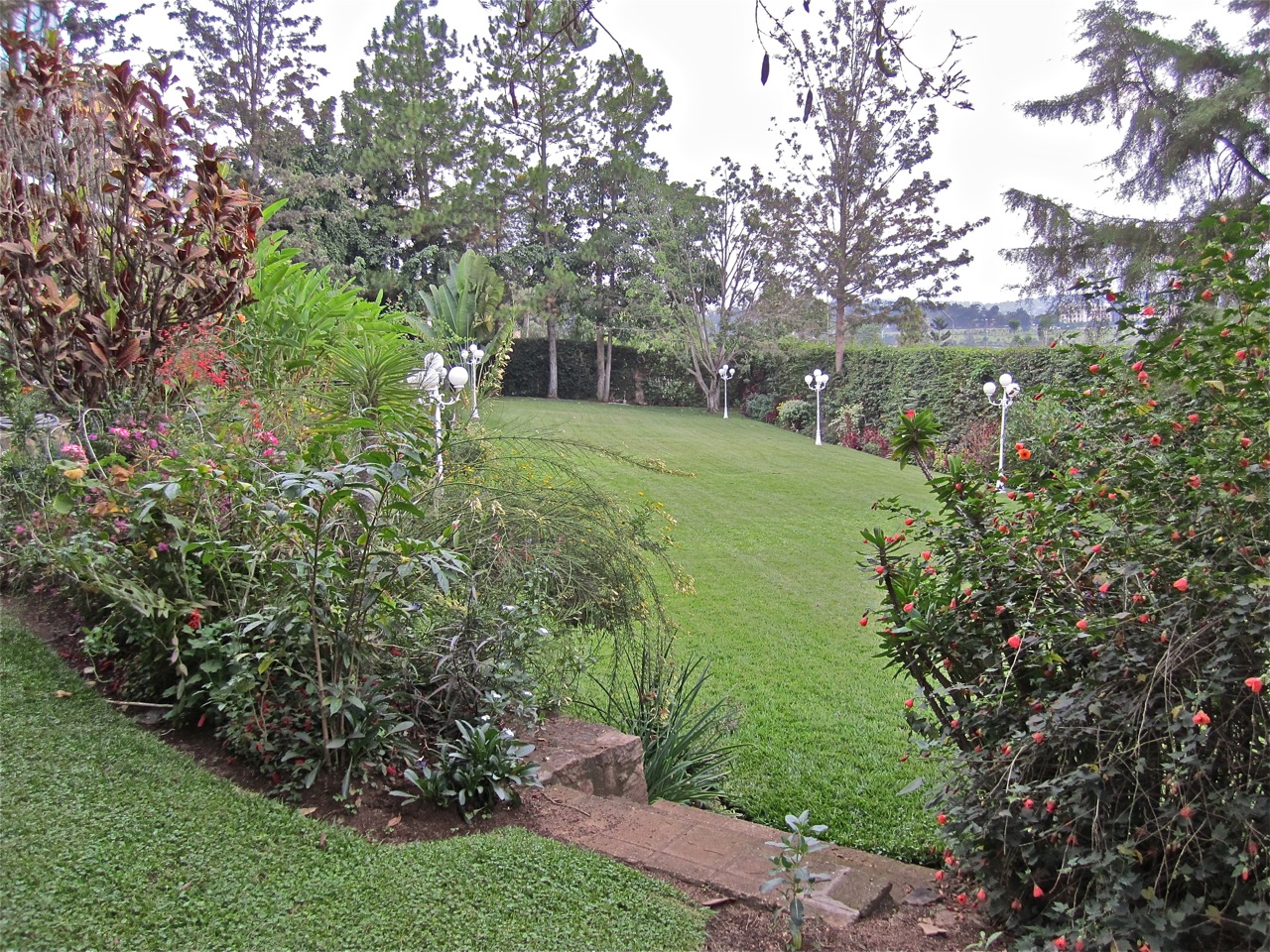
Above is a view of the lawn from one end (at the steps just to the left of the flagpole base in the earlier picture).  When we entertain large groups, the embassy puts up one or two tents in the center of the lawn.
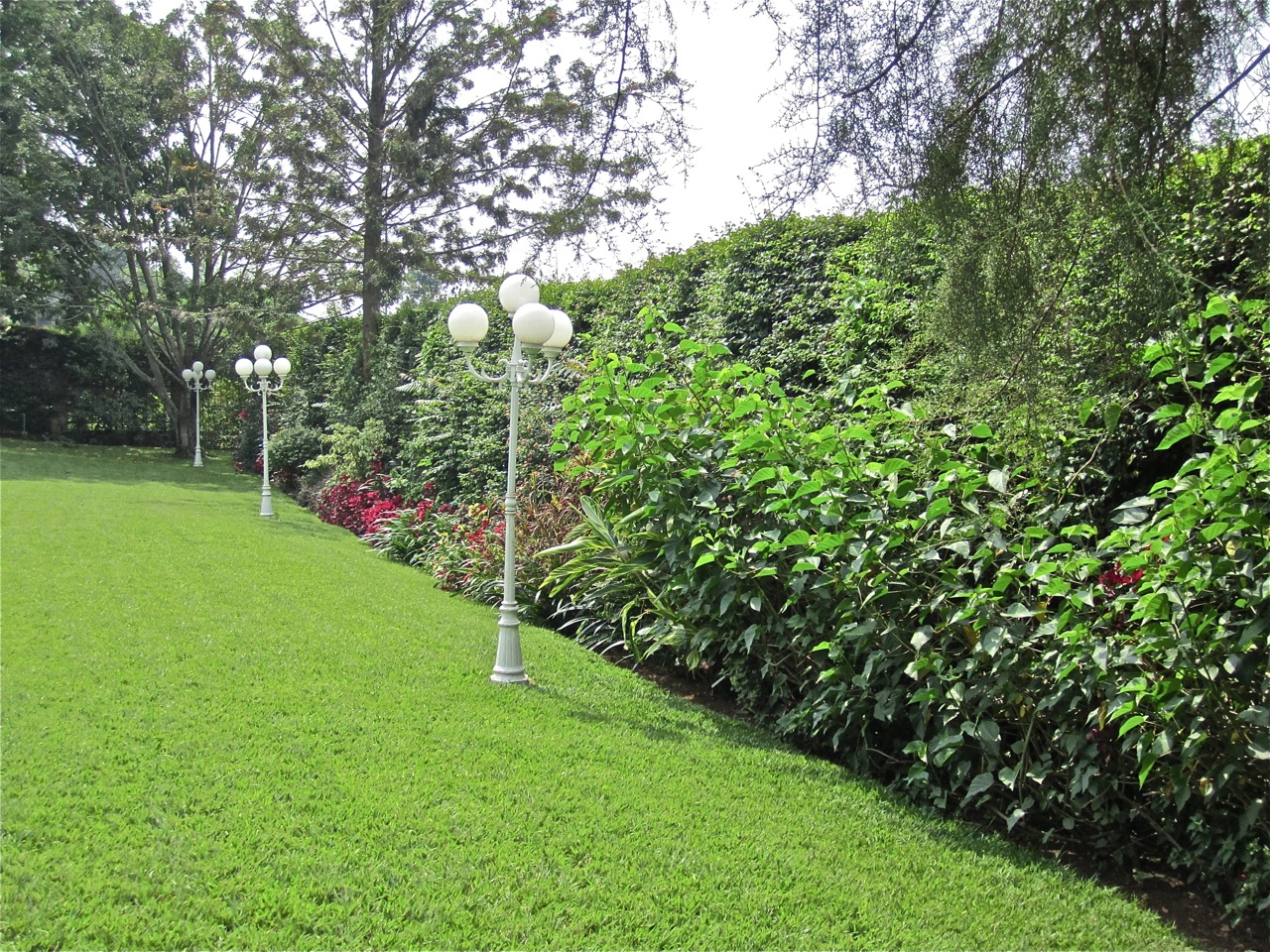
On the right side of the lawn, at the front of the property, there is a clipped bourgainvillea hedge and a variety of interesting shrubs and plants, all sharing a very narrow strip of ground.  The slight dip at the edge of the lawn makes it look like the plants in front are sliding under the hedge.
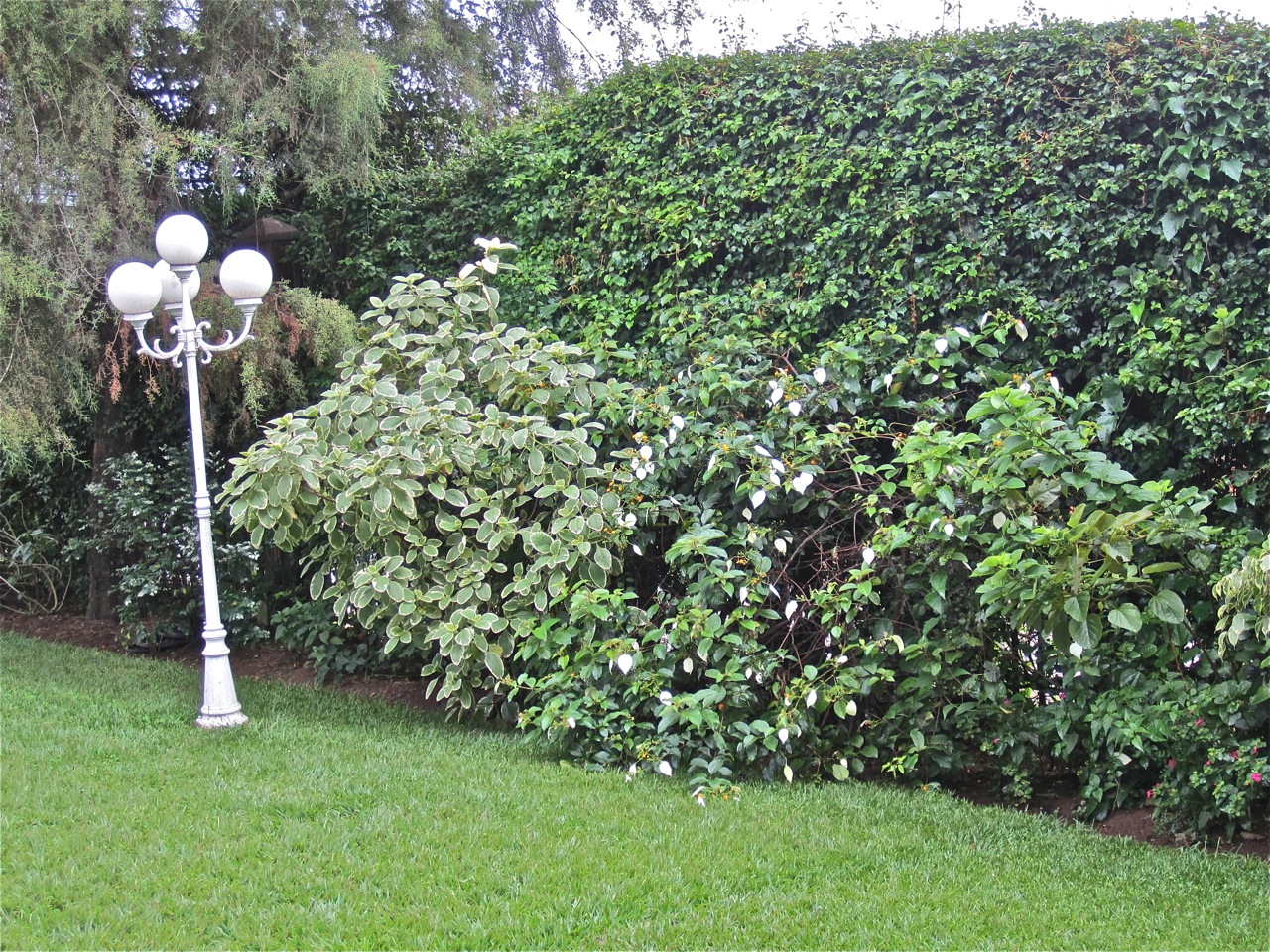
In the photo above, you can see how pretty the shrubs are, but again how little room they have.  Since this picture was taken, the gardener has cut these bushes along their sides to keep them from intruding onto the grass.  Now you see a lot of bare stems — not very attractive.

The white, curlicue, Victorian light posts in the above photos really bug me, I must admit, because, as you can see in the picture below, the lines of the house are attractively modern and simple.
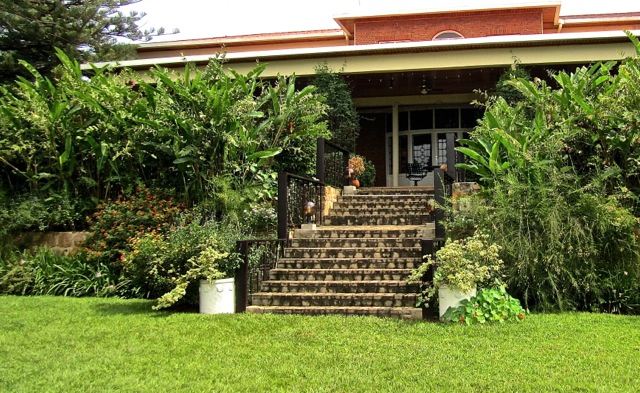
Above is the view from the lawn at the bottom of the center terrace steps.  You can see, to the right and left, how tall and thick the lobster claws are. (Are you getting the idea that maybe something’s going to happen to those plants?)

You can also see from this photo how the two levels of stone retaining walls that branch out from either side are an important feature of this part of the garden.
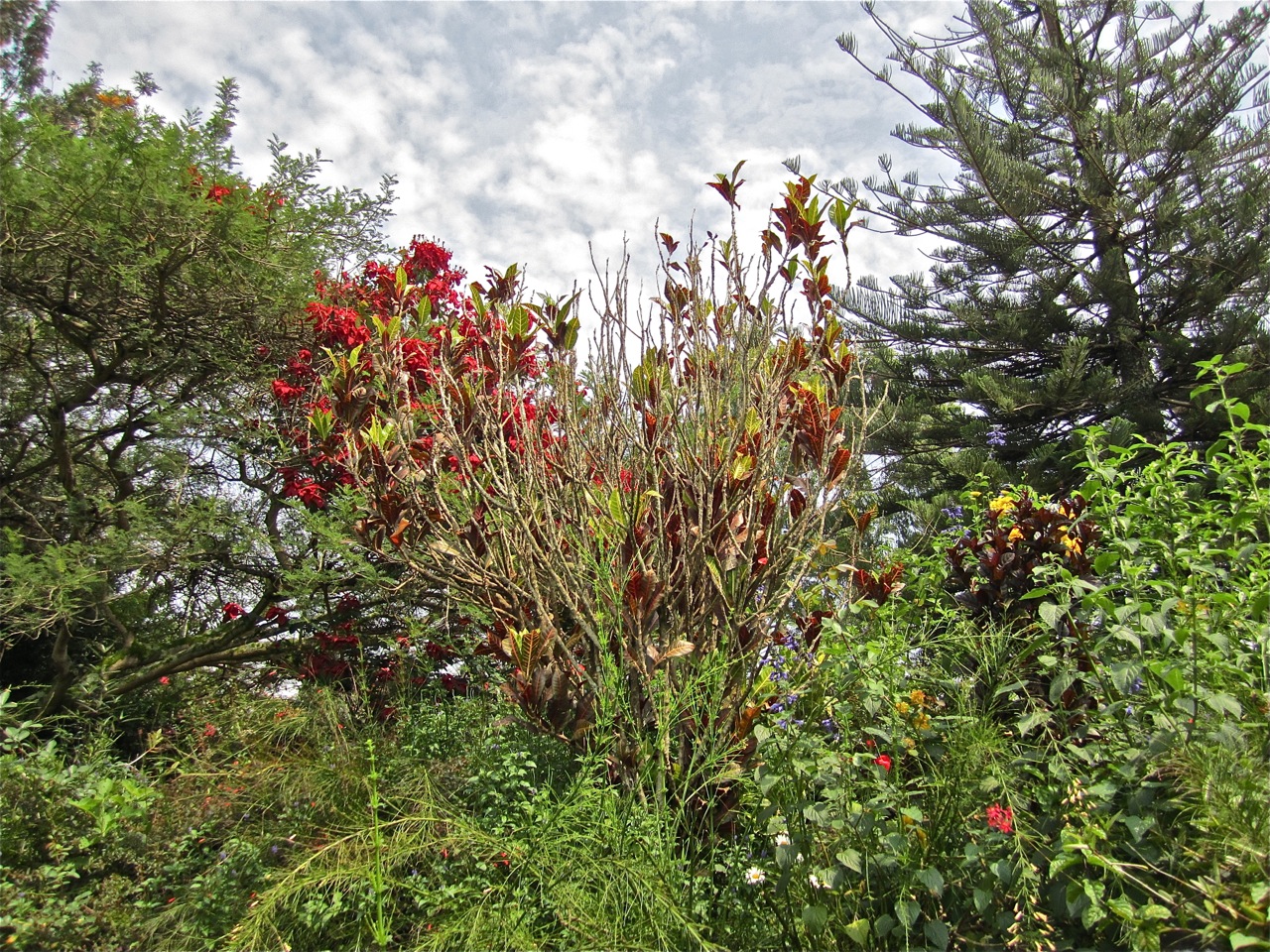
The planting beds at the top of the lower retaining walls are full  of great plants, but it’s a real thicket in there.  I have sometimes found three shrubs growing out of the same 8″ spot of ground.  And this old croton (above) is so overgrown that it’s lost half its leaves.  And at its current height, you look up onto the undersides of the remaining leaves, rather than down onto the colorful tops.
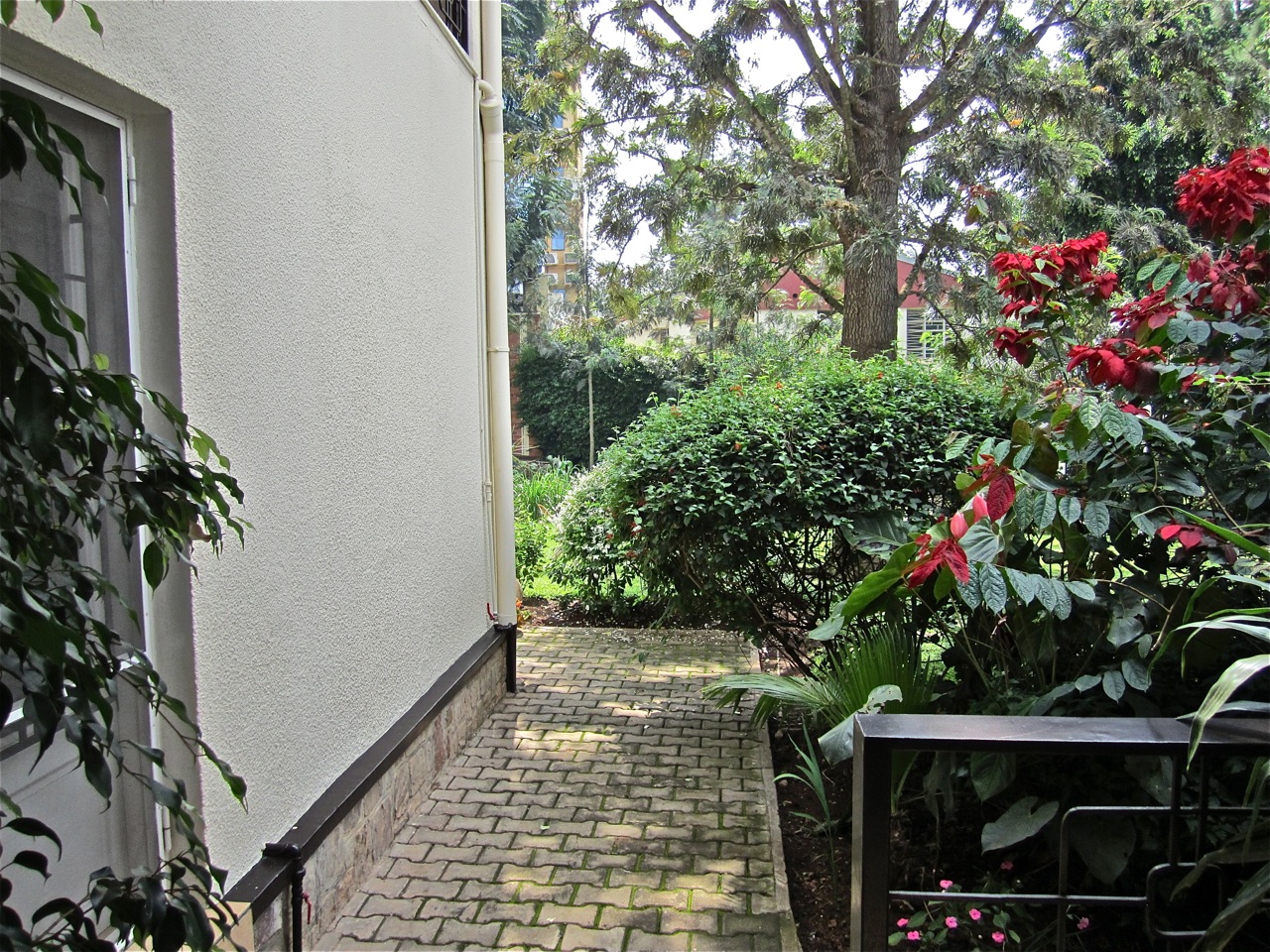
Above, going back up to the terrace and walking its length to the opposite end of the house, the path to the side yard is almost blocked by a very large, very clipped shrub (also shown below).
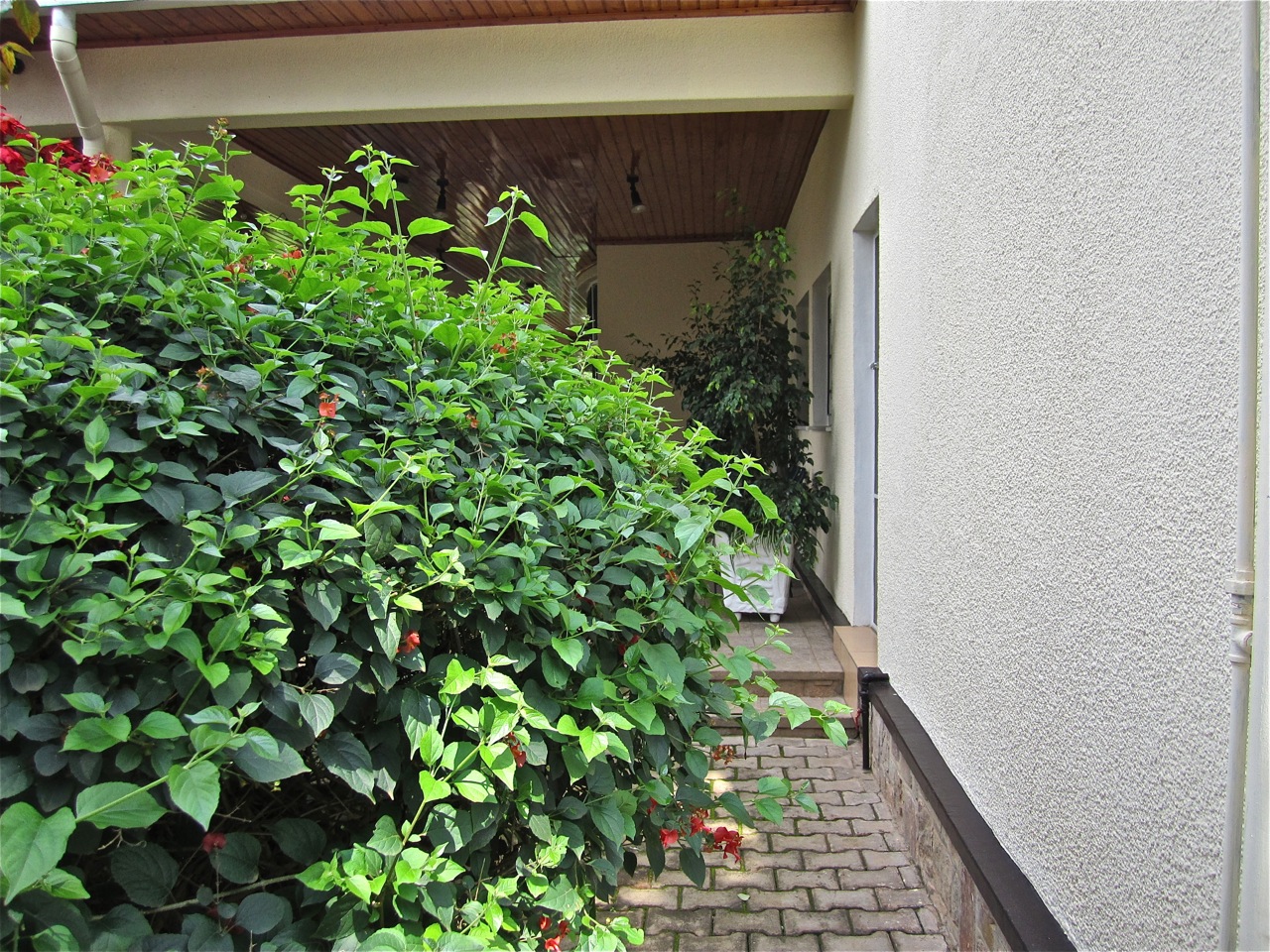
Squeezing past the bush, you come to the side yard  and the other end of the house (below), which has a narrow planting strip along the sidewalk . . .
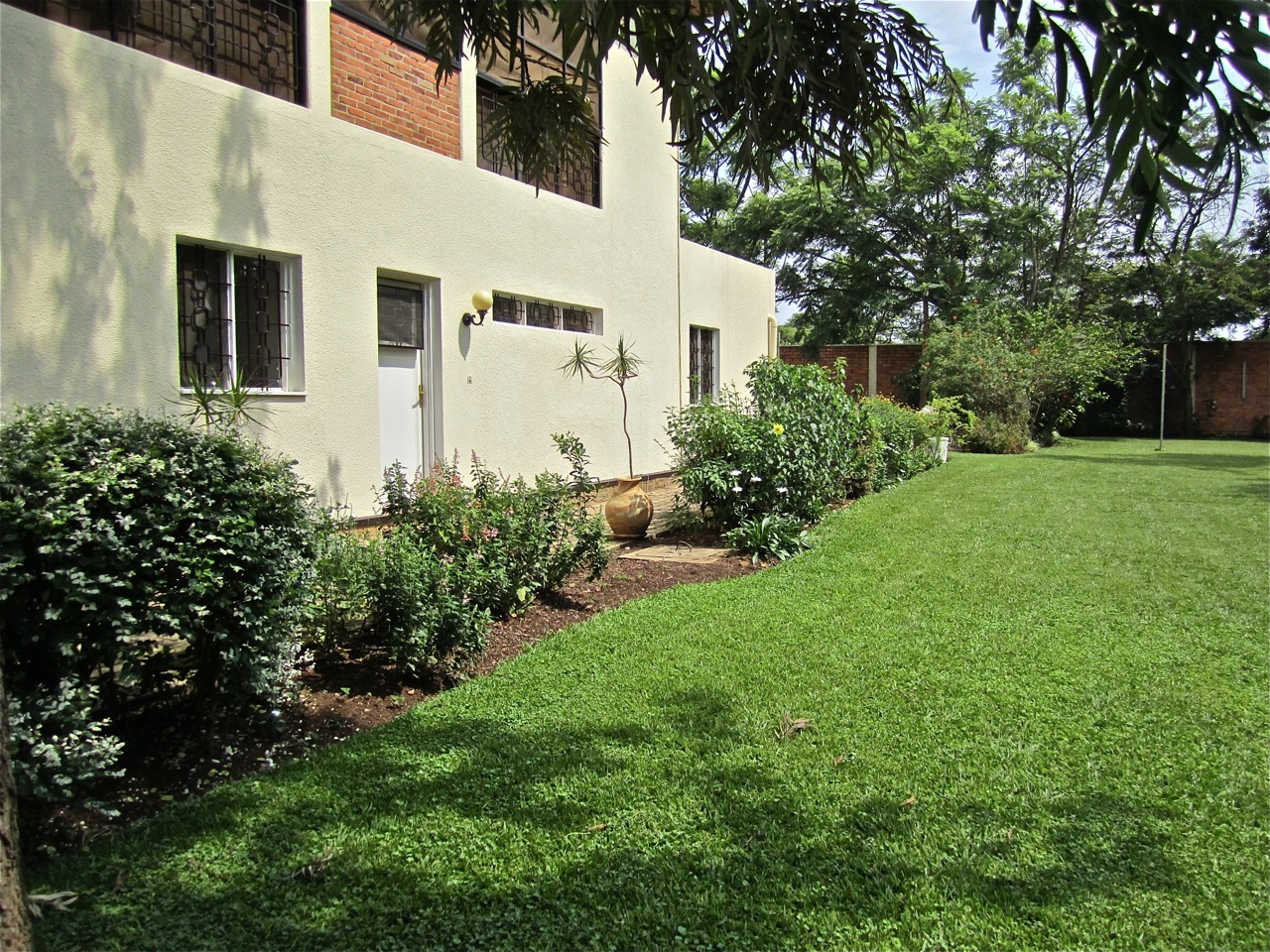
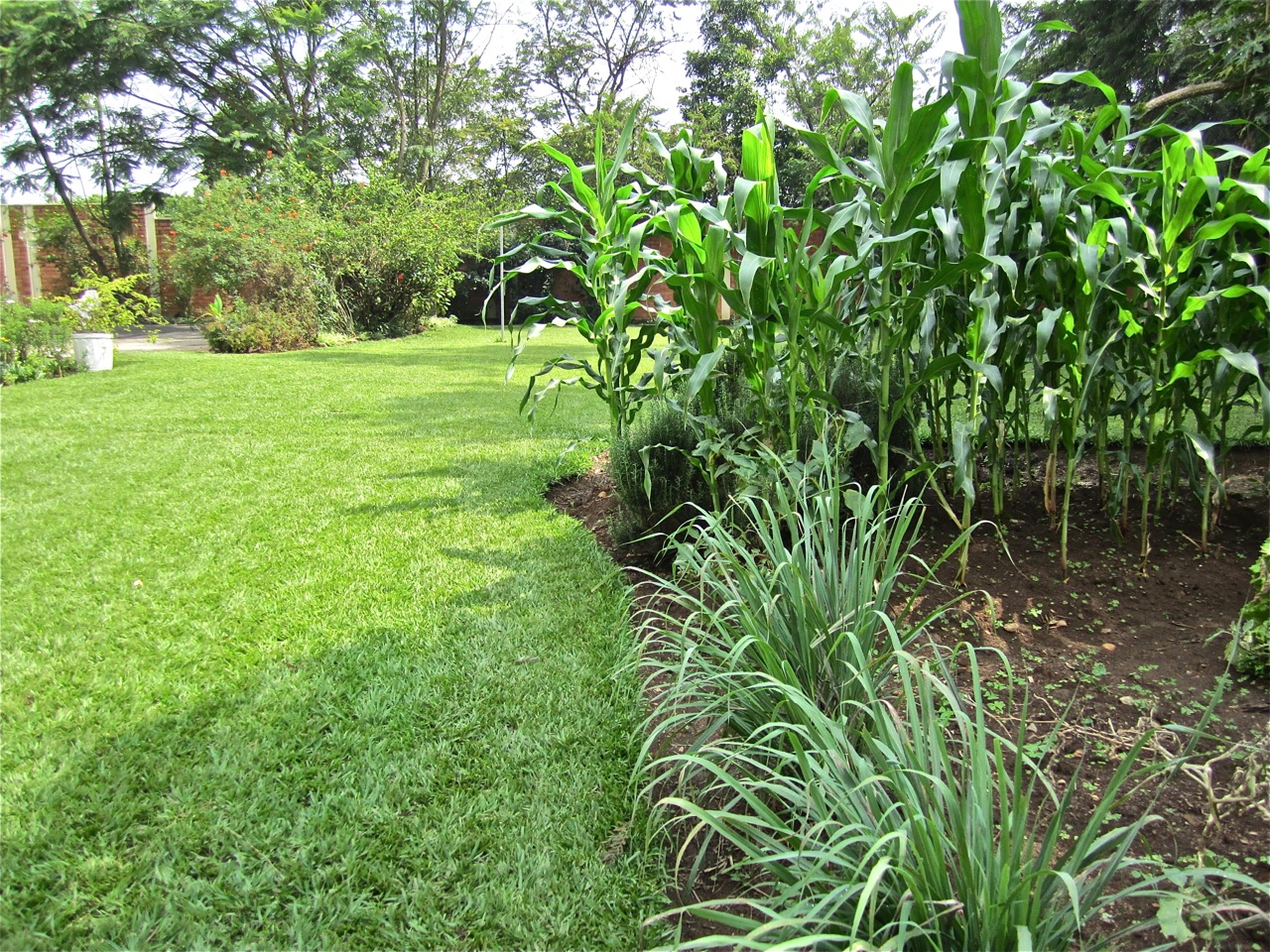
and, across from that (below), a large vegetable garden whose edges have become rather freeform over the years.  There’s a lot of sunny grassy space between these two beds, which isn’t needed for entertaining.
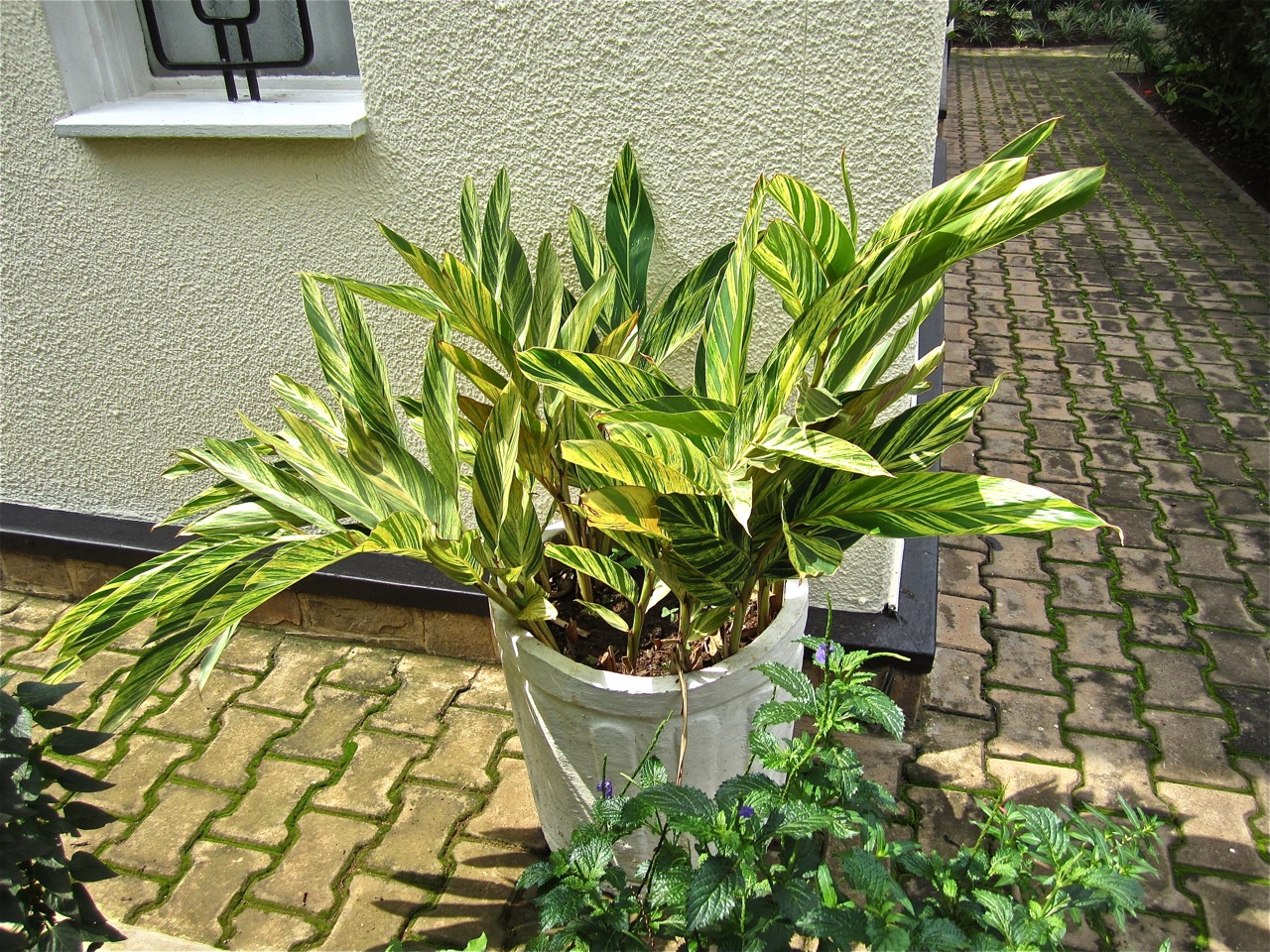
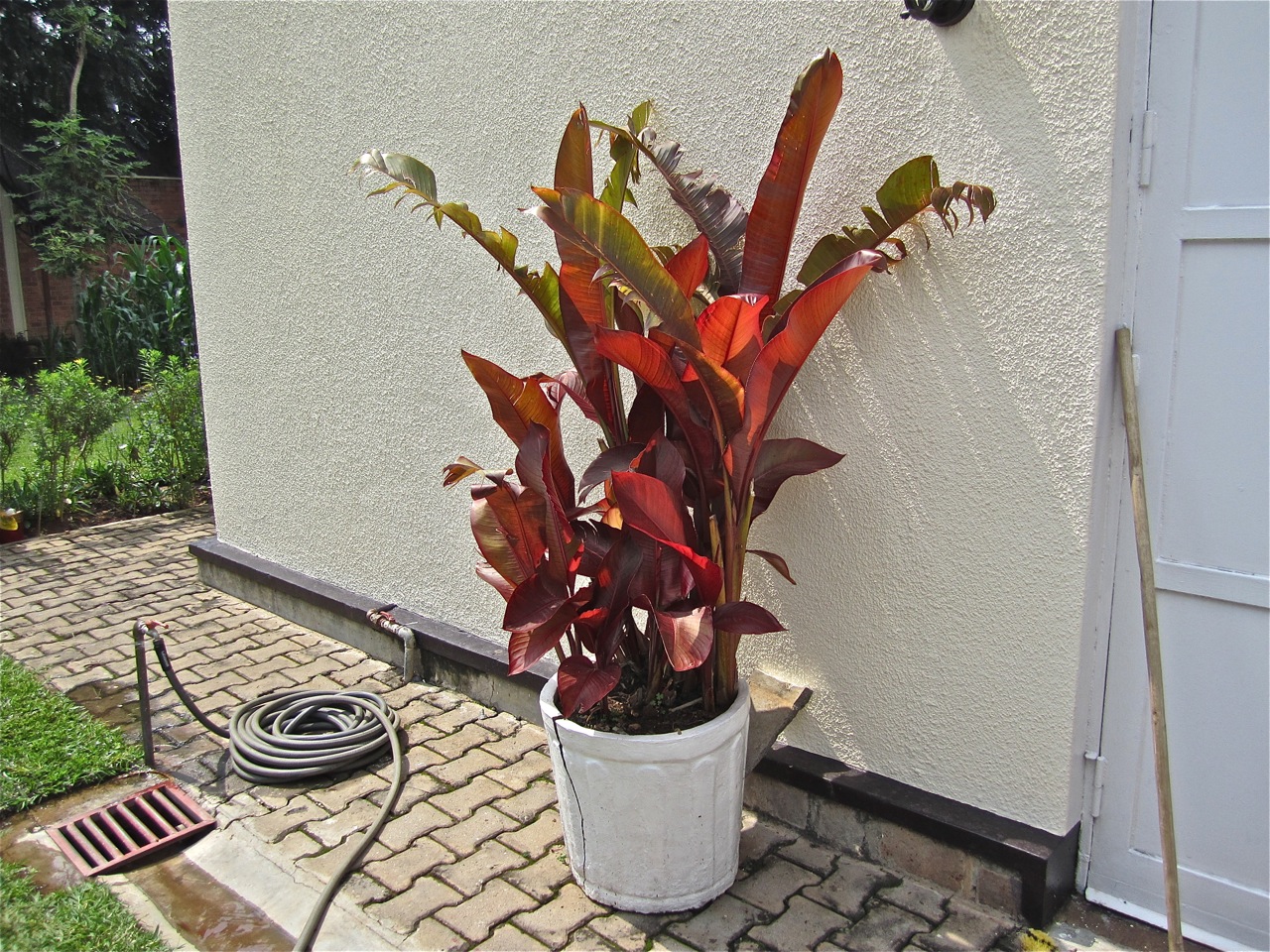
There are a number of potted plants in the garden, including these two (below), which have been left at the back of the house.  They hold burgundy cannas (which are breaking their pot) and bright variegated gingers, but almost no one sees them.  On the terrace, we also have variegated yuccas planted in very nice tall pots, but so deeply that only the ends of their squished up spiky leaves show (and they’re  a bit dangerous at upper-body level).
Soon: a concept and change.
“By any other name . . .” would be wrong

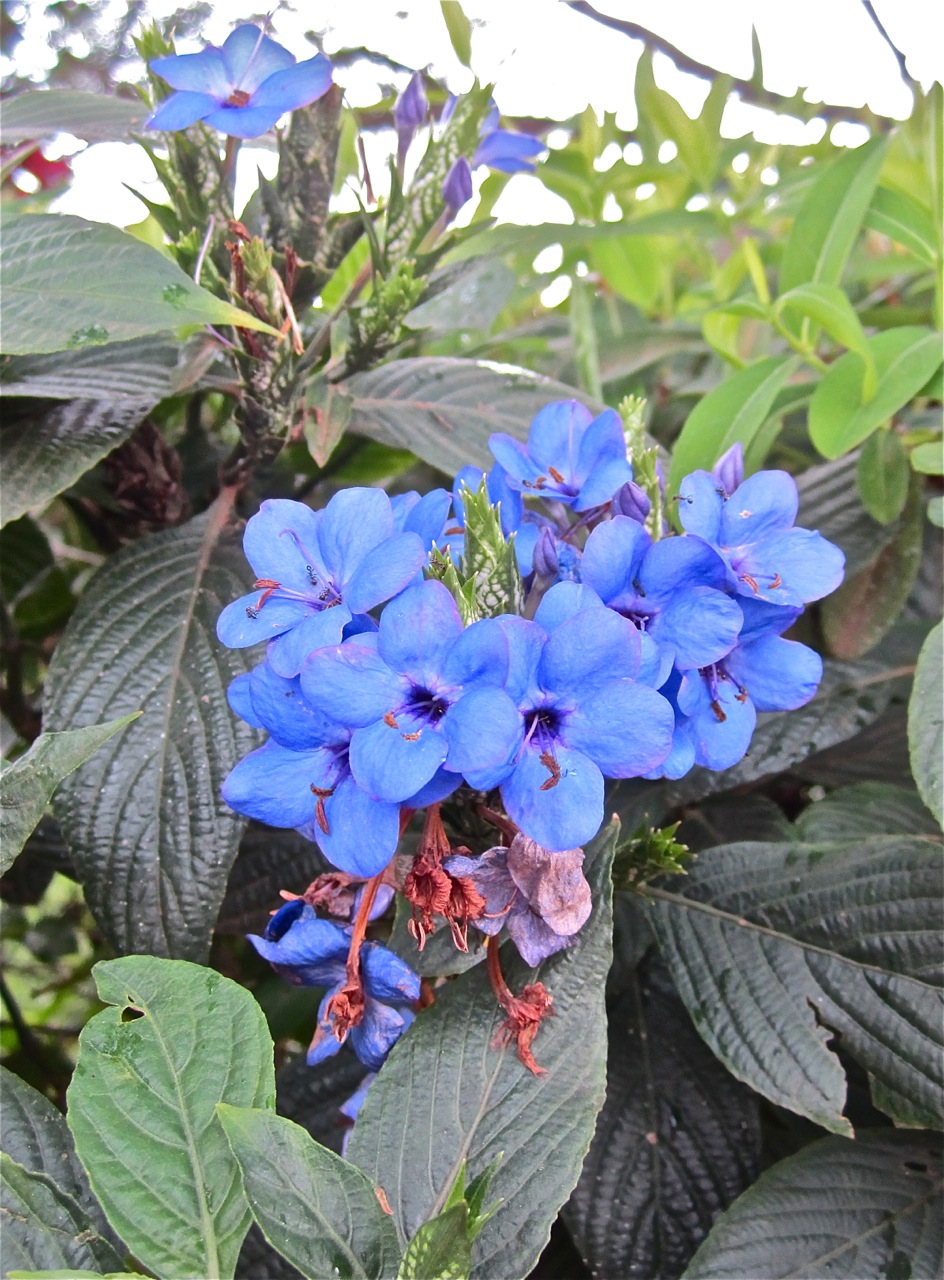
Plant by plant, I am putting names to the flowering shrubs in our Rwanda garden. Here are two more, supplied by the readers of Fine Gardening’s Garden Photos of the Day, from my pictures on Monday and Wednesday.

Eranthemum nervosum (aka E.pulchellum) or blue sage or blue eranthemum has gentian blue flowers, as you can see.  In the family Acanthaceae, it is native to India.  It will grow 4′-6′ and likes light shade.  It will grow in the garden in (U.S.) zones 10b and 11. (I think all the shrubs in this post would be suitable for pots in colder climates.)

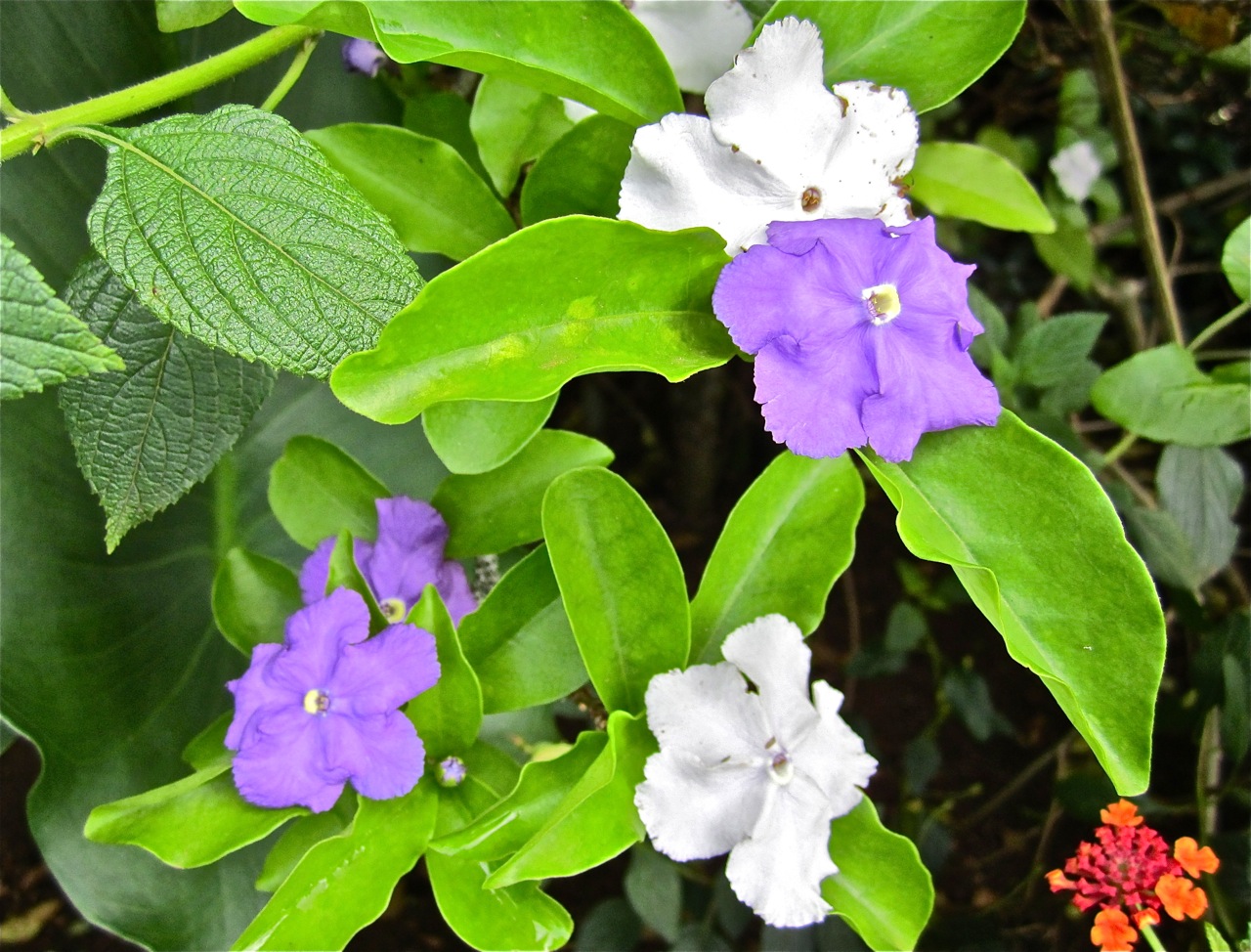
Brunfelsia latifolia (aka B. australis) or yesterday, today, and tomorrow plant is native to South America.  It is very fragrant at night.  Our largest specimen, which needs pruning, is about 5′ tall, 4′ wide.  It is in the same family as potatoes, tomatoes, eggplants, and petunias — Solanaceae or nightshade.

Y.T.T. likes well drained, moist soil and full sun to part shade — its habitats are light woodlands and thickets — and grows in the garden in (U.S.) zones 9-11.  The flowers open purple, then go to lavender, and then white.  The genus was named for early German herbalist Otto Brunfels (1464-1534).

I’m just showing this off.  I already knew its name.

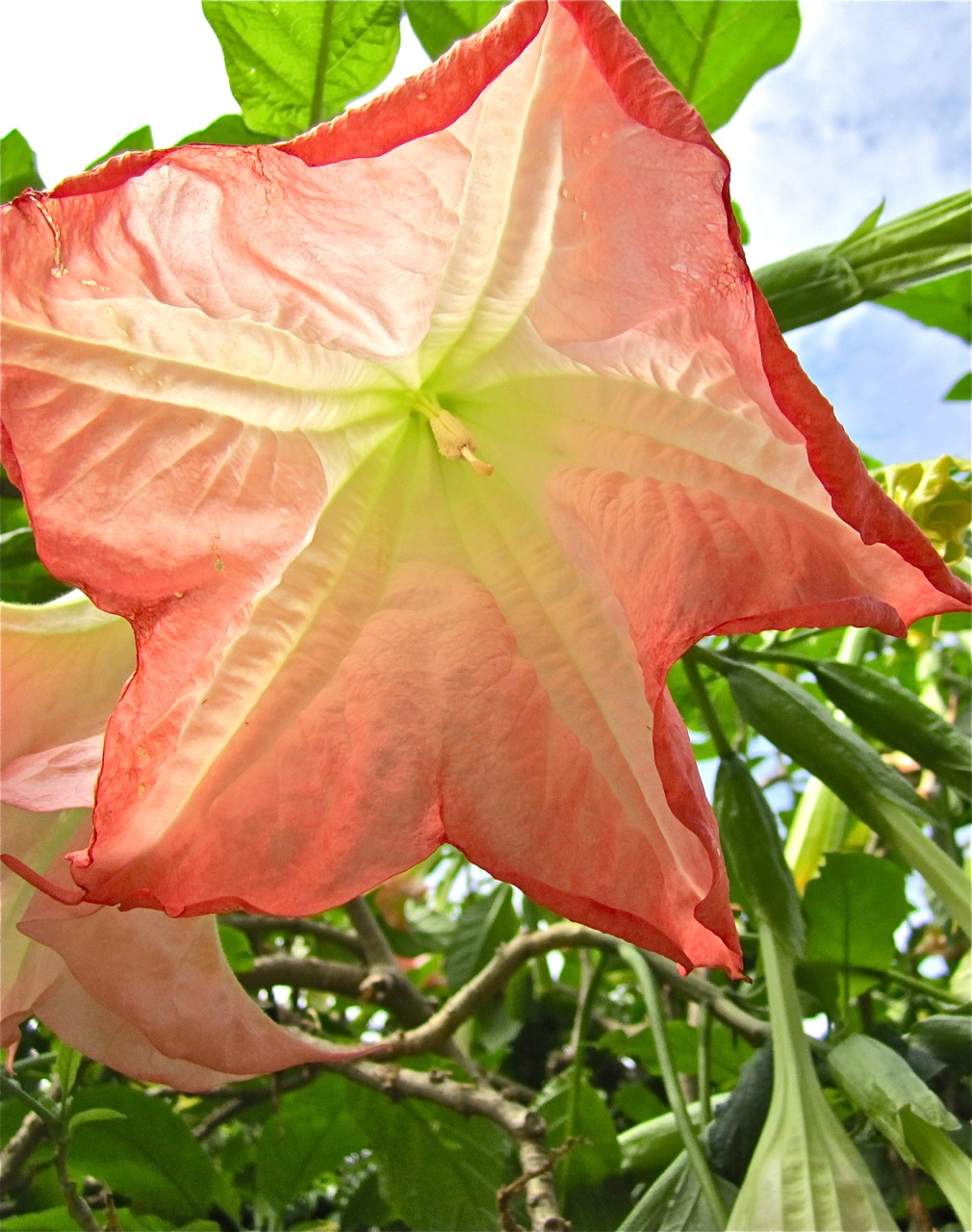
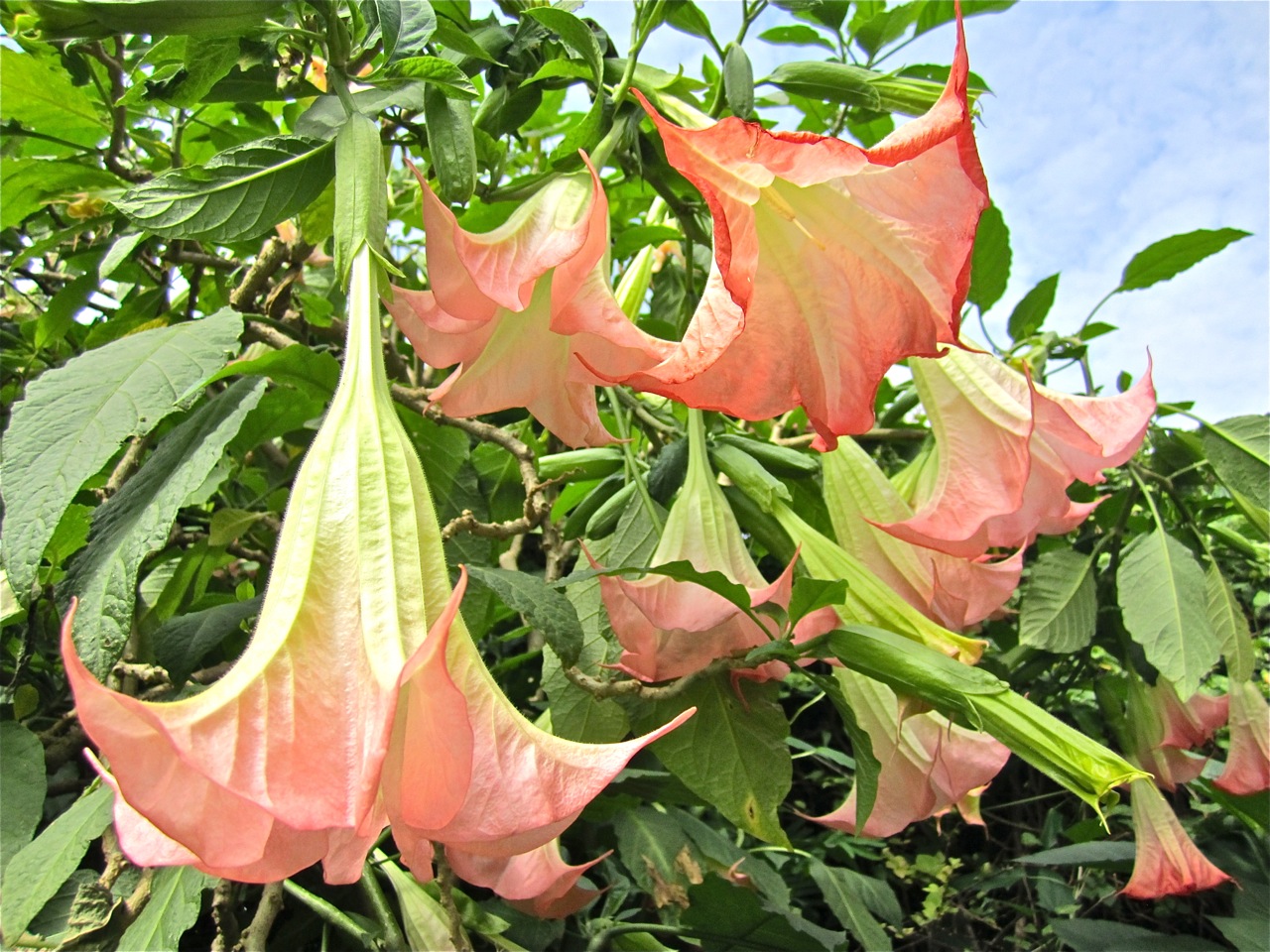
Brugmansia is native to tropical South America and, like the Brunfelsia, is also in the family Solanaceae. It is also called angel’s trumpet or datura (the name of a closely related genus).  The semi-woody shrub can branch off like a small tree and grow to 6′-20′.  It has a fragrance in the evening. It likes moist, well-drained, fertile soil, full sun to part shade, and grows in the garden in (U.S.) zones 9-11.

Thomsoniae who?

In a comment, Diana of Elephant’s Eye asked me about Rwandan native plants. I had to say that I wasn’t sure how many, if any, of the plants in my garden are native to this country or region. It’s amazing how many common ornamental plants in East African gardens are of South American or Asian origin, brought here by colonists or other travelers.

Other plants originate from north, west, or southern Africa, but may have traveled to Rwanda via sojourns in European collectors’ conservatories.

To help me work it all out, I just bought The Illustrated Field Guide to the Plants of Nyungwe National Park  which covers, with color photos, 650 species native to Rwanda.

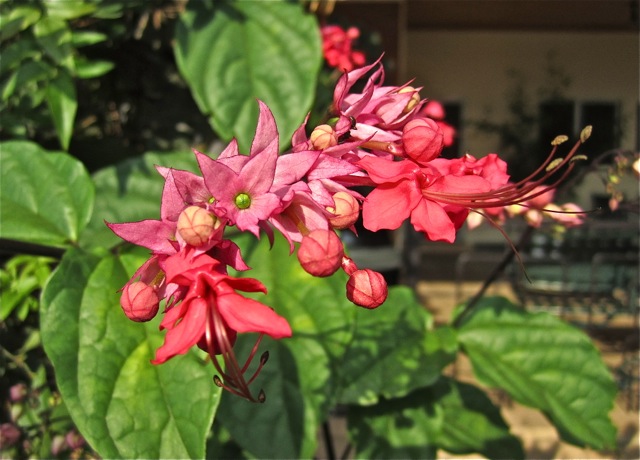
It has already helped me identify two flowering vines in the garden that were unfamiliar to me, Clerodendron thomsoniae and Clerodendron thomsoniae var. delectum. They also go by the common names of Beauty Bush, Bleeding Glory-Bower, or Bleeding Heart Vine.

Cleodendron thomsoniae with white calyx and red flowers. Photo via Wikipedia, taken at the U.S. Botanic Garden.
C. thomsoniae var. delectum with mauve calyx and dark rosy pink flowers.

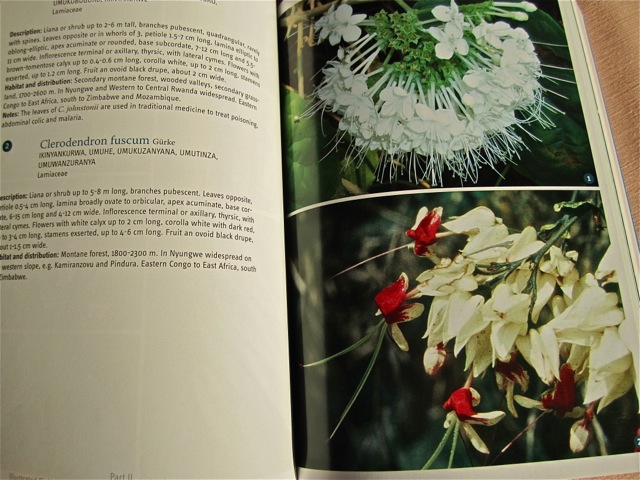
I found that the species is native to tropical West Africa, from Cameroon to Senegal. But a very similar-looking cousin, Clerodendron fuscum, is native to Rwanda and other parts of East Africa — as are two much less showy species, C. johnstonii and C. bukobense.

They are all lianas — long-stemmed, woody vines that use trees as a means of vertical support to reach the light.

A photo of C. fuscum, a Rwandan native, in my book. The flowers are white, blotched with red.

Clerodendron thomsoniae has just the sort of exotic, showy blooms that would have been very desirable to the Victorians. Wikipedia said its 19th century popularity eventually declined, however, because “its root system must be partially submerged in water most of the time and it wants very good light.” Other sources did not indicate that it needs to grow in particularly damp ground. Mine does not. But in the U.S., it probably will not be hardy outside of Florida or California.

Wikipedia also said the species was named in honor of “Rev. William Cooper Thomson (fl. 1820’s-1880’s), a missionary and physician in Nigeria.” However, a further Google search turned up a Rev. Thomson who was a linguist, not a doctor, with the Church Missionary Society in Sierra Leone.   He was a man of zeal in the propagation of the gospel and the crusade against slavery.  In 1841, he led an ultimately fruitless expedition to make treaties with the Muslim Fulani people in what is now Guinea. He died during the journey in 1843.

That much is confirmed by other articles and a copy of his journal posted on the internet. There is no indication, however, of how this William Cooper Thomson might have come to have a popular hothouse plant named after him.

A French website said that the species was named for surgeon-botanist Thomas Thomson (1817-1878), co-author of the first volume of Flora Indica and eventually Superintendent of the botanical garden in Calcutta, India.  Swedish Wikipedia also says that Thomas T. is origin of the name. But Thomas T. never served in Africa.

The source for the English Wikipedia entry is the CRC World Dictionary of Plant Names by Umberto Quattrocchi, which unfortunately is not on-line and costs £204. If any reader does have access to this book, maybe you could let us know what it says. Other sites also give a William Cooper Thomson. as the origin of the name, but they are obviously just quoting Wikipedia.

Regardless of the source of its name,  it is really a lovely African plant.

ADDENDUM: Please see KAMCDONALD’s comment below for more about the source of the name, which was given in honor of the first wife of William Cooper Thomson, a missionary in Nigeria and son of the William Cooper T. discussed above.

Bloom Day in December

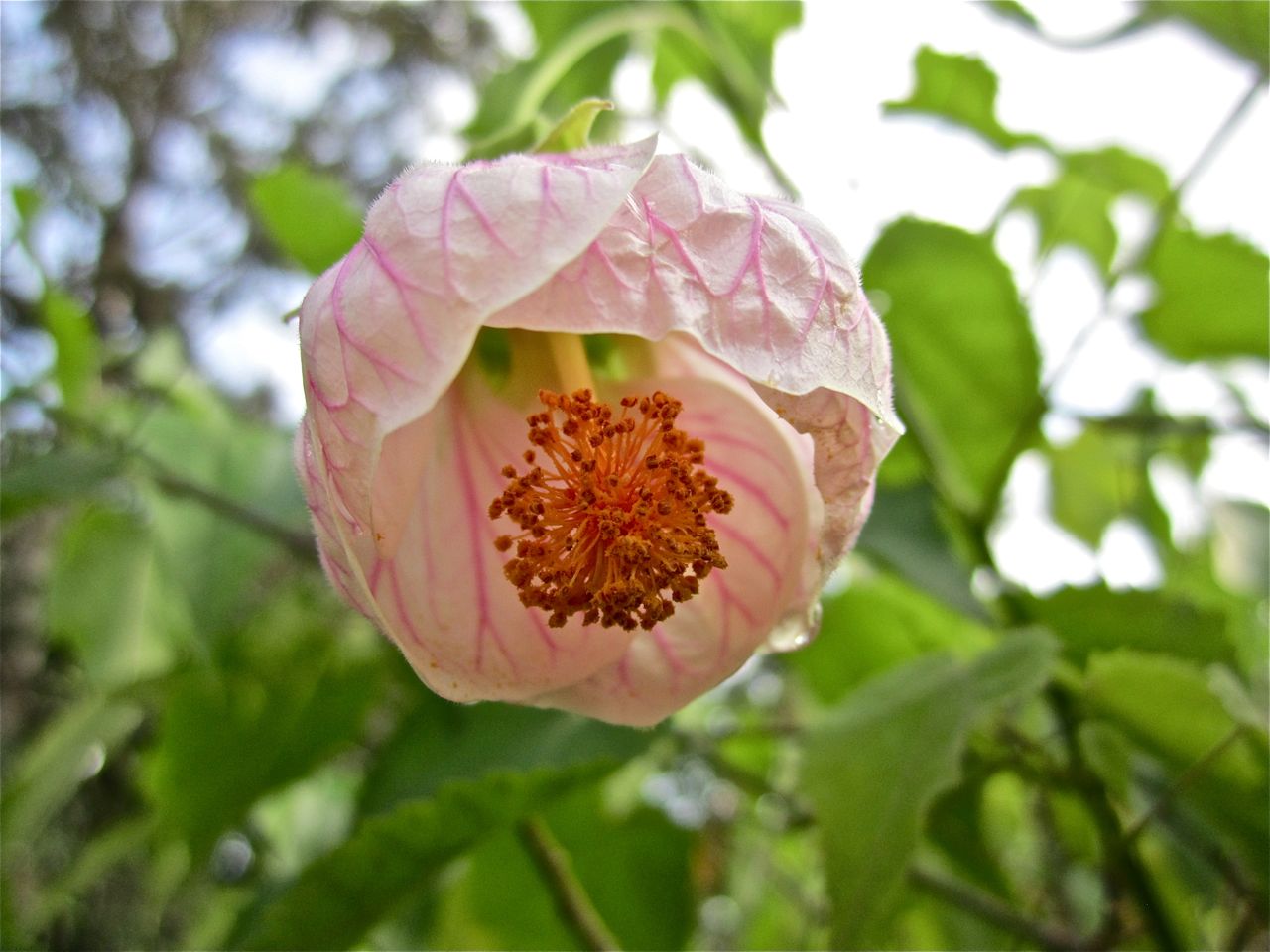
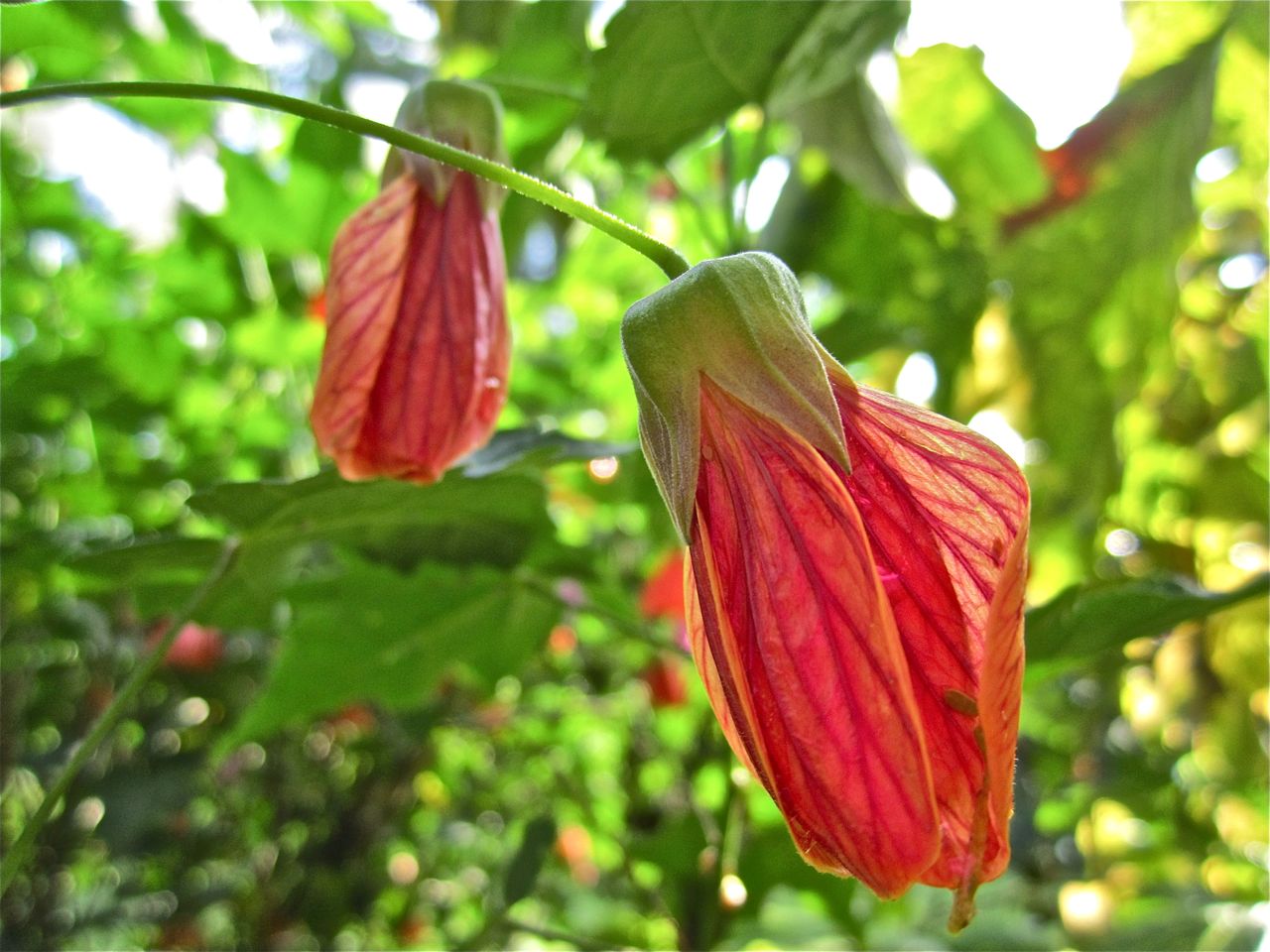
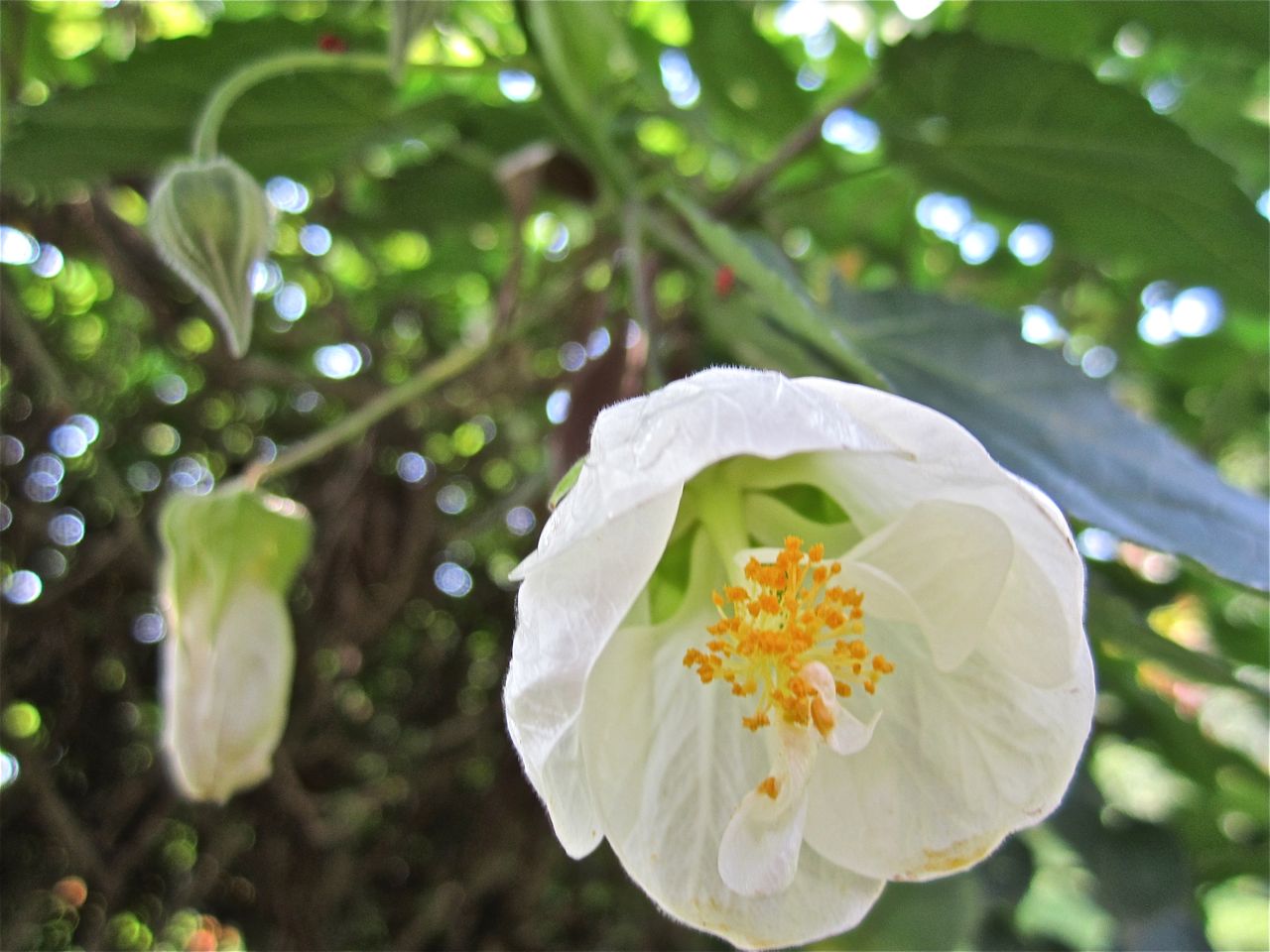
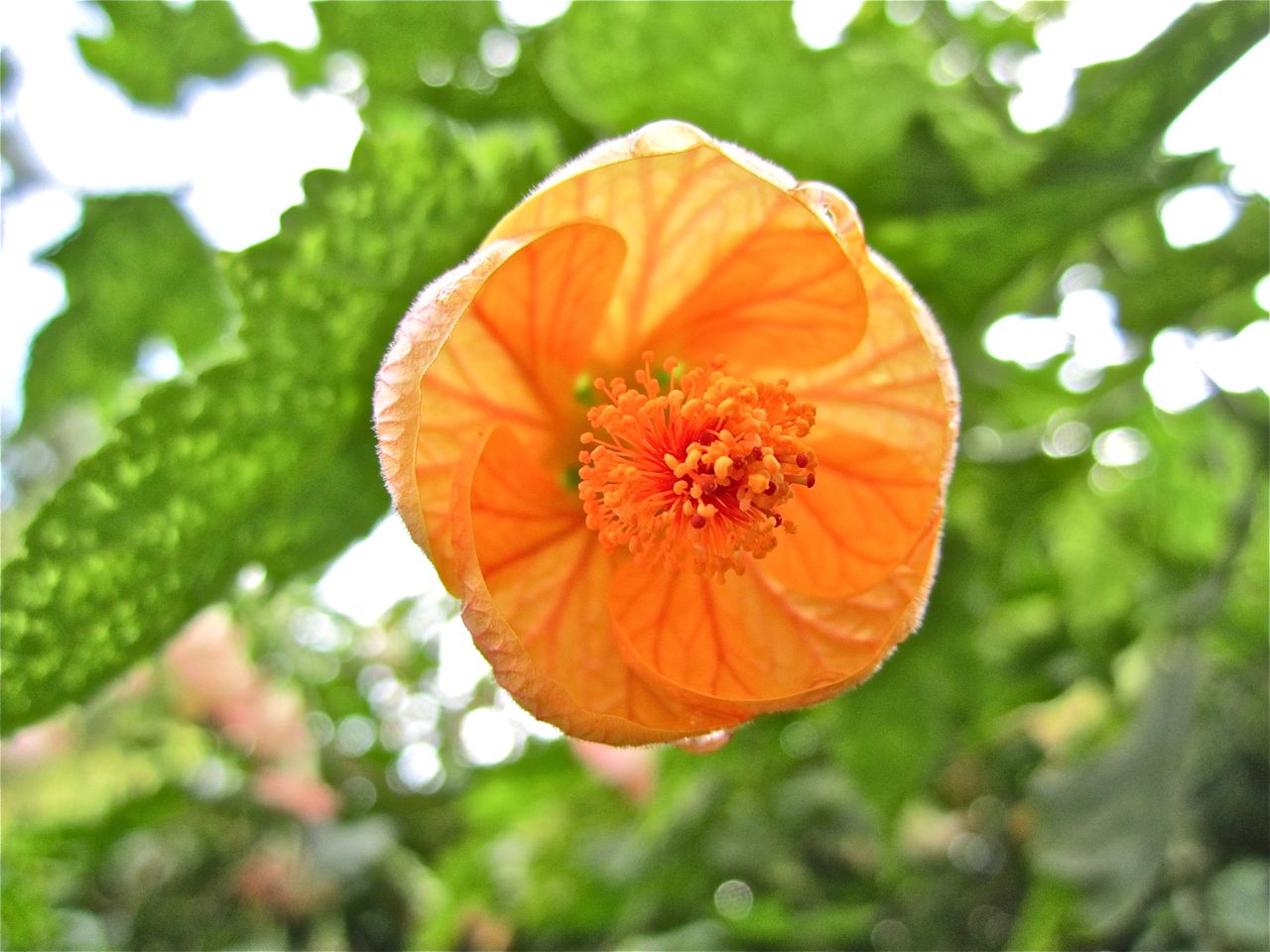
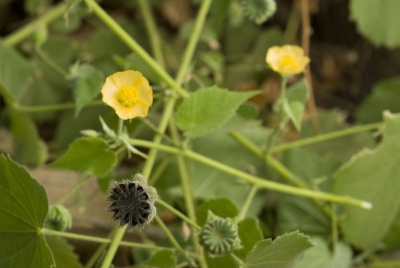
Today, I took a closer look at my Abutilon or Chinese Lantern bushes.

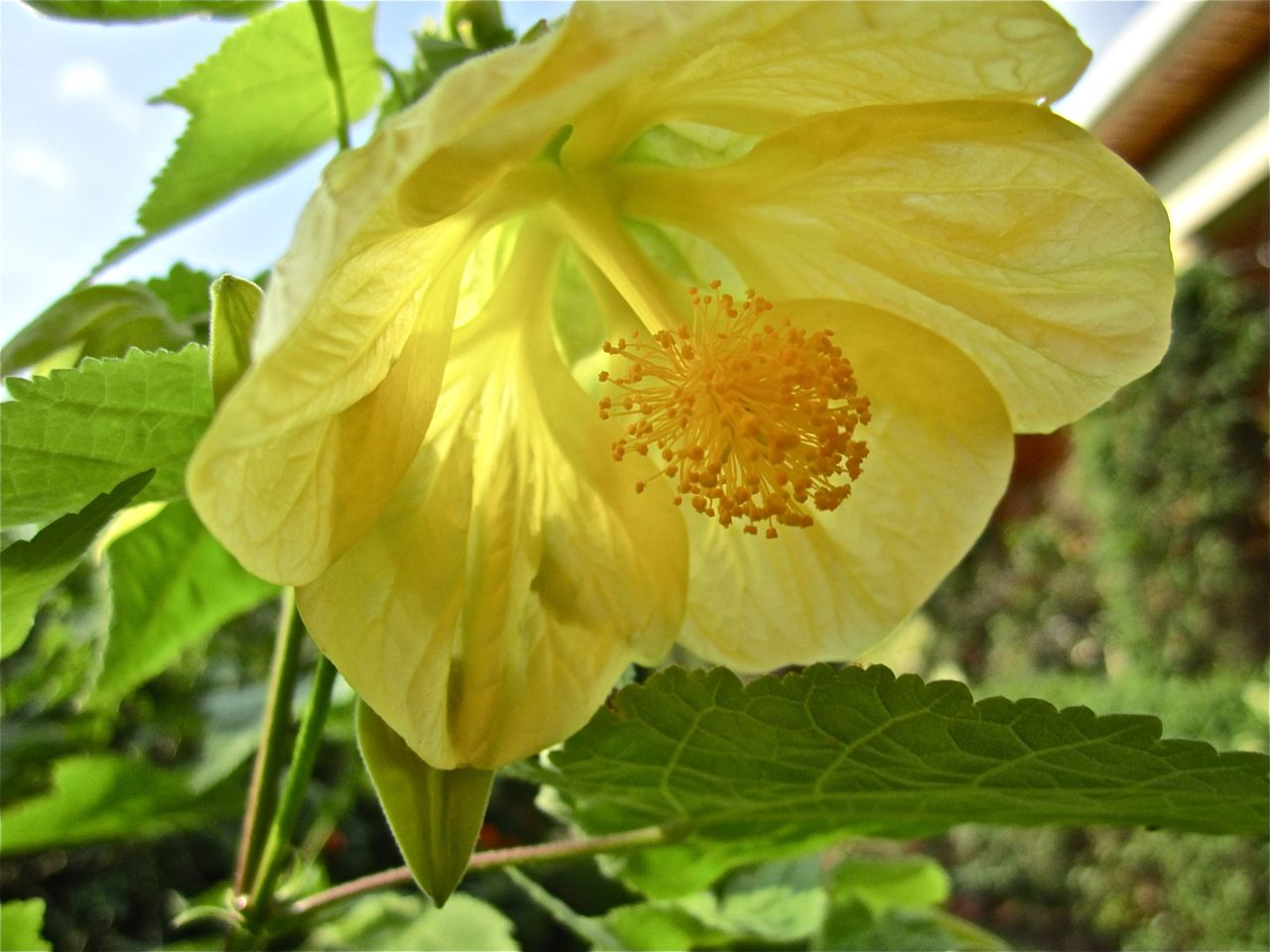
Closeup of yellow Abutilon.

Compared to many of the other tropical or semitropical plants in the garden, the Abutilon are rather quiet.  The flowers are neat and smallish and hang down like bells.

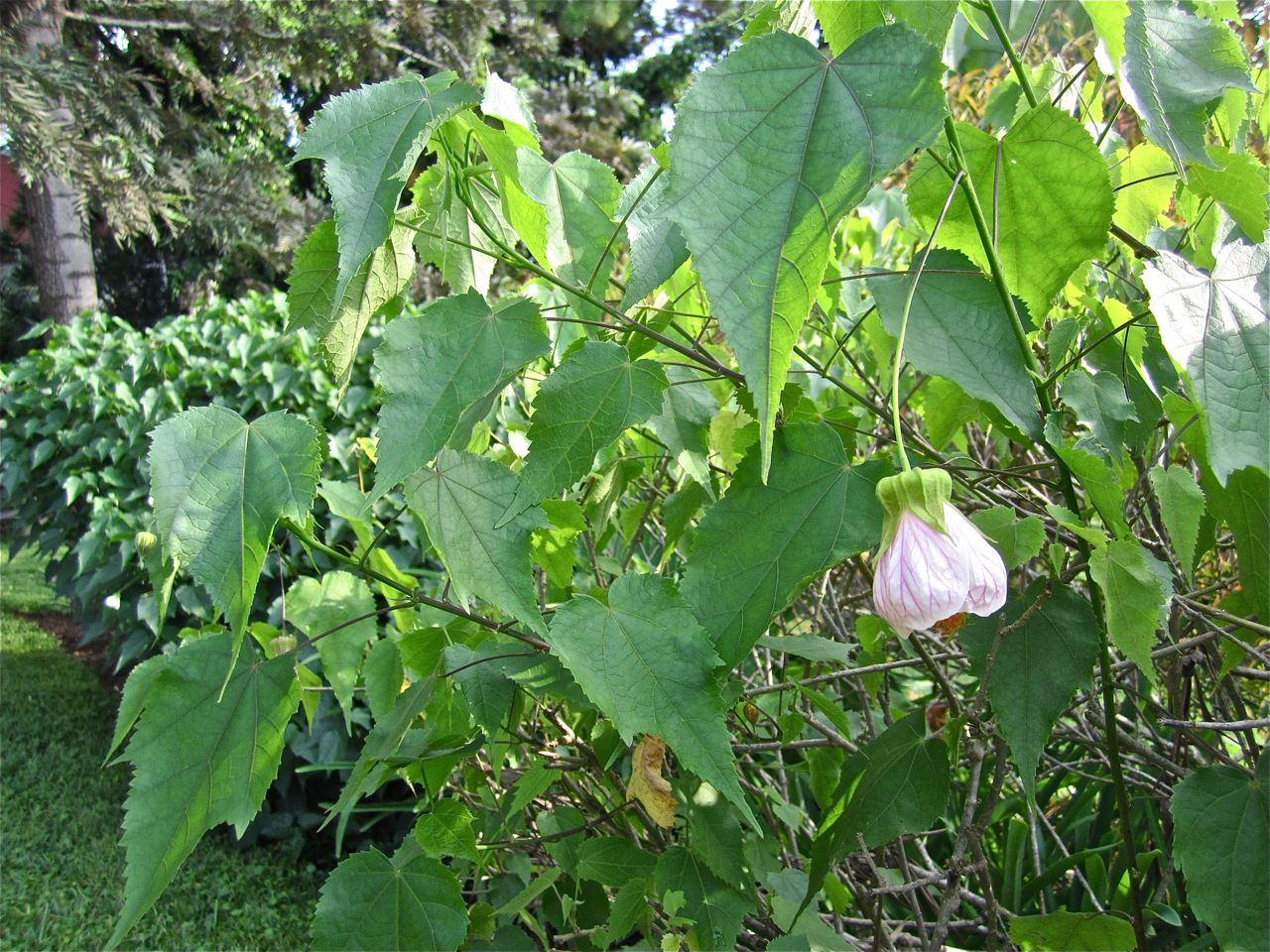
Abutilon are also sometimes called Flowering Maples because of their leaves.
This variety has white blooms with pink veins.
A closeup.
A showier bush with reddish-orange blooms.
A reddish-orange bloom.
Closed blooms.
A white flowered Abutilon.

This bush has variegated leaves and is rather overshadowed by a pink Brugmansia or Angel’s Trumpet.

An Abutilon with variegated leaves beside a Brugmansia.
A coral bloom.  Another name for the bush is Chinese Bell Flower.
Closeup of a coral flower.

I think my bushes are Abutilon x hybridum, descended from South American varieties and brought here by expats.  Rwanda has one native variety, Abutilon bidentatum Hochst. ex A. Rich., which is not very showy.

Abutilon bidentatum.  Photo via http://westerndesertflora.geolab.cz.

Another species, Abutilon longicuspe, with purple flowers, is also native to east and central Africa.

Please visit May Dreams Gardens for more Bloom Day postings (the 15th of every month).

Abutilon longicuspe.  Photo via http://database.prota.org.

Garden Bloggers’ Bloom Day in August

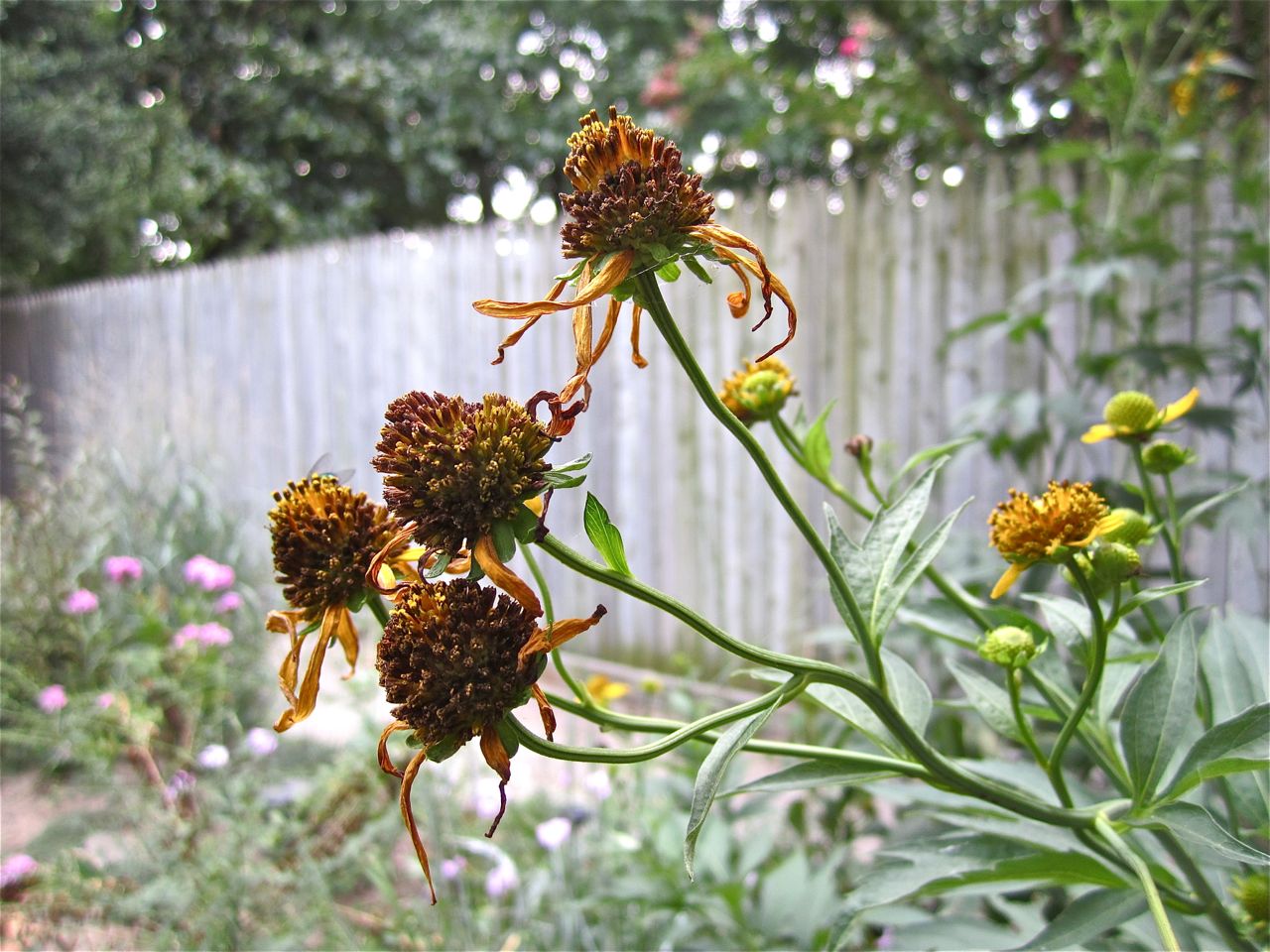
Rudbeckia laciniata flowers at various stages.

To see what’s blooming for other garden bloggers today, visit Carol of May Dreams Gardens, who hosts the monthly Bloom Day.