Vintage landscape: more snow in Washington, D.C.

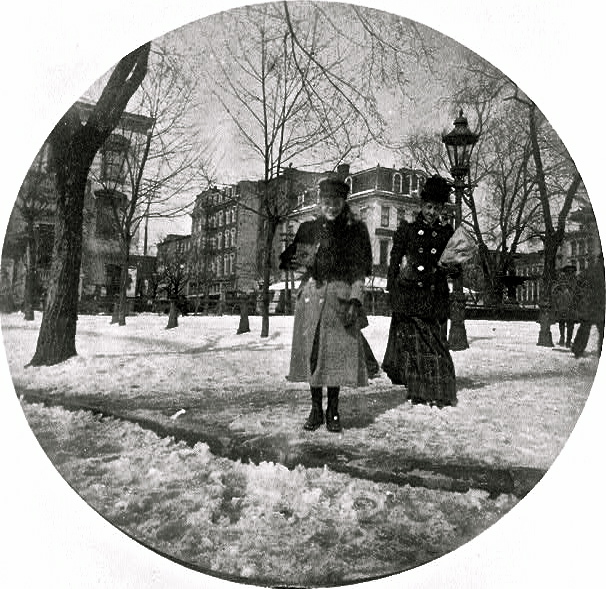
Hunt photo of snowy Washington

“Woman and girl standing in icy square, Washington, D.C.,” 1889, by Uriah Hunt Painter, via Library of Congress Prints and Photographs Division.

Uriah Hunt Painter, 1837-1900, took a number of snapshot photographs of his neighborhood around Franklin Square and of downtown Washington using the first Kodak cameras.  Painter was a businessman and retired newspaper reporter.

“[The p]hoto shows a woman and a young girl posing mid-square with bundles. The two may be Painter’s wife, Melinda Avery Painter, and older daughter, Eleanor, returning from a marketing trip. Or perhaps Painter took their portrait because the girl is holding another Kodak – exemplifying the growing corps of amateur photographers who took advantage of Eastman’s simple box camera.”

— from the LoC online catalog
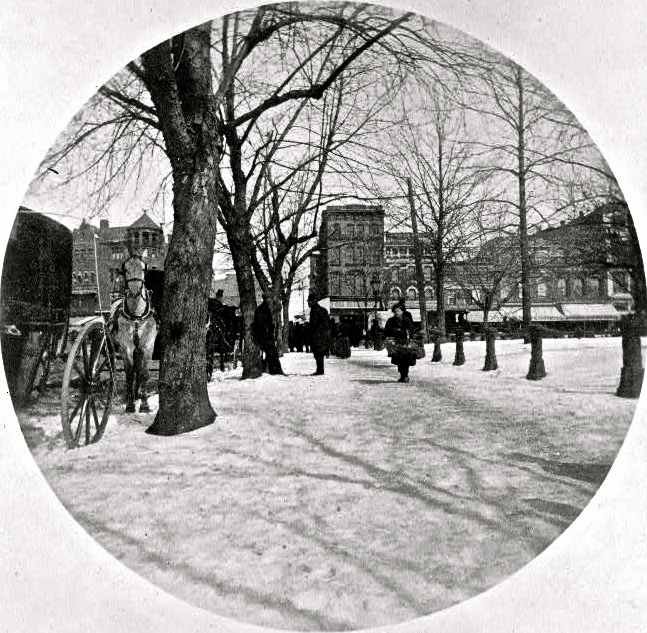
Washington market, 1989

Above: “Market scene, Washington, D.C., snow view,” 1889, by Uriah Hunt Painter. I don’t know which square is pictured in these photos.
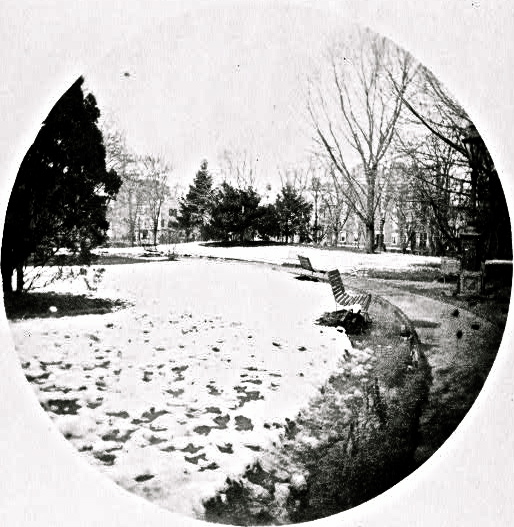
Franklin Square, 1989

Above: “Franklin Square, Washington, D.C., snow view,” 1989, by Uriah Hunt Painter.

Today’s quote

Pope’s famous lines, in his “Epistle to the Earl of Burlington,” on ‘the genius of the place,’ . . . surely evoke a conception of The Garden as an epiphany. For Pope, ‘the genius of the place’ does not refer, as it does for many later writers, to the ambiance or natural setting of a garden: rather, it is that which ‘Now breaks, or now directs, the intending lines’ and ‘Paints as you plant, and, as you work, designs.’ Palpable, here is a sense of The Garden as both a response to and an exemplification of something beyond the control and invention of human beings.

— David E. Cooper, from A Philosophy of Gardens
(Thanks to View from Federal Twist.)


Vintage landscape: the national tree

White House, 19 December 1939, via LoC

On December 19, 1939 — in the photo above — the White House was being decorated for Christmas.  But the “gayly colored” lights on the wreath and trees would not be lit until Christmas Eve when President Roosevelt would also light the “community Xmas tree.”

At that time, what is now known as the National Christmas Tree was called the National Community Christmas Tree (I like that).

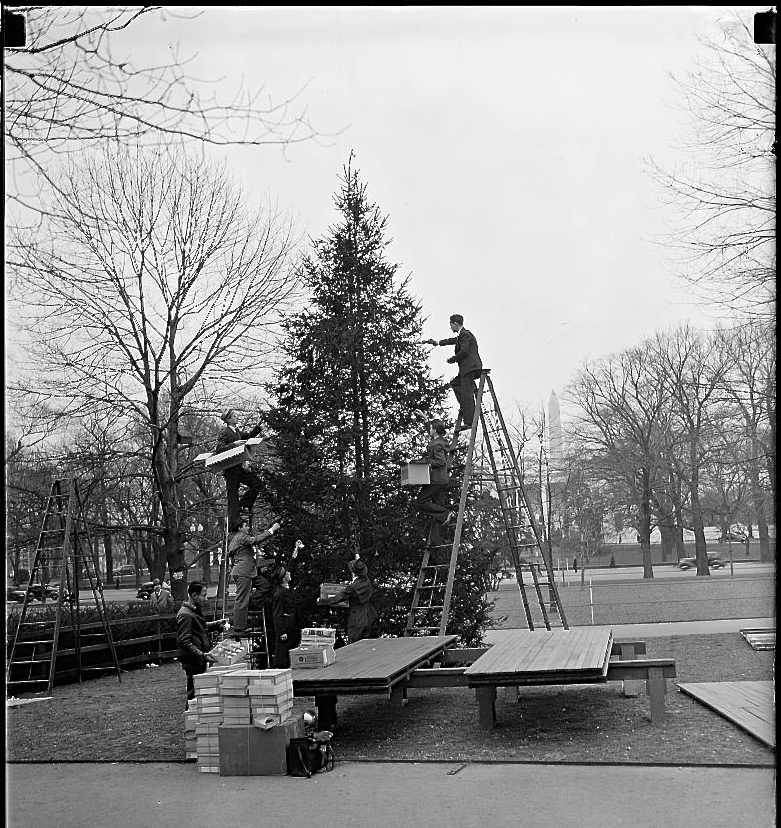
For most of the 1930s, the tree was installed in Lafayette Park, on the north side of the White House.  In the photo below, workers (in suits) decorate the 1937 tree on December 23.

1930's tree, L0C

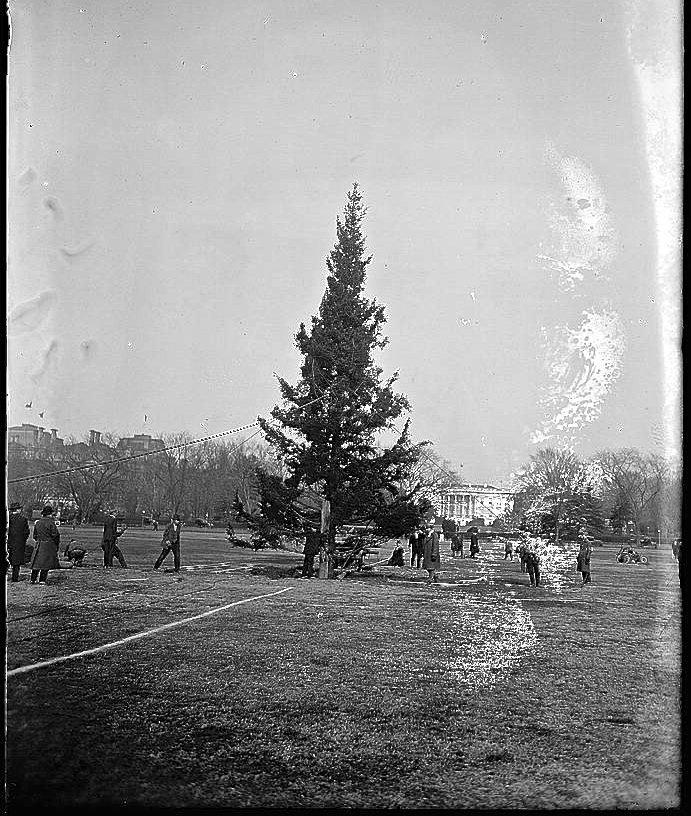
However, the first national tree had been placed on The Ellipse (also its current location), on the south side of the White House, in 1923 (below).

1923 tree setup, L0C

In the early 1920s, according to Wikipedia, “The Society for Electrical Development (an electrical industry trade group) was looking for a way to encourage people to purchase more electric Christmas lights and use electricity, and [Frederick Morris] Feiker [past editor of Electrical World] suggested that President Calvin Coolidge personally light the tree as a way of giving Christmas lights prominence and social cachet.”

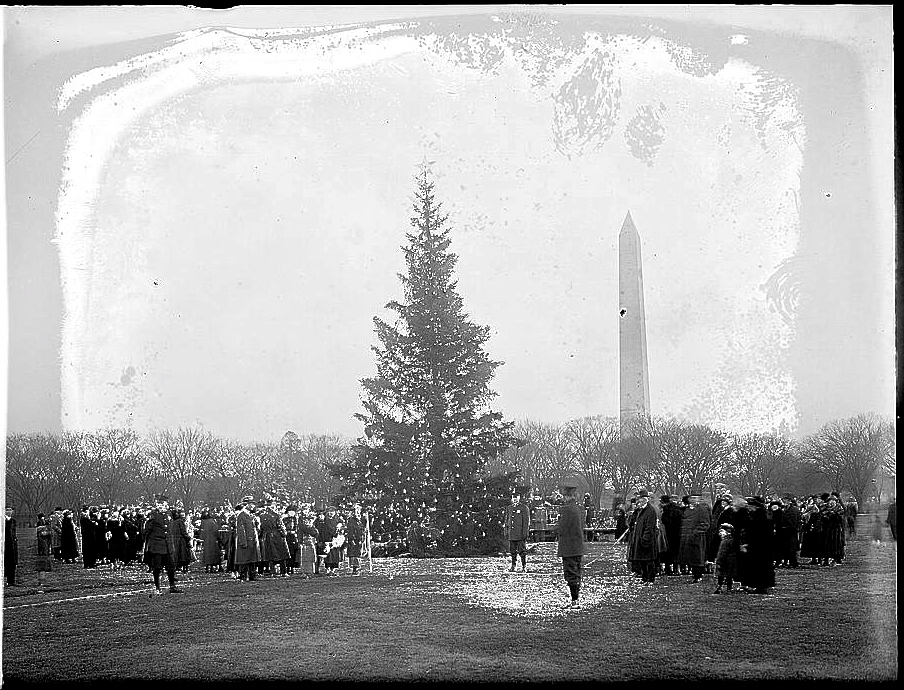
The 48′ tall balsam fir was cut and donated by Middlebury College in the President’s home state of Vermont. The Electric League of Washington donated the 2,500 red, green, and white lights.

1923 tree, LoC

President Coolidge lit the tree on Christmas Eve without making any remarks (below).  A two-hour music concert was then held. Wikipedia notes that “after the white residents of the city had dispersed, African American residents of the city were permitted on the park grounds to see the National Christmas Tree.”

1923 tree lighting, LoC

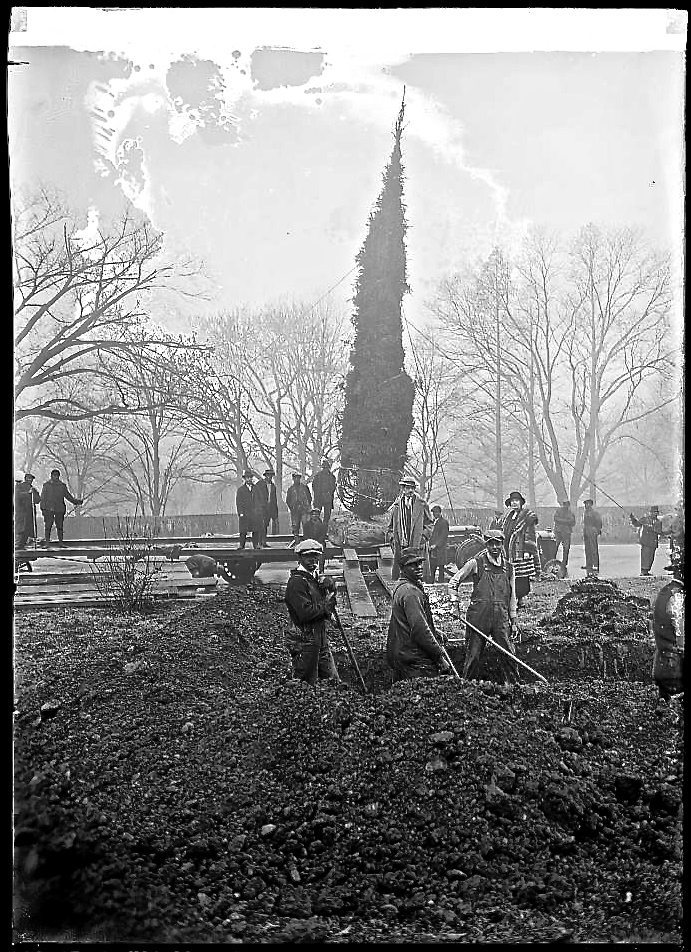
On December 17, 1924 (below), a live “community” tree was planted in Sherman Park (just southeast of the White House).  This had become necessary after Coolidge, speaking before the American Forestry Association that April, had criticized cutting trees for Christmas decorations. (The national tree had to be replaced in 1929 and has been replaced many times since. From the early 50s to the early 70s, cut trees were used.)

1924 tree planted, LoC

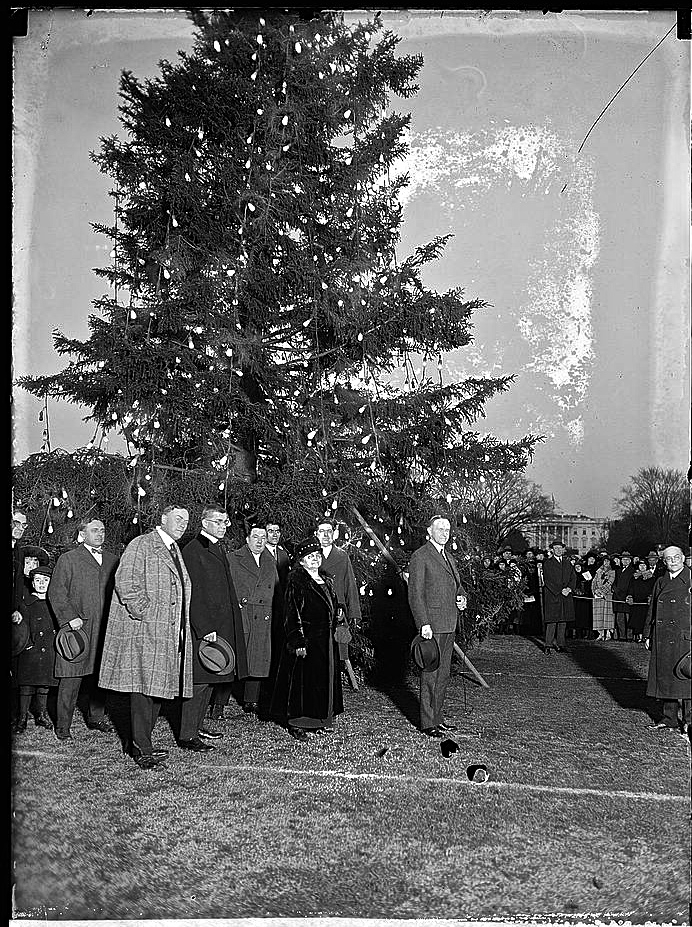
Below is a rather solemn moment from the lighting. The Coolidges’ son had died of blood poisoning earlier in the year, and a new Christmas carol, “Christmas Bells” — dedicated to Mrs. Coolidge — was performed at the ceremony.

1924 tree lit, L0C

Wikipedia has an interesting complete history of the National Christmas Tree here. Two more facts from the article:

“During the 1931 ceremony, a buzzer went off when Hoover lit the tree at 5:00 p.m. Because the button he pressed was not actually connected to the electricity, the buzzer alerted another official to actually light the tree.  The button the president pushed would not be reconnected to actual electricity again until 1980.”

In 1932, “loudspeakers connected to a phonograph were concealed in the branches of the tree, and Christmas carols were played every night from 6:00 p.m. to 10:00 p.m. until New Year’s Day.  The Singing Tree was a hit with the public, and although music and choirs continued to perform each year, the tradition of the Singing Tree lasted for several more decades.”

Facts about this year’s tree are here.

Photo Sources:

1. and 2. Photos by Harris & Ewing via Library of Congress Prints and Photographs Division.

3. to 8.  National Photo Company collection via Library of Congress Prints and Photographs Division.

Vintage landscape: Congressional gardener

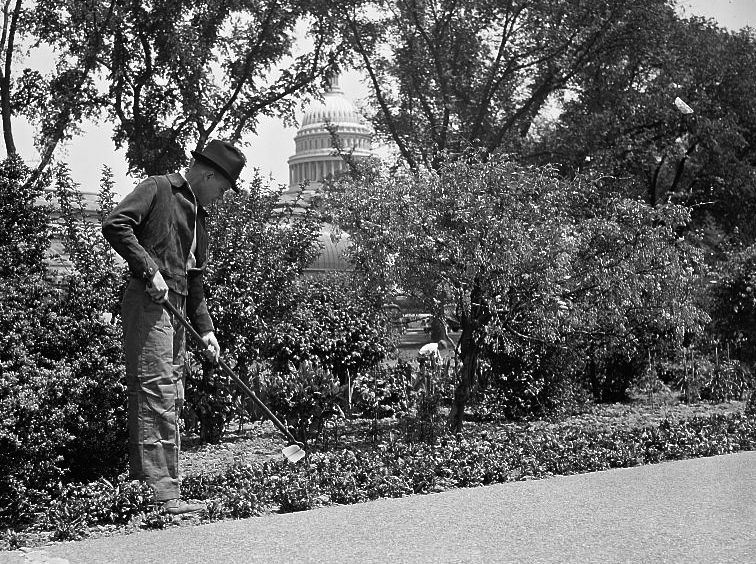
“Washington, D.C., May 7[, 1937].  Rep. William R. Poage, a first term Texas Democrat, likes gardening. He couldn’t find a plot of ground in the crowded capital, so he used his newly acquired congressional influence and won permission to help tend flowers and shrubbery in the government’s Botanical Gardens. So he works along with the regular laborers an hour or two daily.”

These days, many congressmen sleep in their House offices, but I haven’t heard of any tending the flower beds. Representative Poage retired from Congress in 1978.

Photo and text in quotes by Harris & Ewing via Library of Congress Prints and Photographs Division.

A porch in 1941 Mobile and Sunday miscellany

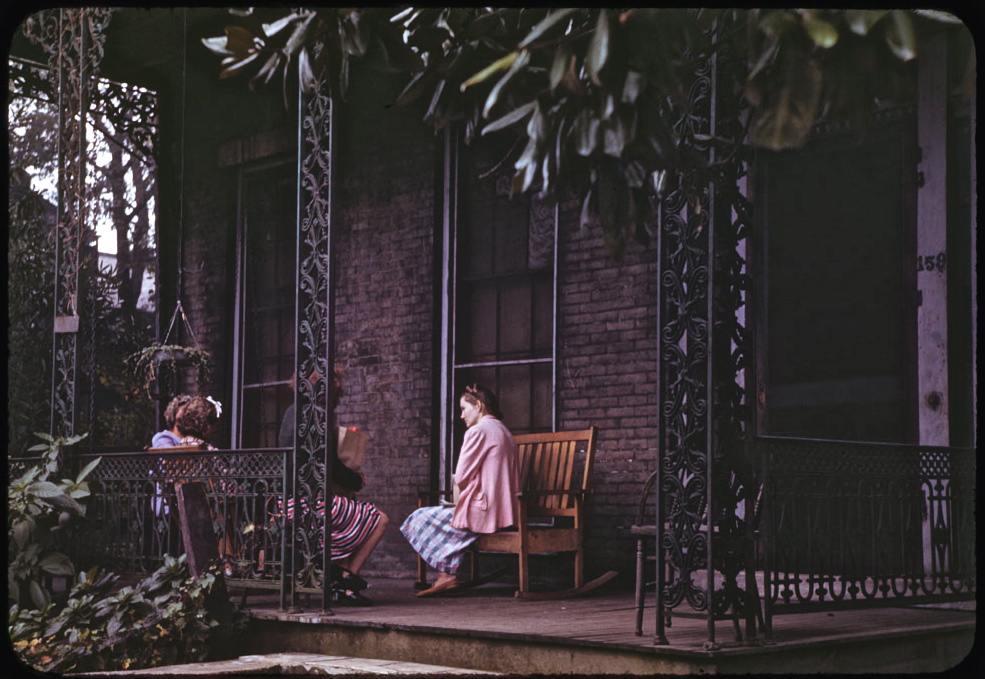
I love this quiet photo: “Porch of old house at Monroe St., Mobile[, Alabama],” taken November 4, 1941, by Charles W. Cushman.

Used with the permission of  the Charles W. Cushman Photograph Collection of the Indiana University Archives.  Please do not “pin” or re-blog without contacting them here.

Miscellany

This post on Gardenista is about houses painted black, but I like the way all of them are incorporated into their natural landscapes.  

And GardenHistoryGirl has an interesting post on what we mean when we talk about ‘natural’ and  “beautiful nature.”

From her post, I learned that you can read the entire book The Wild Garden by William Robinson online  here at Google Books.

Please take a look at View from Federal Twist’s fall photos of the Federal Twist garden — just gorgeous.

Jean’s Garden explains here why your favorite plant may have had one name last year and has another today.

Kigali has gone into billboards in a big way in the last few years.  I wonder if it may eventually be building these too (see here too).

Zoe Tilley Poster of Pearled Earth is now selling her beautiful illustrations at her new Etsy shop here.

Francophiles can catch up on gardening news from France at Our Grumpy Gardener, a blog of French News Online.  If you’ve already starting to think about Christmas, the blog Réparons & Re-Parons Noël has good ideas for handmade decorations.

If you would like to see more of the photographs of Charles W. Cushman, click here for a series of images of New York City in the early 1940s.

Vintage landscape: the benches

“Roominghouse district, Washington,” a Kodachrome slide by Charles W. Cushman, mid-September 1940.*

In the two years leading up to the U.S. entering World War II, the population of Washington, D.C., went from 621,000 to over 1,000,000, according to journalist David Brinkley.

Most of the new arrivals were women, many of whom were hired “before they had even found a place to leave their bags.”  Thousands of townhouses were turned into roominghouses and several women shared each room.  (According to one of them, Enid Bubley,  it was “social suicide” to violate the morning schedule of eight minutes each in the bathroom.)

By 1941, Malcolm Cowley described the city this way:  “Washington in wartime is a combination of Moscow (for overcrowding), Paris (for its trees), Wichita (for its way of thinking), Nome (in the gold-rush days) and Hell (for its livability).”

So the two or three benches placed in each little yard above are significant. They were undoubtedly places of real reprieve from the crowded conditions inside the houses and the chaos of the city.

These gardens still have their wrought iron fences.  During the war, the metal was much needed, and many D.C. residents gave up their black railings for wooden pickets.

The photographer, Charles Cushman, was a talented amateur who traveled across the U.S. and other countries and took more than 14,500 Kodachrome slides from 1938 to 1969.  He bequeathed his images to Indiana University, his alma mater.


*Used with the permission of  the Charles W. Cushman Photograph Collection of the Indiana University Archives.  Please do not “pin” or re-blog without contacting them here.