
 U.S. Embassy-Rwanda LGBT Pride chalk graffiti mural, created June 24, 2014.
Category: life in gardens
The Sunday porch: the portico
A late afternoon gathering on the south portico (or back porch) of the White House, probably between 1890 and 1910, photographer unknown, via the Library of Congress Prints and Photographs Division.
Encyclopedia Britannica defines ‘portico’ as a “colonnaded porch or entrance to a structure, or a covered walkway supported by regularly spaced columns. Porticoes formed the entrances to ancient Greek temples.”
The south portico of the White House was built in 1824, principally from an 1807 design by architect Benjamin Henry Latrobe, then Surveyor of Public Buildings. Latrobe was appointed and supervised by Thomas Jefferson, who loved neoclassical design and called Palladio’s books “the bible.”
The South of France
Roman temple
“simple and sublime”Maria Cosway
harpist
on his mindwhite column
and arch— Lorine Niedecker, from “Thomas Jefferson“
Life in gardens: June 14, 1944
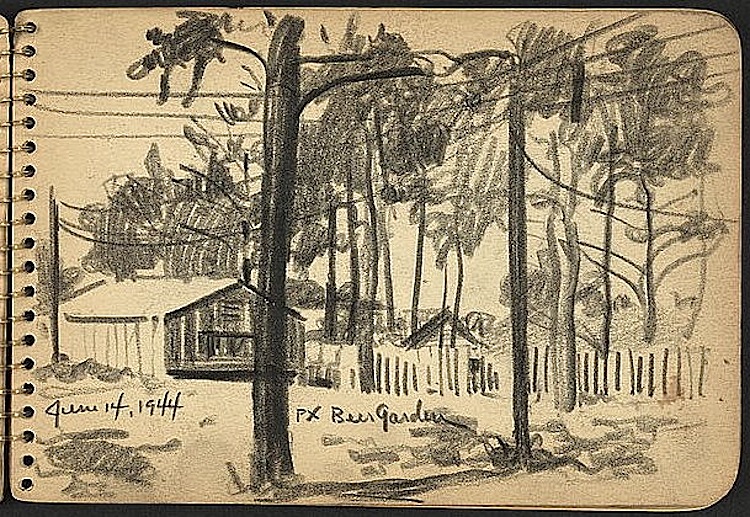
PX beer garden at Fort Jackson, South Carolina, June 14, 1944, by Victor Alfred Lundy, via the Library of Congress Prints and Photographs Division.
A beer garden is simply a shady outdoor area with tables and chairs where beer and sometimes food is served. The idea originated in the Bavaria region of Germany in the 19th century and soon came to America. There’s a brief history of beer gardens in the U.S. here.
Some American beer gardens were such pleasant, seemingly wholesome places that they rattled the resolve of the temperance movement. A woman on a committee investigating Chicago drinking spots wrote of one: “Isn’t it beautiful? Can it be, is it possible, that after all our ideas are wrong and these people are right?”
Beer gardens, like the one pictured above, were features of at least some homeland military camps and forts in the mid 1940s. Camp Mackall in North Carolina had six. I found a reference to one at Fort McClellan near Anniston, Alabama.
During his U.S. Army service, Victor Lundy filled eight sketchbooks with scenes of his training at Fort Jackson, his life on a transport ship crossing the Atlantic, and his frontline duty in France.
After the war, he became an architect, admired today for “his sculptural sense of form” and “innovative use of engineering technology,” according to the Smithsonian Institution.
Vintage landscape: summer shimmer
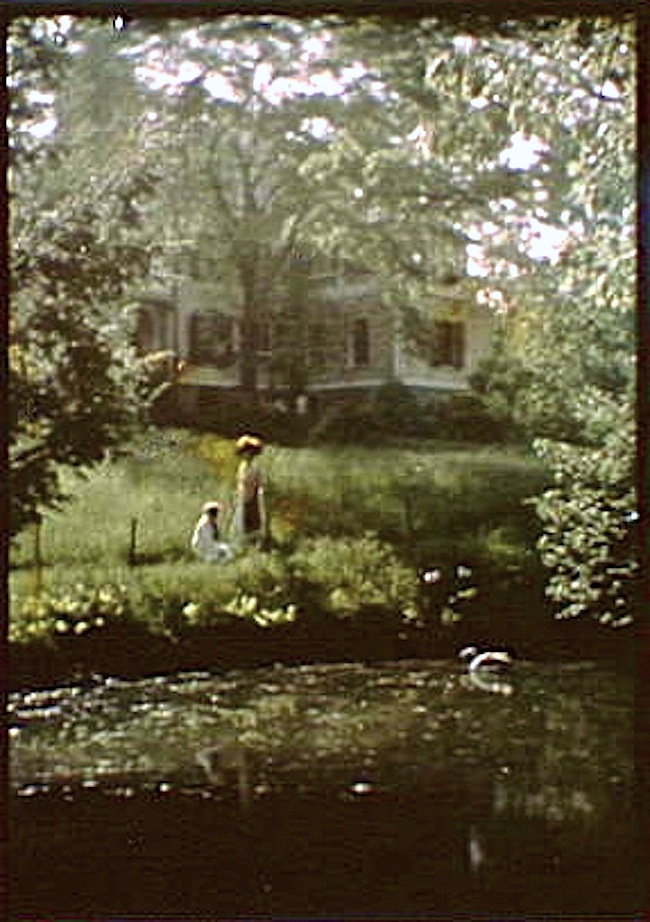 “Woman and child in a field in front of a white house,” an autochrome taken between 1906 and 1942, by Arnold Genthe, via Library of Congress Prints and Photographs Division.
“If an autochrome was well made and has been well preserved, color values can be very good,” according to the Wikipedia entry on this early color photography technique.
“The dyed starch grains are somewhat coarse, giving a hazy, pointillist effect, with faint stray colors often visible, especially in open light areas such as skies. The smaller the image, the more noticeable these effects are. The resulting “dream-like” impressionist quality may have been one reason behind the enduring popularity of the medium even after more starkly realistic color processes had become available.”
. . . The trees rustle
and whisper, shimmer and hiss.— Amy Gerstler, from “Bon Courage“
Vintage landscape: Poca, WV
 “Water cooling towers of the John Amos Power Plant* loom over Poca, [West Virginia], home that is on the other side of the Kanawha River. Two of the towers emit great clouds of steam.”
This photo† (shown here with original caption) was taken in August 1973 by Harry Schaefer for DOCUMERICA, a photography project of the U.S. Environmental Protection Agency.
There are more pictures from DOCUMERICA here.
*Three-unit coal-fired power plant.
†Via the U.S. National Archives Commons on flickr.

