Gathering the waters

This slideshow requires JavaScript.

Whenever we have visited Portland, Oregon — as we did this October –I have made a point of spending some time in the Ira Keller Fountain Park.

The fountain was designed by Angela Danadjieva and Lawrence Halprin in 1968, as part of the Portland Open Space Sequence.

“This new type of people’s park, where nature is abstracted with a geometric naturalism, was based on Halprin’s studies of the High Sierra’s spring cascades,” according to The Cultural Landscape Foundation.

At the time of the park’s opening in 1970, New York Times architecture critic Ada Louise Huxtable said it “may be one of the most important urban spaces since the Renaissance,” and she compared it to the Piazza Navona and the Trevi Fountain.

.   .   .  At the forest’s
edge, where the child sleeps, the waters gather—
as if a hand were reaching for the curtain
to drop across the glowing, lit tableau.

Eleanor Wilner, from “Reading the Bible Backward

Continue reading “Gathering the waters”

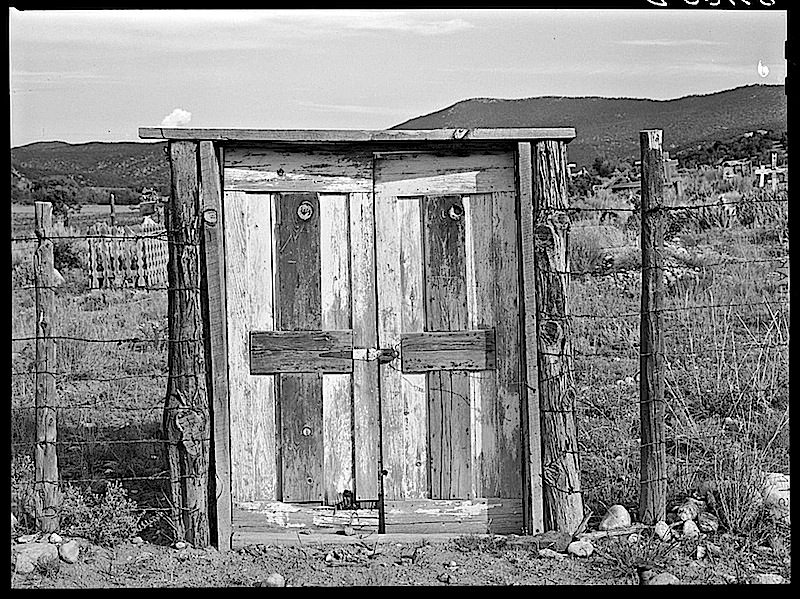
Vintage landscape: Penasco gate

Cemetary gate, New Mexico, Library of Congress“Entrance to the cemetery at Peñasco, New Mexico (along the High Road to Taos), July 1940, by Russell Lee, via Library of Congress Prints and Photographs Division.

Lee and his wife, Jean, spent two weeks in Chamisal and Peñasco documenting the lives of the towns’ Hispanic small farmers and ranchers. The area was settled by Spanish colonists in the late 18th century.

Hark, hark! the lark at heaven’s gate sings…

— William Shakespeare, from Cymbeline

The Sunday porch: the Berry’s

The Berry house“Berry’s house,” between 1910 and 1925,* probably near Selma, California, by National Photo Company, via Library of Congress Prints and Photographs Division (all photos here).

I think this is the farm that Ethel and Clarence Berry bought near her parents’ home in Selma after they became millionaires in the Klondike gold rush.

Ethel was one of the first women miners to go to Alaska, leaving right after her wedding in 1896. The next spring, the couple struck it amazingly rich on the Eldorado and Bonanza Creeks.

When she arrived in Seattle that summer — headed to the bank alone with $100,000 in gold that she’d kept hidden in her bedroll — she was immediately embraced by the popular press as the “Bride of the Klondike.”

The Berrys invested their money in more Alaskan mines (and in oil) and stayed rich.  They moved between the farm in Selma and a home in Alaska until Clarence’s death in 1930. Ethel then moved to Beverly Hills.  She died there in 1948.


*I suspect the photos were taken closer to the earlier year given, judging from the photo of Ethel and her sister (after ‘Continue reading’). Ethel would have been 37 years old in 1910.

Continue reading “The Sunday porch: the Berry’s”

The Downing Urn

Still looking through some photos that I took this fall, when we visited Washington, D.C. . .

This slideshow requires JavaScript.

I admired the Andrew Jackson Downing Urn in the Enid A. Haupt Garden behind the Smithsonian Institution Castle. It was designed by Downing’s architectural partner, Calvert Vaux, and sculpted from marble by Robert E. Launitz several years after Downing’s death.

In 1850, Andrew Jackson Downing transformed the Mall into the nation’s first landscaped public park using informal, romantic arrangements of circular carriage drives and plantings of rare American trees. Downing’s design endured until 1934, when the Mall was restored to Pierre L’Enfant’s 1791 plan. Downing (1815-1852), the father of American landscape architecture, also designed the White House and Capitol grounds.

The memorial urn stood on the Mall near the Smithsonian’s National Museum of Natural History for 109 years (1856-1965). In 1972, it was restored and placed on the lawn east of the Smithsonian Building (“Castle”) flag tower. In 1987, it was relocated to the Rose Garden at the Castle’s east door. The urn was moved to its location in the Enid A. Haupt Garden in 1989.”

– text of the plaque near the foot of the urn’s pedestal

I wonder where the urn will go in the new design plans for the area, recently released by the Smithsonian.

Continue reading “The Downing Urn”

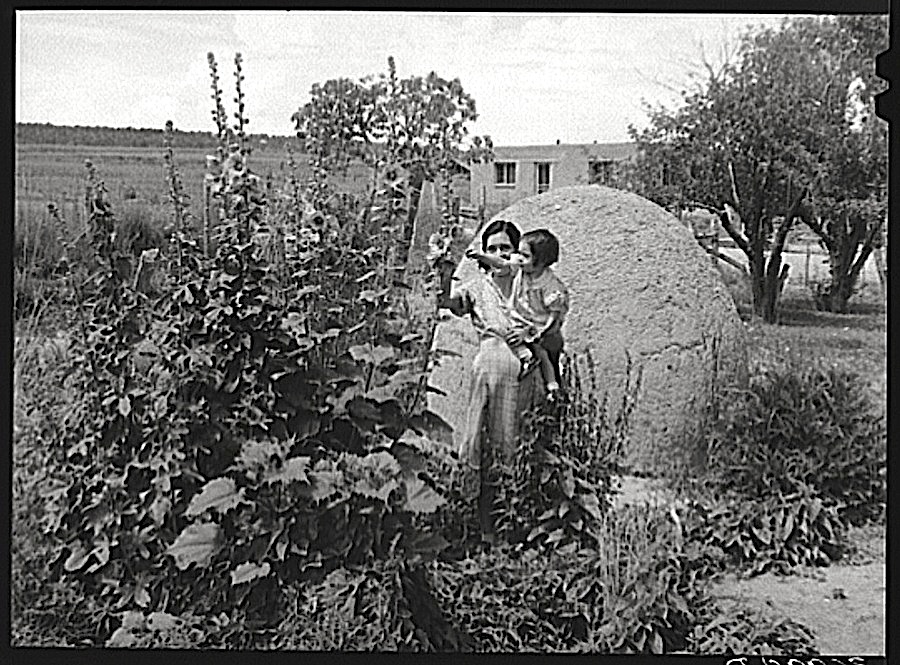
Life in gardens: Chamisal

New Mexico, R. Lee, via LoCWoman and baby in a flower garden in front of an adobe oven, July 1940, Chamisal, New Mexico, (along the High Road to Taos) by Russell Lee, via Library of Congress Prints and Photographs Division.

Chamisal was settled by Spanish colonialists in the 18th century.  The name may come from the “chamois” shrub  (Chrysothamnus or rabbitbrush).

Lee and his wife, Jean, spent two weeks in Chamisal and Peñasco documenting the lives of the towns’ Hispanic small farmers and ranchers.

The winding High Road to Taos begins in Santa Fe and crosses the Sangre de Cristo Mountains.  The landscape includes high desert, forest, farms, and historic Spanish Land Grant and Pueblo Indian villages.