
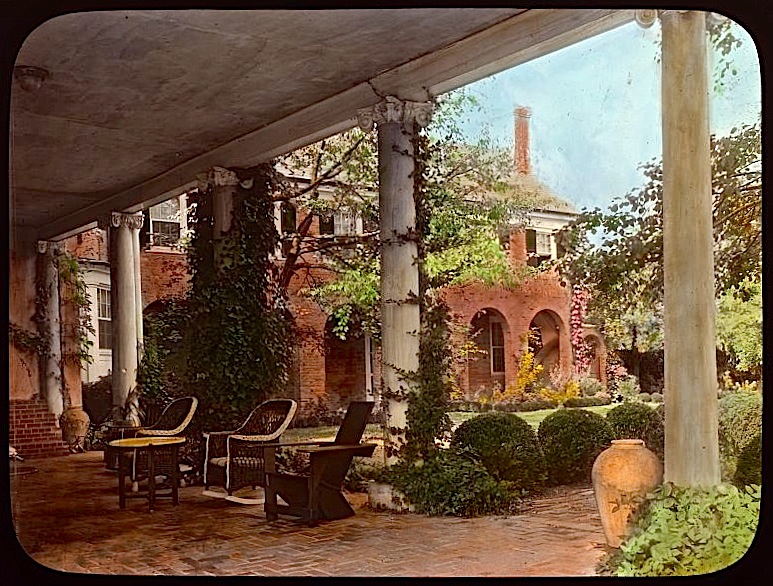
 “Wellington,” near Alexandria, Virginia, 1931, hand-colored glass lantern slide by Frances Benjamin Johnston, via Library of Congress Prints and Photographs Division.
The white columned, ground-level porch wrapped around two and a half sides of one wing of the house. I like the black and white wicker rockers and those terracotta jars.
Today, the house (built in 1757) and its surrounding 25 acres are the headquarters of the American Horticultural Society (AHS) and are called River Farm.
George Washington originally gave the property that name after he purchased it in 1760. It was then 1,800 acres in size and became one of his five farms around Mount Vernon.
During the 1800s, the property, re-named Wellington, passed through several owners’ hands, becoming progressively smaller in size. It was only 280 acres in 1919, when it was purchased by local businessman Malcolm Matheson, who restored the house and gardens.
In 1971, when Matheson wanted to retire to Florida, the house and (then) 27 acres were bought by the AHS. The funds for the purchase had been donated by board member Enid A. Haupt — partly to help the AHS, but also to keep the last of George Washington’s old farm out of the hands of the Soviet Embassy, which had wanted to buy it as a summer dacha for its employees.
Today, River Farm is open to the public weekdays, from 9:00 a.m. to 5:00 p.m. From April through September, it is also open on Saturdays, from 9 am to 1 pm. Admission is free.
And, of course, it can be rented for weddings and events.
A gardyn saw I, ful of blosmy bowes
Upon a ryver, in a grene mede,
There as swetnesse everemore inow is,
With floures whyte, blewe, yelwe, and rede— Geoffrey Chaucer, from “The Parlement of Foulys“


