The Sunday porch: Wellington

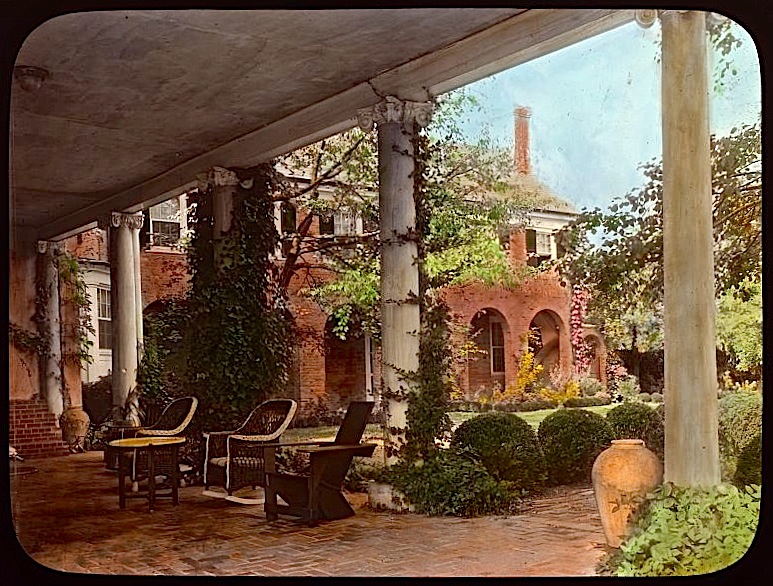
The Sunday porch/enclos*ure: Wellington, now River Farm, about 1931, Alexandria, VA, via Library of Congress.“Wellington,” near Alexandria, Virginia, 1931, hand-colored glass lantern slide by Frances Benjamin Johnston, via Library of Congress Prints and Photographs Division.

The white columned, ground-level porch wrapped around two and a half sides of one wing of the house.  I like the black and white wicker rockers and those terracotta jars.

Today, the house (built in 1757) and its surrounding 25 acres are the headquarters of the American Horticultural Society (AHS) and are called River Farm.

George Washington originally gave the property that name after he purchased it in 1760.  It was then 1,800 acres in size and became one of his five farms around Mount Vernon.

During the 1800s, the property, re-named Wellington, passed through several owners’ hands, becoming progressively smaller in size.  It was only 280 acres in 1919, when it was purchased by local businessman Malcolm Matheson, who restored the house and gardens.

In 1971, when Matheson wanted to retire to Florida, the house and (then) 27 acres were bought by the AHS.  The funds for the purchase had been donated by board member Enid A. Haupt — partly to help the AHS, but also to keep the last of George Washington’s old farm out of the hands of the Soviet Embassy, which had wanted to buy it as a summer dacha for its employees.

Today, River Farm is open to the public  weekdays, from 9:00 a.m. to 5:00 p.m. From April through September, it is also open on Saturdays, from 9 am to 1 pm. Admission is free.

And, of course, it can be rented for weddings and events.

A gardyn saw I, ful of blosmy bowes
Upon a ryver, in a grene mede,
There as swetnesse everemore inow is,
With floures whyte, blewe, yelwe, and rede

— Geoffrey Chaucer, from “The Parlement of Foulys

Vintage landscape: Central Park

Vintage Landscape:enclos*ure -- Central Park, 1906, via Library of CongressCentral Park, New York City, c. 1906, photographer unknown, via Library of Congress Prints and Photographs Division.

Our garden: twilight

The final moments before nightfall. . .

This slideshow requires JavaScript.

These photos were taken yesterday about 6:20 p.m. — standing on the center steps looking down to the lower lawn and out to our view of the city and Mt. Kigali.


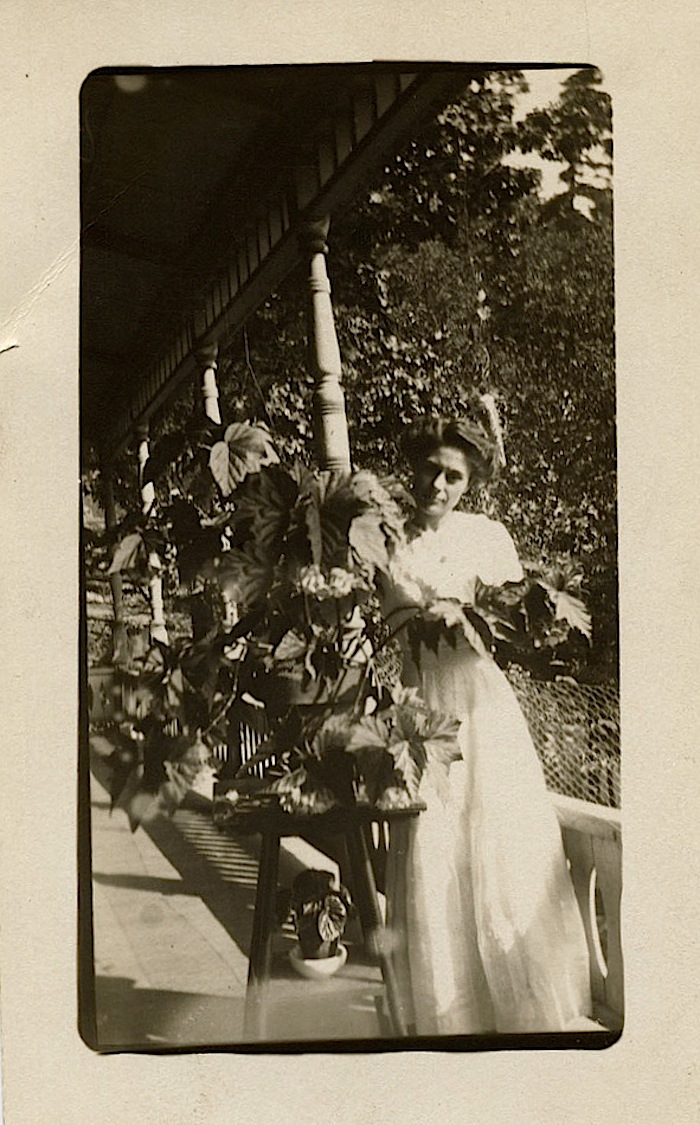
The Sunday porch: the begonia

The Sunday porch/enclos*ure: woman with begonia, via Texas State Archives on flickr“Woman standing beside potted begonias on porch, message from Rosa to Alice on back.” Via the Samuel Bell Maxey Collection of the Texas State Archives Commons on flickr.

Beautiful plant. Conditions must have been ideal on the porch.  Or  was it recently evicted from the living room for taking up too much space?

Unfortunately, Rosa’s message to Alice is not revealed. A thank you note for the original cuttings?  Or just a little gardening conversation/showing off?

I’m also curious about whether the chicken wire all along the front railings was supporting vining plants or keeping animals (or even chickens) back.

The Archives’ photostream gives no information on the photographer, location, or date for this image.  The Samuel Bell Maxey Collection includes the late 19th and early 20th century photographs of the Maxey family of Paris, (northeastern) Texas.

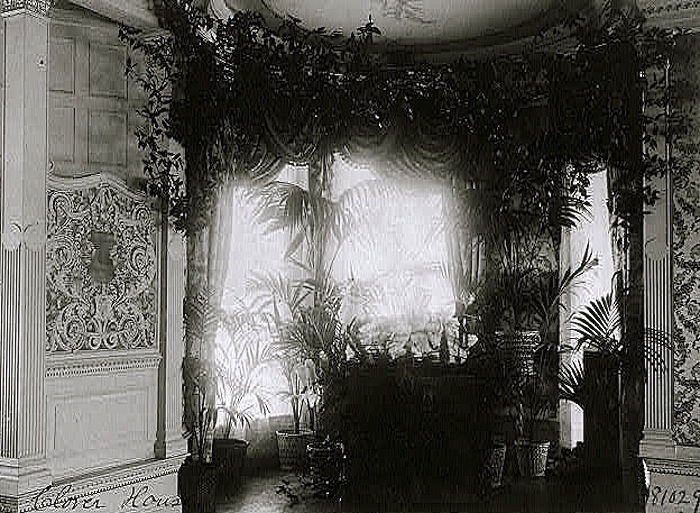
The winter garden: palms

Winter garden:enclos*ure - Glover House, via Library of Congress“Glover House, Washington, D.C.(?),” c. 1900, a cyanotype by Frances Benjamin Johnston, via Library of Congress Prints and Photographs Division.

I haven’t been able to find out anything certain about Glover House.  It seems possible that it was the home of Charles Carroll Glover, who purchased and then donated the land for Rock Creek Park in Washington, D.C., in the 1870s. (He lived at “Westover,” at 4300 Massachusetts Ave., N.W., which is now a modern townhouse development.)

He and  Johnston moved in the same social circles at the turn of the 19th century. As part of her photography business, she took pictures of the homes of many wealthy Washingtonians (and the White House).

Three more winter gardens are here.

The palm at the end of the mind,
Beyond the last thought, rises
In the bronze decor. . .

Wallace Stevens, from “Of Mere Being