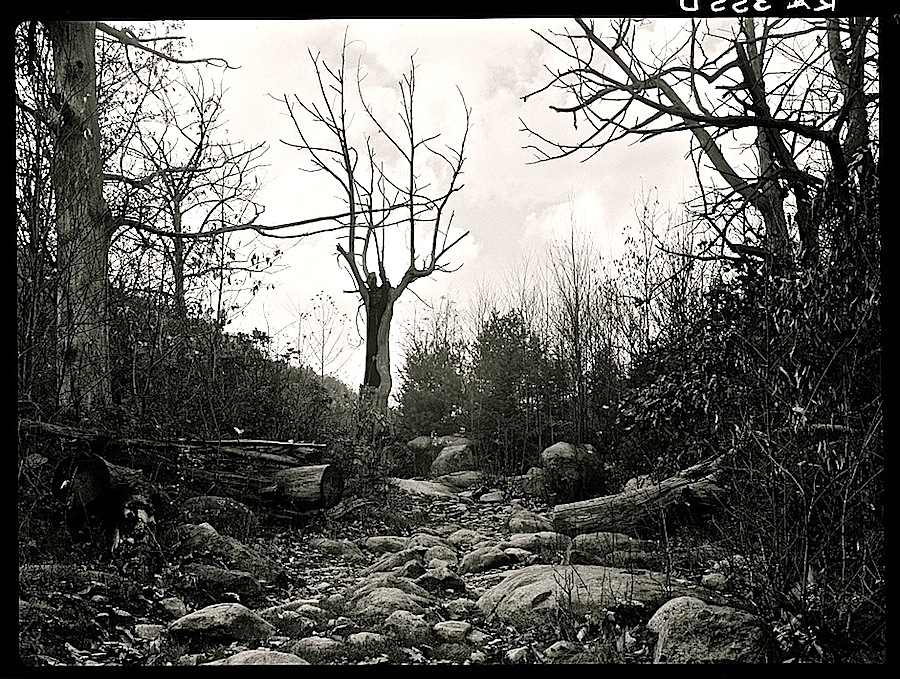
Vintage landscape: rocky road

Dry stream bed, via Library of Congress “Road to Nicholson Hollow. Shenandoah National Park, Virginia,” October 1935, by Arthur Rothstein, via Library of Congress Prints and Photographs Division.
I think this would be a good reference picture for making a dry stream bed path through a naturalistic garden (click to enlarge).

More on Nicholson Hollow this Sunday. . . .

Nel mezzo del cammin di nostra vita
mi ritrovai per una selva oscura
che la diritta via era smarrita

The Divine Comedy – Pt. 1 Inferno – Canto 1 – (1-3)

13. In the middle of the journey
of our life
I came to myself
In a dark forest
The straightforward way
Misplaced.
(Schwerner, 2000)

Caroline Bergvall, from “VIA” (48 Dante Variations)

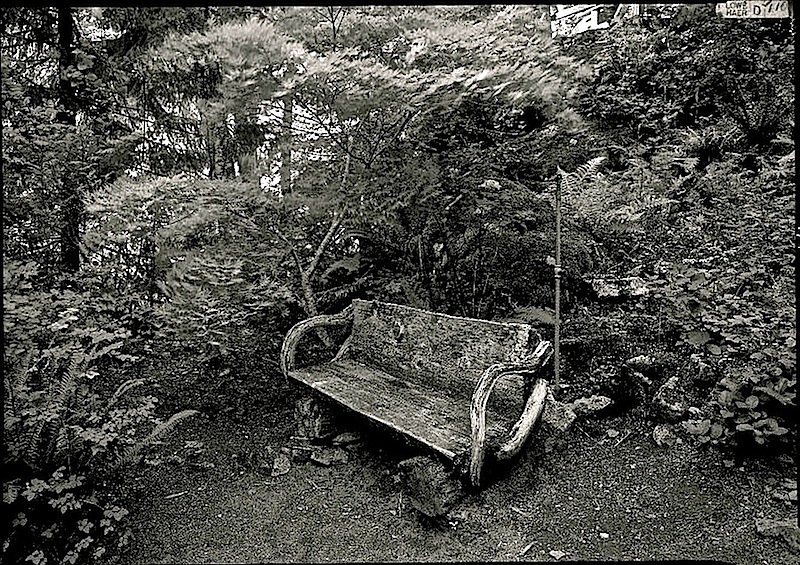
Vintage landscape: the bench

Vintage landscape/enclos*ure: bench at Ladder Creek Gardens, Washington, via HABS, Library of CongressRustic bench at Ladder Creek Gardens, Newhalem, Washington. Photo taken 1989 for an Historic American Buildings Survey (HABS), via Library of Congress Prints and Photographs Division.

The gardens, next to Ladder Creek Falls, were landscaped during the 1930s as a showcase for the Skagit Hydroelectric Project, which now provides power to the city of Seattle.

My husband and I were arguing about a bench we wanted to buy and put in part of our backyard, a part which is actually a meadow of sorts. . . . My husband wanted a four foot bench and I wanted a five foot bench. This is what we argued about. My husband insisted that a four foot bench was all we needed, since no more than two people (presumably ourselves) would ever sit on it at the same time. I felt his reasoning was not only beside the point but missed it entirely; I said what mattered most to me was the idea of the bench, the look of it there, to be gazed at with only the vaguest notion it could hold more people than would ever actually sit down. The life of the bench in my imagination was more important than any practical function the bench might serve. . . .

Mary Ruefle, from “The Bench

The Sunday porch: the portico

This slideshow requires JavaScript.

A late afternoon gathering on the south portico (or back porch) of the White House, probably between 1890 and 1910, photographer unknown, via the Library of Congress Prints and Photographs Division.

Encyclopedia Britannica defines ‘portico’ as a “colonnaded porch or entrance to a structure, or a covered walkway supported by regularly spaced columns. Porticoes formed the entrances to ancient Greek temples.”

The south portico of the White House was built in 1824, principally from an 1807 design by architect Benjamin Henry Latrobe, then Surveyor of Public Buildings.  Latrobe was appointed and supervised by Thomas Jefferson, who loved  neoclassical design and called Palladio’s books “the bible.”

The South of France

Roman temple
“simple and sublime”

Maria Cosway
harpist
on his mind

white column
and arch

Lorine Niedecker, from “Thomas Jefferson

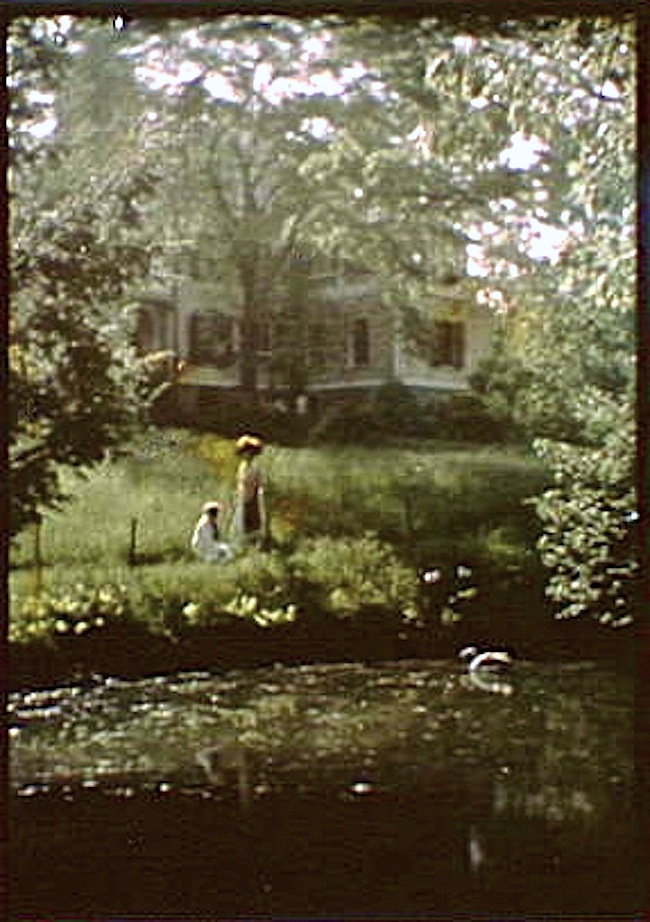
Vintage landscape: summer shimmer

Vintage landscape/enclos*ure: woman and child, Arnold Genthe“Woman and child in a field in front of a white house,” an autochrome taken between 1906 and 1942, by Arnold Genthe, via Library of Congress Prints and Photographs Division.

“If an autochrome was well made and has been well preserved, color values can be very good,” according to the Wikipedia entry on this early color photography technique.

“The dyed starch grains are somewhat coarse, giving a hazy, pointillist effect, with faint stray colors often visible, especially in open light areas such as skies. The smaller the image, the more noticeable these effects are. The resulting “dream-like” impressionist quality may have been one reason behind the enduring popularity of the medium even after more starkly realistic color processes had become available.”

. . . The trees rustle
and whisper, shimmer and hiss.

Amy Gerstler, from “Bon Courage

In Rome

This slideshow requires JavaScript.

Everyone soon or late comes round by Rome.
— Robert Browning, from The Ring and The Book

As you might imagine, late May was a beautiful time to be in Rome.  Coming in from the airport — and later on the way to Naples — we saw swathes of red poppies blooming all along the train tracks.  In the city, there were jasmine flowers everywhere.  The temperatures were in the seventies, and the crowds of tourists weren’t yet (too) bad.

We continued our rather unfocused wanderings in this city as well. But I did spend about two hours in the Museo di Palazzo Doria Pamphilj* (or Pamphili), which was recommended in a 2013 New York Times article, “Three Quiet Museums in Rome.”  It’s a family art collection in what is still the family’s palace home.

Prince Camillo Pamphilj and his brother Pope Innocent X began buying the paintings and sculptures in the 17th century.  In the 18th, the palazzo became the dynasty’s principal residence, and it is now mostly presented as it was at that time.

It is quiet, and you can see masterworks by Bernini, Caravaggio, Memling, Titian, and Rubens, among others.  Admission is €11 and includes a good audio tour by a current Pamphilj prince.

The extended family lives in other parts of the building (you can get a peek at their private courtyard garden just as you enter the museum).  We think my husband, who met up with me later in the gift shop, may have been directed around the corner to the entrance by two of its members — older Italian ladies who told him he would “have a lovely time” in perfect British English.  The audio guide tells you that English is the first language of the family today (a legacy of a 19th century English peeress ancestress).

This slideshow requires JavaScript.

We were also able to visit the beautiful grounds of the American Academy of Rome on Janiculum Hill (photos above).

Miscellaneous tips for Rome

Reserve your hotel room as early as possible. I started looking about six weeks before our trip, and all of my first and second choices were booked up.

The two (casual) restaurants we particularly liked were:

  • the pizzeria Panattoni, Viale di Trastevere 53/57 (dinner only, cash only, closed Wednesdays) in Trastevere — for thin Roman-style pizza.
  • L’Antica Birreria Peroni, near Piazza Venezia — serving lunch and Peroni beer to local businesspeople. (The menu they gave us was only in Italian, but you can see a translation here.)

I liked the Kindle guidebook Revealed Rome by Amanda Ruggeri (and her blog of the same name) for culture, restaurant, and shopping tips.  I also consulted the blogs Parla Food Aglio, Olio e Peperoncino, and The Guardian’s city guide for Rome.

I also liked Italian Survival Guide (on Kindle and paper) by Elizabeth Bingham for a good explanation of Italian pronunciation, numbers, and basic phrases, as well as culture tips.

Not Built in a Day by George H. Sullivan is an interesting guide to Roman architecture, but don’t buy the Kindle version, as I did.  The maps are tiny and fuzzy, making it very difficult to follow his walking tours.  


*It is not part of the large park, Villa Doria Pamphili. The Palazzo is just northwest of the Piazza Venezia in the historic city center.  The entrance is on Via del Corso.

Continue reading “In Rome”