
 Women and Children in the Luxembourg Gardens, Paris, 1898, by Eugène Atget, via The J. Paul Getty Museum Open Content Program.
Category: French gardens
A visitor
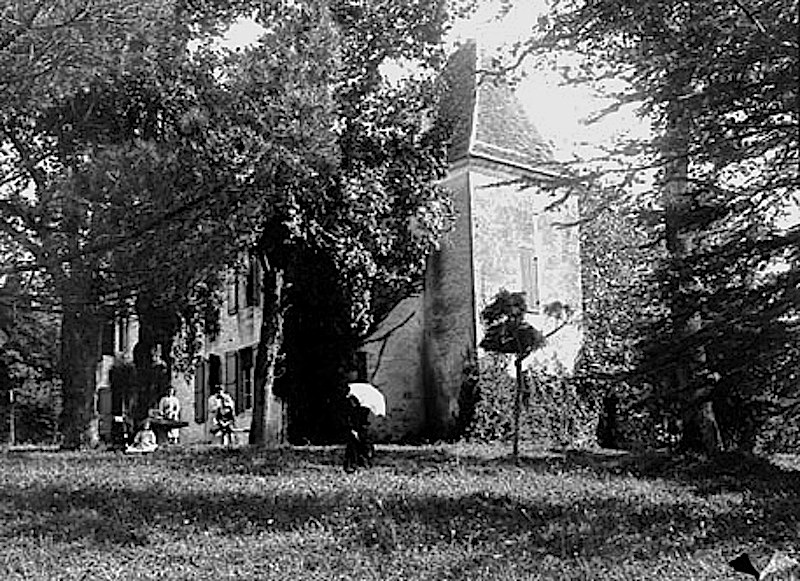
Maison de la Famille Lassagne, September 22, 1897, by Eugène Trutat, (cropped very slightly by me) via Bibliothèque de Toulouse Commons on flickr.
The Sunday porch: le bricolage
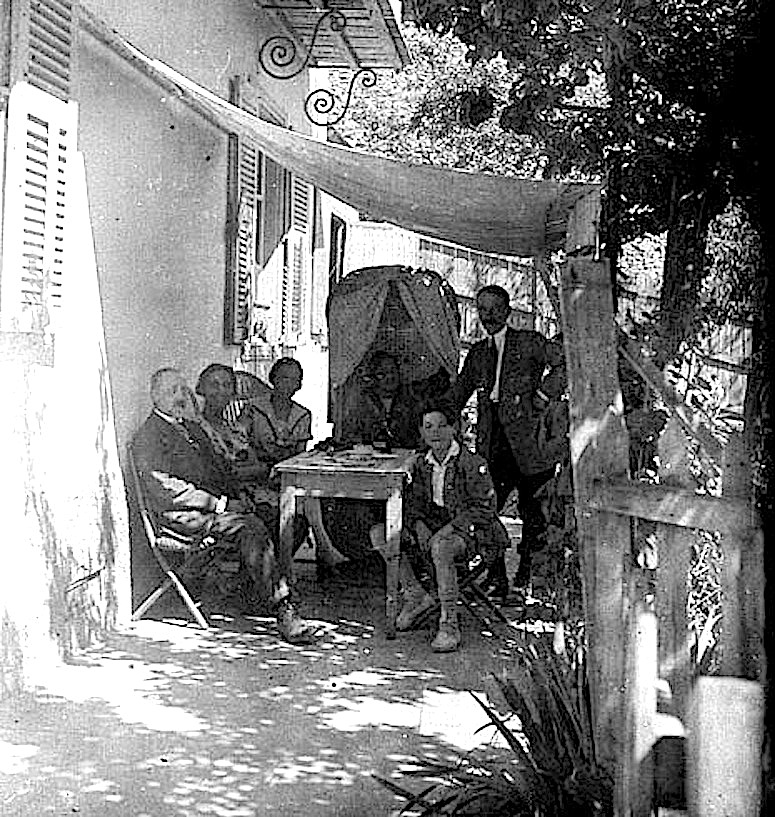 “Famille attablée sur la terrasse, ombragée par une bâche,” (family at a table on a terrace, shaded by a tarp) ca. 1890 – ca. 1910, by Eugène Trutat*, via Bibliothèque de Toulouse (cropped slightly by me).
*I was skeptical about the photographer because Trutat died in 1910, and the women on the left appear to be in the shorter dresses of the 1920s or 30s. However, they could be wearing the bathing suits of around 1900.
Vaux-le-Vicomte
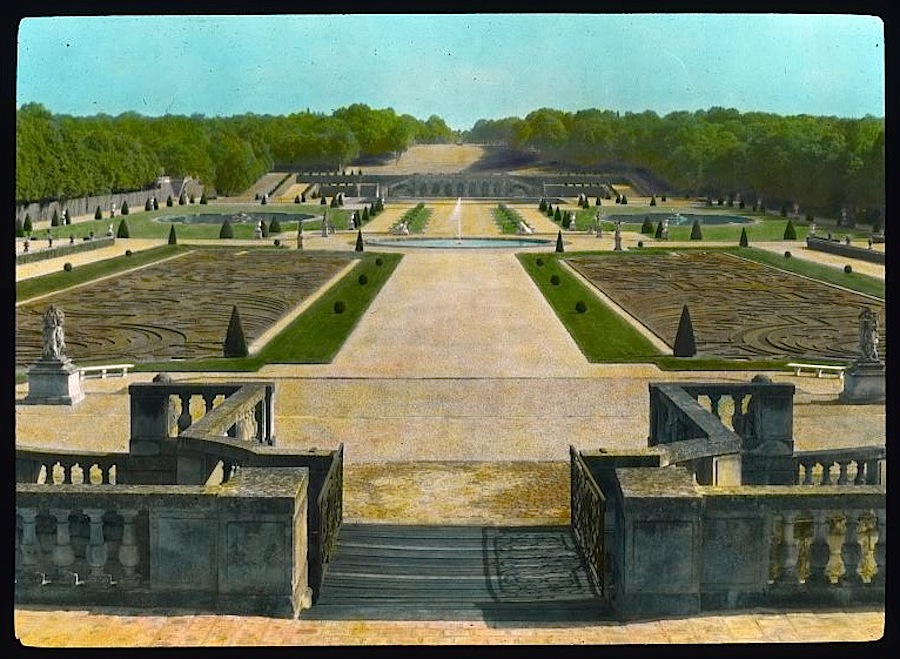
View from the château, Maincy, France, 1925, by Frances Benjamin Johnston, via Library of Congress Prints and Photographs Division.
Vaux-le-Vicomte — the château and garden together — was “the first great work of the French baroque,” according to garden historian Tom Turner.
In his book, The Seven Ages of Paris, Alistair Horne tells the story of the estate’s big reveal to Louis XIV, then only 22 years old and struggling with a nearly bankrupt treasury:
Nicolas Fouquet, a vain, ostentatious and ambitious parvenu, had been Louis’s minister superintendent of finance since 1653. Now aged forty-five, he had just built himself a magnificent mansion at Vaux-le-Vicomte. . . . [O]n 17 August 1661, [he] audaciously invited the King to a lavish gala. . . The massive iron gates gleamed with freshly applied gilt; in the vast gardens laid down by André le Nôtre 200 jets d’eau and fifty fountains spouted on either side of a main alley nearly a kilometer long. For the previous five years, some 18,000 workmen had toiled to produce this wonder of the modern age, eradicating three villages that had happened to be in the way. Certainly it trumped the modest royal hunting-lodge of the King’s father out at Versailles, which Louis was currently doing up.
Inside the imposing mansion the royal party dined off a magnificent gold service which likewise must have made its impression on the King, who had had to sell off his plate to meet military expenditure. . . . [T]he whole episode outraged him. At various points in the evening, Louis came close to losing his temper — whispering to his mother, “Madame, shall we make these people disgorge?” . . . Less than three weeks later, just as he was arriving at a meeting in Nantes, Fouquet was arrested by the legendary D’Artagnan of Three Musketeers fame.
After the arrest, Louis took possession of artwork, furniture, and all the orange trees from Vaux-le-Vicomte. More importantly, he sent its architect, Louis Le Vau, and its painter-decorator, Charles Le Brun — and, of course, Le Nôtre — to Versailles. Fouquet died in prison in 1680.
Seven Ages . . . is a very good history to read if you are planning a trip to the Paris.
I have been taught never to brag but now
I cannot help it: I keep
a beautiful garden, all abundance . . .
I want to take my neighbors into the garden
and show them: Here is consolation.— Paisley Rekdal, from “Happiness“
The Sunday porch: Strasbourg, France

We spent Thursday through Saturday this week in Strasbourg, and a highlight of this trip for me — aside from two great meals (here and here) — was a visit to the Église protestante Saint-Pierre-le-Jeune or Young* Saint Peter’s Protestant Church.
The church has the oldest surviving cloister “north of the Alps,” according to its website.
Three of the four galleries were constructed in the Romanesque style in the 11th century. The fourth, shown above and in the three photos below, was completed in the 14th century in the Gothic style.

The gallery shown above and below was set up for a performance that day.
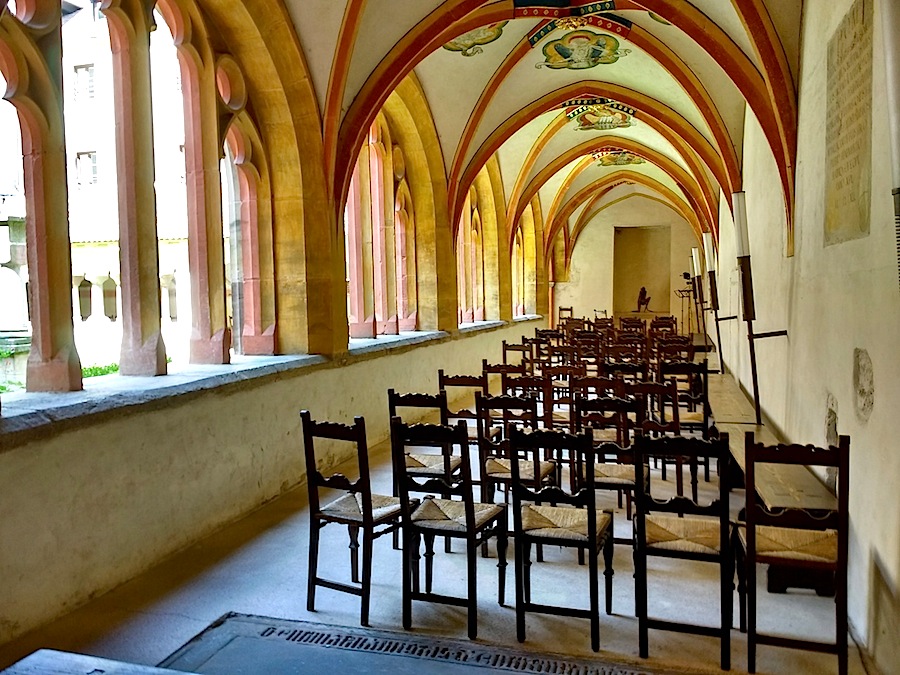

Behind the small stage was a modern sculpture. There were modern works throughout the church. (Unfortunately, I didn’t think to photograph their labels.)

Above: a Romanesque gallery, also ready for a performance or lecture. I loved the pretty chairs, used throughout the church.

A stone mason’s mark?

Above and below: the garden in the center.
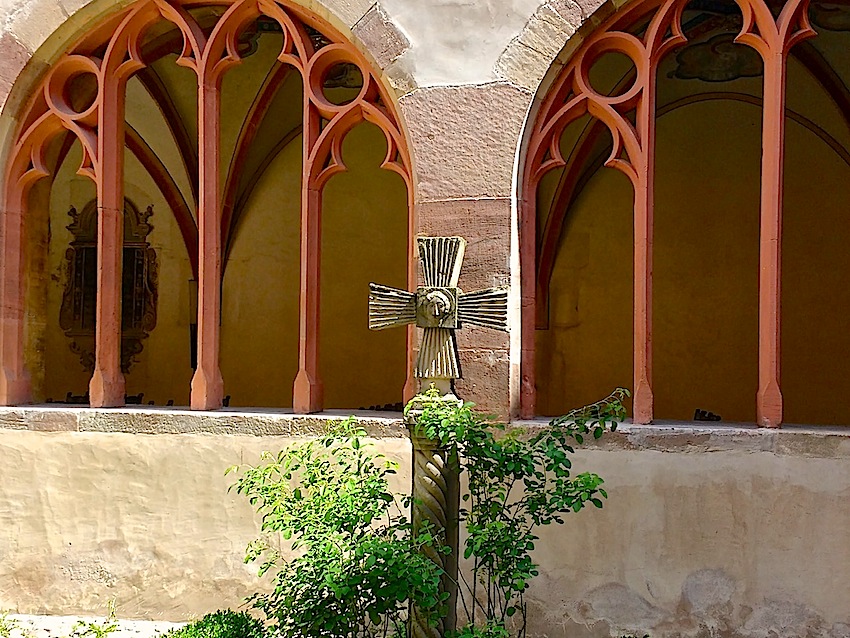
The cloister was heavily damaged and partly buried in the 1700s and then re-built in other ways. After the French revolution, the site was privatized — serving over the years as a wine cellar, a cloth factory, and apartments. It was restored to its original appearance between 2000 and 2008.

On the inside, Église Saint-Pierre is remarkable for its array of colors and forms. The church was built in the 14th and 15th centuries in the Romanesque and Gothic styles.
Originally Catholic, of course, in 1524, it became Protestant. Then in 1682, Louis XIV gave over the choir area behind the rood screen for the exclusive use of the Catholic parish. A dividing wall was built, and it remained there until 1898, when the Catholic congregation moved to its own “Young Saint Peter’s.” In the meantime, in the 18th century, the choir had been redecorated in the Baroque style, in green and gold. Continue reading “The Sunday porch: Strasbourg, France”
 enclos*ure