
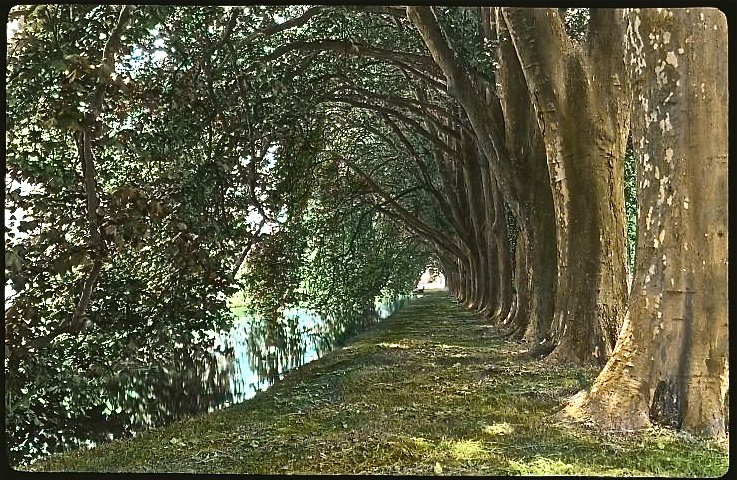
Chateau of Courances, Seine-et-Marne, France. Plane trees along canal, summer 1925, by Frances Benjamin Johnson, who used the image in her lecture, “Old World Gardens.”
Chateau of Courances, Seine-et-Marne, France. Plane trees along canal, summer 1925, by Frances Benjamin Johnson, who used the image in her lecture, “Old World Gardens.”
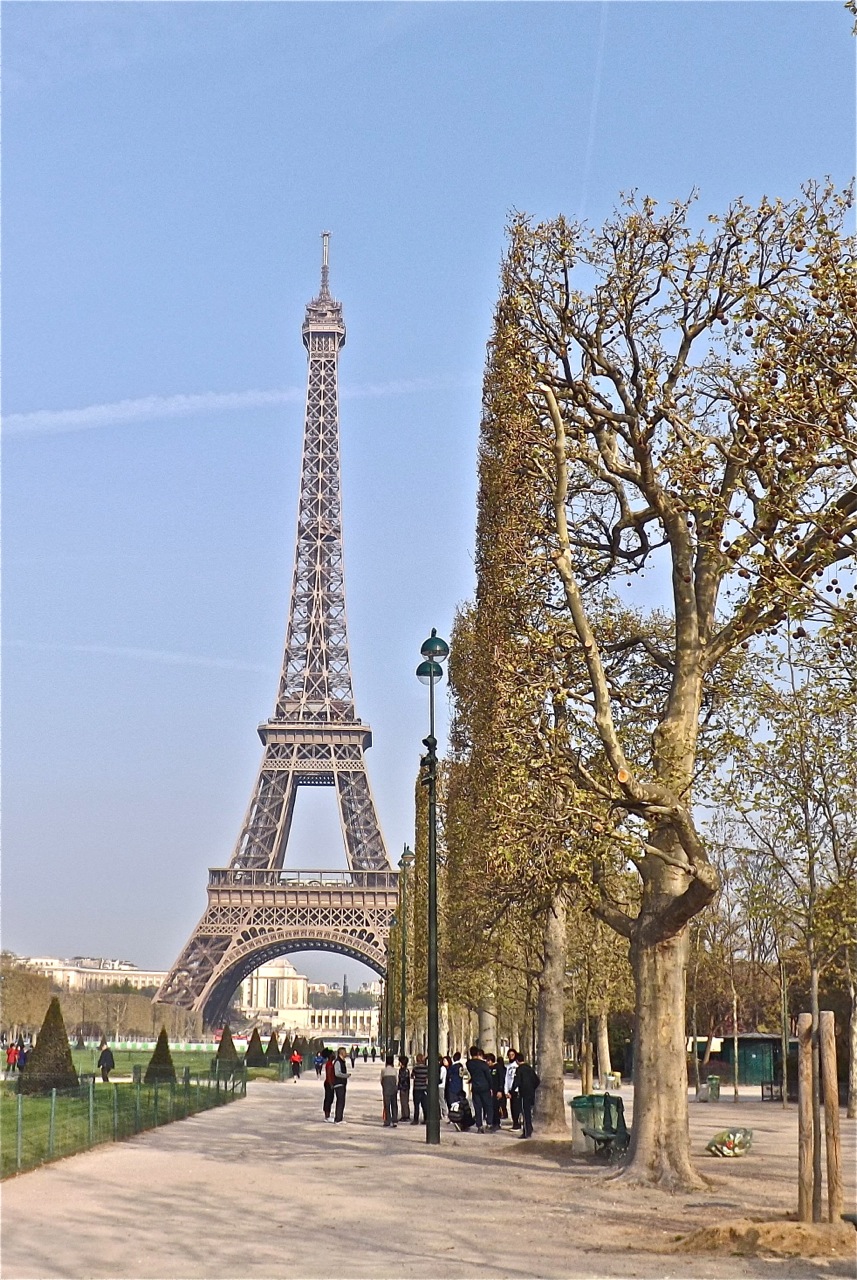
When we visited Paris in the first days of spring, the edges of the pleached trees on the Champ de Mars were still razor sharp.

Located between the Eiffel Tower and the Ecole Militaire, the park was named for the Campus Martius — ‘Mars Field’ — in ancient Rome, which was dedicated to the god of war. (Click any photo to enlarge it.)

In the 18th and 19th centuries, the lawns were used for military marching and drilling. They were opened to the public just before the French revolution.
In the 16th century, the space had been part of an area was called Grenelle and was set aside for market gardening plots.

The trees are London plane trees, Platinus x acerifolia (or x hispanica). In France, they are called platane à feuille d’érable (maple leaf plane tree).
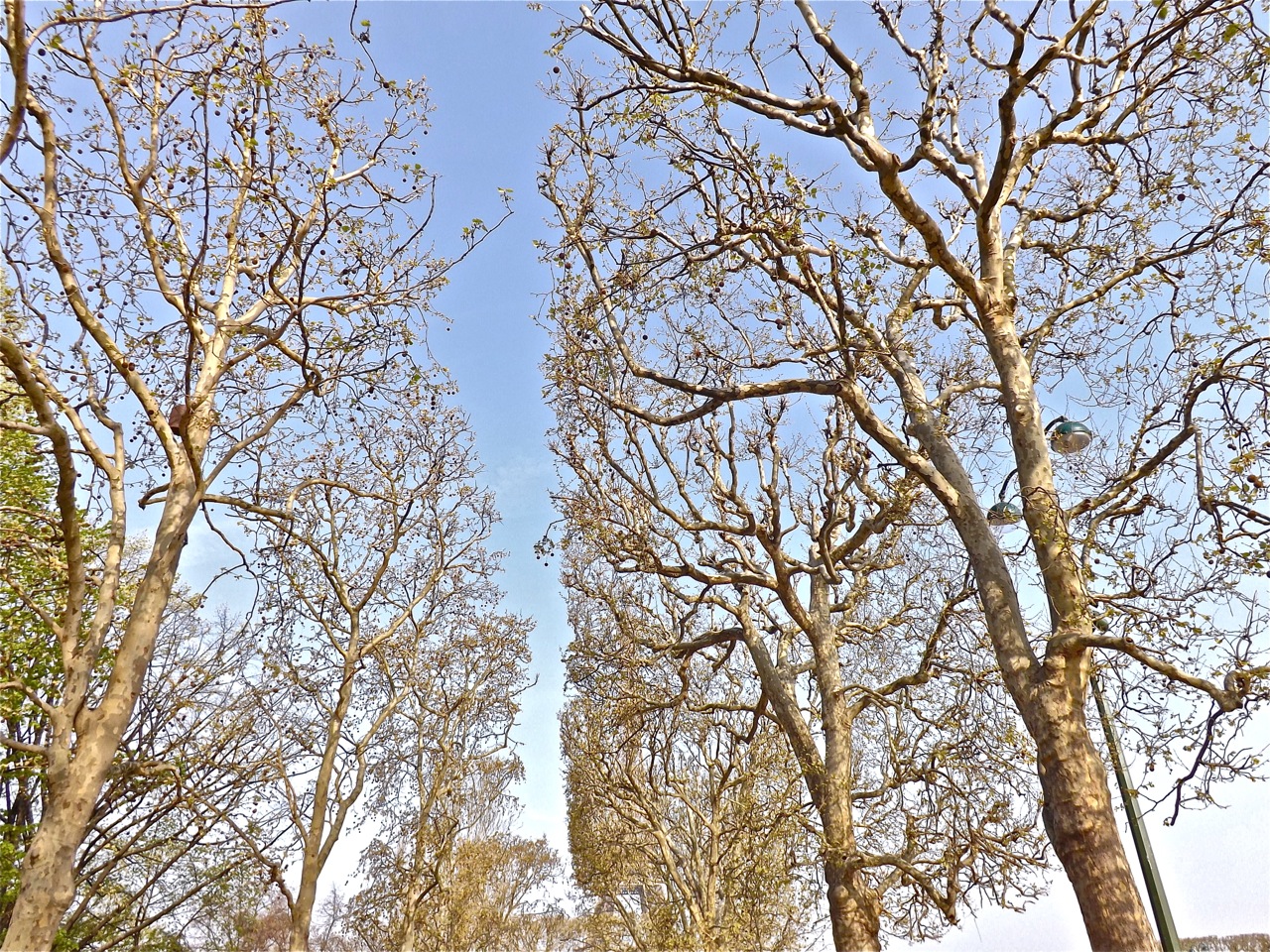
Below, you can see how the park’s gardeners keep them sheared, thanks to the blog Pattersons in Paris.

This is really exciting. Yesterday, the Library of Congress released online the digital images of more than 1,000 hand-colored, glass-plate lantern slides of gardens taken (mostly) by Frances Benjamin Johnston.
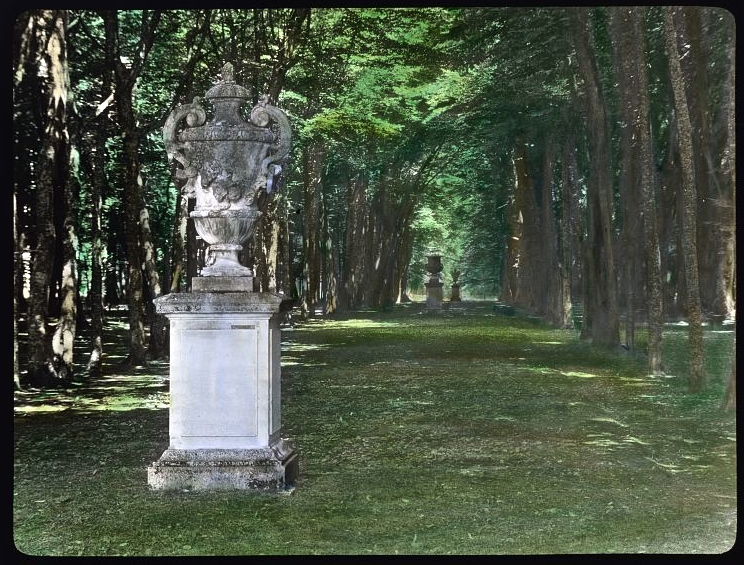
The images in the collection were taken from 1895 to 1935. Originally black and white photographs, Johnston had them hand tinted and made into slides to illustrate her popular garden lectures, which she gave to garden clubs, horticultural societies, and museum audiences from 1915 to 1930. As part of the Garden Beautiful Movement, she encouraged Americans to grow gardens on tenement lots, in row-house yards and in parks, which had deteriorated from industrial pollution and neglect during the Gilded Age.
The slides have not been seen in public since Johnston last projected them during her lectures. They depict more than 200 sites — primarily private gardens — in all regions of the United States and in Europe. The entire collection, 1,130 digital images, can be found in the Library’s Prints and Photographs Online Catalog, here.
I’ve just begun to enjoy this beautiful resource, but here are 11 images that I pulled out quickly during my first enthusiastic look.
The photo above is of Chateau of Bréau, Dammarie-les-Lys, Seine-et-Marne, France. July 1925. (Click any photo to enlarge it.)
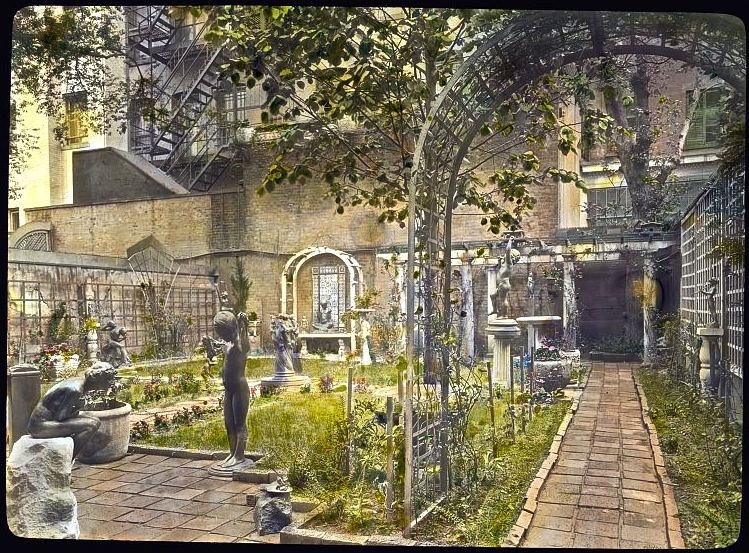
The Touchstone Garden, New York, New York. Sculpture exhibition, summer 1919.
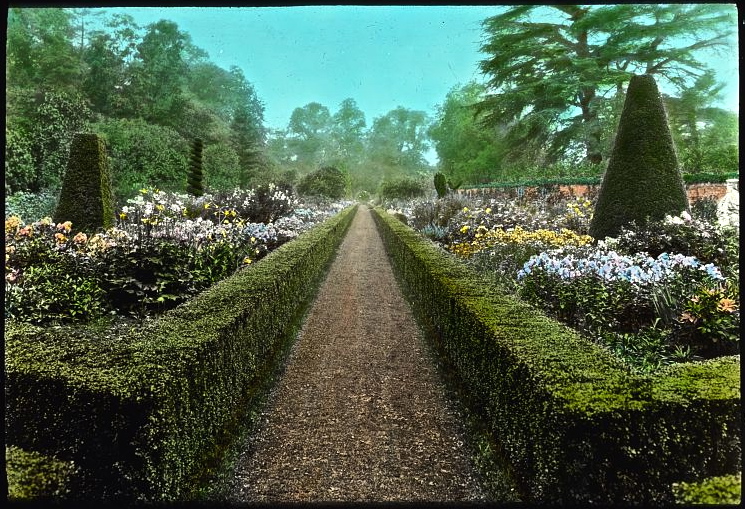
“Cliveden,” Viscount Waldorf Astor house, Taplow, Buckingham, England. Long Garden, summer 1925.

Myron Hunt house, 200 North Grand Avenue, Pasadena, California. Garden Terrace, spring 1917.
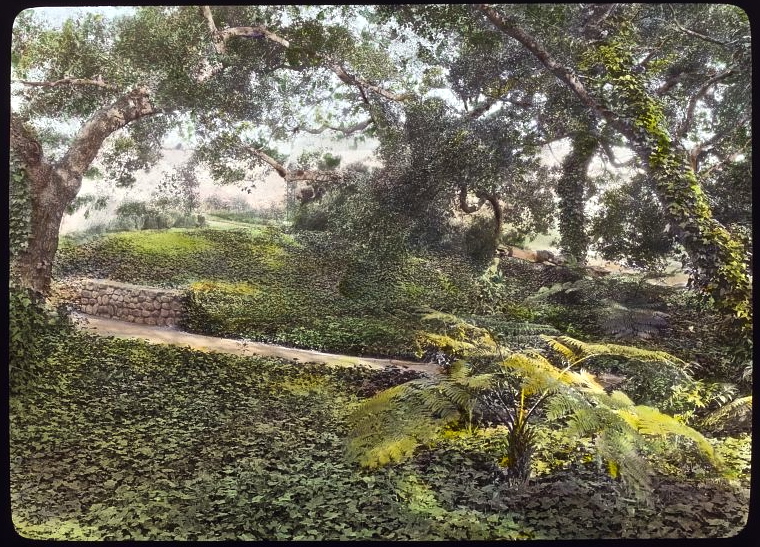
“Inellan,” Walter Douglas house, Channel Drive, Montecito, California. Pathway to Pacific Ocean, spring 1917.

“Flagstones,” Charles Clinton Marshall house, 117 East 55th Street, New York, New York. Tea house/sleeping porch.

“Gray Gardens,” Robert Carmer Hill house, Lily Pond Lane, East Hampton, New York, New York. View to Garden Trellis.

West Potomac Park, Washington, D.C. Irises along the embankment, April 1905.
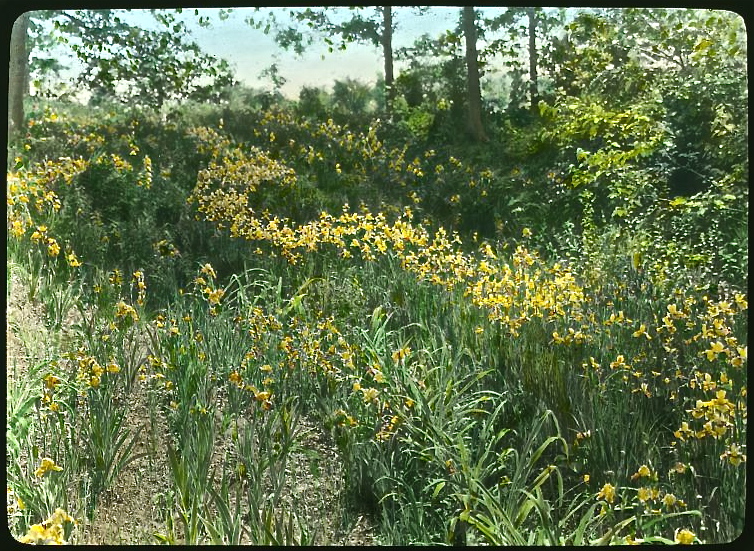
Dr. Charles William Richardson house, Chevy Chase, Washington, D.C. Irises, 1921.
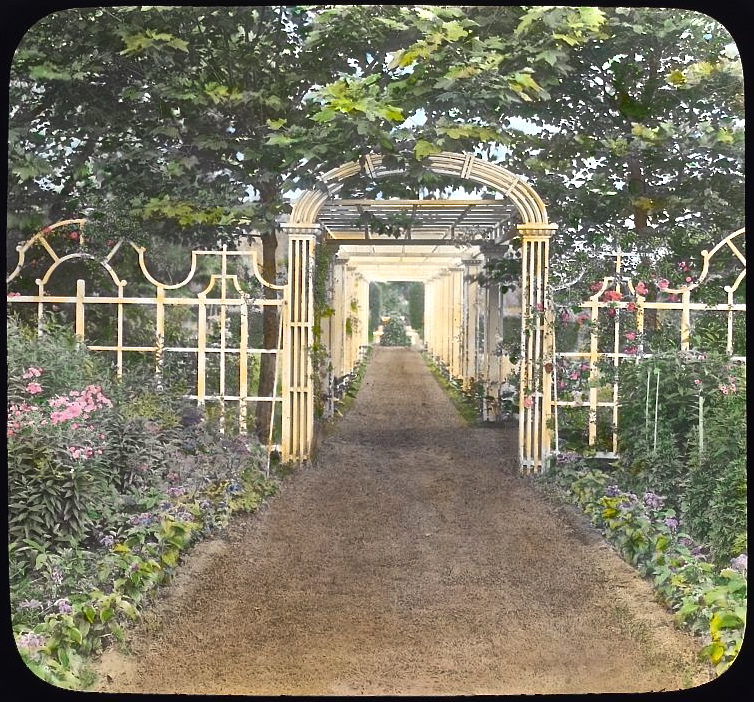
“The Fens,” Lorenzo Easton Woodhouse house, Hunting Lane, East Hampton, New York. Pergola, 1914.
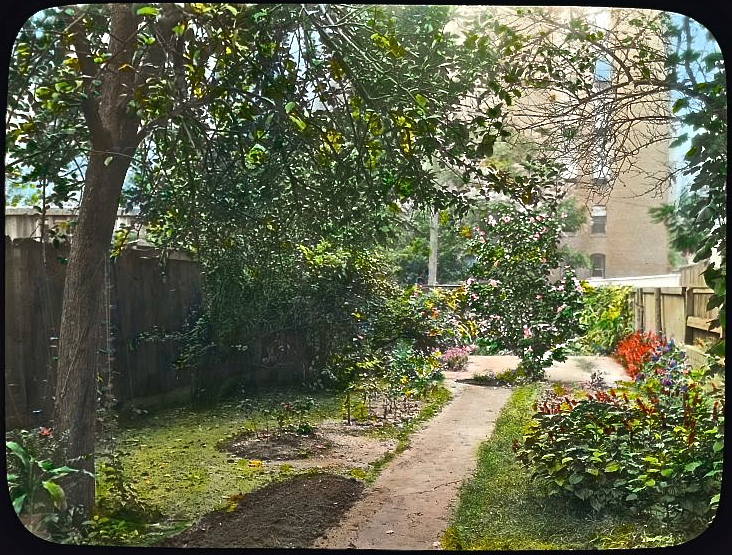
Unidentified city garden, probably in New York, New York. Pathway, 1922.
A selection of 250 of the color images can also be seen in a new book by house and garden historian Sam Watters, Gardens for a Beautiful America, 1895-1935: Photographs by Frances Benjamin Johnston. It will be published this month by Acanthus Press, in association with the Library. ($79, here — not yet available.)
The Library of Congress is the repository of Johnston’s personal papers and approximately 20,000 photographs. But the lantern slides lacked garden names, locations, and dates and, therefore, had not been released to general public access. Watters took on the challenge of cataloging the collection, and after five years of research in libraries and archives, he has transformed vague earlier library notations into detailed data. For example, an unlabeled slide was recognized as a prize winner in a 1922 design contest and is now identified as “The Janitor’s Garden, 137 E. 30th St., New York City.”
For more information about Frances Benjamin Johnston, see here and here.
This is another little spot we came across on our one day in Paris last month. (We were on our way from Lyon to Brussels).
This petit park, which is the courtyard of the 16th c. Hôtel de Lamoignon in the Marais, is very traditionally landscaped with lined-up trees, clipped shrubs, decorative trellis, and lawn.

It’s nothing special, in fact — except that the grass is studded with dozens of small solar lights.

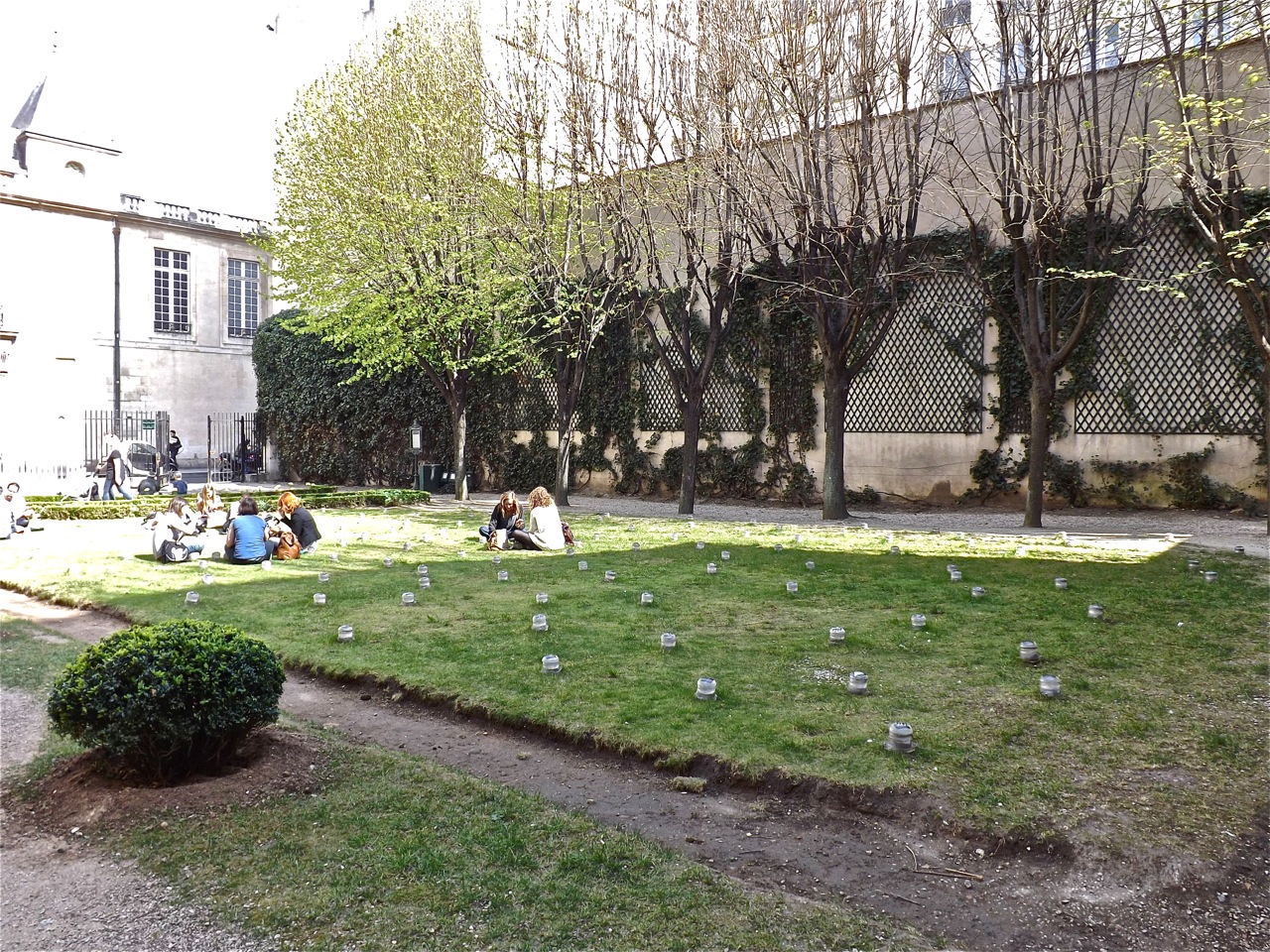

But the little fixtures didn’t stop anyone from enjoying the grass on such a warm March day.
I couldn’t go back to the park at night, but I did find a photo on flickr.
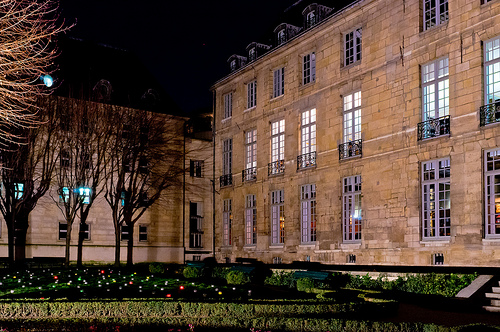
The courtyard is on the Rue des Francs Bourgeois, two and a half blocks west of the Place des Vosges.
We spent one of the last days of March in Paris — just walking around and occasionally stopping for tiny $4 coffees.
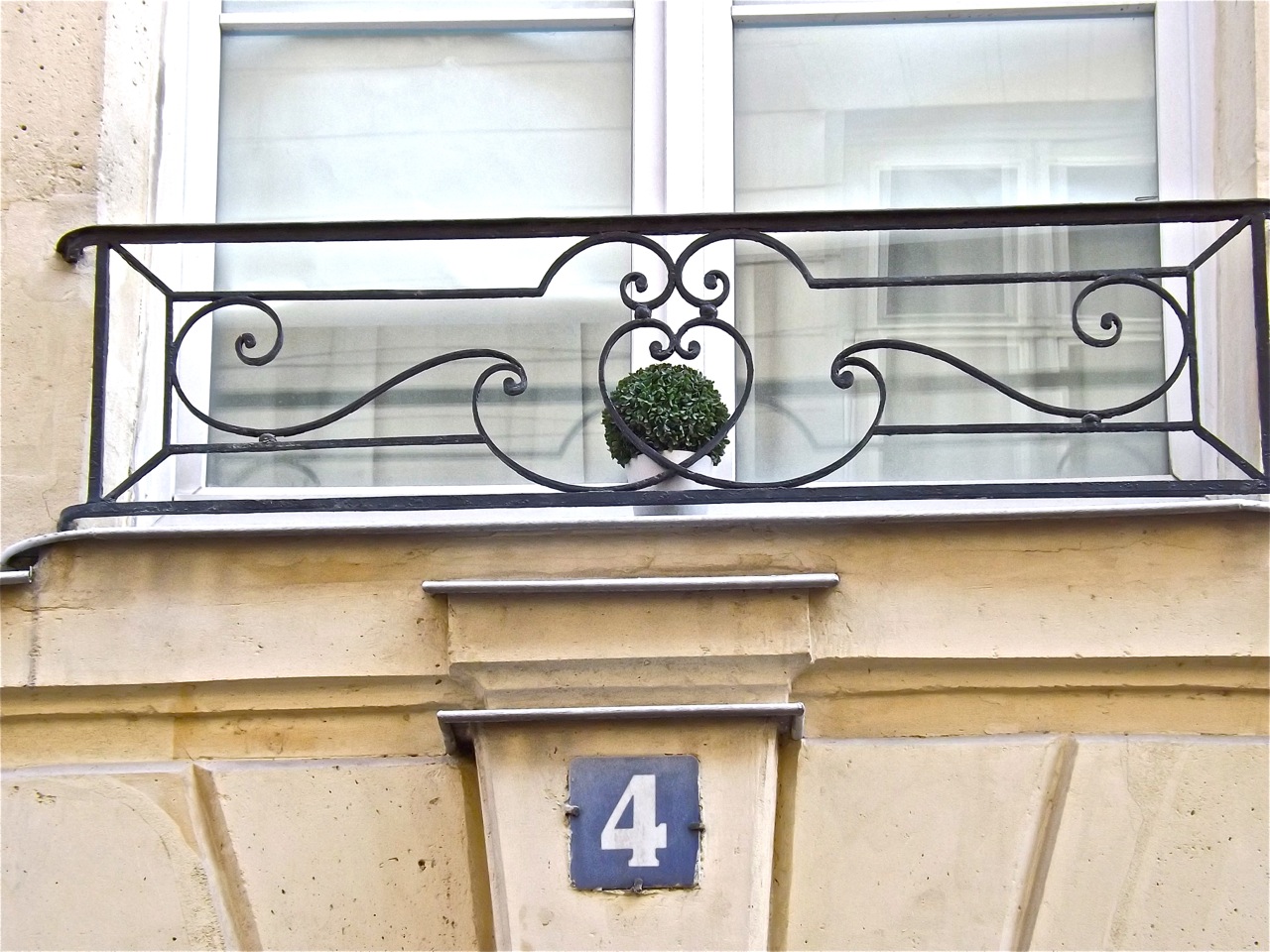
We spotted this tres discret window decoration in the chic Saint Germain des Pres neighborhood.
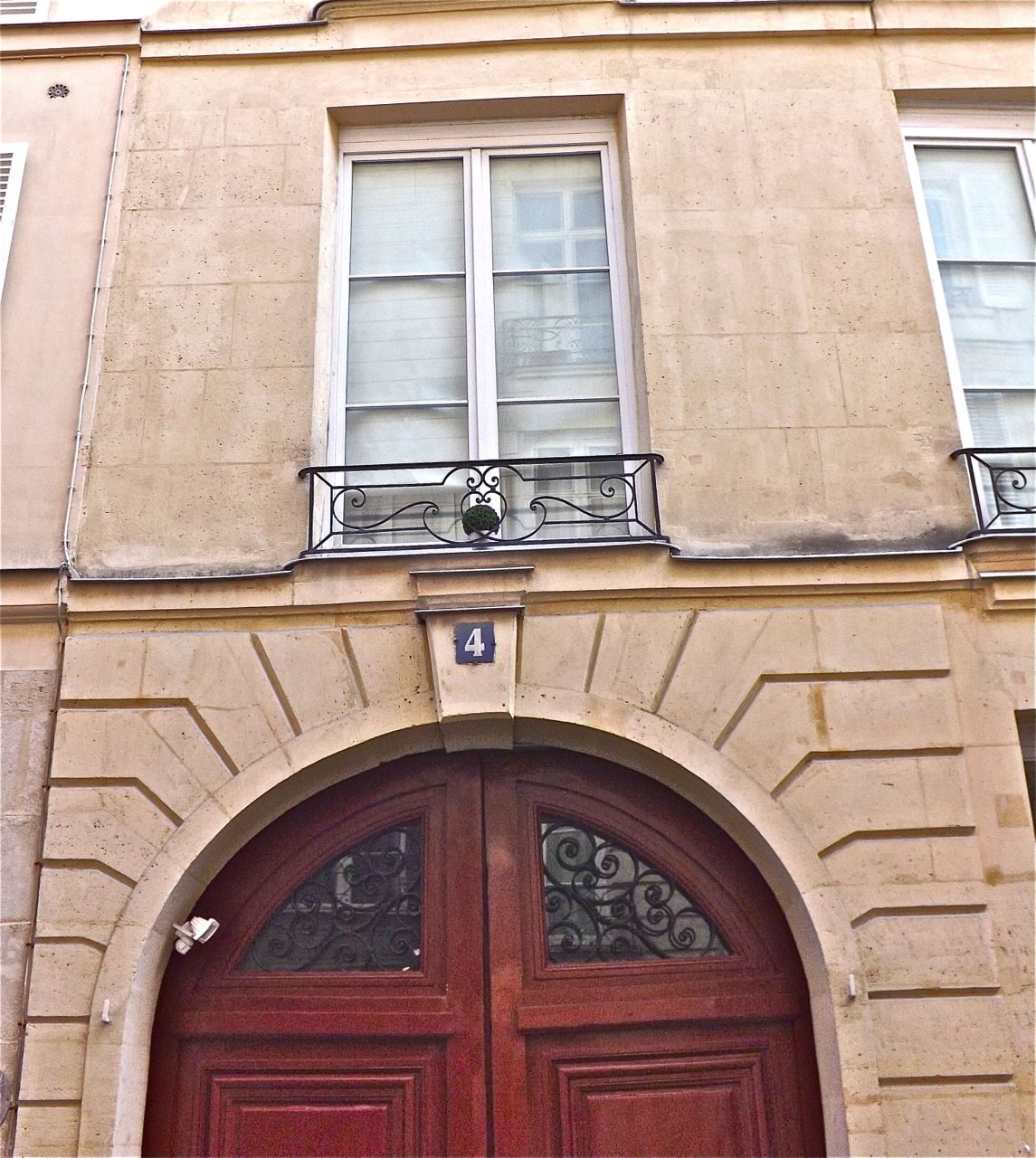
The little topiary pots were in several windows across the building.
This pleated bag, below, in the window of Pleats Please Issey Miyake made me think of this previous Wordless Wednesday.

We crossed over to the right bank, and I saw this graffiti alongside the Louvre.

‘Regarde le ciel’ (look at the sky) is a rather common sight in Paris, as I learned from a Google search. I could not find the origin of this street art, but I thought it might refer to a song by Cortezia, which excoriates airplanes. (Apparently, Cortezia does not tour far from home.)
However, there seems to be a Romanian connection, as another common version of the graffiti is ‘priveste cerul,’ (look at the sky in Romanian).
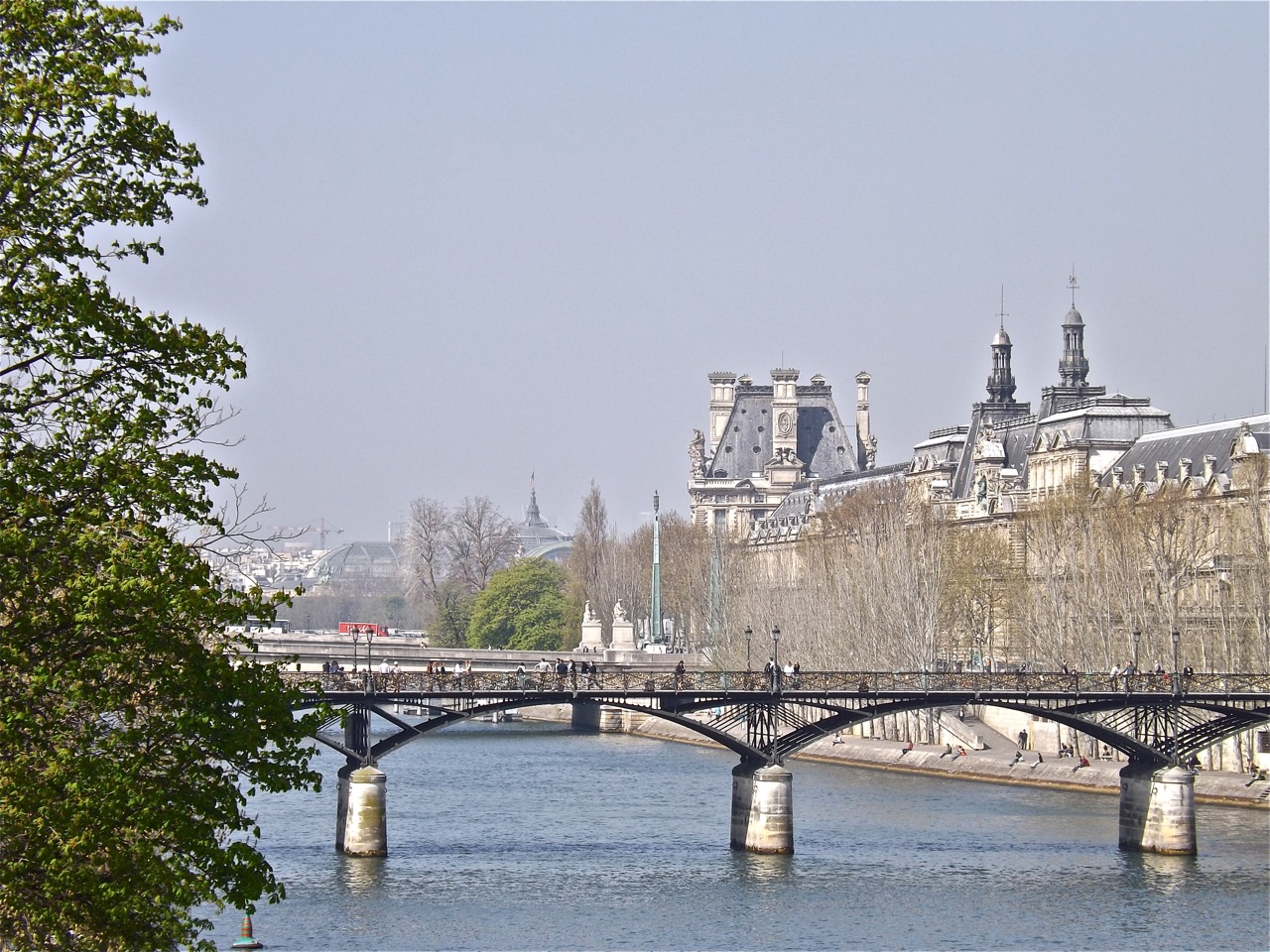
At any rate, the sky was just about perfect, as you can see from this photo of the Passerelle des Arts. If you click and enlarge it, you can see how the bridge glitters from hundreds of padlocks or ‘lovelocks’ (we also saw the beginning of this fad on a pedestrian bridge in Lyon).

Since this was Paris, I probably should throw in a restaurant recommendation. We ate dinner that night at the wonderful Café Constant, which is owned by “Top Chef” jury member Christian Constant. Located at 135, rue Saint Dominique, in the neighborhood near the Eiffel Tower, it is the first in a row of three restaurants owned by Constant, each a little more expensive (we were in the least expensive and most casual). The café doesn’t take reservations, so go early for lunch or dinner.
*a look around
 enclos*ure