
 Back porch, possibly in Northwest Manville, New Jersey, February 1936, by Carl Mydans for the U.S. Resettlement Administration, via Library of Congress Prints and Photographs Division.
Category: design
The Sunday porch: Washington, Kentucky
 Collins-Davis House, Main Street, Old Washington, Kentucky, 1982, by Jack Boucher for an Historic American Buildings Survey (HABS), via Library of Congress Prints and Photographs Division (all photos here).

This clapboard structure, built in 1875, is the most exuberant interpretation of Gothic Revival architecture in Washington. . . . A mid-western interpretation of Gothic Revival cottage architecture, . . . with three steep gables emphasizing verticality and the porch with stylized Tudor arches drawing attention from the Greek Revival doorway. Notably absent is any vestige of . . . the “gingerbread” often associated with post-Civil War architecture.
— HABS, written ca. late 1970s or early 1980s
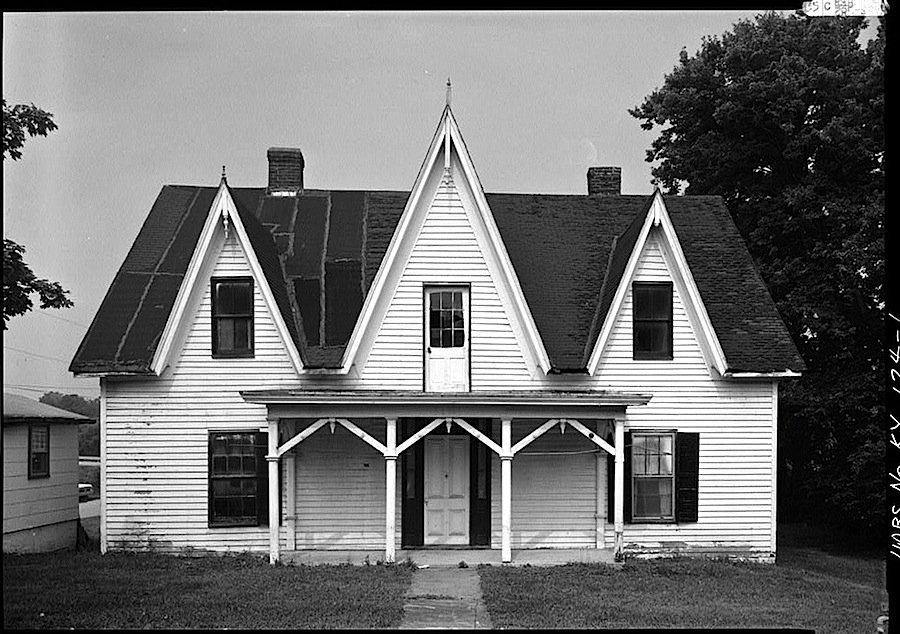
Looking at Google Maps street view for Old Washington, it appears that the house still exists in good condition.
The Sunday porch: Edgemont
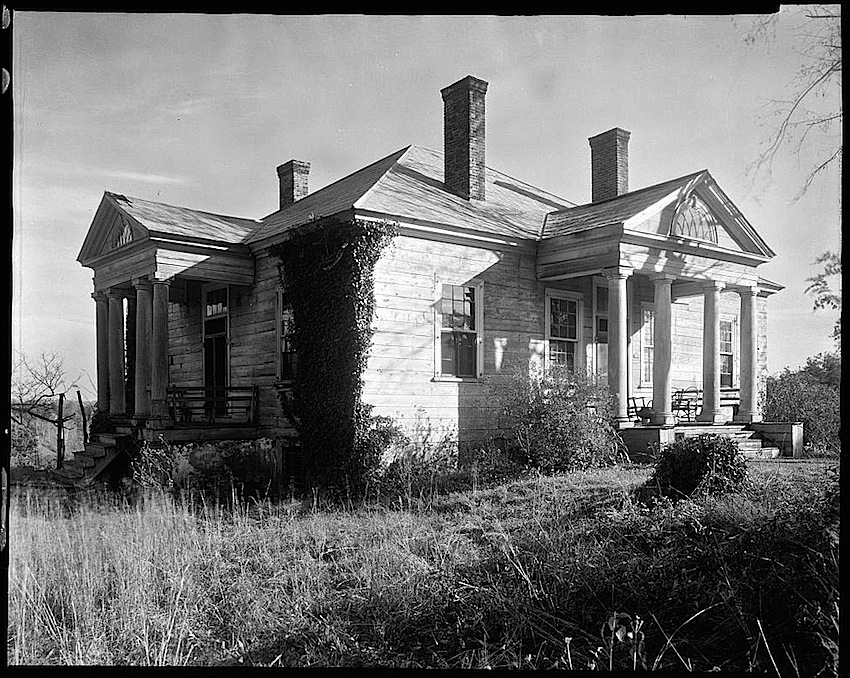 Edgemont (or Cocke Farm), Albemarle County, Virginia, 1935, by Frances Benjamin Johnston, via Library of Congress Prints and Photographs Division.
Built ca. 1796 for James Powell Cocke, Edgemont is significant as a very early example of a country residence in the combination Palladian and French manner promulgated by Thomas Jefferson. Although the design of the house has been credited to Jefferson for several decades, precise documentation of the authorship remains yet to be established. The character* of the compact and sophisticated dwelling is uniquely Jeffersonian, however, and exhibits the influence he had on the architecture of his region. . . .
— from the 1980 nomination to the National Register of Historic Places
At the time of the photo, only two porticoes of the probable original four still existed. The house was restored and renovated in the late 1930s and 1940s. There are more F.B.J. photos here and 1996 photos here.
* “a formality and classical correctness devoid of monumentality. . .”
Vintage landscape: white fence
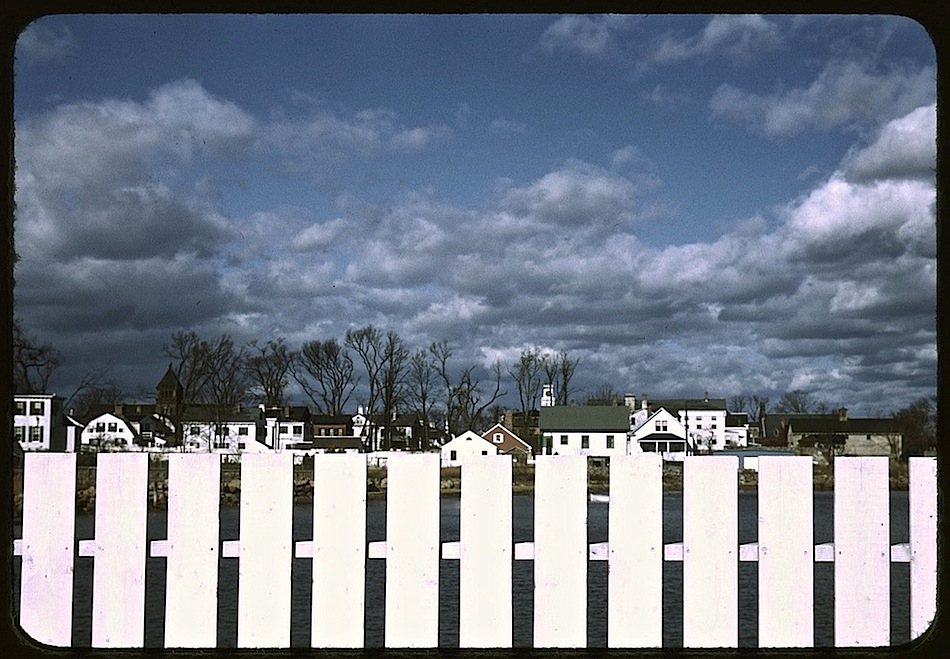 Picket fence and view of Stonington, Connecticut, November 1940, by Jack Delano, via Library of Congress Prints and Photographs Division.
The image was taken for the U.S. Farm Security Administration on the then new Kodachrome color transparency film.
The Sunday porch: late afternoon
A repeat porch from June 2014. . .

A gathering on the south portico (or back porch) of the White House, probably between 1890 and 1910, photographer unknown, via the Library of Congress Prints and Photographs Division.
The portico was built in 1824, principally from an 1807 design by architect Benjamin Henry Latrobe, then Surveyor of Public Buildings. Latrobe was appointed and supervised by Thomas Jefferson, who loved neoclassical design and called Palladio’s books “the bible.”
The South of France
Roman temple
“simple and sublime”Maria Cosway
harpist
on his mindwhite column
and arch— Lorine Niedecker, from “Thomas Jefferson“
 enclos*ure