Striped road

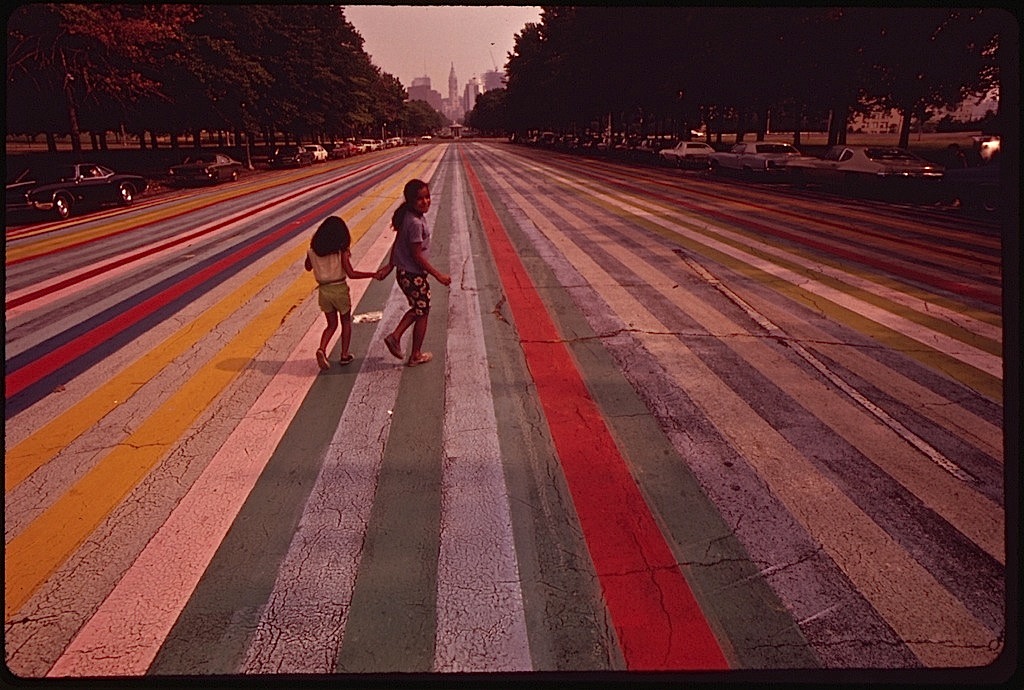
Vintage landscape/enclos*ure: Big Strips, painting by G. Davis, 1973, via Natl. Archives“Crossing the painted road which extends east from The Philadelphia Museum of Art, August 1973,” by Dick Swanson, via the U.S. National Archives Commons on flickr.

This is another photo taken for DOCUMERICA, a 1970’s photography program of the U.S. Environmental Protection Agency (shown here with original caption).

The road painting, “Big Stripes,” by Gene Davis, was created in 1972. At the time, it was the world’s largest painting.  Davis was a leader in the Washington [D.C.] Color School.

Does anyone know if any part of this painting survives today?

The Sunday porch: East Boston

East Boston, c. 1973, via National ArchivesLaundry hanging from triple-decker porches in East Boston near Logan Airport, May 1973.

East Boston, c. 1973, via National Archives“From the rear porch of his home at the southern corner of Neptune and Lovell Streets, Larry Vienza watches jet take off from Runway 15r-33l. Once airborne, the jet will fly directly over his house, May 1973” (with photographer’s caption).

These photos* were taken by Michael Philip Manheim, for DOCUMERICA, a 1970’s photography project of the Environmental Protection Agency.

The East Boston neighborhood was devastated by the noise from Logan airport’s expansion in the 1960s and 70s. (See Friday’s post, “Neptune Road.”)

There are more pictures from DOCUMERICA here.


*Via the U.S. National Archives Commons on flickr.

Another May

Poem on window pane (detail), HABS, Library of Congress

Another May new buds new flowers
Ah why has happiness no second spring

Scratched into a sitting room window pane of Borough House, which was built between 1758 and 1821 in Sumter County, South Carolina.

The words (with slight variations) are from “Sonnet II” by Charlotte Smith  — whose poems were praised by her contemporaries Wordsworth and Coleridge.

I have not been able to find out who might have put them on the window.

Borough House, S.C., HABS, Library of CongressBorough House is architecturally noteworthy because it is partly constructed with rammed earth — an unusual building material in the United States.  (There is more about the house here.) It still stands today, in private ownership.

(I believe that the window with the poem is one of the two left of the front door.)

The photos here are part of an Historic American Buildings Survey (HABS), May 1985, via Library of Congress Prints and Photographs Division.

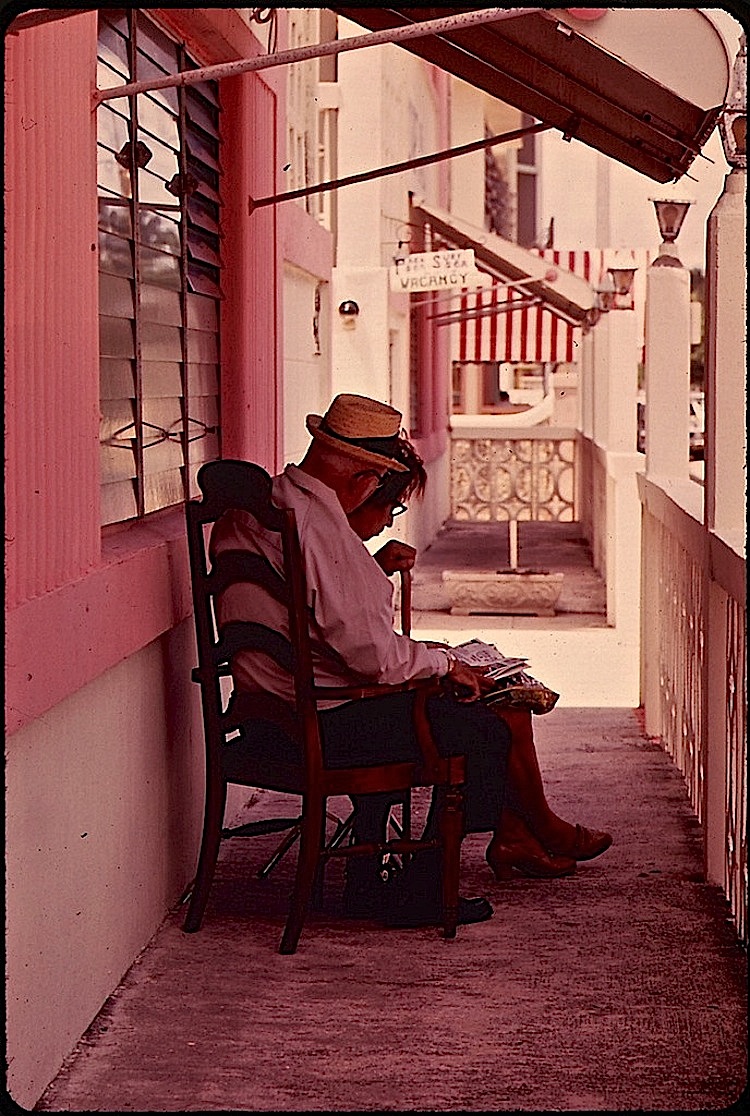
The Sunday porch: South Beach

South Beach porch, 1973, via Natl. Archives“Inexpensive retirement hotels are a hallmark of the South Beach area [of Miami Beach, Florida]. A favored place is the front porch, where residents sit and chat or watch the activities on the beach.”

South Beach, c. 1975, via Natl. Archives

These c. 1975  pictures* (shown here with their original captions) were taken by Flip Schulke for DOCUMERICA — a photography program created in late 1971 by the brand new U.S. Environmental Protection Agency.

The EPA hired over 100 photographers to “document subjects of environmental concern.”  The work continued until 1977 and left behind an archive of about 20,000 images.

In addition to recording damage to the nation’s landscapes, the project captured “the era’s trends, fashions, problems, and achievements,” according to the U.S. National Archives, which held an exhibit of the photos, “Searching for the Seventies,” in 2013. 

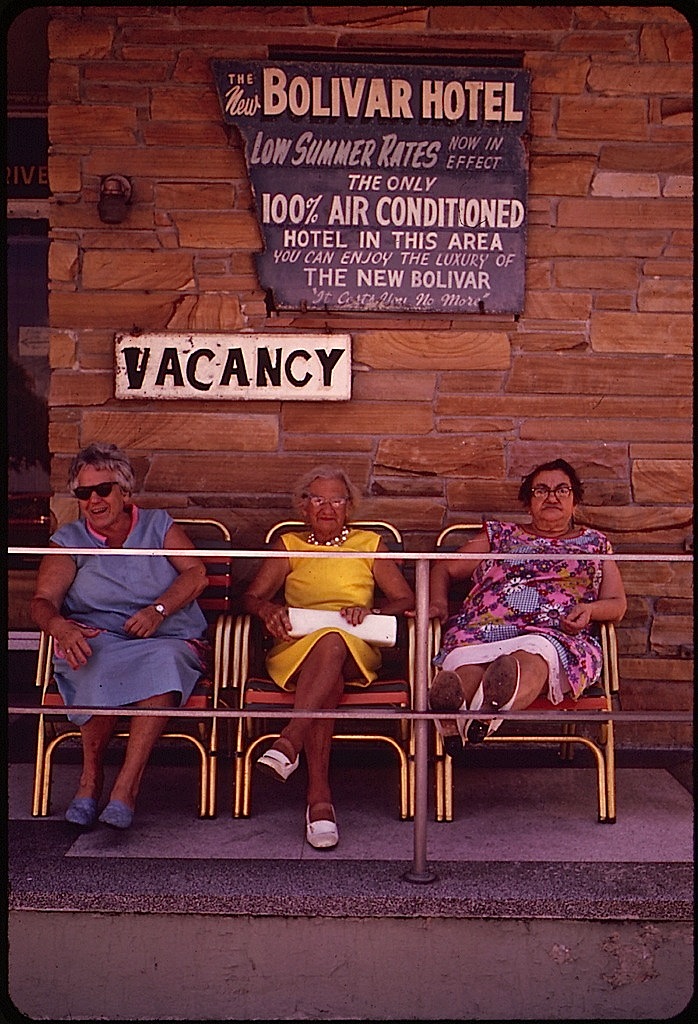
South Beach, c. 1975, via Natl. Archives“One of the many residential hotels for retired people living on small incomes. . . . The front porch is a favorite retreat.”

South Beach, c. 1975, via Natl. Archives“Income of the retirees in this area is not high, and most live in residential hotels such as the one pictured here.”

There are more pictures from DOCUMERICA here.


*Via the U.S. National Archives Commons on flickr.
Life in gardens: conversation

This slideshow requires JavaScript.

I like this trio of photos by Louise Rosskam, which capture two men on a town common bench evidently enjoying a funny story or joke.

They were  taken in Vergennes, Vermont, in August 1940.*

New England commons were (and are) community spaces that probably evolved from the lots originally set aside for village meetinghouses or churches.  After the mid 19th century, many began to function like parks.†

Although Rosskam was not employed there, a series of photos that she took in rural Vermont became part of the picture archives of the Farm Security Administration.

In a 1965 oral history interview, she related how she proposed taking these pictures for the FSA, where her husband, Edwin, was a photo editor.

. . . [O]nce I took a vacation in Vermont, and I said to Roy [E. Stryker, head of the Information Division],”Could I take some pictures for you?” you know, “I’ll buy my own film and everything.” And he said, “Oh, here’s some film,” and then he starts rambling along about Vermont and really it didn’t sound as if it had anything to do with what you wanted to do at all. You started talking about hills, farmhouses and how people build a little extension on the house for the old people, and about pickled limes, the sky and how to get to Vermont 50 years ago, you know; by the time you got through listening to him ramble along, you begin to get some sort of formation in your mind of what there was up there so that when you get out there (phone rings)-

LOUISE ROSSKAM: (continues after phone conversation) But I’m sure that everybody sitting around, listening to Roy ramble, as it seemed, began to get his mind turned in the direction to be open to a lot of things that ordinarily he wouldn’t perceive when he got to a place. Don’t you think that’s true?

For many years afterward, her Vermont photos were attributed to her husband.  The records were corrected in 2001.

Laura Katzman, an associate professor of art history at James Madison University, curated two exhibits of Louise Rosskam’s photos and described her work like this:

She was one of those documentary photographers for whom the people and the work were so much more important than her name or her career. . . .  She tried to erase herself as much as possible. It was a pure documentary ideal that was impossible to achieve: let the subject feel comfortable, take yourself out of it and see what happens in the encounter. She did this beautifully because her ego wasn’t invested in it.

You can see four more photos by Rosskam of the Vergennes common by clicking on ‘Continue reading’ below.


*All via the Library of Congress Prints and Photographs Division.

†Vergennes is actually a city — the first chartered in Vermont and currently its smallest (in population). It is approximately 2.5 sq. miles in area.