Vintage landscape: Barclay Street

Barclay St. Station, late 1800s, New York City, via Library of Congress“Cut Christmas trees [at the] market in front of Barclay Street Station, New York, N.Y.,” between 1885 and 1895, by Detroit Publishing Company, via Library of Congress Prints and Photographs Division.

The station was part of the IRT Ninth Avenue elevated railway line and was located at Barclay and Greenwich Streets, north of  today’s Six World Trade Center.  It closed with the rest of the line in 1940.

O
fury-
bedecked!
O glitter-torn!
Let the wild wind erect
bonbonbonanzas; junipers affect
frostyfreeze turbans; iciclestuff adorn. . .

George Starbuck, from “Sonnet in the Shape of a Potted Christmas tree

Gathering the waters

This slideshow requires JavaScript.

Whenever we have visited Portland, Oregon — as we did this October –I have made a point of spending some time in the Ira Keller Fountain Park.

The fountain was designed by Angela Danadjieva and Lawrence Halprin in 1968, as part of the Portland Open Space Sequence.

“This new type of people’s park, where nature is abstracted with a geometric naturalism, was based on Halprin’s studies of the High Sierra’s spring cascades,” according to The Cultural Landscape Foundation.

At the time of the park’s opening in 1970, New York Times architecture critic Ada Louise Huxtable said it “may be one of the most important urban spaces since the Renaissance,” and she compared it to the Piazza Navona and the Trevi Fountain.

.   .   .  At the forest’s
edge, where the child sleeps, the waters gather—
as if a hand were reaching for the curtain
to drop across the glowing, lit tableau.

Eleanor Wilner, from “Reading the Bible Backward

Continue reading “Gathering the waters”

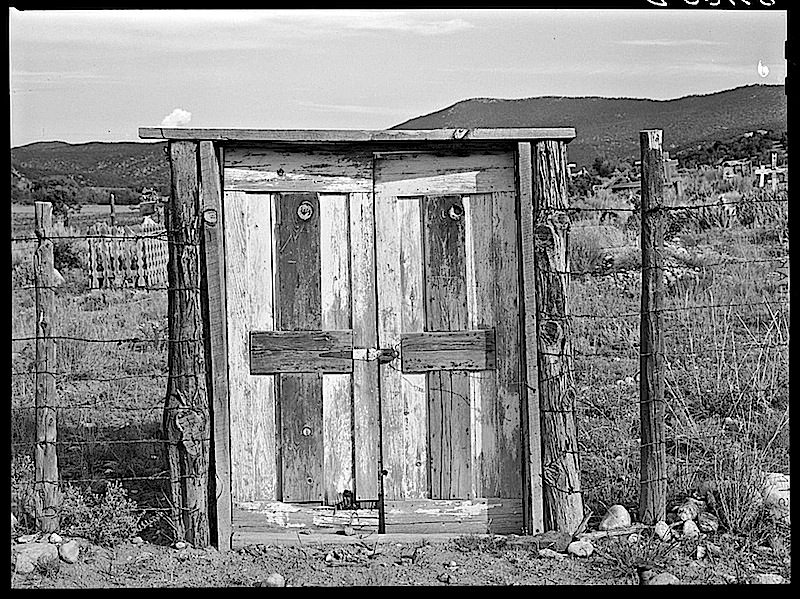
Vintage landscape: Penasco gate

Cemetary gate, New Mexico, Library of Congress“Entrance to the cemetery at Peñasco, New Mexico (along the High Road to Taos), July 1940, by Russell Lee, via Library of Congress Prints and Photographs Division.

Lee and his wife, Jean, spent two weeks in Chamisal and Peñasco documenting the lives of the towns’ Hispanic small farmers and ranchers. The area was settled by Spanish colonists in the late 18th century.

Hark, hark! the lark at heaven’s gate sings…

— William Shakespeare, from Cymbeline

Bloom Day in December

This slideshow requires JavaScript.

I have done relatively little work in the garden since October, when we returned from our home leave in the U.S. — so finding these bird of paradise or Strelitzia reginae blooms this morning was a nice surprise.

I will keep this post quite short because our internet speed has taken a nosedive today (descending to brink-of-tears level), and I just need to get on and off and go decorate the tree.

This is my last Garden Bloggers’ Bloom Day report from Rwanda.  Next month, we are moving to Stuttgart, Germany. We are very excited about living in Europe for the first time. Please stay tuned. . . . and send me recommendations of German gardens to visit.

To see what’s blooming today for other garden bloggers, visit Carol at May Dreams Gardens.

And have a wonderful holiday season!

The Sunday porch: the Berry’s

The Berry house“Berry’s house,” between 1910 and 1925,* probably near Selma, California, by National Photo Company, via Library of Congress Prints and Photographs Division (all photos here).

I think this is the farm that Ethel and Clarence Berry bought near her parents’ home in Selma after they became millionaires in the Klondike gold rush.

Ethel was one of the first women miners to go to Alaska, leaving right after her wedding in 1896. The next spring, the couple struck it amazingly rich on the Eldorado and Bonanza Creeks.

When she arrived in Seattle that summer — headed to the bank alone with $100,000 in gold that she’d kept hidden in her bedroll — she was immediately embraced by the popular press as the “Bride of the Klondike.”

The Berrys invested their money in more Alaskan mines (and in oil) and stayed rich.  They moved between the farm in Selma and a home in Alaska until Clarence’s death in 1930. Ethel then moved to Beverly Hills.  She died there in 1948.


*I suspect the photos were taken closer to the earlier year given, judging from the photo of Ethel and her sister (after ‘Continue reading’). Ethel would have been 37 years old in 1910.

Continue reading “The Sunday porch: the Berry’s”