Vintage landscape: Edo blossoms

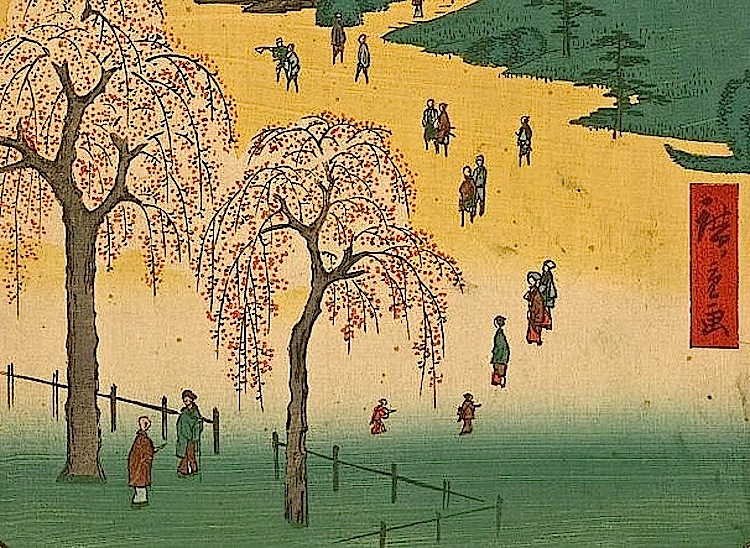
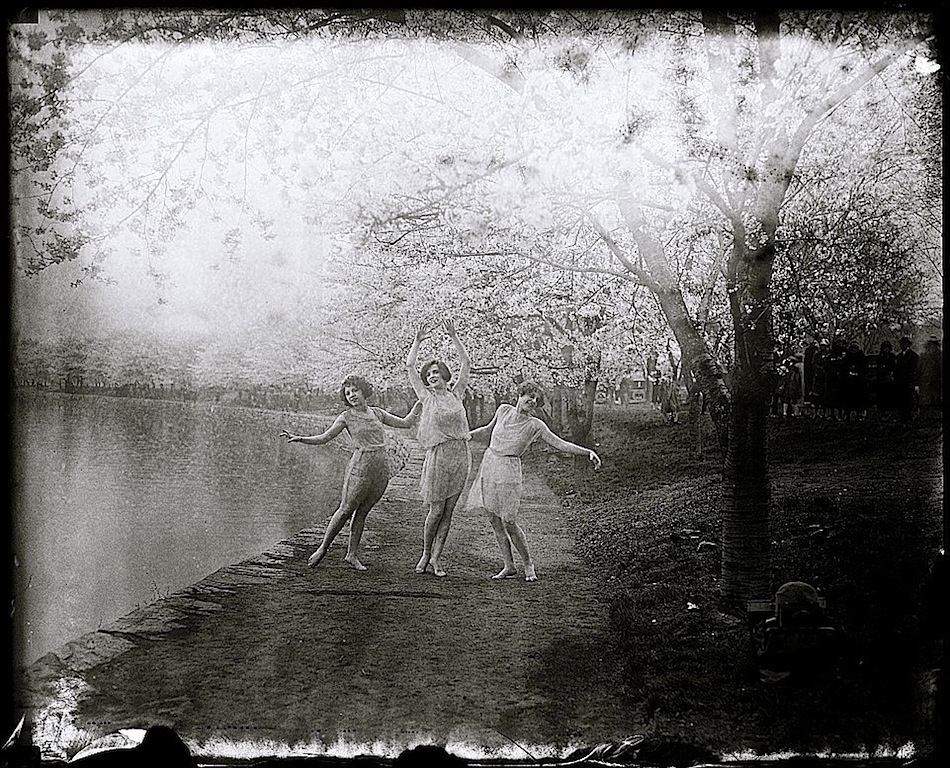
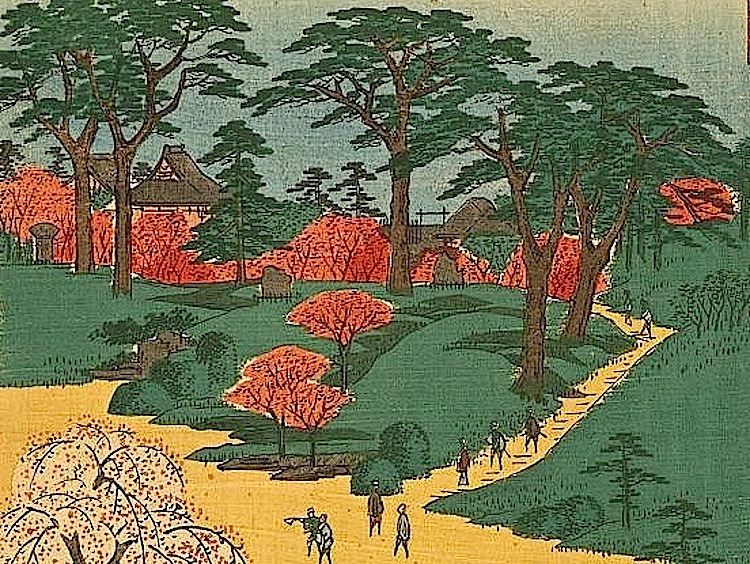
Cherry blossoms in Japan, Library of Congress“Higurashi no sato jiin no rinsen” (Temple Gardens, Nippori), 1857, a woodblock print by Andō Hiroshige, via Library of Congress Prints and Photographs Division.

The view is from Ueno Hill of Shūsō-in, one of three Buddhist temple gardens known as Hanamidera or Flower-viewing Temples. This print is one of fifty in an album of Edo (present day Tokyo) by Hiroshige.

Detail of print above.

There’s a nice essay on cherishing the brief beauty of the cherry blossoms by Diane Durston in today’s Washington Posthere.

Detail of print above.
The cherry trees in our neighborhood here in Stuttgart have just begun to bloom this week.

Life in gardens: colored eggs

chicken fed food color, Library of Congress“Possible now to color yolks of eggs “red, white and blue” by feeding hens different feeds,” April 7, 1939, by Harris & Ewing, via Library of Congress Prints and Photographs Division.

Washington, D.C., April 7. . . . Charles A. Denton, Junior Chemist, poultry nutrition laboratory of the National Agriculture Research Center, Beltsville, Maryland, feeding a hen a certain food to produce a definite colored yolk.

— from the original Harris & Ewing caption

Blue eggs and ham?

More photos of the Department of Agriculture in action in the 1930s here and here.

. . . Yesterday the egg so fresh
it felt hot in his hand and he pressed it
to his ear. . . .
riveted to the secret of birds
caught up inside his fist. . . .

— Naomi Shihab Nye, from “Boy and Egg

The Sunday porch: French Legation

This slideshow requires JavaScript.

The front porch of the French Legation to the Republic of Texas, Austin, Texas, 1934, by Louis C. Page, Jr., via Historic American Building Survey (HABS), Library of Congress Prints and Photographs Division.

This house — now the French Legation Museum — is the oldest extant building in Austin.  It was constructed between 1839 and 1841 for Monsieur Jean Pierre Isidore Alphonse Dubois, a secretary at the French Legation in Washington, D.C., who was sent to Texas to investigate the benefits of establishing relations with the new Republic of Texas.

On Dubois’s advice, Texas was soon recognized as a sovereign nation by France and he himself was appointed as the King’s chargé d’affaires.  Unfortunately — and probably before he could ever occupy his house — he became involved in a number of political, financial, and personal controversies, culminating in the so-called “Pig War.” When the Republic’s capital moved to Houston in 1841, Dubois left for New Orleans, only occasionally returning to Texas.

The style of the house is a blend of vernacular Greek revival and Mississippi Valley French. It may have been designed by carpenter Thomas William Ward, who had previously worked in Louisiana.

At the time of the 1934 photos above, the house was owned and occupied by Miss Lillie Robertson, whose father had purchased it in 1848.  After Lillie’s death, the property was sold to the State of Texas in 1945.  It was then put into the custody of the Daughters of the Republic of Texas.  They restored it and opened it to the public in 1956.

This slideshow requires JavaScript.

The same views in 1961, by Jack E. Boucher, also via HABS, Library of Congress.

By 1961, the Legation house was surrounded by a formal arrangement of boxwood hedges — perhaps having taken a lesson from  M. Dubois, the son of a tax collector,  who styled himself Count de Saligny after he arrived in Texas.

Today, the museum looks much the same.  Its surrounding park is 2 1/2 acres and is open to the public. Its wide gravel paths are sometimes used for games of pétanque. From the front porch, visitors can see the Texas Capitol Building and downtown Austin.

Life in gardens: spring dance

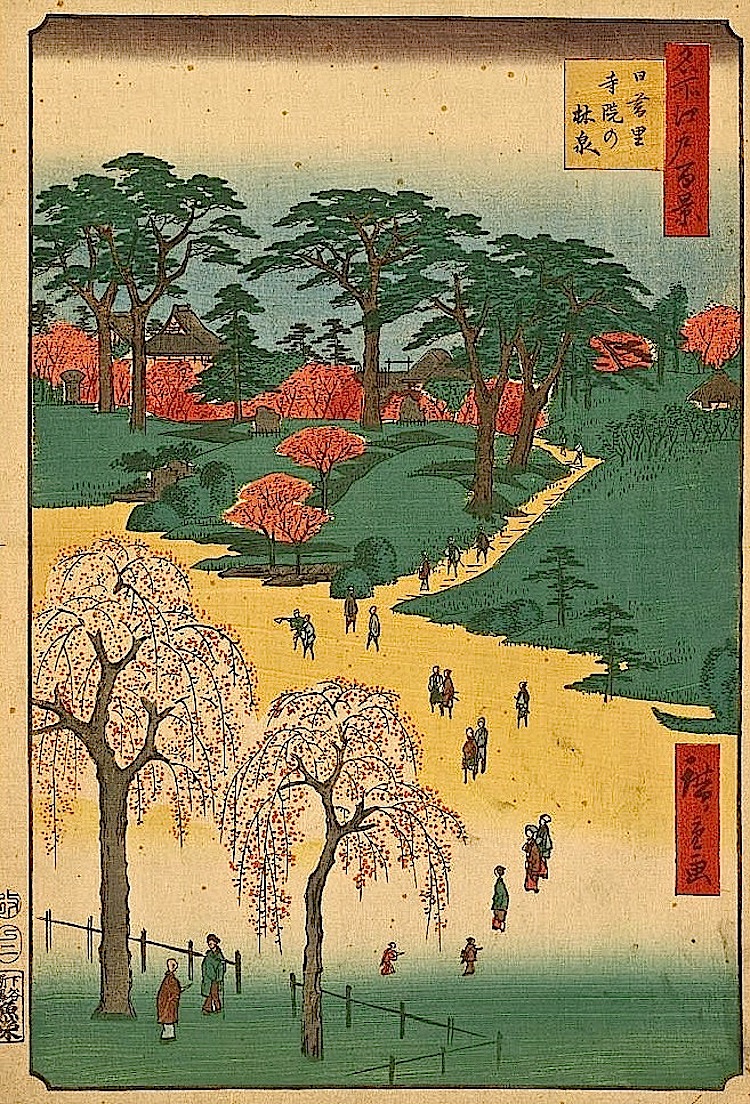
Rites of Spring, 1927, Wash.DC, Library of CongressDancers and cherry blossoms, [Tidal Basin,] Washington, D.C.,” between 1923 and 1929, by Harris & Ewing, via Library of Congress Prints and Photographs Division.
The National Cherry Blossom Festival in Washington, D.C., began on March 20 and continues until April 12. This year, the National Park Service is predicting that peak bloom will occur between April 11 and 14.

The first Tidal Basin Yoshino cherry trees — a gift from the city of Tokyo — were planted in 1912. The first organized celebration of them was held in 1927, when D.C. schoolchildren reenacted the planting.  The first Cherry Blossom Festival, which became the annual event, took place in 1935.

Castle garden in Meersburg

This slideshow requires JavaScript.

Castle garden, Meersburg, March 29, 2015.

I’m sorry that I had no porch for you on Sunday; we spent a long weekend in the town of Meersburg on Lake Constance, about an hour and a half south of Stuttgart.

Aside from its lakefront location (and a beautiful view of the Swiss Alps across the water), the town’s principal feature is the medieval Alte (old) Burg — Germany’s oldest inhabited castle.*

Its sweet little garden, tucked along a high wall, seems to reflect the presence of the castle’s most distinguished resident, the romantic poet Annette von Droste-Hülshoff. She frequently stayed there in the 1840s, when her brother-in-law owned it.

Her pretty rooms with their floral wallpapers have been carefully preserved — she died there in 1848.

You can see the position of the garden along the castle walls in this Wikipedia photo.


*Sections date as early as the 7th century.