A Sunday in the streets of Brussels

On the first day of our recent travels, we were lucky enough to arrive in Brussels on its annual “Car Free Sunday.” The streets of the city were closed to “all traffic with an engine”* from 9:00 a.m. to 7:00 p.m.

The streets were full of happy bikers, skaters, skateboarders, and walkers — in about that order. In addition, stands devoted to regional food and drink, organic farming, and ecology were set up from the Grand’Place to the Royal Palace and Brussels Park.

This slideshow requires JavaScript.

I like this garden (above slides) at the Mont des Arts. Like so many outdoor spaces in Brussels, its design successfully encompasses many centuries.

Under the rows of pleached trees, there were booths selling food and wine from France, so, bien sur, we had fois gras sandwiches for lunch.

This slideshow requires JavaScript.

A little farther east, on the street between the Royal Palace (above slides) and Brussels Park, sod had been put down over the stone block paving, and people were picnicking on every kind of organic cuisine.

I also really like Brussels Park (below slides).  It has very formal wide gravel walkways laid out in the shape of the Free Masonry symbol of an architect’s compass. Two rows of espaliered trees surround its perimeter.  But inside, there are forest-style groupings of very tall trees, long berms planted in a natural way with a variety of shrubs, and some well-used grass.

This slideshow requires JavaScript.

In the afternoon, we went back to our hotel for a rest and found that the street under our window had been blocked off for children’s activities. A local radio station had set up a stage, and, for the length of our planned nap, it featured a teenage punk rock band. I must admit they sang and played (what seemed like) their one song over and over again with some proficiency (I guess).

We ended our lovely day of walking in the neighborhood of Dansaert, along Rue de Flandre (or Vlaamsesteenweg), where the shops and residents were having a street-long yard sale/block party. At no. 17, we ate traditional Belgian food at the restaurant Viva M’Boma** (long live grandmother), which we highly recommend — as long as you eat meat.

To scroll through larger versions of all the photos above, click on ‘Continue reading’ below.


*Except for buses, taxis, some delivery vans, police, and ambulance.  The event is always in September, to coincide with the  European Week of Mobility.  I found one webpage indicating that it will be on September 16 in 2014.

**But they are normally closed on Sundays — and Wednesdays.  Main courses are between 11€ and 18€.


The Sunday porch: Mount Morne

Reed-Morrison Hse, Mt. Mourne, in North Carolina, 1938, via Library of Congress.Reed [or Reid] Morrison House, Mount Mourne, North Carolina, 1938, by Frances Benjamin Johnston, via Carnegie Survey of the South Collection, Library of Congress.

Click on the photo to enlarge it and check out the pretty little sconces on each side of the front door.

The house exists today as a private residence — in seemingly excellent condition, but, alas, the sconces and vines are gone.

The Sunday porch: Washington, D.C.

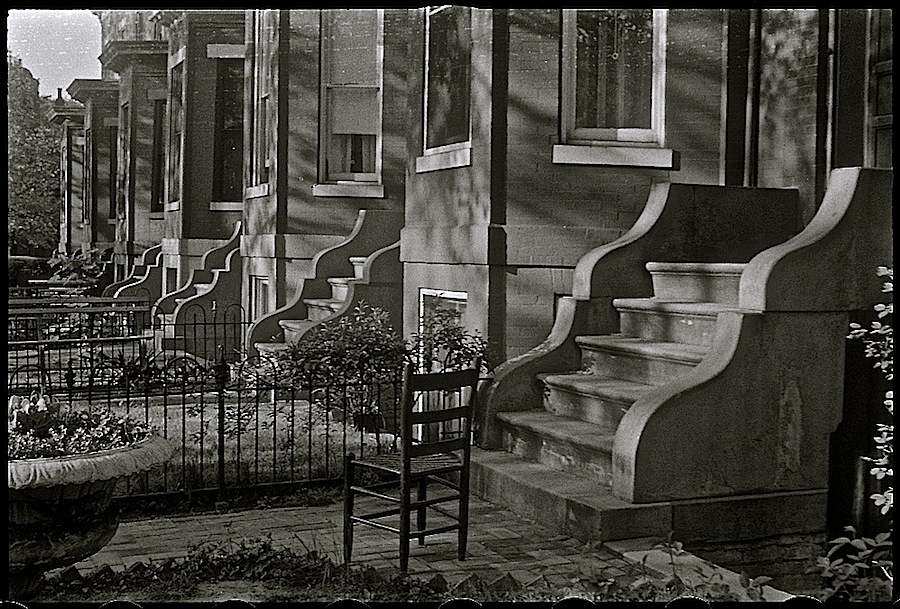
Wash. D.C., rowhouses, via Library of CongressSeven Washington, D.C., rowhouses in 1939, by David Myers, via Library of Congress Prints and Photographs Division.

The neighborhood is not given, although it looks like Capitol Hill to me.

In his book, The American Porch, Michael Dolan attempts to trace the European, African, and Asian origins of our many kinds of porches.  The front stoop — several steps and a small landing — came from the Dutch.

Down the coast [from New England], in Nieuw Amsterdam, a different entry was proliferating.  Made of stone or brick, the stoep — Dutch for “step” — was a roofless link between doorway and street.  Though municipal tradition required a building’s occupants to maintain the stoep, the Dutch deemed it public territory.  However, in Nieuw Amsterdam, the stoop acquired a private connotation:  “. . . before each door there was an elevation, to which you could ascend by some steps from the street,” an observer wrote.  “It resembled a small balcony, and had some benches on both sides on which the people sat in the evening, in order to enjoy the fresh air, and have the pleasure of viewing those who passed it.”

The stoops above lack benches, but the owner of the first one has brought down a chair, and two doors down there is a park bench in the tiny garden.  You can see a similar arrangement here.

I’m taking a break from blogging for a couple more weeks (except for “The Sunday porch”), but I’ll be back for GB Bloom Day in October.

The Sunday porch: Gee’s Bend

Gee's Bend, Alabama, Library of Congress

This porch and its wonderful chairs were in Gees Bend [Boykin], Alabama,  in 1939. The photo was taken by Marion Post Wolcott,* and she captioned it:

Jorena Pettway and her daughter making [a] chair cover out of bleached flour sacks and flower decorations from paper. She also made the chairs and practically all the furniture in the house.

Gee’s Bend is an African-American community located in a large bend of the Alabama River. It has become famous in the last decade for its remarkable quilts.

In 1816, Joseph Gee brought slaves to the area and started a cotton plantation, which was sold in 1845 to the Pettway family. After the Civil War, the farm’s freed slaves remained on the land as sharecroppers and many took the last name of Pettway.

In the winter of 1932-33, the community’s particular isolation — with a small ferry to the east and a bad road to the west — and its dire poverty came to the attention of the Red Cross, which sent a boatload of flour and meal.   It began receiving Resettlement Agency assistance in 1935, and the Agency purchased the plantation in 1937. By 1939, when the Farm Security Administration sent Wolcott to take photos, there had been a number of improvements, such as new homes (one is pictured above).

In 1962, when residents began trying to register to vote, the local government eliminated the ferry service, which connected Gee’s Bend to the county seat of Camden. Without it, people of the community had to drive more than an hour to reach the town. The ferry service remained closed until 2006.

In 2002, an exhibition of quilts made by the women of Gee’s Bend opened at the Museum of Fine Arts in Houston and then traveled to the Whitney Museum in New York City. Another show in Houston and at the Smithsonian Institution followed in 2006. The New York Times art critic, Michael Kimmelman, called the quilts on display “some of the most miraculous works of modern art America has produced.”

In August of the same year, the United States Postal Service released ten stamps picturing Gee’s Bend quilts sewn between 1940 and 2001.

The U.S. Embassy in Rwanda has three Gee’s Bend quilts by Mary Lee Bendolph and Loretta Bennett in its permanent art collection.


*Via Library of Congress Prints and Photographs Division.

Vintage landscape: California living

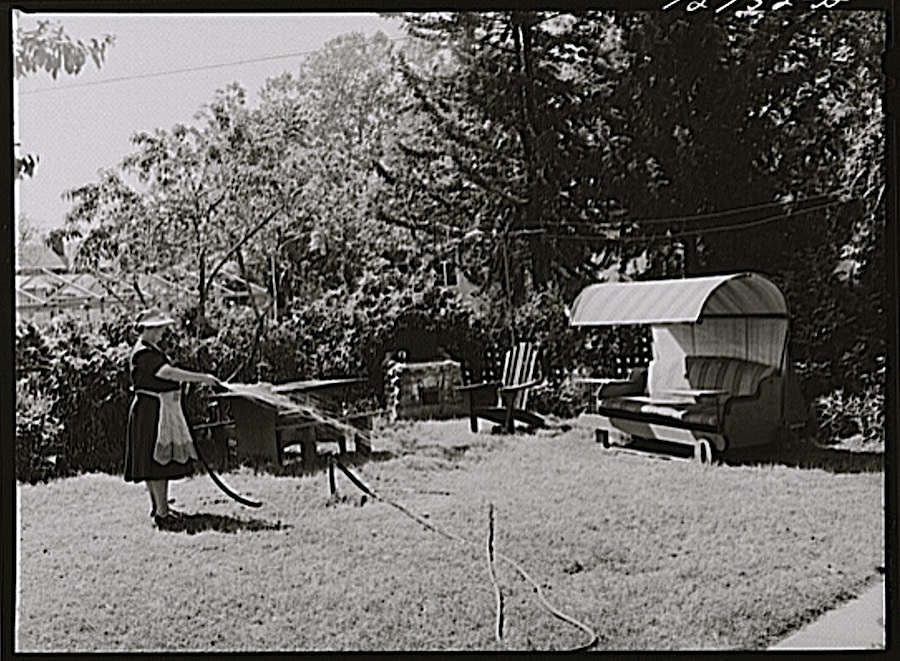
Back yard, Turlock, CA, 1943, by Russell Lee, Library of Congress

I just like this life-in-the-garden photo by Russell Lee, * of a (May) 1942 Turlock, California, backyard.  (Unfortunately, it’s not very sharply focused.)  The caption, possibly by the photographer, reads:

Housewife waters the lawn. All garden furniture and barbecue pit were made by her husband; about one out of every three houses in this town has such an arrangement in the backyard, and during the summer months people eat and spend many hours in their yards.

I particularly like the rolling sofa thing with the awning.  Turlock is located in central California between Modesto and Merced.

Lee was working for the Farm Security Administration/Office of War Information at the time.  He seems to have been sent to Turlock to photograph townfolks being resilient in the face of changes brought on by the war.  He took a number of photographs of this family, described in the Library of Congress online catalogue as from the “upper middle income group.”

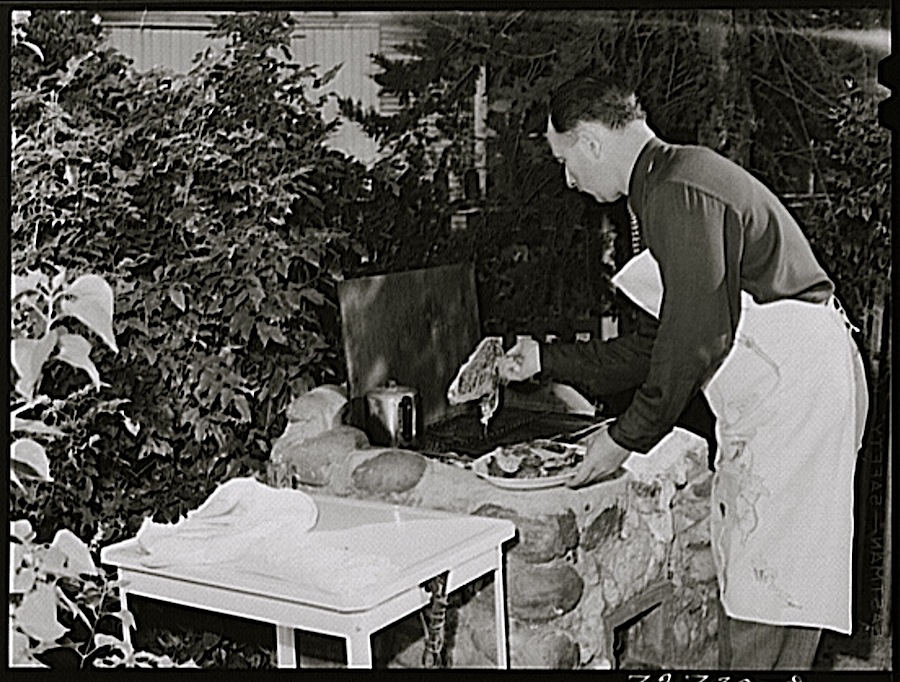
Grillling steaks, Turlock, CA, 1943, by Russell Lee, Library of CongressAbove: “Man of the house barbecues steaks over open grill in his backyard. This family keeps vegetables, fruits and meats in frozen food lockers in town.”

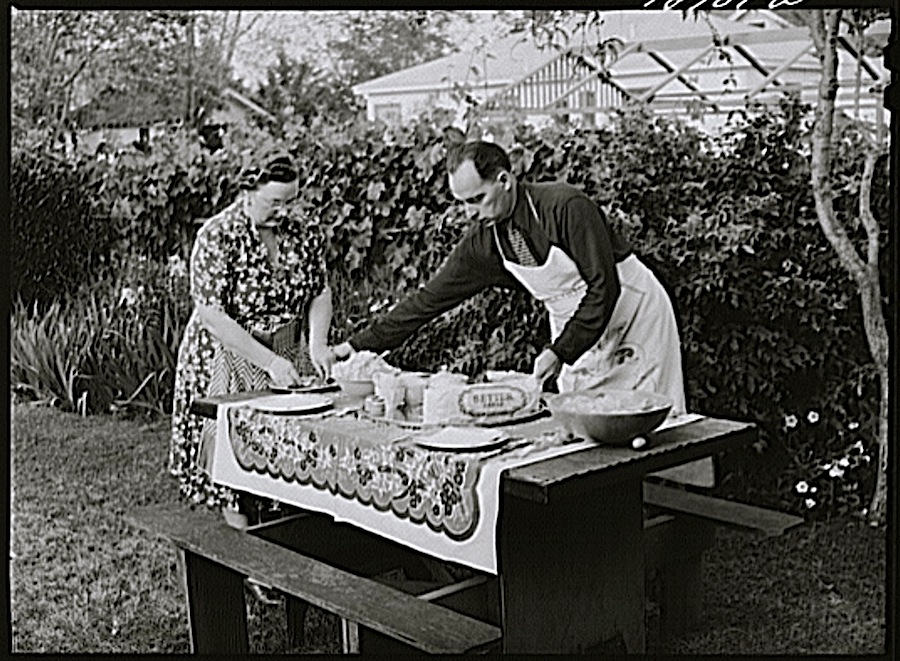
Setting the table, Turlock, CA, 1943, by Russell Lee, Library of CongressAbove: “Husband and wife get ready for dinner in their backyard. Menu: barbecued steaks, fresh peas, potato salad, potato chips, celery and olives, strawberry shortcake, and coffee.”

The package around the loaf of bread says, “Better Bread.”  Over the hedge, the neighbors seem to be putting in a greenhouse.

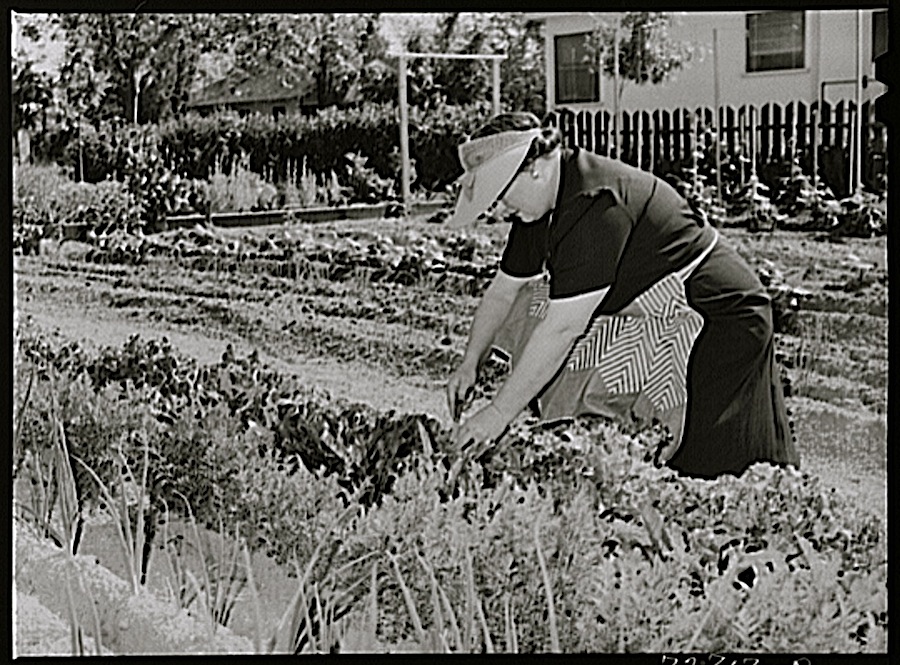
Tending the garden, Turlock, CA, 1943, by Russell Lee, Library of CongressAbove: “Housewife works in her vegetable garden. She lives in small town where there is ample space for gardens; says she would move to country if she couldn’t have a garden in town.”

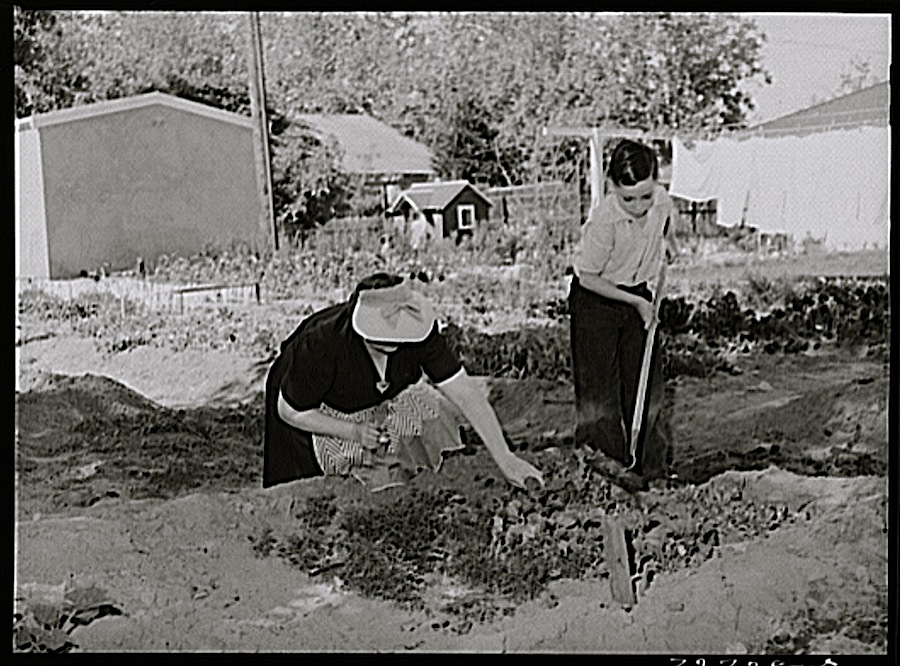
It’s quite impressive — and particularly that she works it in a dress.  Here’s another view, below:

Son's garden, Turlock, CA, 1943, by Russell Lee, Library of CongressAbove: “Housewife helps her son with his garden.”

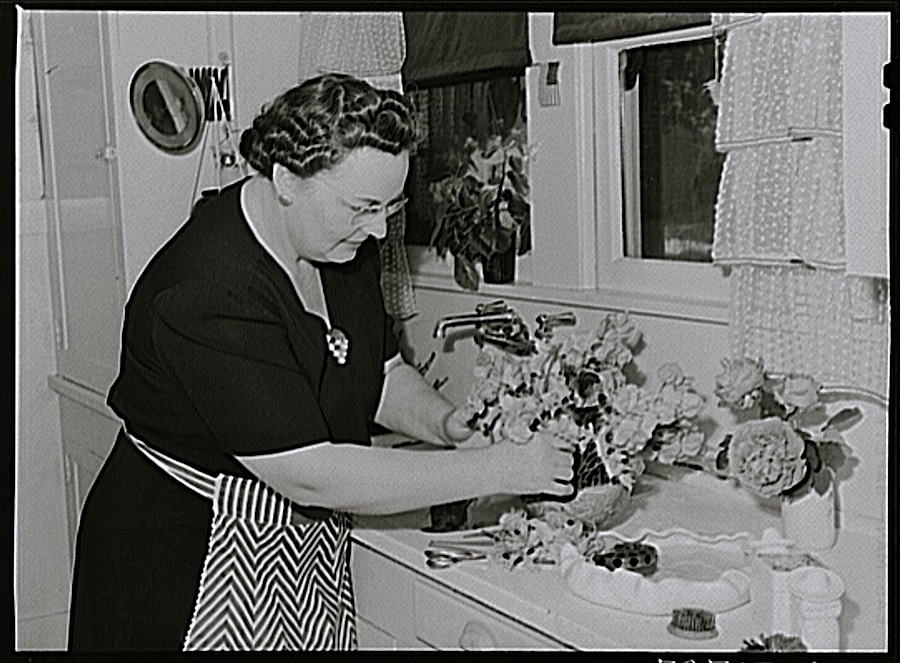
Arranging flowers, Turlock, CA, 1942, by Russell Lee, Library of CongressAbove: “Housewife arranging flowers in her kitchen.”

I like her dotted swiss curtains.

I’m going to take a break from blogging for a few weeks (except for “The Sunday porch”), but I’ll be back for GB Bloom Day in October.


* All photos here via Library of Congress Prints and Photographs Division.