Vintage landscape: yellow plums

This slideshow requires JavaScript.

Yellow plums inside the conservatory at Blizhniaia dacha, Kyshtym, Russia, by Sergeĭ Mikhaĭlovich Prokudin-Gorskiĭ, 1910, via Library of Congress Prints and Photographs Division.

Prokudin-Gorskiĭ made early color photographic surveys of the Russian Empire between 1905 and 1915.

The Sunday porch: geraniums

More properly called by their genus name, Pelargonium.

Porch, Chamisal, New Mexico, Library of CongressAn enclosed front porch in Chamisal, New Mexico, July 1940, by Russell Lee, via Library of Congress Prints and Photographs Division.

Lee and his wife, Jean, spent two weeks in Chamisal and Peñasco documenting the lives of the towns’ Hispanic small farmers and ranchers. Both communities are located along the High Road to Taos, which begins in Santa Fe and crosses the high desert and forest of the Sangre de Cristo Mountains.

The area was the setting for the 1974 book  The Milagro Beanfield War  as well as the filming location for the 1988 movie of the same name.  Milagro was the first of a trilogy of novels by John Nichols about north central New Mexico.  The second and third books were set in the fictional town of Chamisaville.

Vintage landscape: Barclay Street

Barclay St. Station, late 1800s, New York City, via Library of Congress“Cut Christmas trees [at the] market in front of Barclay Street Station, New York, N.Y.,” between 1885 and 1895, by Detroit Publishing Company, via Library of Congress Prints and Photographs Division.

The station was part of the IRT Ninth Avenue elevated railway line and was located at Barclay and Greenwich Streets, north of  today’s Six World Trade Center.  It closed with the rest of the line in 1940.

O
fury-
bedecked!
O glitter-torn!
Let the wild wind erect
bonbonbonanzas; junipers affect
frostyfreeze turbans; iciclestuff adorn. . .

George Starbuck, from “Sonnet in the Shape of a Potted Christmas tree

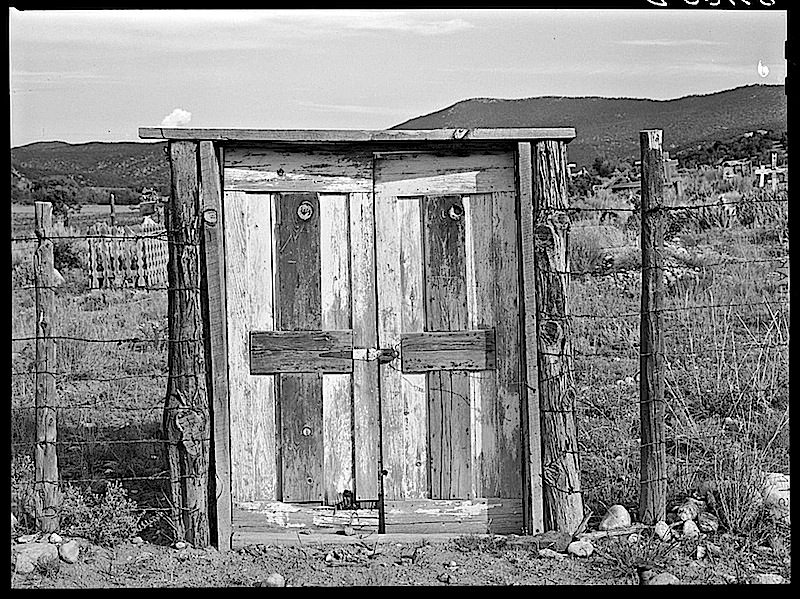
Vintage landscape: Penasco gate

Cemetary gate, New Mexico, Library of Congress“Entrance to the cemetery at Peñasco, New Mexico (along the High Road to Taos), July 1940, by Russell Lee, via Library of Congress Prints and Photographs Division.

Lee and his wife, Jean, spent two weeks in Chamisal and Peñasco documenting the lives of the towns’ Hispanic small farmers and ranchers. The area was settled by Spanish colonists in the late 18th century.

Hark, hark! the lark at heaven’s gate sings…

— William Shakespeare, from Cymbeline

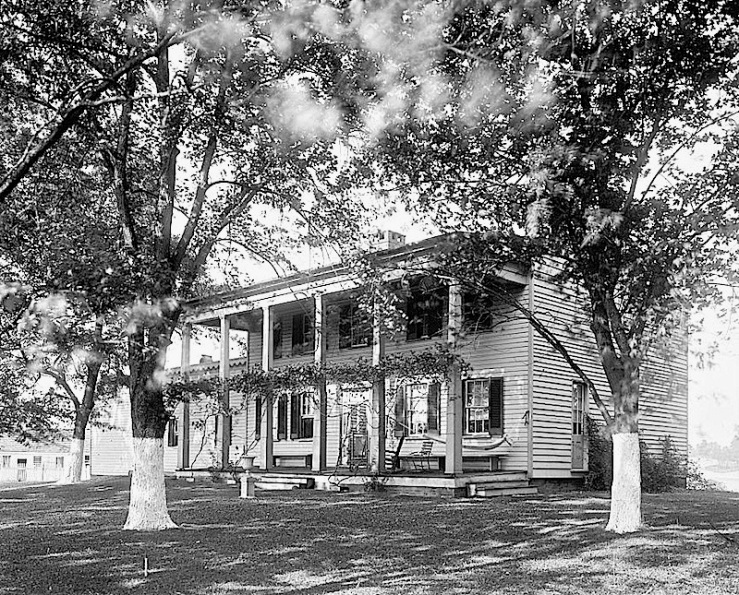
The Sunday porch: the Berry’s

The Berry house“Berry’s house,” between 1910 and 1925,* probably near Selma, California, by National Photo Company, via Library of Congress Prints and Photographs Division (all photos here).

I think this is the farm that Ethel and Clarence Berry bought near her parents’ home in Selma after they became millionaires in the Klondike gold rush.

Ethel was one of the first women miners to go to Alaska, leaving right after her wedding in 1896. The next spring, the couple struck it amazingly rich on the Eldorado and Bonanza Creeks.

When she arrived in Seattle that summer — headed to the bank alone with $100,000 in gold that she’d kept hidden in her bedroll — she was immediately embraced by the popular press as the “Bride of the Klondike.”

The Berrys invested their money in more Alaskan mines (and in oil) and stayed rich.  They moved between the farm in Selma and a home in Alaska until Clarence’s death in 1930. Ethel then moved to Beverly Hills.  She died there in 1948.


*I suspect the photos were taken closer to the earlier year given, judging from the photo of Ethel and her sister (after ‘Continue reading’). Ethel would have been 37 years old in 1910.

Continue reading “The Sunday porch: the Berry’s”