“Kindergarten in a vegetable garden,” Washington, D.C., ca. 1899, by Frances Benjamin Johnston, via Library of Congress Prints and Photographs Division.
Before she became immersed in the work of photographing old houses and gardens, Johnston was a photojournalist and a portraitist. In 1899, she became interested in progressive education and made a photo survey of students at public schools in Washington, D.C.
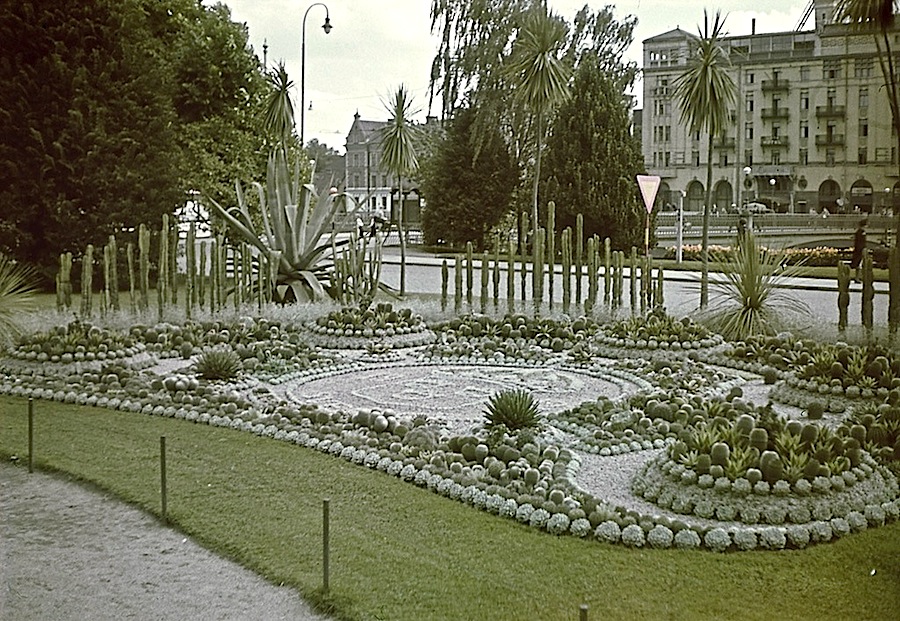
Kaktusplanteringen (cactus planting) in Karl Johan Park in Norrköping, Sweden, 1942, a color slide by Fredrik Bruno, via Swedish National Heritage Board Commons on flickr.
Since 1926, there has been an annual cactus display in the park, with a different theme every year. In the photo above, the motif was the smaller version of Sweden’s national coat of arms.
Garden at Enniscorthy, the Cole-Morrill house, Albemarle County, Virginia, 1932, by Frances Benjamin Johnston, via Library of Congress Prints and Photographs Division.
The 1850 house still exists, and its 500 acres have been placed in a conservation easement. An earlier home on the plantation sheltered Thomas Jefferson’s family when the British raided Monticello in 1780.
I could not find out when this simple house* was built or if it still exists. It is somewhat similar to this house in the same area, which Johnston’s notes say was built between 1776 and 1850.
Michaux was one of eleven plantations in southern Virginia owned by the Hairston family, one of the largest slaveholders in the South. Its name probably indicates that the land was also once owned by a member (this one?) of the local branch of the Michaux family.
This is the kingdom that you find
When the brave eye-holes stare
impartially against the air. . .
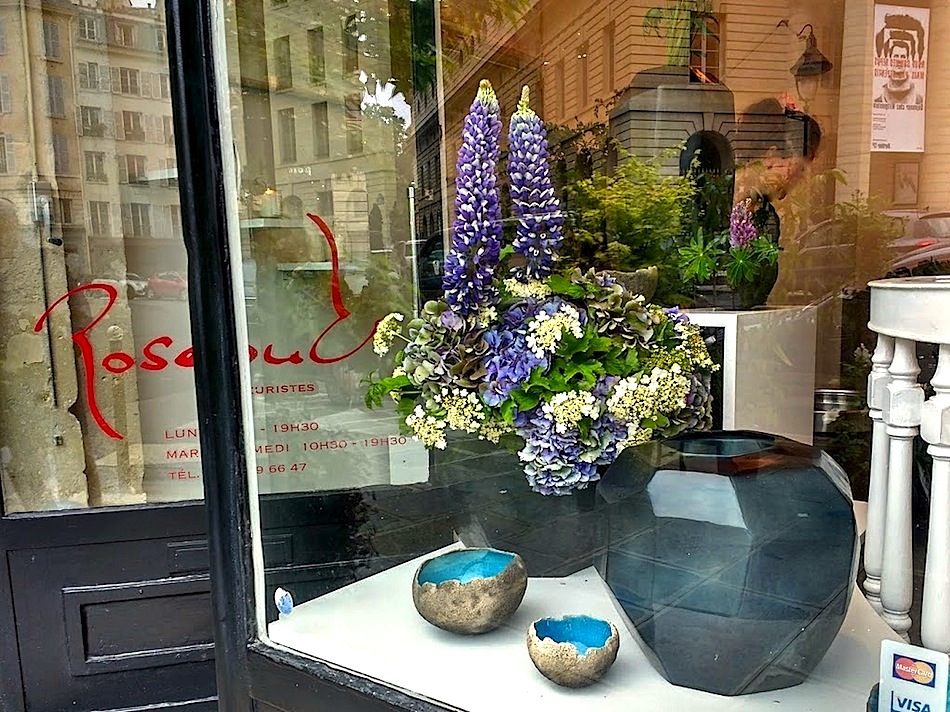
Passing by the windows of Rosebud Fleuristes, 4, Place de l’Odéon, Paris. In the vase are lupin, viburnum, and hydrangea flowers.
We spent the long holiday weekend in Paris, just getting back this afternoon — so I don’t have a flower arrangement of my own today. But I can offer a few pictures of the windows of two florists in the area north of the Luxembourg Garden: Rosebud and Stanislaus Draber.
Foxtail lilies and viburnum flowers at Rosebud, which was mentioned in the Paris-Match article as having been created with “a concept of florist-art gallery” (à l’origine d’un concept de fleuriste-galerie d’art).
On the train to France, I read an article in Paris-Match magazine, “La Fleur Fait Sa Révolution!”
“The flower has become a symbol of an urban renaissance, creative and super-cool,” it said. “One talks flowers with the same appetite that characterizes the foodistas for cooking. The opening of peonies, the Japanese [pruning] knife, and the art of the bouquet are now at the heart of urban conversations.” The trend is “embodied by the explosion of the neo-artisans who are also called the ‘makers’ (les «makers»).”
The article also mentions that the flower-market gardens around Paris “have almost disappeared in favor of the industrialized Dutch market. If nothing is done within ten years, there will be no bouquets of real scented garden roses for the high fashion Parisian florists.”
Peonies, roses, and sweet peas in the window of Stanislas Draber, 19, rue Racine, Paris.
To see what other gardeners/bloggers/makers have put in vases today, please visit Cathy at Rambling in the Garden.
ADDENDUM: There’s an interesting video clip by Rick Steves of a giant Dutch commercial flower auction here.

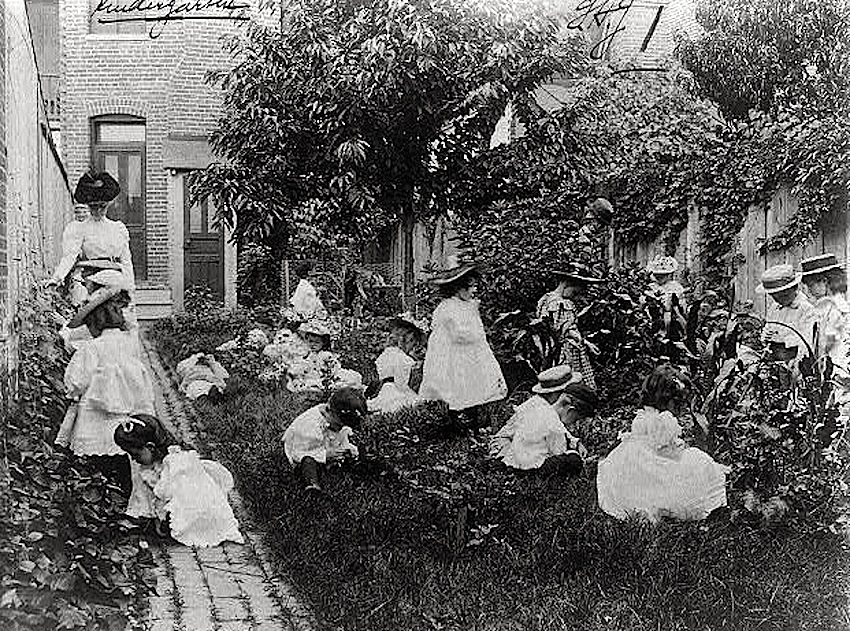 “Kindergarten in a vegetable garden,” Washington, D.C., ca. 1899, by Frances Benjamin Johnston, via Library of Congress Prints and Photographs Division.