
 “Memie” (Mary Elizabeth Edwards) and her first post office in Lloyd, Florida, ca. 1910, via State Library and Archives of Florida (Florida Memory) Commons on flickr.
Shades of Eudora Welty. . . here’s her famous story.
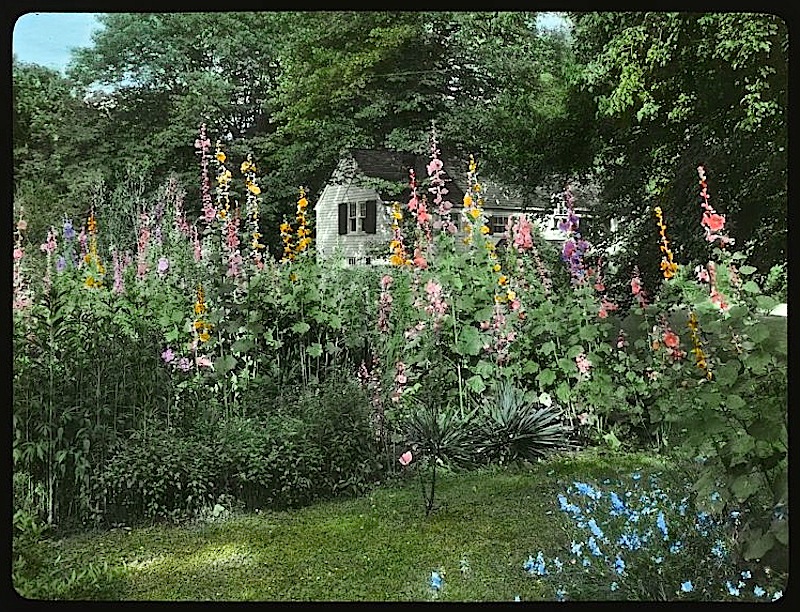 Mary Ball Washington house, Fredericksburg, Virginia, 1927, a hand-colored glass lantern slide by Frances Benjamin Johnston, via Library of Congress Prints and Photographs Division.
The house was the last home of George Washington’s mother. It still exists and is open to the public. The garden was restored in 1968 to reflect how it might have looked between 1772 and 1789.
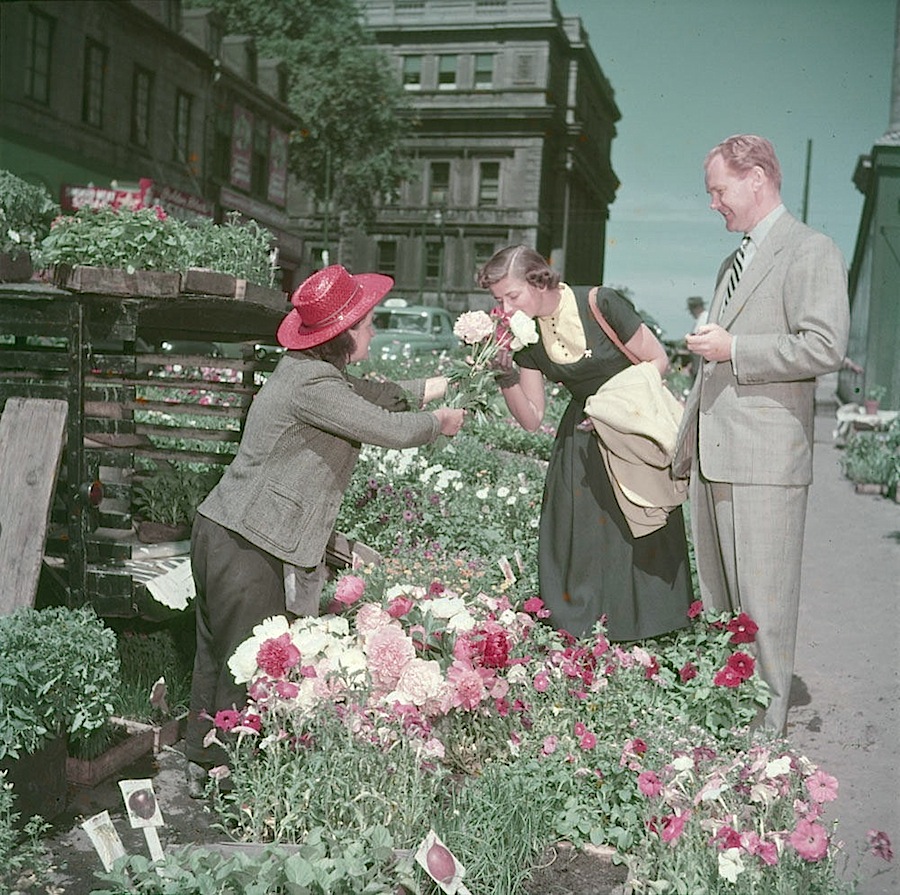
Une femme sent des fleurs à vendre au Marché Bonsecours, à Montréal (A woman smelling some flowers offered by a vendor at the Bonsecours market in Montreal,” June 1950, by Chris Lund, via Library and Archives Canada on flickr (under CC license).
 “Waiters at Day and Brothers Ice Cream Saloon,” 1880, Ocean Grove, New Jersey, by William H. Stauffer, via Robert Dennis Collection of Stereoscopic Views, The New York Public Library.

The image is not very clear, but it looks like a fun place. The same company still exists at the location shown above as Day’s Ice Cream. It is Ocean Grove‘s oldest continuously operating business.
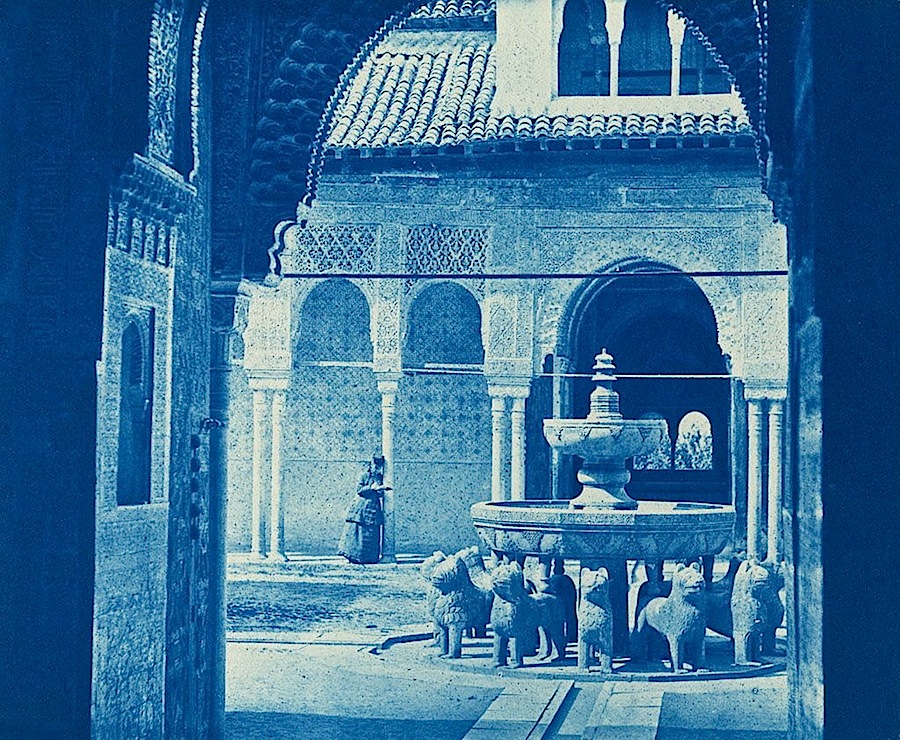 The Alhambra, Granada, Spain, 1878, by Carl Curman, via Swedish National Heritage Board Commons on flickr.
The cyanotype shows the photographer’s wife, Calla, either sketching or reading during a visit to the Court of the Lions. She was 28 at the time and just married to Curman. This may have been their honeymoon trip.
The Alhambra fortress/palace was built primarily in the 13th and 14th centuries by the Muslim Nasrid dynasty of southern Spain. After the Christian Conquest in 1492, it became the royal residence of Ferdinand and Isabella and, later, their grandson, Charles V. However, by the 18th century the site was derelict and largely abandoned.
In 1829, the American writer Washington Irving stayed in the Alhambra for three months and then turned his impressions into the romantic Tales of the Alhambra.
“The peculiar charm of this old dreamy palace,” he wrote, “is its power of calling up vague reveries and picturings of the past, and thus clothing naked realities with the illusions of the memory and the imagination.”
The book was popular, “the exotic was in vogue,” and cultured travelers — Calla was the daughter of a wealthy industrialist — began to visit the ruins in increasing numbers. Restoration work — often controversial — soon followed. Today, the old complex is a UNESCO World Heritage site.
About 30 years after Carl and Calla’s trip, their son also visited the Court of the Lions and took the picture below.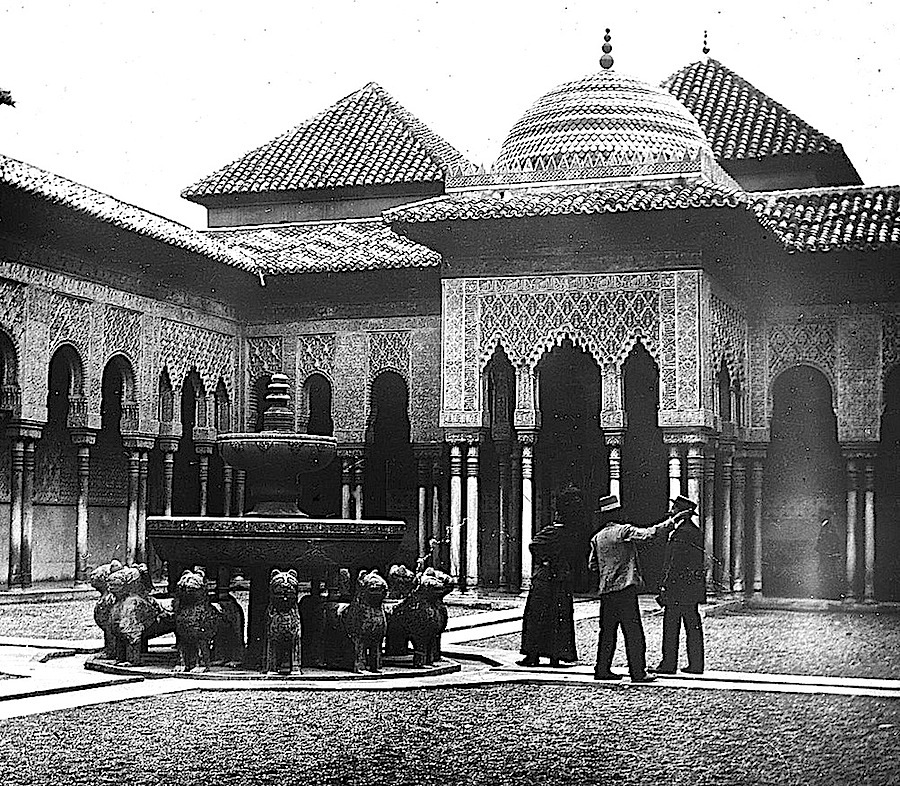 Group of tourists in the Court of the Lions, ca. 1910, by Sigurd Curman, via Tekniska museet (Stockholm) Commons on flickr.
In the 14th century, the area around the fountain was a little lower than the walkways and planted in flowers, giving a tapestry or carpet effect. Today, as in the photo above, the space is entirely covered in dry pebbles to preserve the building’s foundation.
I am the garden appearing every morning with adorned beauty; contemplate my beauty and you will be penetrated with understanding.
— Ibn Zamrak, from a poem on the wall of the Hall of the Two Sisters in the Alhambra.

