Clement’s Inn, London

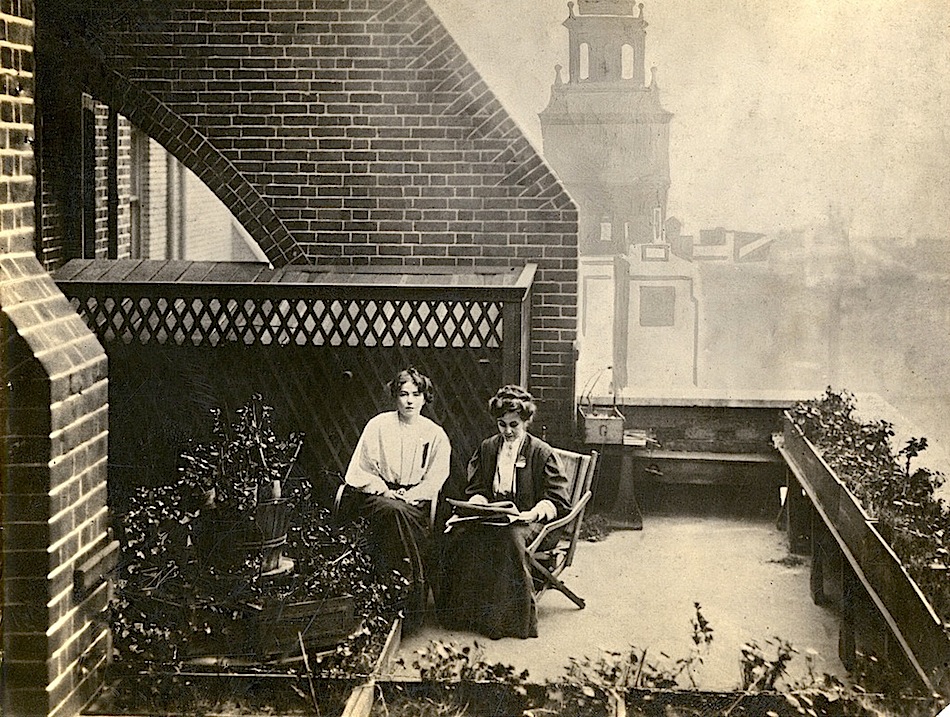
pankhursts-on-roof-garden1908-lse-libraryChristabel and Emmeline Pankhurst on the roof at Clement’s Inn, London, October 1908, via LSE (London School of Economics) Library Commons on flickr. A note on the back of the photo says that they were hiding* from the police.

At the time of the photo, numbers 3 and 4 Clement’s Inn† housed the offices of the Women’s Social and Political Union (WSPU), which Emmeline had founded in 1903. The organization was an all-female group campaigning for women’s suffrage and was known for its physical confrontations with police, hunger strikes, and arson. Christabel was Emmeline’s oldest daughter and eventually took over leadership of the group.  At the outbreak of WWI, both women called for a halt to WSPU militant activities in support of the war effort and became involved in the “white feather” movement, handing out the traditional symbol of cowardice to men in civilian clothes.

There’s an interesting history of the Pankhurst women (there were two more daughters, Sylvia and Adela) here.


* A warrant had been issued for their arrest.  After the photo was taken, they went down to the street and were arrested.

†Located about here. The Clement’s Inn buildings, built in the 1880s, were five to seven stories high and housed both offices and apartments.  They were all demolished by 1977. The photo above was taken from the roof garden of the apartment of another WSPU member.
A lady’s paradise


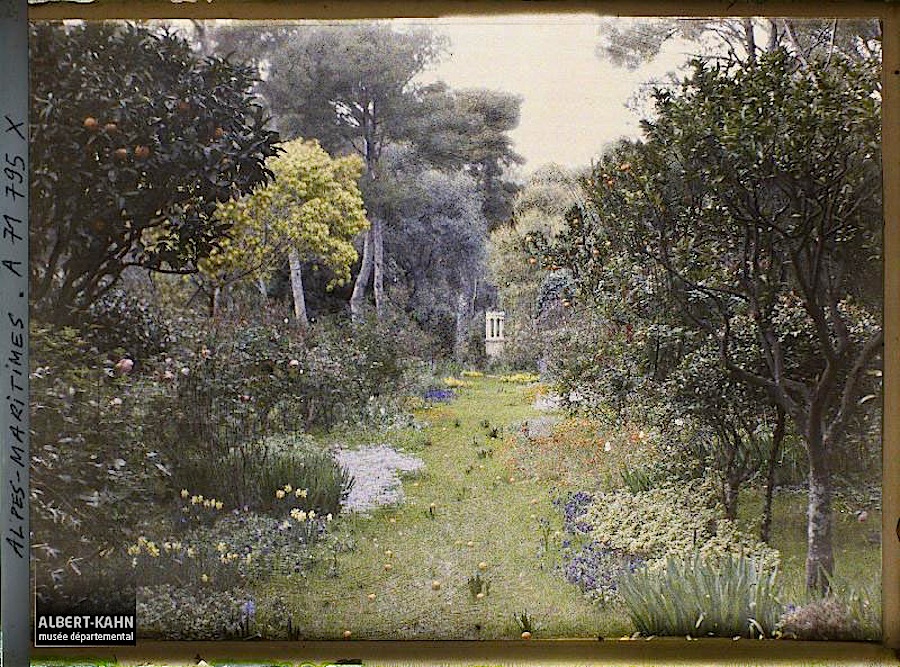
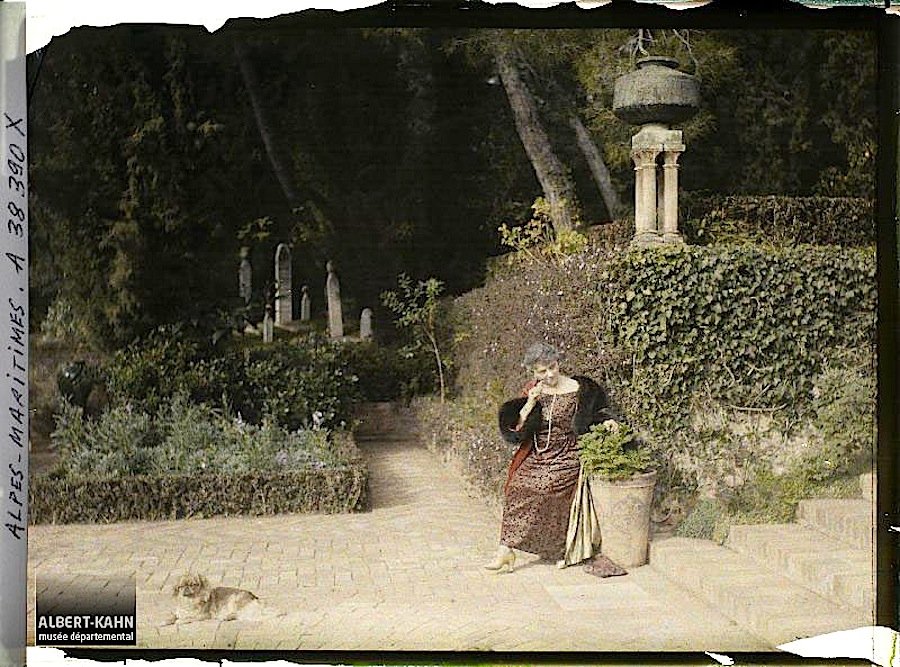
“The property of Madame Douine, Cap Martin, France,” January 1923, by Roger Dumas, via Archives of the Planet Collection – Albert Kahn Museum /Département des Hauts-de-Seine (both photos).

If you watched The Paradise (2013) on either BBC America or Masterpiece and wondered what happened to Denise after the series ended . . . well, perhaps it was this.

The series was based on Au Bonheur des Dames (The Ladies’ Paradise) by Émile Zola. It is novel about a saleswoman in one of the grand Paris department stores — Denise — who eventually marries the store’s owner. Her story mirrored the real life of Cyprienne Dubernet, a saleswoman at Grand Magazins du Louvre who married the owner, Olympe Hériot, in 1887.*

Cyprienne in her garden.

In 1909, Cyprienne — now widowed and re-married to Roger Douine — decided to build a villa in Cap Martin on the French Riviera. Her architect designed a Neo-Byzantine house inspired by her travels to Naples, Smyrna, Cairo, Jerusalem, and Constantinople. She named it “Villa Cypris” in tribute to the Greek goddess of love and her own name. Italian painter Raffael Mainella designed the interiors and the garden, which included a stone bridge along the seafront, a cloister, a “Venetian Sanctuary,” a Mauritanian pergola, and sunken Dutch-style parterres with a canal/swimming pool.

You can see more pictures of the estate here, on its website (it seems to be for sale). There’s a video here

The autochromes above are two of about seventy-two thousand that were commissioned and then archived by Albert Kahn, a wealthy French banker, between 1909 and 1931. Kahn sent thirteen photographers and filmmakers to fifty countries “to fix, once and for all, aspects, practices, and modes of human activity whose fatal disappearance is no longer ‘a matter of time.'”† The resulting collection is called Archives de la Planète and now resides in its own museum at Kahn’s old suburban estate at Boulogne-Billancourt, just west of Paris. Since June 2016, the archive has also been available for viewing online here (search “Madame Douine” to see more of Villa Cypris).


*It seems doubtful that Cyprienne (born just plain Anne Marie) was the direct inspiration for Denise, as the novel was published in 1883. She and Olympe had at least one (maybe two) of their four children before their marriage. Their oldest son, Auguste, was an inspiration for the main character of Colette’s novel Cheri. Cyprienne died in 1945.

words of Albert Kahn, 1912. Also, the above photos (A 71 795 and A 38 390 X) are © Collection Archives de la Planète – Musée Albert-Kahn and used under its terms, here.

The urn


“Castle, possibly in Italy,” ca. 1900, by Queen Victoria of Sweden, via Tekniska Museet (Sweden) Commons on flickr under CC license.

Click on the image to enlarge it.  There are three more enormous urns on the right and some very tall agave blooms/stalks to the left of the little gate just in front of the castle.

Victoria (or Viktoria) of Baden — Queen of Sweden after 1907 — was the daughter of the Grand Duke of Baden (south-west Germany). She married Crown Prince Gustaf in 1881, and they had three children, but it was not a happy marriage. From 1882, she spent almost every winter in Egypt and Italy, mostly in Capri. She was a good amateur photographer, as well as a painter and sculptor.

The flower seller, Ontario


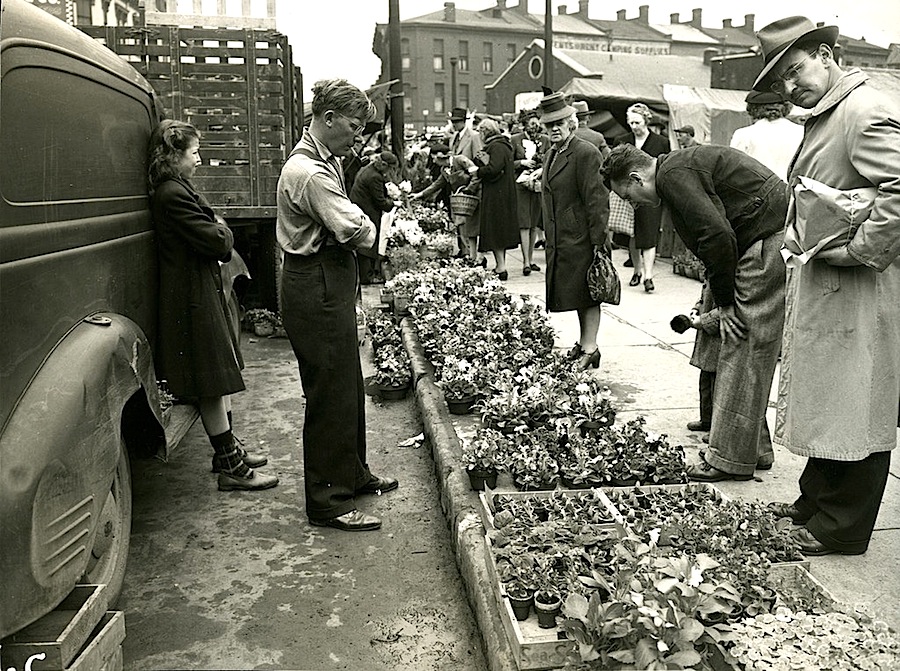
Plant seller at the Hamilton Farmers’ Market, 1946, by J. Morris, via  Local History & Archives Hamilton (Ontario) Public Library Commons on flickr.

There are more photos of the market here.

The Sunday porch: East Hampton, N.Y.

Home of E.E. McCall, East Hampton, New York, between ca. 1910 and ca. 1915, by Bain News Service, via Library of Congress Prints and Photographs Division.

The house was a split level. You can see the two-story side here.

Edward Everett McCall was a Justice of the Supreme Court of New York. He also ran unsuccessfully for mayor of New York City as the Tammany candidate. He died in 1924, and his seaside house burned down three years later.