The flower sellers, Paris

Flower sellers at Place Louis-Lépine on the l’île de la Cité, at Quai de la Corse, Paris, France, May 2, 1918, by Auguste Léon, via Archives of the Planet Collection – Albert Kahn Museum /Département des Hauts-de-Seine (both photos).

There has been a flower market on or near this spot since 1808. Since June 2014, it has been called Queen Elizabeth II Flower Market, to commemorate the visit of the British queen just prior to the 70th anniversary of D-Day.

Behind the sellers, on the other side of the river, is the Palmier Fountain and Châtelet Theater.
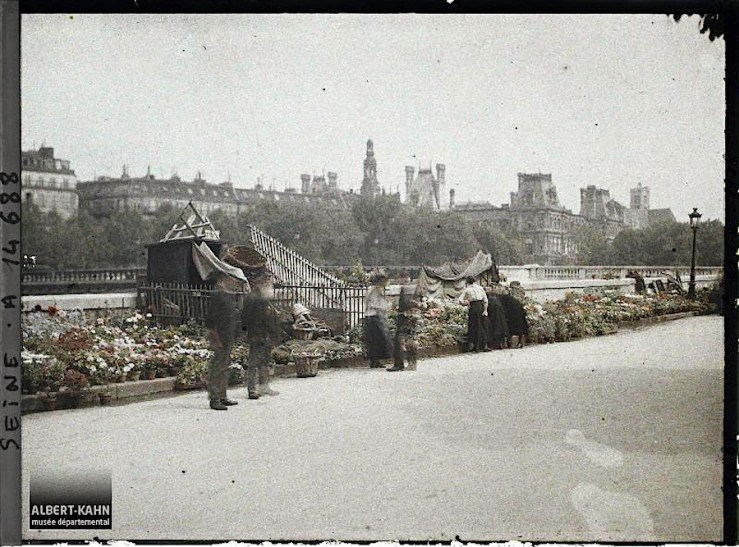
France, Paris, Marché aux fleurs
Looking the other directions, with the Hotel de Ville in the background across the river.

These autochromes are two of about seventy-two thousand that were commissioned and then archived by Albert Kahn, a wealthy French banker and pacifist, between 1909 and 1931. Kahn sent thirteen photographers and filmmakers to fifty countries “to fix, once and for all, aspects, practices, and modes of human activity whose fatal disappearance is no longer ‘a matter of time.'”* The resulting collection is called Archives de la Planète and now resides in its own museum at Kahn’s old suburban estate at Boulogne-Billancourt, just west of Paris. Since June 2016, the archive has also been available for viewing online here.


*words of Albert Kahn, 1912. Also, the above photos (A 13 994, A 14688) are © Collection Archives de la Planète – Musée Albert-Kahn and used under its terms, here.

The Sunday porch: Williamsboro, N.C.

 “Blooming Hope” (also called “Cedar Walk”), Williamsboro, North Carolina, 1938, by Frances Benjamin Johnston, via Library of Congress Prints and Photographs Division.

I like the way the vines are a little blurry from a sudden gust of wind.

The home may have been built as early as the 1750s by a Hutchins (or possibly Robert) Burton, who called it “Blooming Hope.” He may have operated a boarding school there. It also seems to have served as an academy for young ladies later in the early 1800s, run by the Rev. Henry Patillo. At some point in its first 100 years, there was a suicide in the house (either Burton or Patillo’s son), and it acquired a reputation as haunted. It was torn down in 1967.

Ytre Eikås, Norway

Six sisters from Ytre Eikås, Jølster Commune, Norway, ca. 1930 – ca. 1935, by Olai Fauske, via Fylkesarkivet (County Archives) i Sogn go Fjordane Commons on flickr.

Of course it’s about their flowered dresses, aprons, and blouse. For a much closer look, click here and then on the flickr page image.

The sisters are Anne, Johanna, Synneve, Inga, Ragna, and Kristina. In 1936, Kristina emigrated to the U.S. (The two girls in front are unidentified.)

The photographer, Olai Fauske, worked all around the Sunnfijord district, which included Jølster. He sold his photos and postcards not only locally, but to people who had emigrated from the area to the U.S. and then wrote back to him requesting pictures of home.

His childhood friend Alfred, for instance, longed to see Erviki in all its summer glory: “When June comes I believe it wouldn’t be such a bad idea to try and get a picture of Erviki, when all the hills are green and the waterfall quite big. I liked that the best. . .,” he wrote in a letter to Fauske in 1909.

notes on flickr album of Fauske’s photos

Fauske’s photo archive is now part of the County Archives of Sogn go Fjordane.

Gerbéviller, France

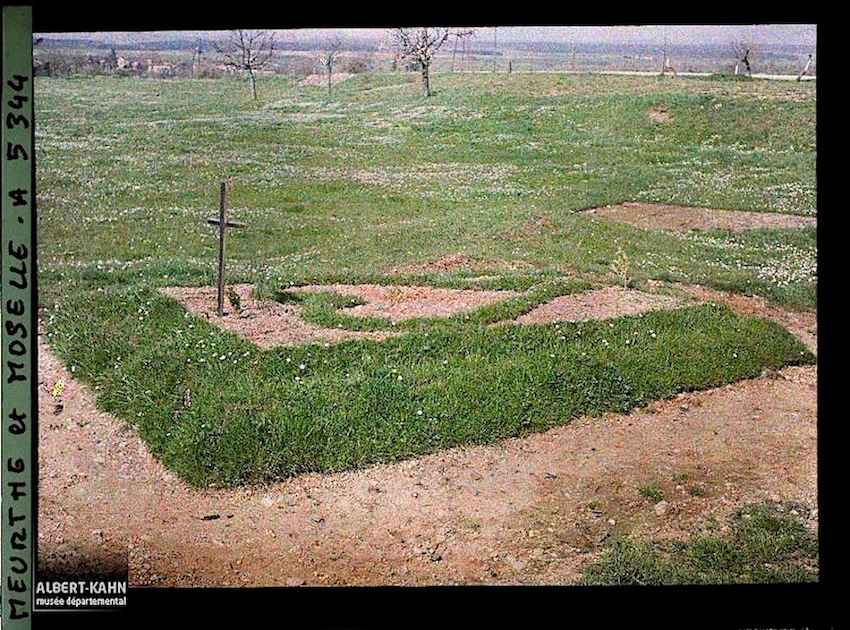
“La Tombe des Coloniaux, a heart of grass, near Gerbéviller,” April 28, 1915, by Georges Chevalier, via Archives of the Planet Collection – Albert Kahn Museum /Département des Hauts-de-Seine.

This seems to be the grave of a soldier (or perhaps soldiers) from one of the French Colonial Infantry Regiments. He probably fell in the Battle of Lorraine about seven or eight months before the photo was taken. Such men, called “Marines,” were recruited from both France and the white settler and indigenous populations of the French colonial empire.

The town of Gerbéviller itself had been caught in the same battle’s crossfire. German troops had systematically burned over 400 houses and killed over 60 inhabitants. It became “Gerbéviller-la-Martyre” in the press and a kind of pilgrimage site.

Today, there are both French and German WWI cemeteries in Gerbéviller.

This autochrome is one of about seventy-two thousand that were commissioned and then archived by Albert Kahn, a wealthy French banker and pacifist, between 1909 and 1931. Kahn sent thirteen photographers and filmmakers to fifty countries “to fix, once and for all, aspects, practices, and modes of human activity whose fatal disappearance is no longer ‘a matter of time.'”* The resulting collection is called Archives de la Planète and now resides in its own museum at Kahn’s old suburban estate at Boulogne-Billancourt, just west of Paris. Since June 2016, the archive has also been available for viewing online here.


*words of Albert Kahn, 1912. Also, the above photo (A 5 344) is © Collection Archives de la Planète – Musée Albert-Kahn and used under its terms, here.

Tilba Tilba portrait

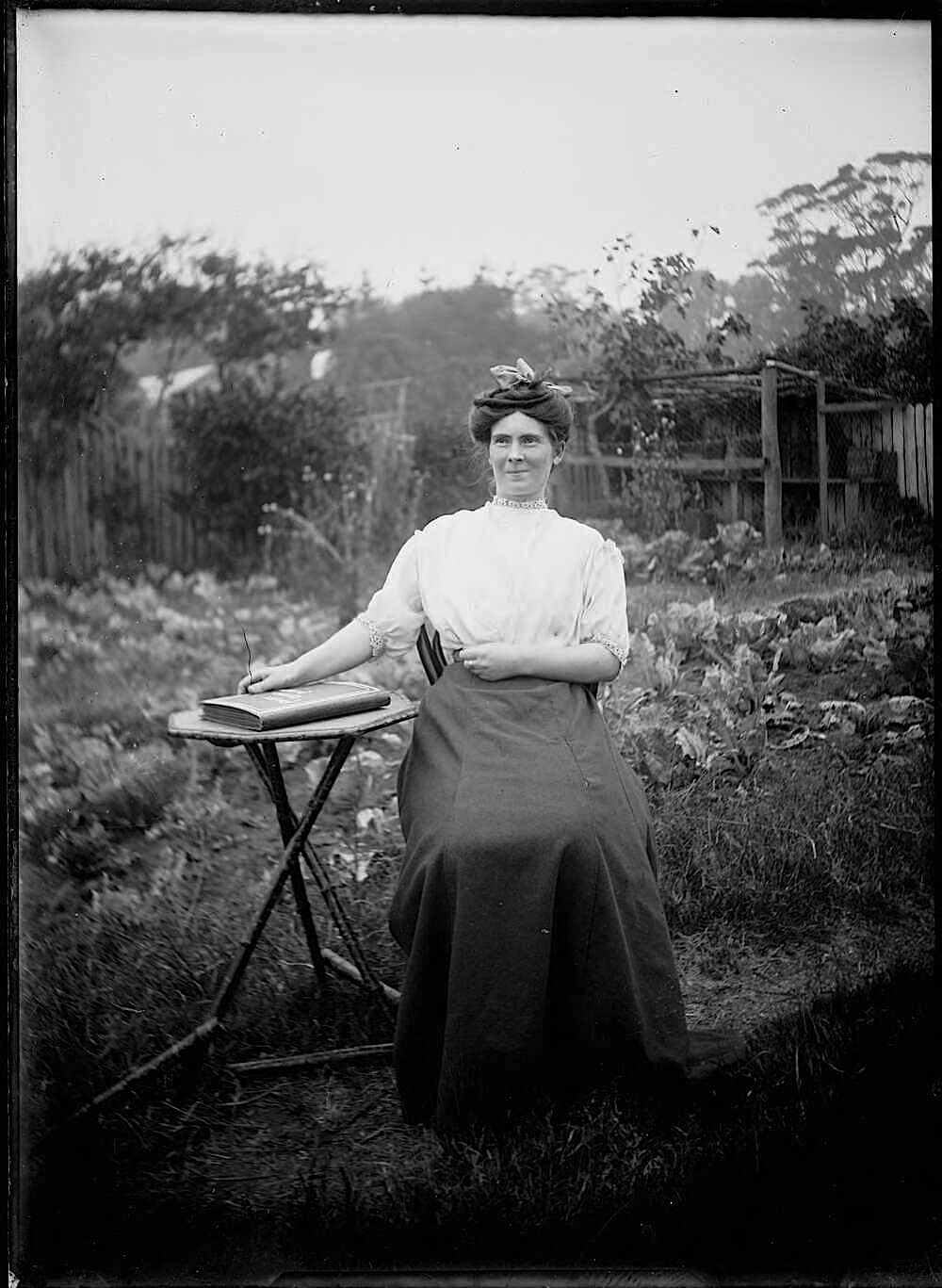
“Charlie Ferguson’s sister,” Tilba Tilba, New South Wales, ca. 1895, by William Henry Corkhill, via Trove of the National Library of Australia.

I love this formal pose in front of a vegetable garden — and it’s very typical of the photographer’s work.

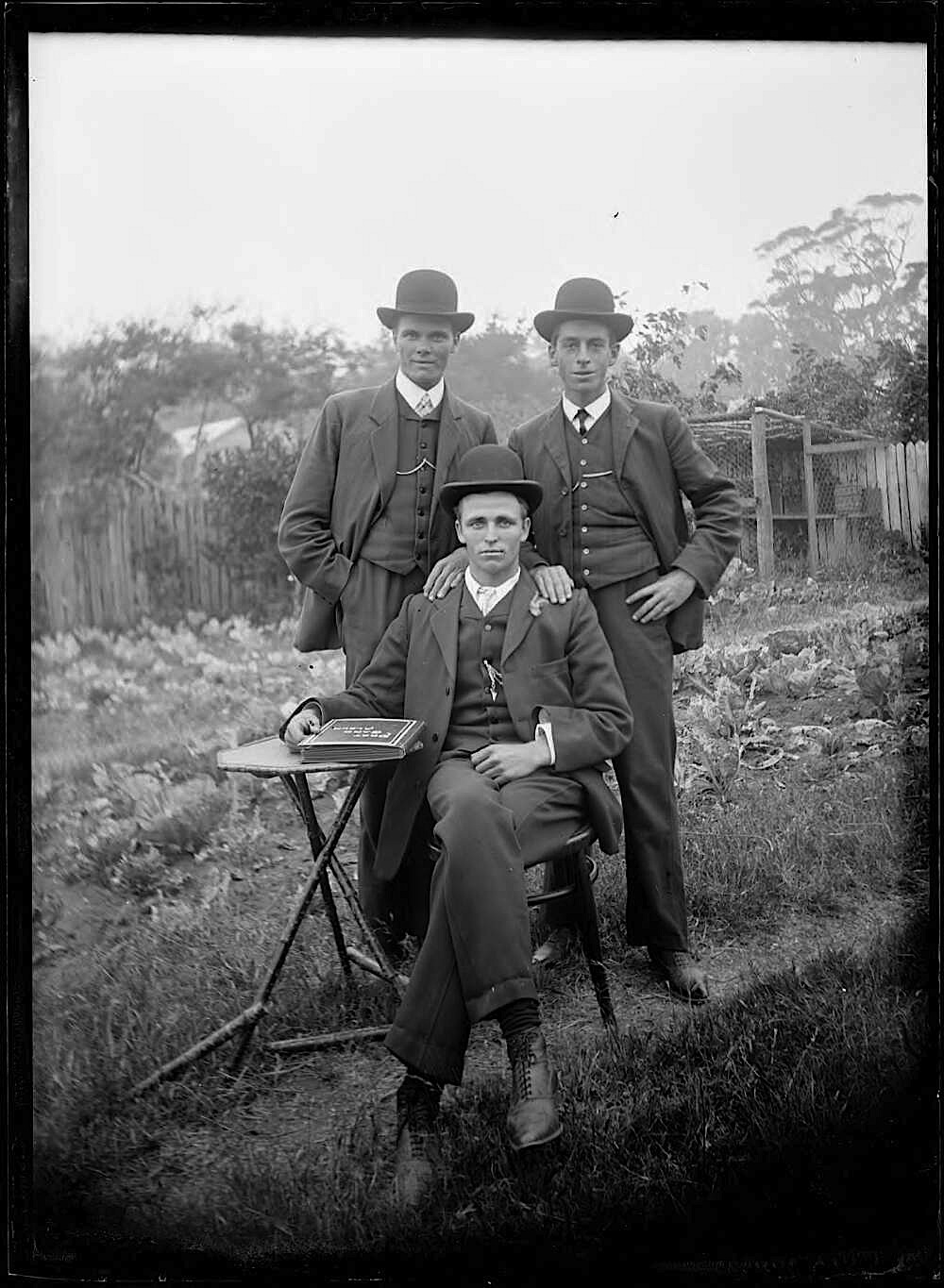
“Charlie Ferguson and William (Wallaga) Arthur Mead with an unidentified man. Click to enlarge.

Corkhill was an amateur who took thousands of pictures of his prosperous dairy farming community between 1890 and 1910.

His images were rediscovered in 1975, when his daughter gave his surviving glass plate negatives to the National Library. Among the 840 that could still be printed were portraits of family and neighbors of a “special intensity and intimacy,” according to the book, Taken at Tilba.

For the natural light, Corkhill had to work outside, in gardens and farmyards. But he often posed his subjects as if they were in a studio, with small tables, chairs, and books. His backdrops were sometimes shrubs and flowers, but he also seemed satisfied with rough fences, water tanks, or the space between two farm sheds. Occasionally, the sitters look a little amused by the process, but the photographer’s approach is not ironic.

“Corkhill’s familiarity with and affection for his subjects is evident . . . and imbues his photographs with a strange combination of authority and informality. He has a rather casual approach to the backgrounds in his portraits, as if his familiarity with the scenes he records makes him impervious to some of their oddities,” according to his biography on the Library’s website.

You can click on the linked titles below to see more of his pictures, or you can browse through the online catalog here.

Woman with a dog
Woman by a cane table
Daisy Mead
Boy by a chair
Mrs. Elizabeth Kendall Bate, aged about 83
Man sitting in a garden
Two young men
Frank Stanley Griffiths
Corkhill’s wife and their children
Byrnes family
Young woman by a table
Two children
Two young men