I know I promised news of our garden renovation for my next post, but I didn’t want to wait too long before sharing my photos of the baby gorilla naming ceremony on Saturday in Kinigi-Musanze in the north of Rwanda.
The Rwanda Development Board has been holding a naming ceremony (Kwita Izina) for each year’s babies since 2005 to raise awareness of conservation in the Volcanoes National Park and to highlight the work of the various Rwandan tourism enterprises.
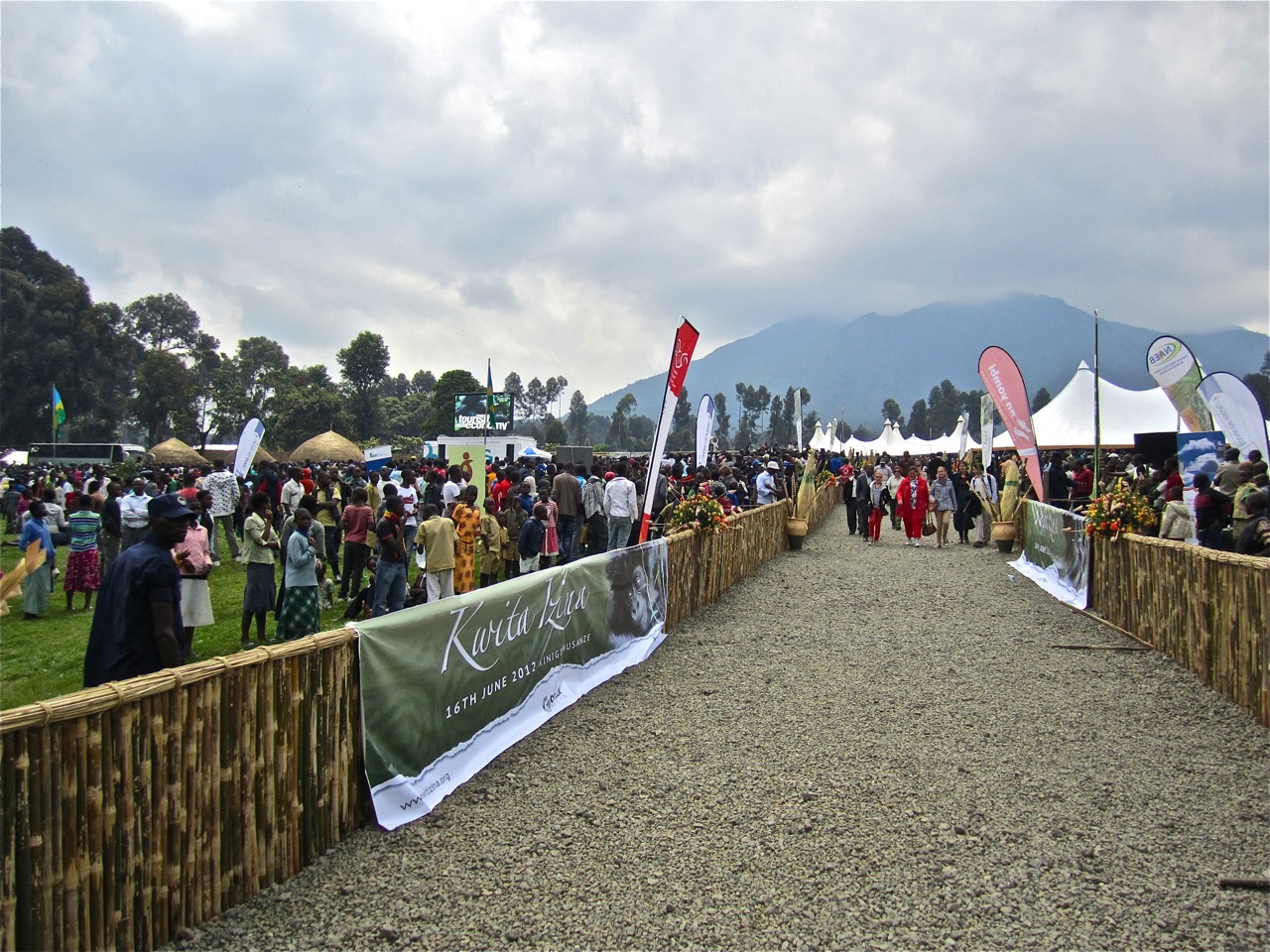
Banana stalks are traditionally used to mark the way to an important event. On Saturday, there were banana stalks staked up on both sides of the road from Kigali to Kinigi-Musanze (a 2-hour drive) about every 25 yards.The tents and banners of the event. Unfortunately, the sky stayed overcast so we never really got a good view of the volcanoes.
Unfortunately, good animal conservation practices did not allow for the actual presence at the ceremony of this year’s 20 babies. But we had a card with their pictures, their mothers’ names, and a place to write their new names as they were called out. You can ooh and aah over more of their really cute pictures at this link.
This baby’s mother is Nchili, and he likes kissing. Photo via kwitizina.org.This baby’s mother is Rwandrushya. According to http://www.kwitizina.org, he has already challenged the silverback of his group.
However, we did have a fun bit of theatrics with 2o children costumed as gorillas.
The “baby gorillas” arrive. Click the photos to enlarge them.The “baby gorillas” cavort for the crowd as their park ranger observers take note.
They did a really good job of mimicking the movements of real young gorillas, and they were even accompanied by observers taking notes. However, the masks were maybe a little too toothy.
The baby gorillas pose for the press.
We had a great morning, although it was quite cold — next year I will bring a blanket — and it was too overcast to see the volcanoes’ peaks.
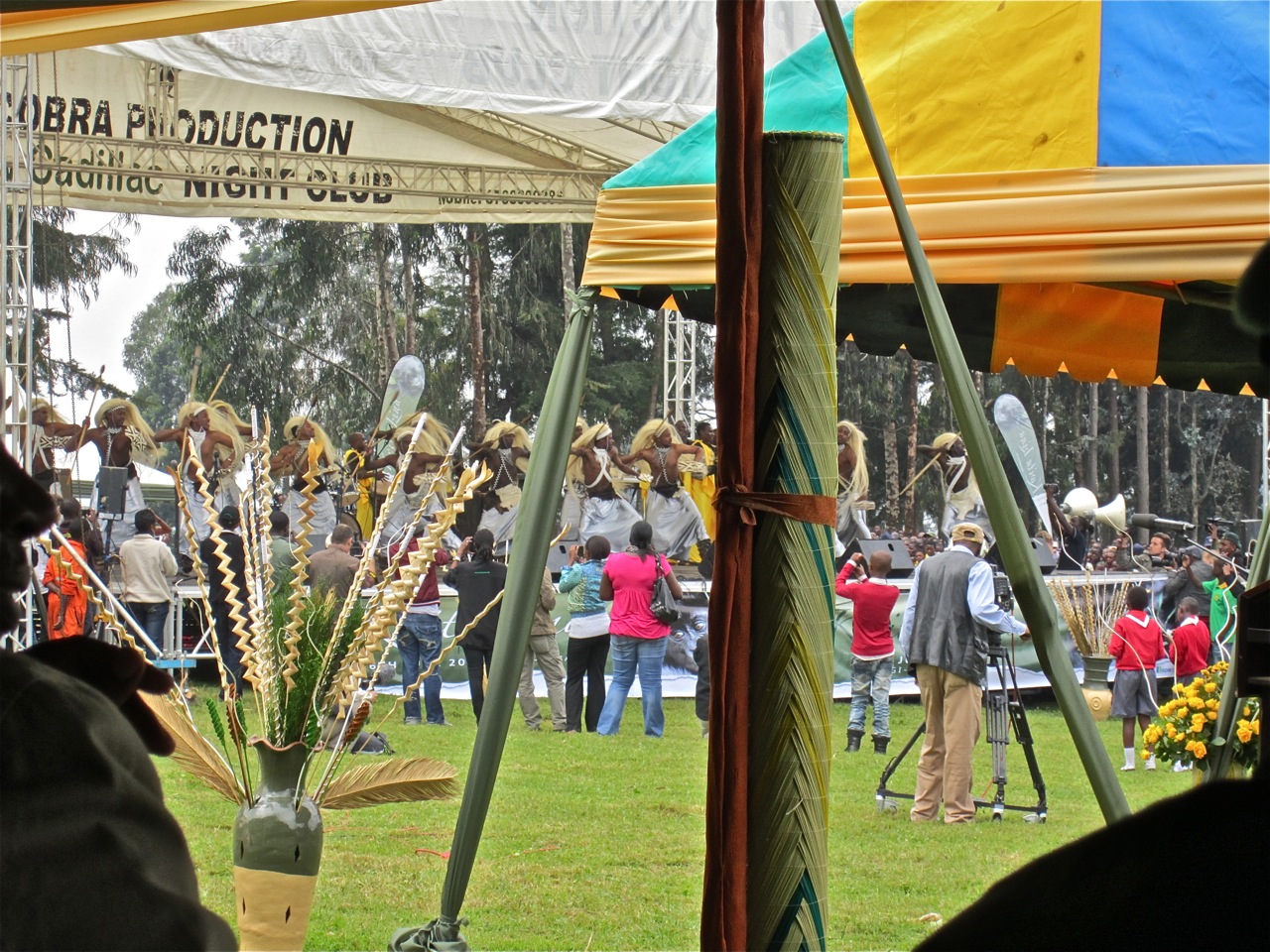
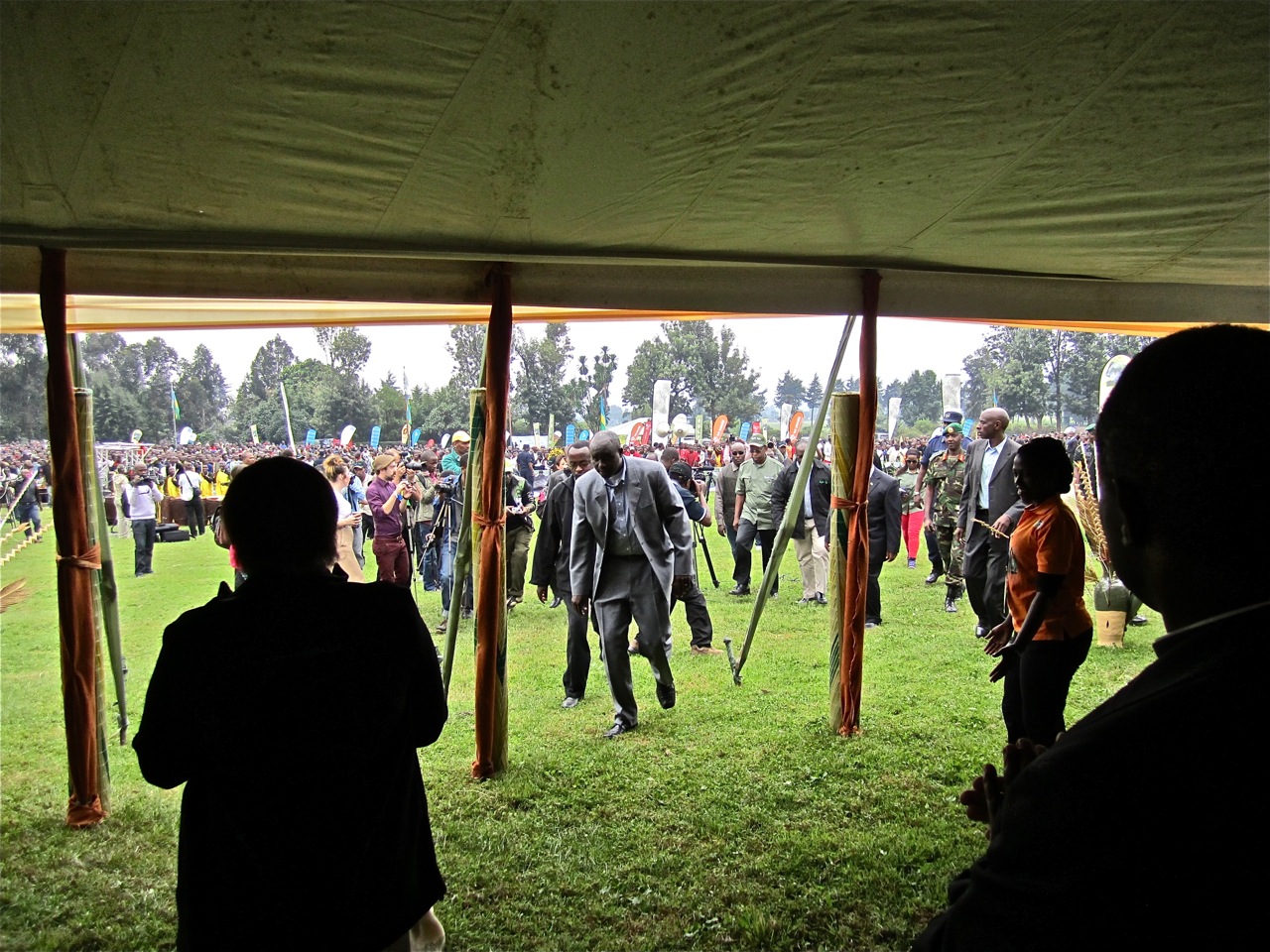
A Rwandan drumming group entertains before the naming ceremony.They were followed on the stage by traditional Intore dancers.The arrival of the Prime Minister. Unfortunately, the rumor that Robert DeNiro was coming to the ceremony turned out to be untrue.The baby gorillas onstage as the Mayor of Musanze announces a baby’s name.A faint glimpse of a volcano peak behind the tents.
Gorilla tourism in Rwanda has contributed to a 26.3% growth in the mountain gorilla population since the last census in 2003. Tourism brought US$200 million in revenues to Rwanda in 2010.
I’ll take one more pass at the interesting photographs of the Library of Congress Matson Collection (American Colony of Jerusalem).
“Garden of Gethsemane in snow,” February 28, 1938.
The American Colony photographers took many pictures of the Garden of Gethsemane during the first half of the 20th century. Presumably, they were big sellers in the Colony’s tourist shop near Jaffa Gate.
“Garden of Gethsemane semi-distant with overhanging olive branch,” c. 1898-1946. The garden is in the middle of the photo. Click the image to enlarge it.
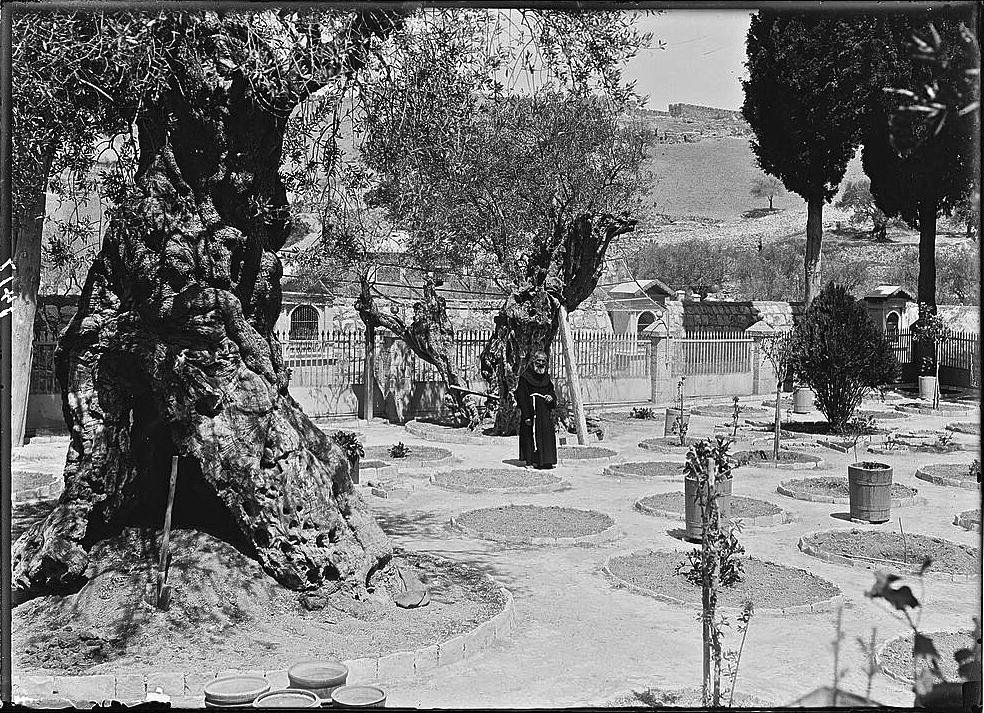
‘Gethsemane’ is a Greek word derived from an Aramaic word for ‘oil-press.’ The Roman Catholic-administered garden is located at the foot of the Mount of Olives. It is one of four locations in the area currently claimed by different religions as the place where Jesus prayed the night before the crucifixion.
“Jerusalem. Gethsemane from convent roof showing city wall and Golden Gate.” Image hand-colored c. 1950 – 1970, but original black and white photo was probably taken earlier.
In the gospels of Matthew and Mark, it is called by a word meaning ‘place,’ ‘property,’ or ‘estate.’ In the gospel of John, the Greek word ‘kepos’ is used; it can mean ‘garden,’ but also ‘cultivated tract of land.’
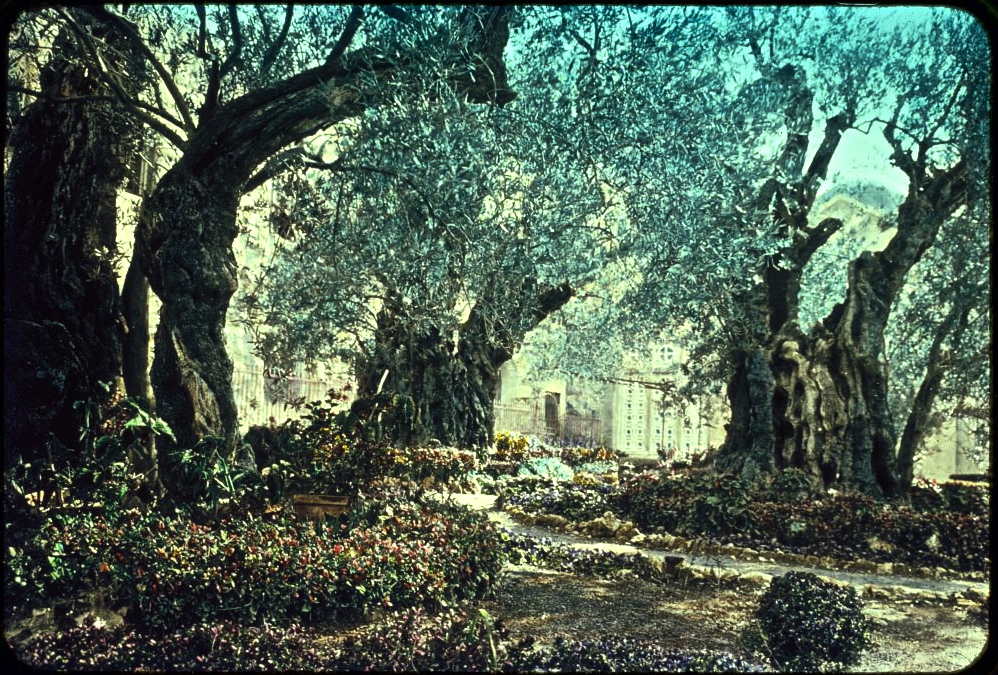
“Garden of Gethsemane, inside enclosure.”
The first recorded pilgrimage to the site was made in 333 A.D. by the anonymous “Pilgrim of Bordeaux,” who recorded his travels in the Holy Land in Itinerarium Burdigalense.
“Jerusalem (El-Kouda, Garden of Gethsemane, interior),” c. 1898-1914.
The building attached to the garden, the Church of All Nations, was built in the 1920s. The garden’s olive trees are said to be 2,000, 1,000, or 900 years old, depending on the source.
“The terrible plague of locusts in Palestine, March-June 1915. The same garden after visitation by the locust.”
In 1915, a plague of locusts swept through Palestine, stripping areas — including the garden — of all vegetation. The American Colony was asked to photograph the devastation, which caused food shortages, by the Ottoman-Turkish governor for “Syria and Arabia.”
Almost as soon as their medium was invented in 1839, early photographers sought to make panoramic images that would capture a field of view as wide as or wider than that of the human eye.
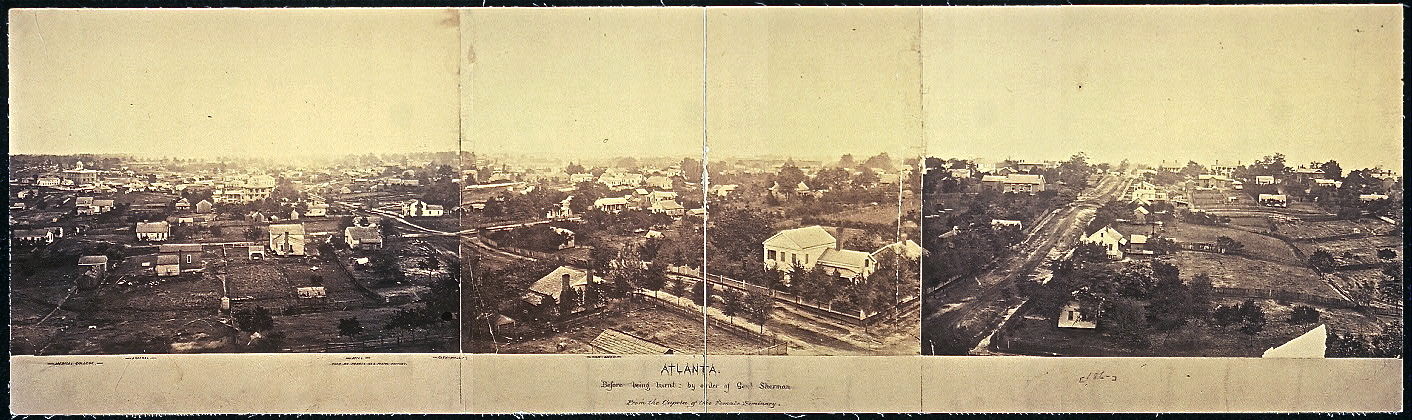
Specialized panoramic cameras with extra long negatives and rotating lenses were available by the 1840s, but the simplest method (well, actually nothing was simple with early photography) was to take a series of photographs and paste them together side by side to form one long picture, as shown in the image below.
“Atlanta, before being burnt; by order of Gen’l. Sherman, from the cupola of the Female Seminary” by George N. Barnard, October 1864. Click on the photo to enlarge it.
By 1899, Kodak had developed a panoramic camera for amateurs. In 1904, the Cirkut camera, based on improved 1840’s technology, was introduced and soon became popular with commercial photographers.
The Library of Congress has a collection of approximately 4,000 panoramic photographs, mainly assembled during the late 19th and early 20th centuries, when panoramic scenes were most popular. It includes landscapes, group portraits, and cityscapes.
I made a search of city parks and other urban recreational spaces and found a number of interesting images from 1902 to 1921.
(You can click each photo to enlarge it or click on “Continue reading” below and then on the first thumbnail in the gallery to scroll through all the larger versions.)
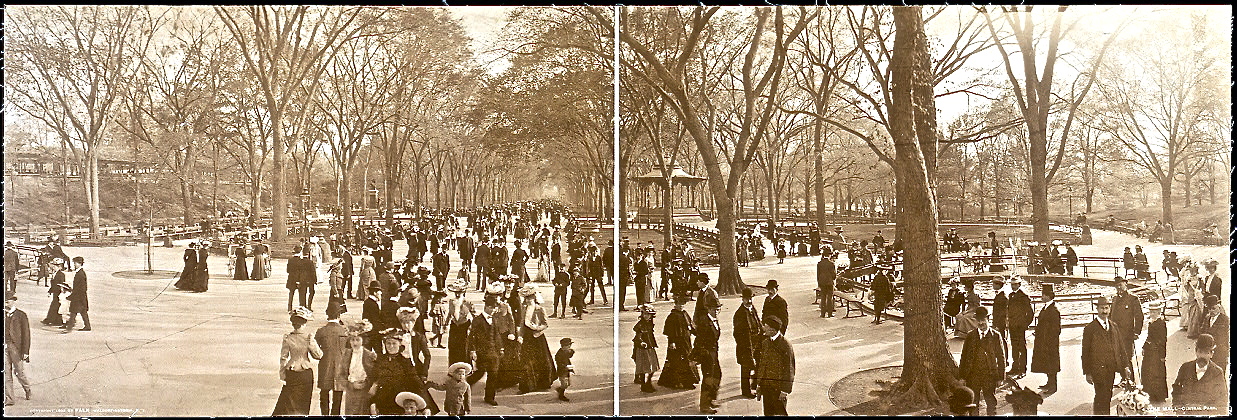
The photo above shows The Mall in Central Park, New York City. This part of the park was designed by Olmstead and Vaux to be an “open air hall of reception,” and it certainly was on this day in 1902.
Such a “grand promenade” was considered an “essential feature of a metropolitan park,” even by the designers, who created a more naturalistic plan for most of the rest of the park.
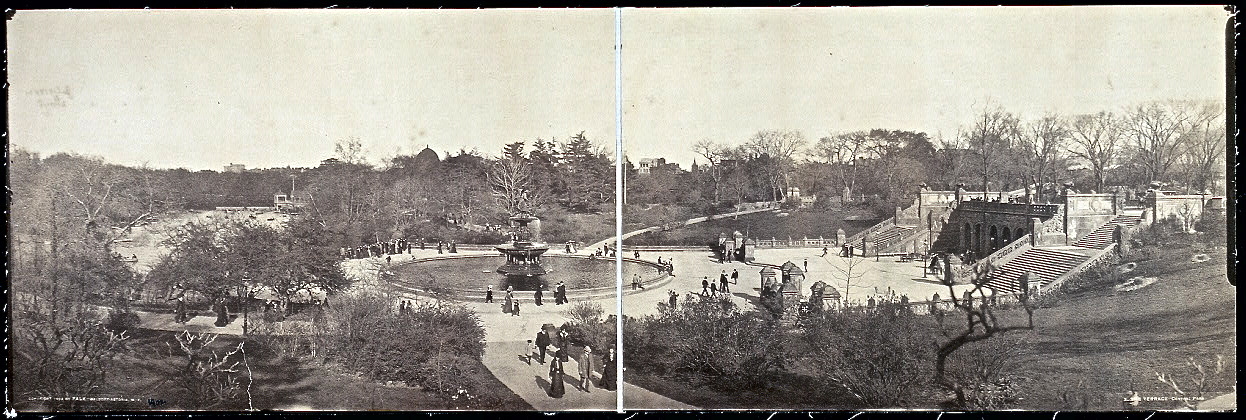
The Mall leads to The Bethesda Terrace, shown above. Both Central Park pictures were taken by Benjamin J. Falk.
Diamond Park in Meadville, Pennsylvania, had the same features as Central Park’s Mall, although on a smaller, simpler scale. The photo above was taken c. 1910 by W.R. Hites. The round pool and gazebo exist in the park today.
The photo of Diamond Park, and those of the two pictures below, may have been taken with a Cirkut camera, which distorted images and made straight paths or roads in the centers of its photos appear curved.
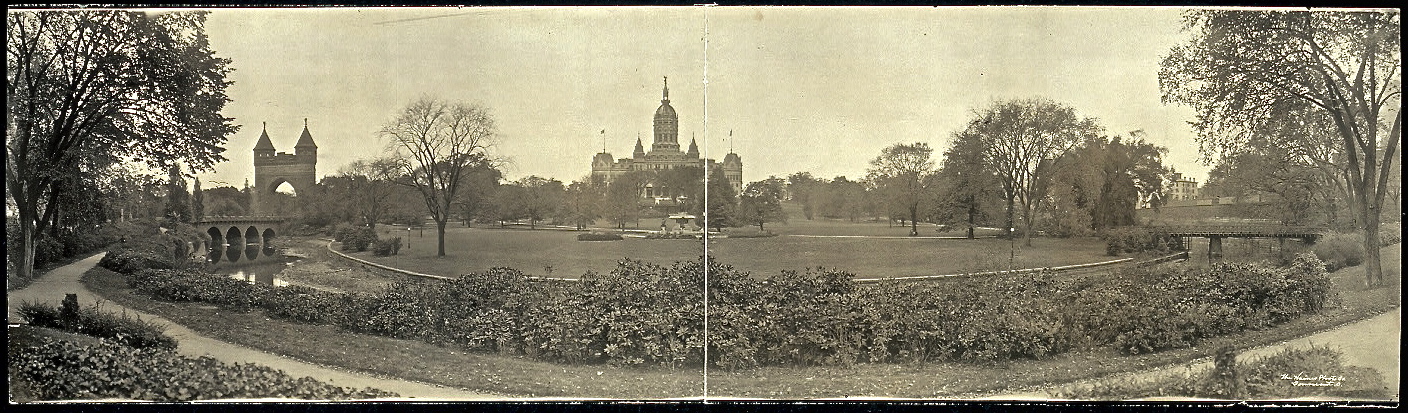
Bushnell Park of Hartford, Connecticut, shown above, was the first municipal park in the U.S. to be conceived of and paid for with public funds. It was designed in 1861 by Jacob Weidenmann in a natural style that featured informal clusters of 157 varieties of evergreen and deciduous trees, which buffered the sights and sounds of the city.
This photo was taken c. 1909, by Haines Photo Co. The state capitol building can be seen in the background.
Grand Circus Park was a social center of Detroit, Michigan, when the photo above was taken by Manning Bros. in 1921. It was surrounded by eight theaters, as well as ornate hotels.
At the time of the picture, the Russell Alger Memorial Fountain would have just been completed. It was designed by Henry Bacon, who also designed the Lincoln Memorial in Washington, D.C. The fountain featured a sculpture by Daniel French, who also sculpted Abraham Lincoln for the Memorial.
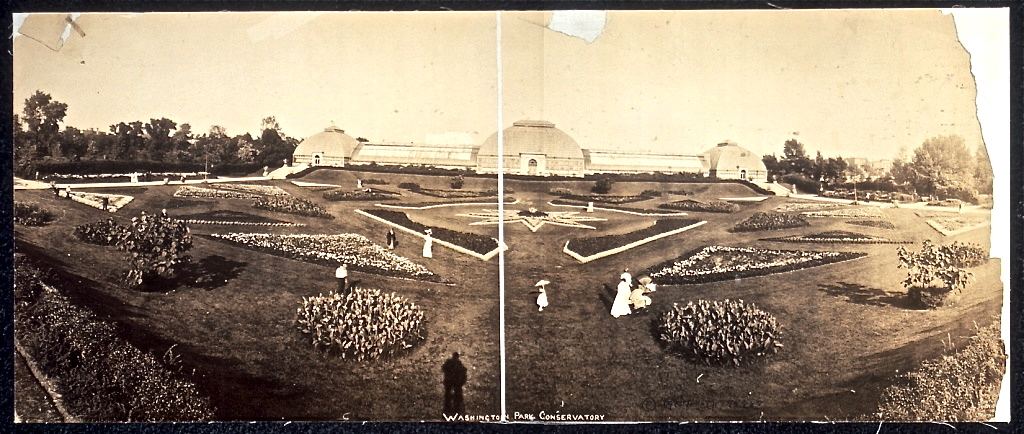
This 1907 picture of Victorian “bedding out” at the Conservatory in Washington Park seems at odds with Olmsted and Vaux’s original 1870 vision for the park in south Chicago, Illinois. (Their blueprint was destroyed in the Great Fire of 1871.) Olmsted designed a natural feel to the park, including a meadow surrounded by trees and maintained by grazing sheep.
The conservatory and ornate sunken garden were designed by D.H. Burnham & Co. and built in 1897. By the Great Depression, the building was too expensive to maintain and was torn down. The photo was by George R. Lawrence Co.
In this 1909 photo, Oxnard, California, still shows its roots as an agricultural boomtown. About 1897, local ranchers had thought that growing sugar beets would be profitable and had convinced Henry Oxnard to build a factory in the midst of the new fields. A town, with plaza, rapidly sprung up alongside it.
The city was incorporated in 1903, and by 1907, it even had a classically styled Andrew Carnegie library — which I think can be seen above the park about a third of the way from the photo’s left side, partly covered by a tree. The photo was taken by West Coast Art Co.
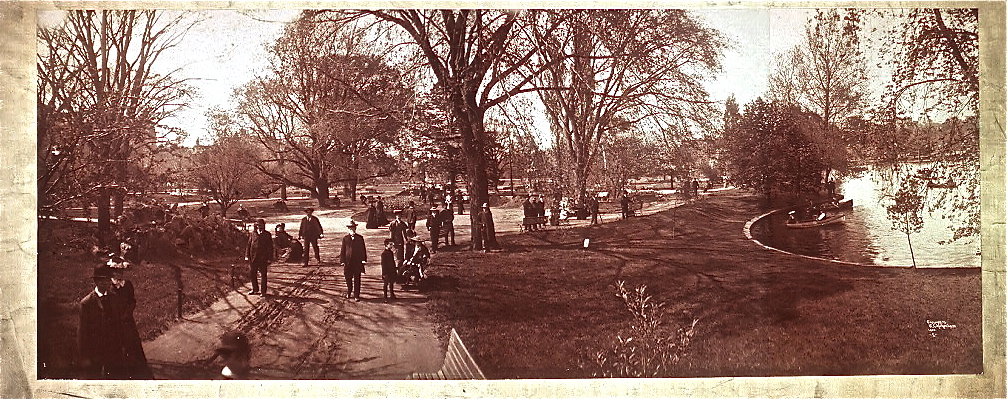
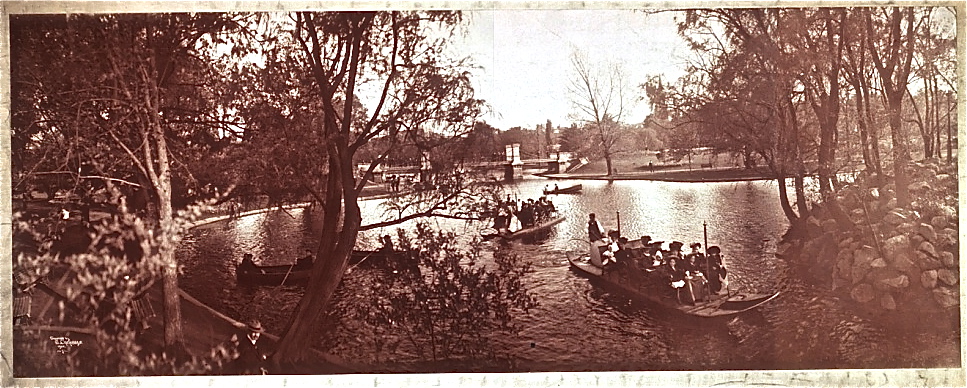
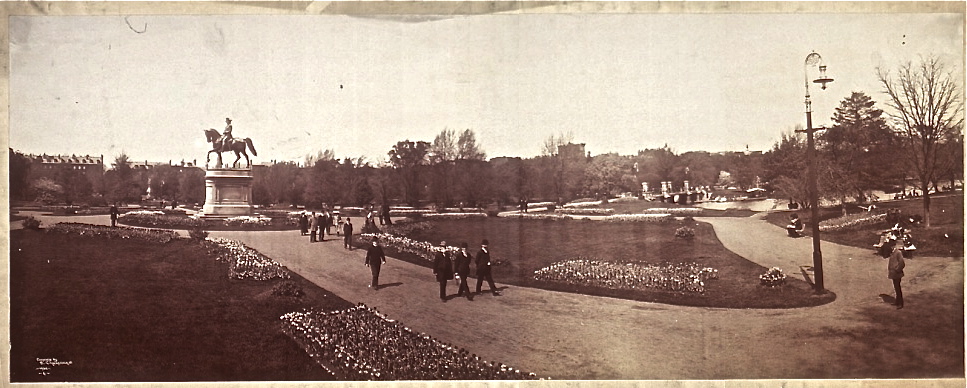
The Boston Public Garden, designed by George F. Meacham, was first proposed to the city fathers in 1837, but construction did not begin until the early 1860s.
It has always been an ornamental pleasure garden, famous for its flower beds, meandering paths, and swan pond and boats.
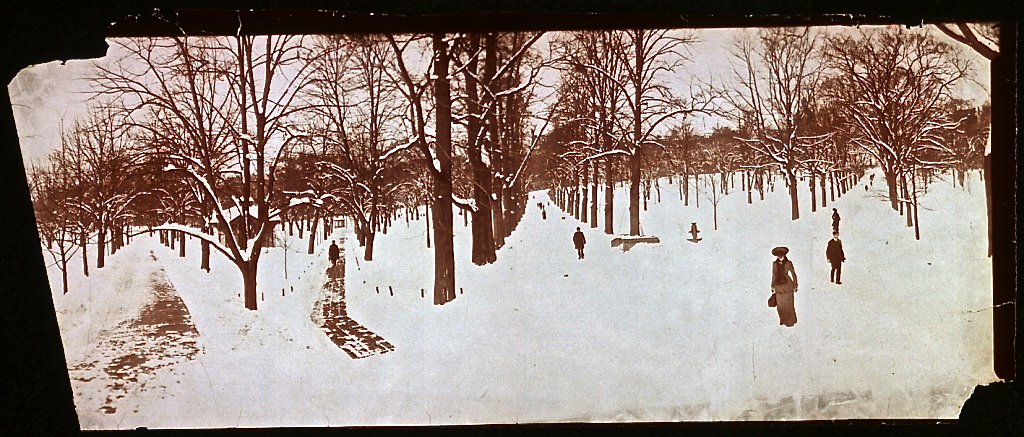
With the adjoining Boston Common, it forms the northern end of Olmsted’s great string of parks called the Emerald Necklace. The three photos above were taken c. 1904, by E. Chickering & Co.
This snow scene taken of Boston Common, taken January 10, 1904, by E. Chickering & Co., has the feel of a post-impressionist painting.
The Common was a public livestock grazing space from 1634 to 1830. In 1836, it was enclosed by an ornamental iron fence, and its five perimeter malls or recreational promenades were completed. In contrast to the Public Garden, it is laid out with straight lines and open areas for recreation and public gatherings.
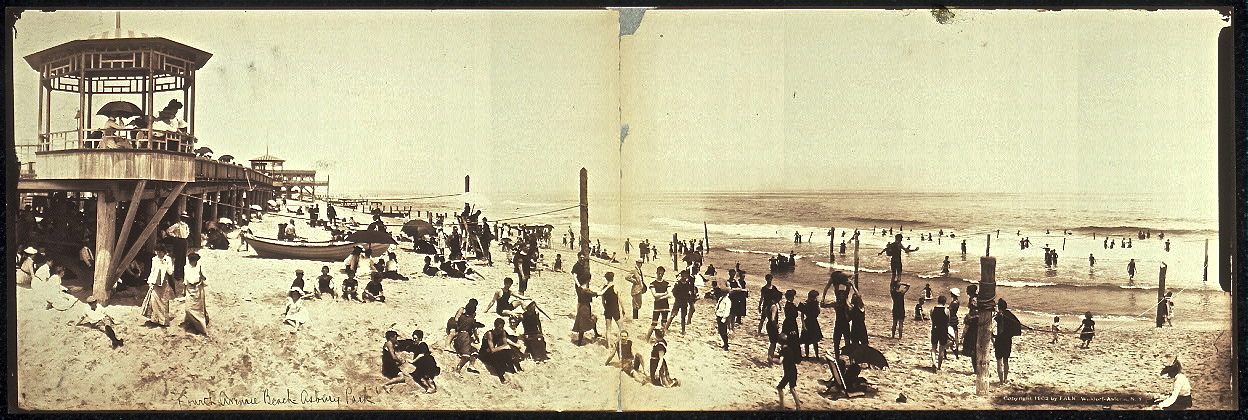
In the three decades after 1871, developers took Asbury Park, New Jersey, from a small seaside community to a residential resort of more than 600,000 vacationers. They built a boardwalk, orchestra pavilion, changing rooms, and a pier along its beachfront, as well as a number of grand hotels. The above photo by Benjamin J. Falk shows the Fourth Avenue Beach c. 1902.
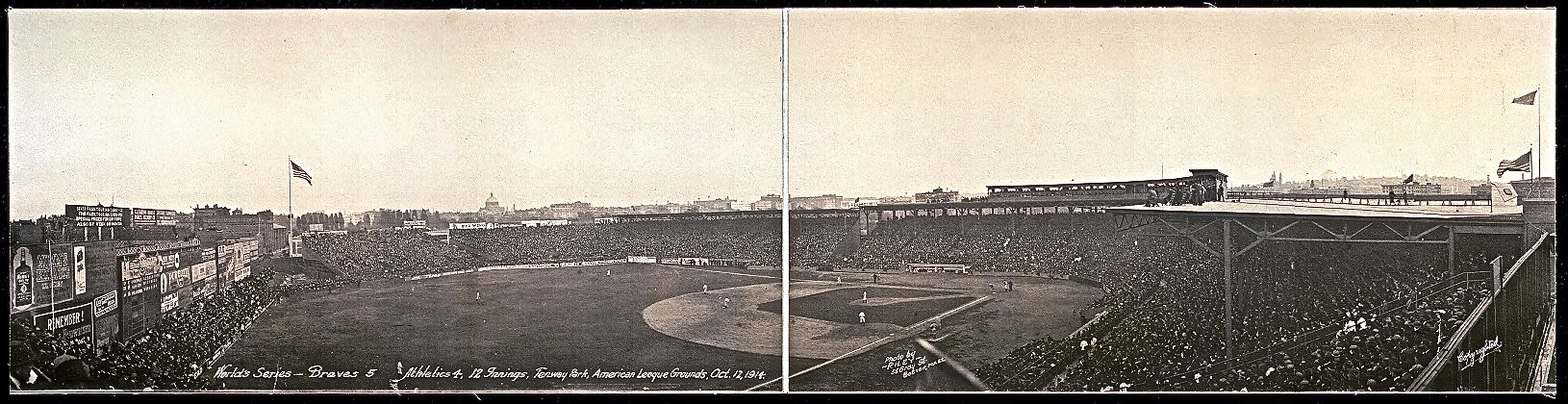
This photo shows another kind of Boston park, the American League Grounds at Fenway Park, and the World Series game of October 12, 1914. The score was [Boston] Braves 5 – [Philadelphia] Athletics 4 in 12 innings. The photo is by John F. Riley.
The first World Series had taken place ten years earlier, also in Boston, on what is now the campus of Northeastern University. A panoramic photo of one of those games is here.
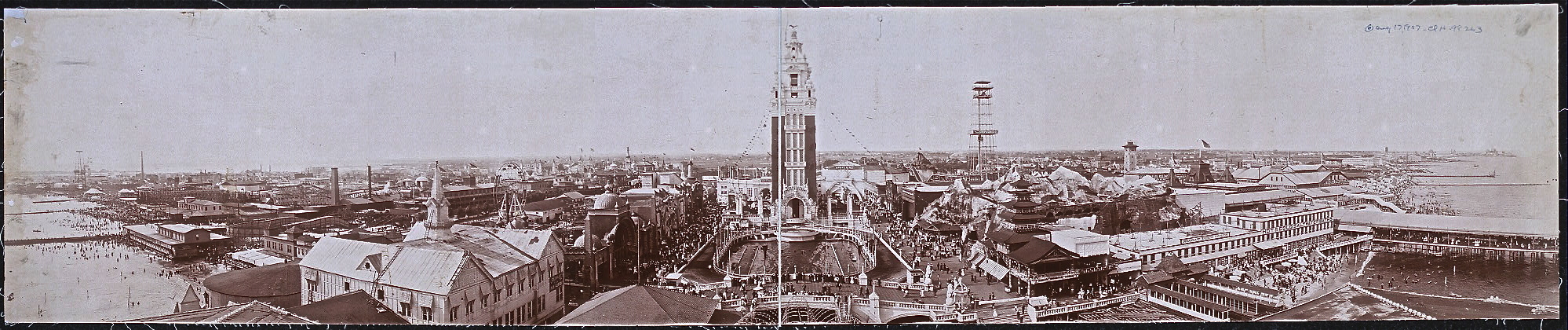
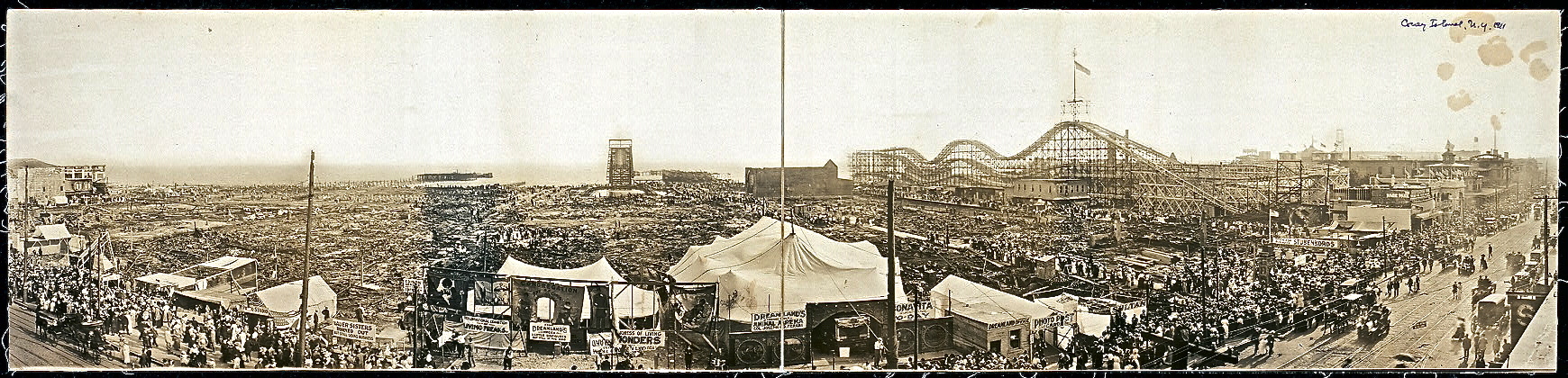
The above photo shows Brooklyn’s Coney Island and Luna Park (also known as Dreamland) around 1907. This picture and the one below were taken by Charles E. Stacy.
Luna Park was created by Frederick Thompson and Elmer Dundy and opened in 1903. There’s a very interesting history of the enterprise at this link.
By 1915, another inventor, Frederick Ingersoll, had opened Luna Parks all over the world, and the term “luna park” became a generic name for amusement parks. The blog Poemas del rio Wang features a series of photos of Paris’s Luna Park in 1910.
The above photo shows the destruction of part of the park after a fire on December 11, 1911.
We’ll take a trip up to the moon
For that is the place for a lark
So meet me down at Luna, Lena
Down at Luna Park.
— recorded by Billy Murray, 1905 (hear him singing it here)
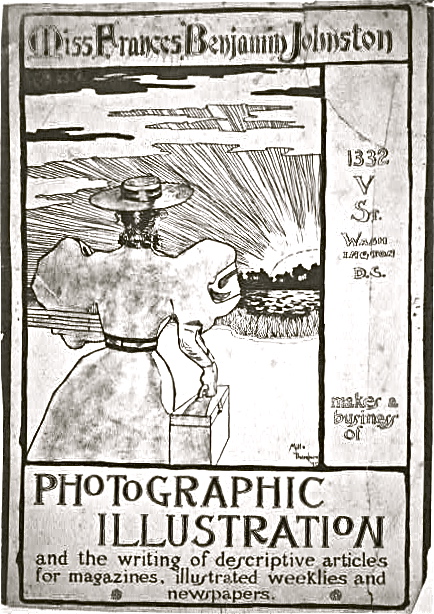
This was a small advertising poster for Frances Benjamin Johnston’s photography business in 1895, via Library of Congress Prints and Photographs Division.
I think the image of a woman striding into the landscape with a case of tools in hand (and others tucked firmly under her arm) must have been quite a bold one for that time (although she was well supported by her sleeves).
We crossed over to the right bank, and I saw this graffiti alongside the Louvre.
‘Regarde le ciel’ (look at the sky) is a rather common sight in Paris, as I learned from a Google search. I could not find the origin of this street art, but I thought it might refer to a song by Cortezia, which excoriates airplanes. (Apparently, Cortezia does not tour far from home.)
However, there seems to be a Romanian connection, as another common version of the graffiti is ‘priveste cerul,’ (look at the sky in Romanian).
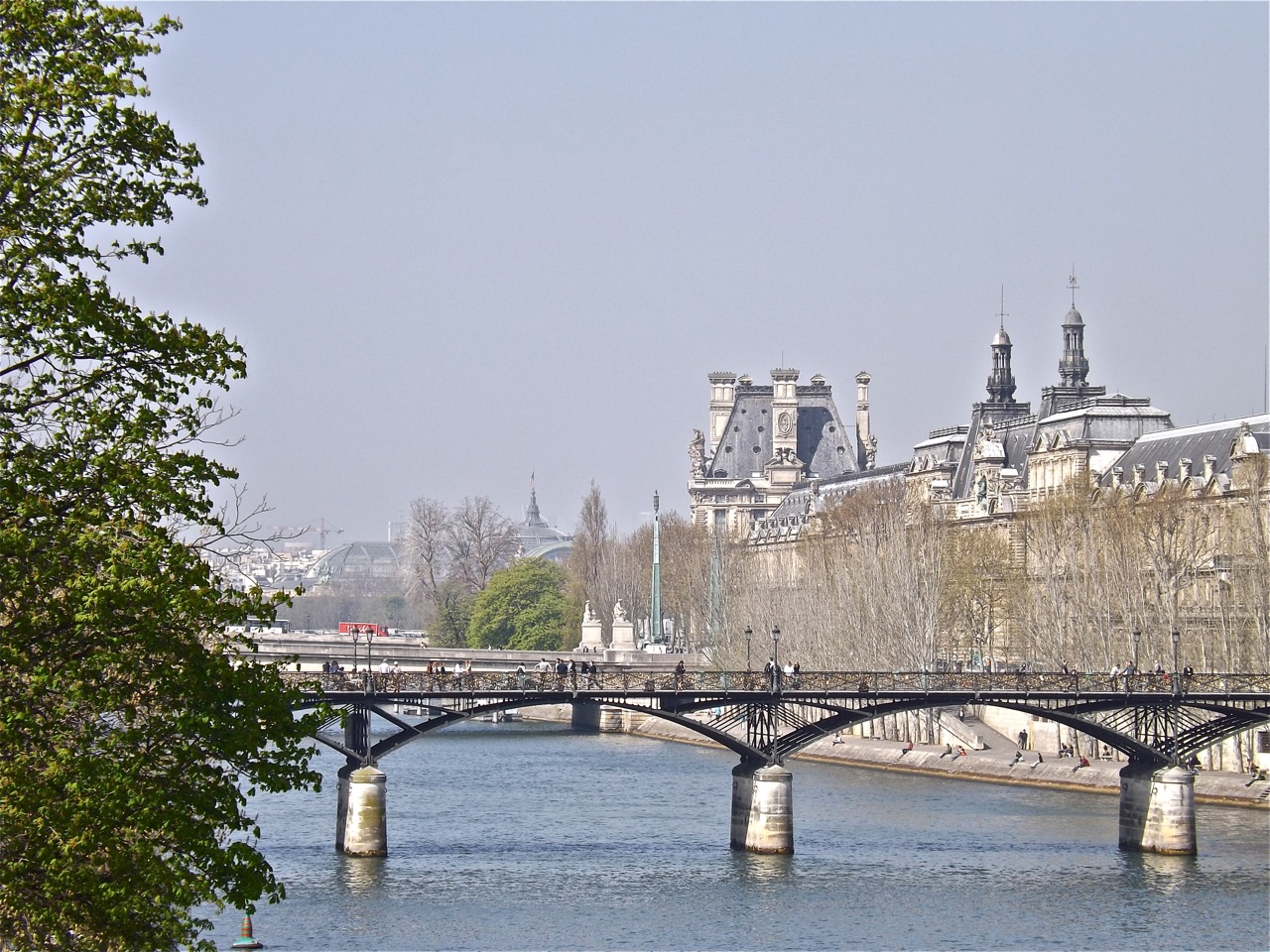
At any rate, the sky was just about perfect, as you can see from this photo of the Passerelle des Arts. If you click and enlarge it, you can see how the bridge glitters from hundreds of padlocks or ‘lovelocks’ (we also saw the beginning of this fad on a pedestrian bridge in Lyon).
Since this was Paris, I probably should throw in a restaurant recommendation. We ate dinner that night at the wonderful Café Constant, which is owned by “Top Chef” jury member Christian Constant. Located at 135, rue Saint Dominique, in the neighborhood near the Eiffel Tower, it is the first in a row of three restaurants owned by Constant, each a little more expensive (we were in the least expensive and most casual). The café doesn’t take reservations, so go early for lunch or dinner.













 enclos*ure