Pompeii, Italy

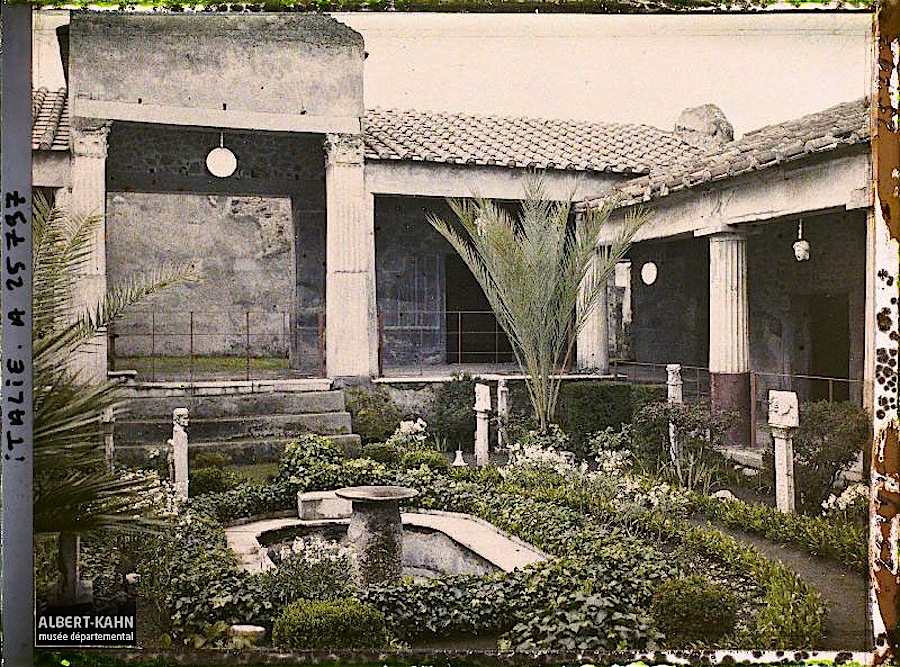
Peristyle of the House of the Golden (or Gilded) Cupids, Pompeii, Italy, March 28, 1921, by Auguste Léon, via Archives of the Planet Collection – Albert Kahn Museum /Département des Hauts-de-Seine.

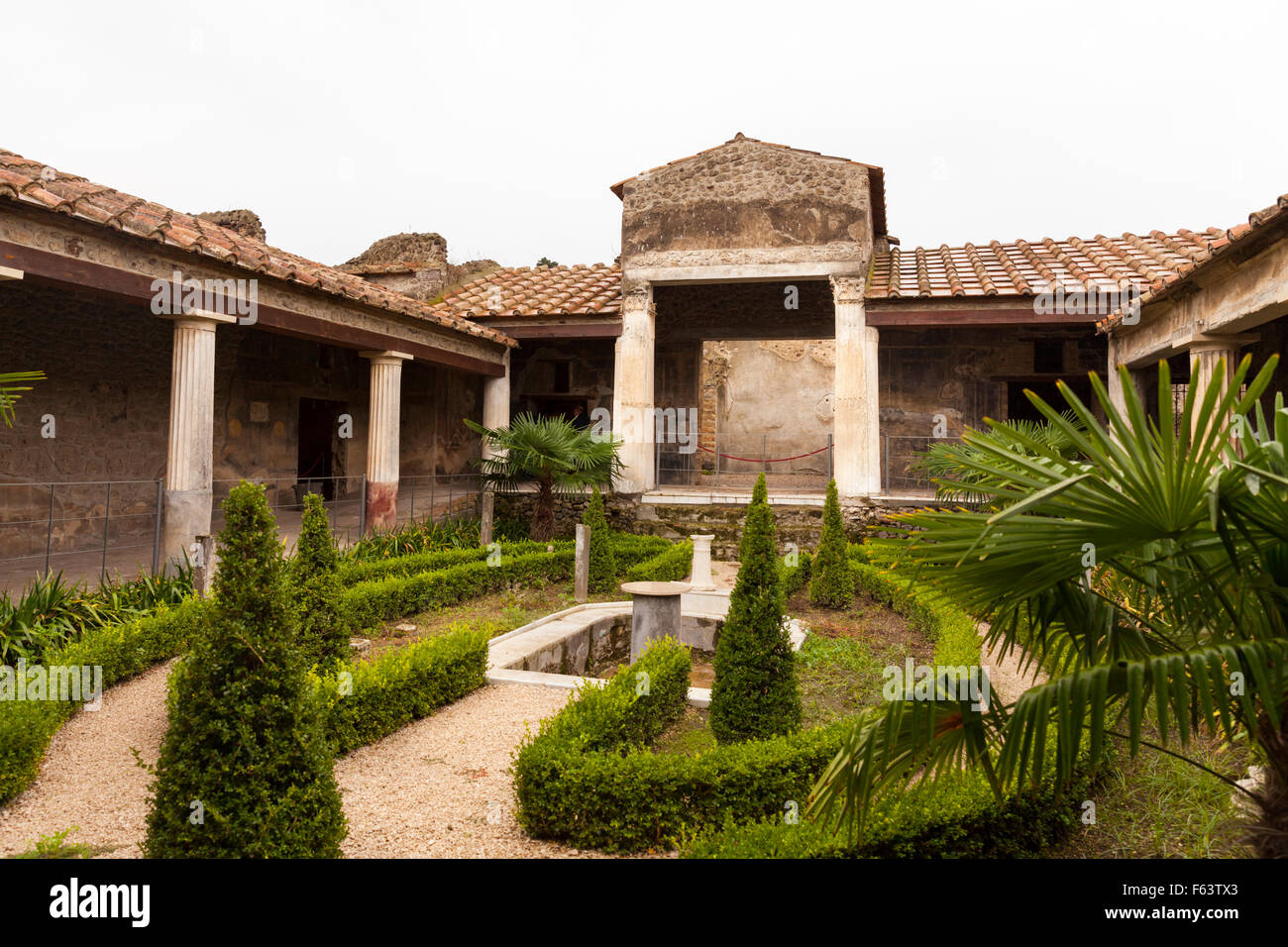
There are recent photos of the garden here and here and here. It has been restored to what is believed to be its Roman appearance, based on archaeological research, including taking root castings.

This autochrome is one of about seventy-two thousand that were commissioned and then archived by Albert Kahn, a wealthy French banker and pacifist, between 1909 and 1931. Kahn sent thirteen photographers and filmmakers to fifty countries “to fix, once and for all, aspects, practices, and modes of human activity whose fatal disappearance is no longer ‘a matter of time.'”* The resulting collection is called Archives de la Planète and now resides in its own museum at Kahn’s old suburban estate at Boulogne-Billancourt, just west of Paris. Since June 2016, the archive has also been available for viewing online here.


*words of Albert Kahn, 1912. Also, the above photo (A 25 797 S) is © Collection Archives de la Planète – Musée Albert-Kahn and used under its terms, here.
Lens, France


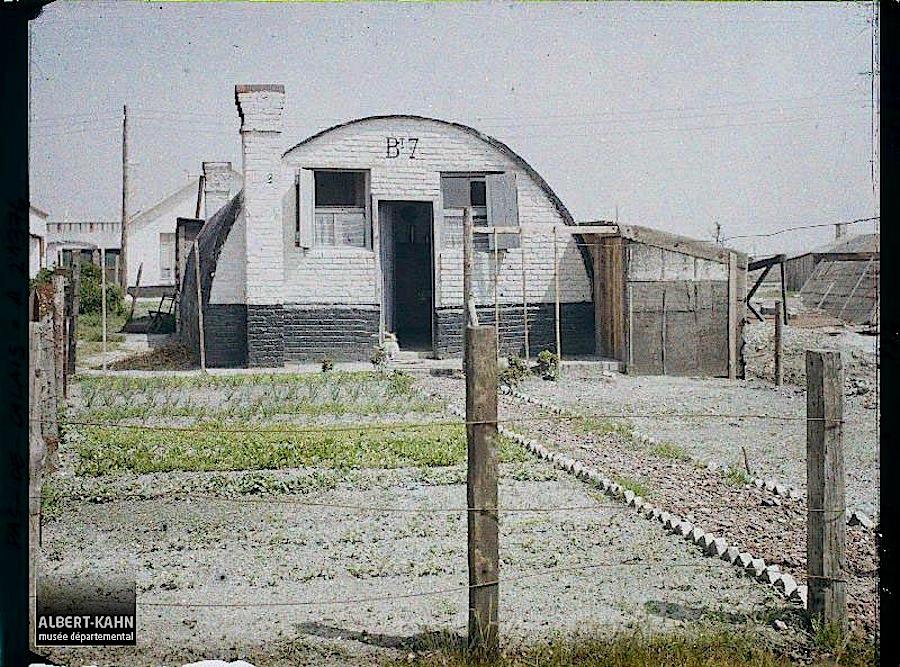
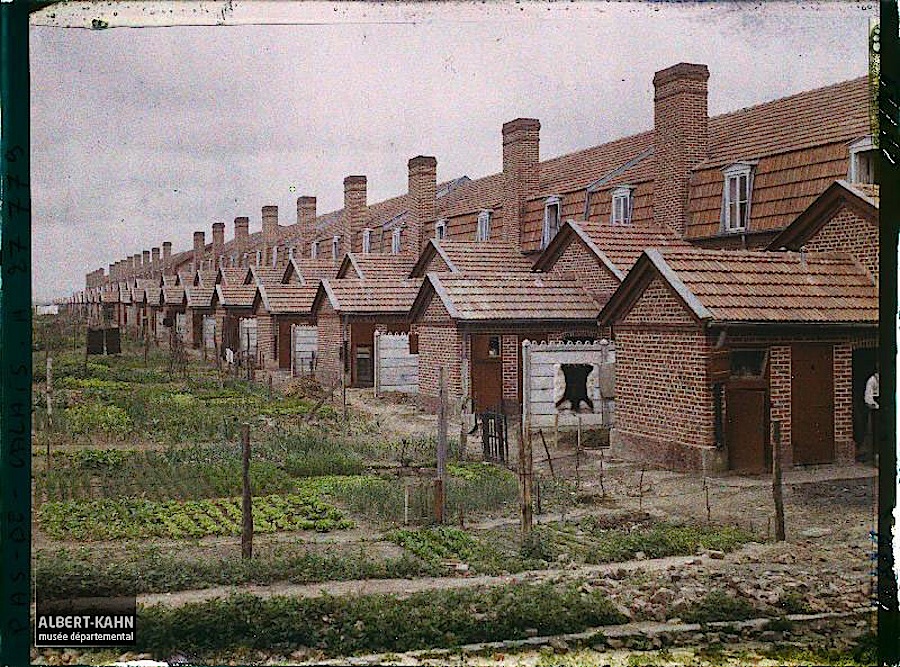
Little house and garden of a coal minerLens, France, May 16, 1920, by Frédéric Gadmer, via Archives of the Planet Collection – Albert Kahn Museum /Département des Hauts-de-Seine (all three photos).

The city of Lens, once home to the Lens Mining Company, was largely destroyed in World War I. The photo above shows post-war temporary workers’ housing.

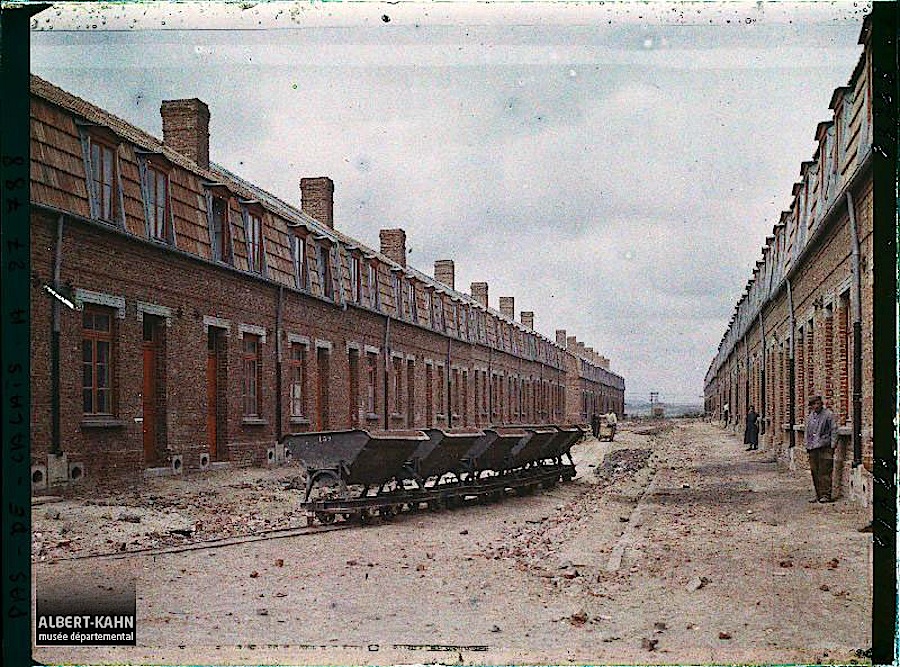
Avion, just south of Lens, was similarly devastated. The photos above and below show new houses on Rue Pascal on June 14, 1921.

The front sides of the new houses on Rue Pascal.

Avion was un coron (a mining village) of the Liévin Company, which had 9,695 employees at the start of WWI.

You can see these homes today here.

These autochromes are three of about seventy-two thousand that were commissioned and then archived by Albert Kahn, a wealthy French banker and pacifist, between 1909 and 1931. Kahn sent thirteen photographers and filmmakers to fifty countries “to fix, once and for all, aspects, practices, and modes of human activity whose fatal disappearance is no longer ‘a matter of time.'”* The resulting collection is called Archives de la Planète and now resides in its own museum at Kahn’s old suburban estate at Boulogne-Billancourt, just west of Paris. Since June 2016, the archive has also been available for viewing online here.


*words of Albert Kahn, 1912. Also, the above photos (A 21 376, A 27 779, A 27 788) are © Collection Archives de la Planète – Musée Albert-Kahn and used under its terms, here.
The Sunday porch: Norway


Employees of a hotel, Fagernes, Norway, August 12, 1910, by Auguste Léon, via Archives of the Planet Collection – Albert Kahn Museum /Département des Hauts-de-Seine.

I thought it was worth showing even a corner of this really pretty pink porch.

This autochrome is one of about 72,000 that were commissioned and then archived by Albert Kahn, a wealthy French banker who was committed to the ideal of universal peace and believed that “knowledge of foreign cultures encourages respect and peaceful relations between nations.”* He was also acutely aware that the 20th century was going to bring rapid material change to the world.

Accordingly, from 1909 to 1931, Kahn sent thirteen photographers and filmmakers to 50 countries “to fix, once and for all, aspects, practices, and modes of human activity whose fatal disappearance is no longer ‘a matter of time.’”† The resulting collection is called Archives de la Planète and now resides in its own museum at Kahn’s old suburban estate at Boulogne-Billancourt, just west of Paris. Since June 2016, the archive has also been available for viewing online here.


*Collections Albert Kahn website. Also, the above photo (A 288) is © Collection Archives de la Planète – Musée Albert-Kahn and used under its terms, here.
†words of Albert Kahn, 1912.

Front yard, Georgia

Georgia family in their front yard, ca. 1899, photographer unknown, via Library of Congress Prints and Photographs Division.

This photo was in one of the several albums depicting African-American life that W. E. B. Du Bois compiled to exhibit at the 1900 Paris World’s Fair.

Click on the image for a little better view.

Florence, Italy


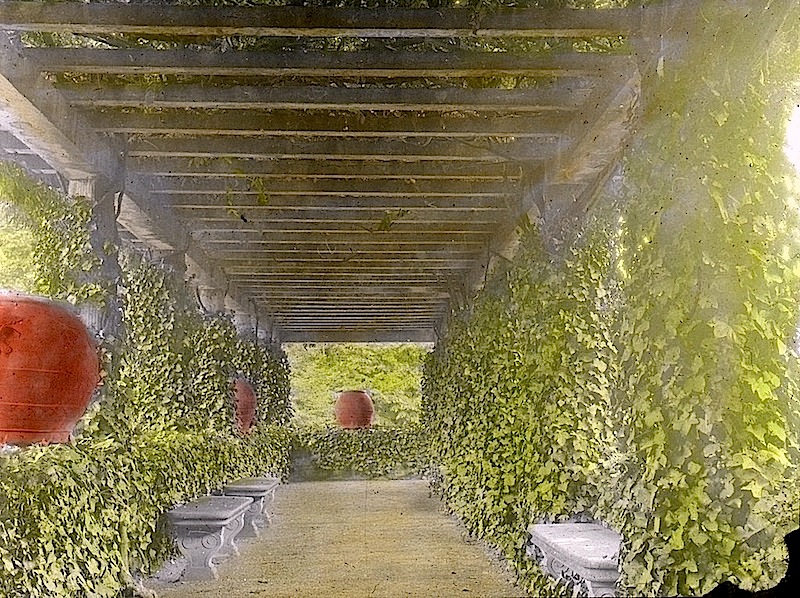
Pergola covered in wisteria and ivy in a garden of Villa Palmieri, Florence, ca. 1915, from the Arthur Peck Collection, via Oregon State University (OSU) Special Collections & Archives Commons on flickr.

The 14th century Villa Palmieri is credited with being the story-telling setting for Boccaccio’s Decameron.

To see this garden, its handsome ordering, the plants, and the fountain with rivulets issuing from it, was so pleasing to each lady and the three young men that all began to affirm that, if Paradise could be made on earth, they couldn’t conceive a form other than that of this garden that might be given it.

However, the garden was completely restructured in 1697 and then partially redesigned several times thereafter, according to current fashions, through to the 1920s.

Since 1986, the villa has been owned by the Italian government and houses part of the European University Institute.

Arthur Peck was a Professor of Landscape Architecture at the Oregon Agricultural College from 1908 to 1948. During his long career, he created a teaching library of 24 boxes of glass lantern slides — now in OSU’s archives.